SUBSCRIBE TO OUR FREE NEWSLETTER
Daily news & progressive opinion—funded by the people, not the corporations—delivered straight to your inbox.
5
#000000
#FFFFFF
To donate by check, phone, or other method, see our More Ways to Give page.
Daily news & progressive opinion—funded by the people, not the corporations—delivered straight to your inbox.
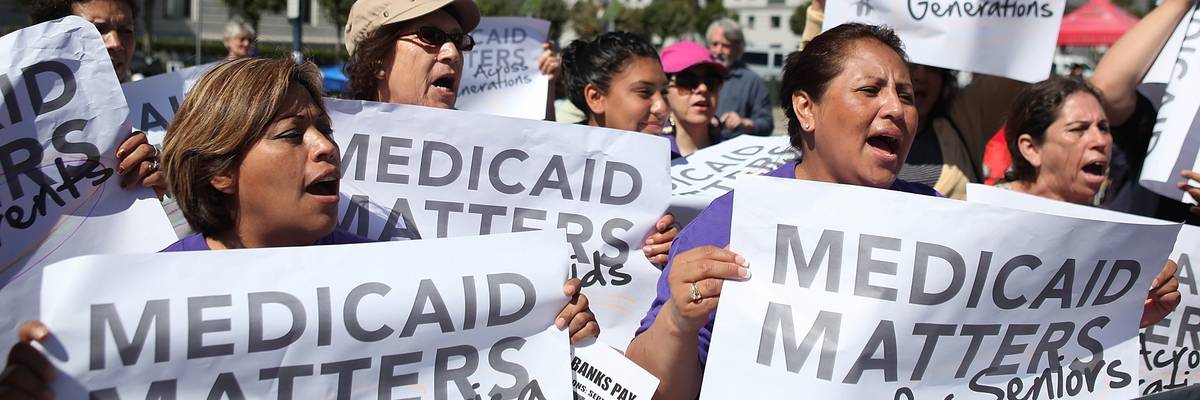
Protestors carry signs as they demonstrate against proposed cuts to Medical and Medicare outside San Francisco city hall on September 21, 2011 in San Francisco, California.
Attacks on Medicaid are just the latest tactic used by anti-choice politicians to strip us of our bodily autonomy and further deny us access to lifesaving reproductive healthcare.
When U.S. Congress recently approved a budget proposing nearly $880 billion in spending cuts to execute President Donald Trump’s agenda, which will almost certainly mean funding tax cuts for the wealthy, it didn’t just target unnecessary spending—it targeted our healthcare.
Republicans claim this is about combating fraud, but we know the truth. Let’s be clear: Slashing Medicaid by billions of dollars is a direct attack on critically needed health services, as it covers essential healthcare like doctors visits, hospital care, cancer screenings, reproductive healthcare, and more. These cuts threaten not only our access to care, but our fundamental rights to live and thrive.
Attacks on Medicaid will impact millions of Americans, but will disproportionately harm marginalized groups, including people with disabilities; the elderly; low-income families; and most severely Black women, girls, and gender-expansive people. Given the wide-ranging impact these cuts will have on people’s ability to control their health, bodies, lives, and reproduction, this isn’t just a healthcare issue—it’s a matter of reproductive justice.
Expanding Medicaid in more states, increasing access to doula care, and committing to researching racial discrimination in the healthcare system are just a few of the steps we must take.
Medicaid is a lifeline in addressing the deep inequities in healthcare coverage, and any cuts to this vital program threaten to unravel the limited progress we’ve fought so hard to make. Currently, Medicaid funds almost two-thirds of Black births, provides coverage for almost a third of Black women, and insures over half of Black girls. The fact of the matter is that Black women, girls, and gender-expansive people have the most to lose, and it’s undeniable that Medicaid cuts will only exacerbate the Black maternal mortality crisis our communities are already struggling to survive.
It is true that providing lifesaving healthcare to millions of people comes at a cost. But when politicians start looking for ways to trim the federal budget, Medicaid is often first on the chopping block. And yet, slashing Medicaid has proven politically impossible—because the truth is, 8 in 10 Americans overwhelmingly support it. People like being able to see a doctor when they need to, and they recognize Medicaid is essential in making that possible.
Despite its popularity, cuts to Medicaid may soon become reality because of decades of relentless attacks on reproductive justice by our elected leaders. From forced sterilization, to shackling women during birth, from the Hyde Amendment and to overturning the federal right to an abortion, this country has an insidious history of reproductive abuse—particularly against Black women. Now, attacks on Medicaid are just the latest tactic used by anti-choice politicians to strip us of our bodily autonomy and further deny us access to lifesaving reproductive healthcare.
Access to healthcare should never be determined by income or zip code, but these cuts force states to make up this deficit by either raising taxes or slashing education budgets, further burdening our communities. Rural Americans, particularly, will suffer as rural hospitals often rely heavily on Medicaid funding to stay afloat. These cuts will worsen maternal healthcare deserts, which have 1 in 6 Black babies born in areas with limited or no access to essential maternal care.
What’s worse, adding “work requirements,” which were narrowly avoided under Trump’s first administration, will also be used as a tool to remove people from Medicaid. Not because they are not working, but because new bureaucratic reporting requirements will create confusion, and ultimately cause people, including people with disabilities and the elderly, to be disqualified from coverage.
In reality, 92% of Medicaid beneficiaries under 65 are employed, debunking the harmful stereotype that people on Medicaid are not working. There is a long history of scapegoating poor people for receiving social services and adding increased burdens to show they “deserve” help. This is the same racist welfare reform narrative we have heard for decades—the false “welfare queen” myth, used to police Black women, incarcerate Black mothers, and justify cuts to social services.
Make no mistake, Black women will bear the brunt of these Medicaid cuts. Yes, our healthcare system, including Medicaid, has flaws, but slashing coverage for the most vulnerable Americans is not the solution. During a time when access to reproductive healthcare is under attack like never before and Black maternal mortality rates are still continuing to rise, we need policy solutions rooted in reproductive justice.
This means centering Black women, girls, and gender-expansive people who are disproportionately impacted by Medicaid cuts and the policies driving these changes. Expanding Medicaid in more states, increasing access to doula care, and committing to researching racial discrimination in the healthcare system are just a few of the steps we must take. Our lives—and our future—depend on it.
Dear Common Dreams reader, It’s been nearly 30 years since I co-founded Common Dreams with my late wife, Lina Newhouser. We had the radical notion that journalism should serve the public good, not corporate profits. It was clear to us from the outset what it would take to build such a project. No paid advertisements. No corporate sponsors. No millionaire publisher telling us what to think or do. Many people said we wouldn't last a year, but we proved those doubters wrong. Together with a tremendous team of journalists and dedicated staff, we built an independent media outlet free from the constraints of profits and corporate control. Our mission has always been simple: To inform. To inspire. To ignite change for the common good. Building Common Dreams was not easy. Our survival was never guaranteed. When you take on the most powerful forces—Wall Street greed, fossil fuel industry destruction, Big Tech lobbyists, and uber-rich oligarchs who have spent billions upon billions rigging the economy and democracy in their favor—the only bulwark you have is supporters who believe in your work. But here’s the urgent message from me today. It's never been this bad out there. And it's never been this hard to keep us going. At the very moment Common Dreams is most needed, the threats we face are intensifying. We need your support now more than ever. We don't accept corporate advertising and never will. We don't have a paywall because we don't think people should be blocked from critical news based on their ability to pay. Everything we do is funded by the donations of readers like you. When everyone does the little they can afford, we are strong. But if that support retreats or dries up, so do we. Will you donate now to make sure Common Dreams not only survives but thrives? —Craig Brown, Co-founder |
When U.S. Congress recently approved a budget proposing nearly $880 billion in spending cuts to execute President Donald Trump’s agenda, which will almost certainly mean funding tax cuts for the wealthy, it didn’t just target unnecessary spending—it targeted our healthcare.
Republicans claim this is about combating fraud, but we know the truth. Let’s be clear: Slashing Medicaid by billions of dollars is a direct attack on critically needed health services, as it covers essential healthcare like doctors visits, hospital care, cancer screenings, reproductive healthcare, and more. These cuts threaten not only our access to care, but our fundamental rights to live and thrive.
Attacks on Medicaid will impact millions of Americans, but will disproportionately harm marginalized groups, including people with disabilities; the elderly; low-income families; and most severely Black women, girls, and gender-expansive people. Given the wide-ranging impact these cuts will have on people’s ability to control their health, bodies, lives, and reproduction, this isn’t just a healthcare issue—it’s a matter of reproductive justice.
Expanding Medicaid in more states, increasing access to doula care, and committing to researching racial discrimination in the healthcare system are just a few of the steps we must take.
Medicaid is a lifeline in addressing the deep inequities in healthcare coverage, and any cuts to this vital program threaten to unravel the limited progress we’ve fought so hard to make. Currently, Medicaid funds almost two-thirds of Black births, provides coverage for almost a third of Black women, and insures over half of Black girls. The fact of the matter is that Black women, girls, and gender-expansive people have the most to lose, and it’s undeniable that Medicaid cuts will only exacerbate the Black maternal mortality crisis our communities are already struggling to survive.
It is true that providing lifesaving healthcare to millions of people comes at a cost. But when politicians start looking for ways to trim the federal budget, Medicaid is often first on the chopping block. And yet, slashing Medicaid has proven politically impossible—because the truth is, 8 in 10 Americans overwhelmingly support it. People like being able to see a doctor when they need to, and they recognize Medicaid is essential in making that possible.
Despite its popularity, cuts to Medicaid may soon become reality because of decades of relentless attacks on reproductive justice by our elected leaders. From forced sterilization, to shackling women during birth, from the Hyde Amendment and to overturning the federal right to an abortion, this country has an insidious history of reproductive abuse—particularly against Black women. Now, attacks on Medicaid are just the latest tactic used by anti-choice politicians to strip us of our bodily autonomy and further deny us access to lifesaving reproductive healthcare.
Access to healthcare should never be determined by income or zip code, but these cuts force states to make up this deficit by either raising taxes or slashing education budgets, further burdening our communities. Rural Americans, particularly, will suffer as rural hospitals often rely heavily on Medicaid funding to stay afloat. These cuts will worsen maternal healthcare deserts, which have 1 in 6 Black babies born in areas with limited or no access to essential maternal care.
What’s worse, adding “work requirements,” which were narrowly avoided under Trump’s first administration, will also be used as a tool to remove people from Medicaid. Not because they are not working, but because new bureaucratic reporting requirements will create confusion, and ultimately cause people, including people with disabilities and the elderly, to be disqualified from coverage.
In reality, 92% of Medicaid beneficiaries under 65 are employed, debunking the harmful stereotype that people on Medicaid are not working. There is a long history of scapegoating poor people for receiving social services and adding increased burdens to show they “deserve” help. This is the same racist welfare reform narrative we have heard for decades—the false “welfare queen” myth, used to police Black women, incarcerate Black mothers, and justify cuts to social services.
Make no mistake, Black women will bear the brunt of these Medicaid cuts. Yes, our healthcare system, including Medicaid, has flaws, but slashing coverage for the most vulnerable Americans is not the solution. During a time when access to reproductive healthcare is under attack like never before and Black maternal mortality rates are still continuing to rise, we need policy solutions rooted in reproductive justice.
This means centering Black women, girls, and gender-expansive people who are disproportionately impacted by Medicaid cuts and the policies driving these changes. Expanding Medicaid in more states, increasing access to doula care, and committing to researching racial discrimination in the healthcare system are just a few of the steps we must take. Our lives—and our future—depend on it.
When U.S. Congress recently approved a budget proposing nearly $880 billion in spending cuts to execute President Donald Trump’s agenda, which will almost certainly mean funding tax cuts for the wealthy, it didn’t just target unnecessary spending—it targeted our healthcare.
Republicans claim this is about combating fraud, but we know the truth. Let’s be clear: Slashing Medicaid by billions of dollars is a direct attack on critically needed health services, as it covers essential healthcare like doctors visits, hospital care, cancer screenings, reproductive healthcare, and more. These cuts threaten not only our access to care, but our fundamental rights to live and thrive.
Attacks on Medicaid will impact millions of Americans, but will disproportionately harm marginalized groups, including people with disabilities; the elderly; low-income families; and most severely Black women, girls, and gender-expansive people. Given the wide-ranging impact these cuts will have on people’s ability to control their health, bodies, lives, and reproduction, this isn’t just a healthcare issue—it’s a matter of reproductive justice.
Expanding Medicaid in more states, increasing access to doula care, and committing to researching racial discrimination in the healthcare system are just a few of the steps we must take.
Medicaid is a lifeline in addressing the deep inequities in healthcare coverage, and any cuts to this vital program threaten to unravel the limited progress we’ve fought so hard to make. Currently, Medicaid funds almost two-thirds of Black births, provides coverage for almost a third of Black women, and insures over half of Black girls. The fact of the matter is that Black women, girls, and gender-expansive people have the most to lose, and it’s undeniable that Medicaid cuts will only exacerbate the Black maternal mortality crisis our communities are already struggling to survive.
It is true that providing lifesaving healthcare to millions of people comes at a cost. But when politicians start looking for ways to trim the federal budget, Medicaid is often first on the chopping block. And yet, slashing Medicaid has proven politically impossible—because the truth is, 8 in 10 Americans overwhelmingly support it. People like being able to see a doctor when they need to, and they recognize Medicaid is essential in making that possible.
Despite its popularity, cuts to Medicaid may soon become reality because of decades of relentless attacks on reproductive justice by our elected leaders. From forced sterilization, to shackling women during birth, from the Hyde Amendment and to overturning the federal right to an abortion, this country has an insidious history of reproductive abuse—particularly against Black women. Now, attacks on Medicaid are just the latest tactic used by anti-choice politicians to strip us of our bodily autonomy and further deny us access to lifesaving reproductive healthcare.
Access to healthcare should never be determined by income or zip code, but these cuts force states to make up this deficit by either raising taxes or slashing education budgets, further burdening our communities. Rural Americans, particularly, will suffer as rural hospitals often rely heavily on Medicaid funding to stay afloat. These cuts will worsen maternal healthcare deserts, which have 1 in 6 Black babies born in areas with limited or no access to essential maternal care.
What’s worse, adding “work requirements,” which were narrowly avoided under Trump’s first administration, will also be used as a tool to remove people from Medicaid. Not because they are not working, but because new bureaucratic reporting requirements will create confusion, and ultimately cause people, including people with disabilities and the elderly, to be disqualified from coverage.
In reality, 92% of Medicaid beneficiaries under 65 are employed, debunking the harmful stereotype that people on Medicaid are not working. There is a long history of scapegoating poor people for receiving social services and adding increased burdens to show they “deserve” help. This is the same racist welfare reform narrative we have heard for decades—the false “welfare queen” myth, used to police Black women, incarcerate Black mothers, and justify cuts to social services.
Make no mistake, Black women will bear the brunt of these Medicaid cuts. Yes, our healthcare system, including Medicaid, has flaws, but slashing coverage for the most vulnerable Americans is not the solution. During a time when access to reproductive healthcare is under attack like never before and Black maternal mortality rates are still continuing to rise, we need policy solutions rooted in reproductive justice.
This means centering Black women, girls, and gender-expansive people who are disproportionately impacted by Medicaid cuts and the policies driving these changes. Expanding Medicaid in more states, increasing access to doula care, and committing to researching racial discrimination in the healthcare system are just a few of the steps we must take. Our lives—and our future—depend on it.