SUBSCRIBE TO OUR FREE NEWSLETTER
Daily news & progressive opinion—funded by the people, not the corporations—delivered straight to your inbox.
5
#000000
#FFFFFF
To donate by check, phone, or other method, see our More Ways to Give page.
Daily news & progressive opinion—funded by the people, not the corporations—delivered straight to your inbox.
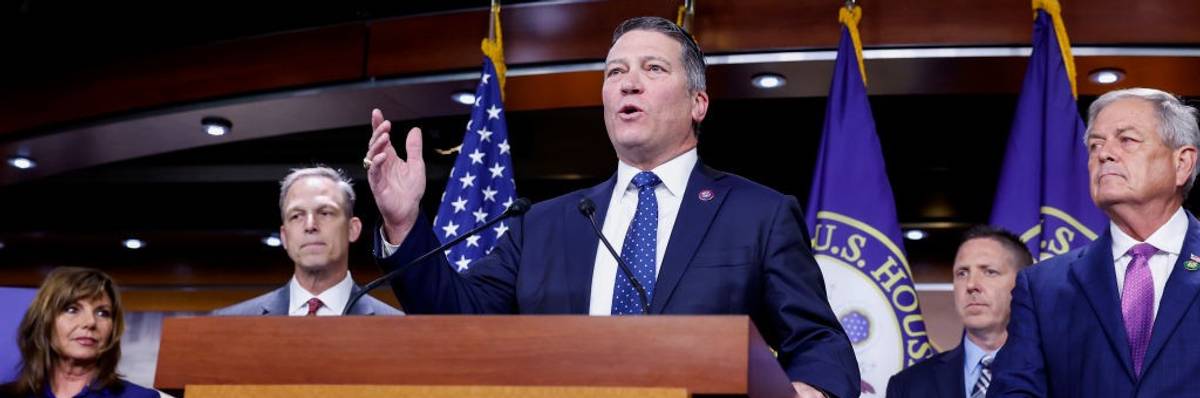
Rep. Ronny Jackson (R-Texas) speaks during a press conference on the National Defense Authorization Act (NDAA) with members of the House Freedom Caucus on July 14, 2023 in Washington, D.C.
This is no way to handle global superpower status, the largest military in the world, nor hard-earned taxpayer dollars.
The culture wars have come to U.S. military policy, and the price could be far higher than any of us can afford. Rather than a serious debate over military spending and foreign policy, we’re being subjected to a right-wing circus performance.
The annual National Defense Authorization Act, or NDAA, lays out how the military budget—$886.3 billion for this coming year—will be spent. There are few pieces of legislation with more significant consequences for U.S. taxpayers or the world.
Members of Congress frequently opine that passing this legislation is one of their most important jobs—but just as important should be getting it right. With war, peace, and nearly $1 trillion on the line, the stakes are too high to mess this up.
It’s not the first time that Congress has flagrantly ignored what should be their highest priorities in this bill—keeping the peace and protecting taxpayers. But at least in past years, there was debate and voting on the issues of war budgets and war powers.
Against all common sense, earlier this month, Republican representatives came at this all-important legislation with one clear set of goals in mind. It wasn’t a clear focus on how the military with the world’s largest budget and greatest number of overseas bases could ensure peace and avoid new wars in a century where the United States is unlikely to remain the sole superpower. It wasn’t shameful price gouging by Pentagon contractors, even though those contractors account for hundreds of billions of dollars—roughly half of the Pentagon budget.
And it wasn’t the fact that Congress has abdicated its constitutional war powers authority for more than 20 years, leaving any current or future president a galaxy-size loophole to engage the country in military conflict without consulting Congress. That’s despite legislators ranging from the right-wing Senator Rand Paul, Republican of Kentucky, to the left-leaning Representative Barbara Lee, Democrat of California, calling to close that loophole.
Instead, Republicans have focused on cutting off access to abortion for military troops and families. They tried to eliminate health care options for transgender service members or family members. And they took a blowtorch to anything resembling racial diversity initiatives in the military, with one Republican slipping into using segregation-era language about “colored people.”
In doing so, they displayed their contempt for service members who are trans or have a trans family member, or those who may have found value in diversity initiatives or training, or those who have a uterus.
But they also displayed their contempt for the fiscal responsibility they claim to hold dear, which is being flaunted daily by a Pentagon that continues to reward price-gouging contractors and that has never managed to pass a financial audit. Nor was there any focus on the sheer size of the Pentagon budget, which accounts for more than half of annual discretionary spending.
A groundbreaking amendment from Representatives Lee, Mark Pocan, Democrat of Wisconsin, and others that would have cut the Pentagon budget by $100 billion—returning it to the levels of just a few years ago—didn’t even receive a vote. That’s despite polling showing that a majority of voters are concerned about military spending and support reallocating some of those funds.
Republican leaders also acquiesced to our forever wars and the executive overreach they claim to oppose. Despite bipartisan support for the idea, multiple amendments to revoke war authorizations going back twenty years or longer were left on the cutting room floor, giving future presidents a free pass to use them to start new wars.
It’s not the first time that Congress has flagrantly ignored what should be their highest priorities in this bill—keeping the peace and protecting taxpayers. But at least in past years, there was debate and voting on the issues of war budgets and war powers.
This year, far-right lawmakers decided those issues weren’t even worth debating. The final bill passed the House of Representatives by the narrowest of margins, 219-210, on a near-party-line vote. The U.S. Senate is now taking up its own version.
This is no way to handle global superpower status, the largest military in the world, nor hard-earned taxpayer dollars.
The Republican culture wars have already come for the most vulnerable among us. Now that they’ve hijacked the debate over nearly $1 trillion and made wars more likely, it’s even more clear just how unaffordable this business is.
Dear Common Dreams reader, It’s been nearly 30 years since I co-founded Common Dreams with my late wife, Lina Newhouser. We had the radical notion that journalism should serve the public good, not corporate profits. It was clear to us from the outset what it would take to build such a project. No paid advertisements. No corporate sponsors. No millionaire publisher telling us what to think or do. Many people said we wouldn't last a year, but we proved those doubters wrong. Together with a tremendous team of journalists and dedicated staff, we built an independent media outlet free from the constraints of profits and corporate control. Our mission has always been simple: To inform. To inspire. To ignite change for the common good. Building Common Dreams was not easy. Our survival was never guaranteed. When you take on the most powerful forces—Wall Street greed, fossil fuel industry destruction, Big Tech lobbyists, and uber-rich oligarchs who have spent billions upon billions rigging the economy and democracy in their favor—the only bulwark you have is supporters who believe in your work. But here’s the urgent message from me today. It's never been this bad out there. And it's never been this hard to keep us going. At the very moment Common Dreams is most needed, the threats we face are intensifying. We need your support now more than ever. We don't accept corporate advertising and never will. We don't have a paywall because we don't think people should be blocked from critical news based on their ability to pay. Everything we do is funded by the donations of readers like you. When everyone does the little they can afford, we are strong. But if that support retreats or dries up, so do we. Will you donate now to make sure Common Dreams not only survives but thrives? —Craig Brown, Co-founder |
The culture wars have come to U.S. military policy, and the price could be far higher than any of us can afford. Rather than a serious debate over military spending and foreign policy, we’re being subjected to a right-wing circus performance.
The annual National Defense Authorization Act, or NDAA, lays out how the military budget—$886.3 billion for this coming year—will be spent. There are few pieces of legislation with more significant consequences for U.S. taxpayers or the world.
Members of Congress frequently opine that passing this legislation is one of their most important jobs—but just as important should be getting it right. With war, peace, and nearly $1 trillion on the line, the stakes are too high to mess this up.
It’s not the first time that Congress has flagrantly ignored what should be their highest priorities in this bill—keeping the peace and protecting taxpayers. But at least in past years, there was debate and voting on the issues of war budgets and war powers.
Against all common sense, earlier this month, Republican representatives came at this all-important legislation with one clear set of goals in mind. It wasn’t a clear focus on how the military with the world’s largest budget and greatest number of overseas bases could ensure peace and avoid new wars in a century where the United States is unlikely to remain the sole superpower. It wasn’t shameful price gouging by Pentagon contractors, even though those contractors account for hundreds of billions of dollars—roughly half of the Pentagon budget.
And it wasn’t the fact that Congress has abdicated its constitutional war powers authority for more than 20 years, leaving any current or future president a galaxy-size loophole to engage the country in military conflict without consulting Congress. That’s despite legislators ranging from the right-wing Senator Rand Paul, Republican of Kentucky, to the left-leaning Representative Barbara Lee, Democrat of California, calling to close that loophole.
Instead, Republicans have focused on cutting off access to abortion for military troops and families. They tried to eliminate health care options for transgender service members or family members. And they took a blowtorch to anything resembling racial diversity initiatives in the military, with one Republican slipping into using segregation-era language about “colored people.”
In doing so, they displayed their contempt for service members who are trans or have a trans family member, or those who may have found value in diversity initiatives or training, or those who have a uterus.
But they also displayed their contempt for the fiscal responsibility they claim to hold dear, which is being flaunted daily by a Pentagon that continues to reward price-gouging contractors and that has never managed to pass a financial audit. Nor was there any focus on the sheer size of the Pentagon budget, which accounts for more than half of annual discretionary spending.
A groundbreaking amendment from Representatives Lee, Mark Pocan, Democrat of Wisconsin, and others that would have cut the Pentagon budget by $100 billion—returning it to the levels of just a few years ago—didn’t even receive a vote. That’s despite polling showing that a majority of voters are concerned about military spending and support reallocating some of those funds.
Republican leaders also acquiesced to our forever wars and the executive overreach they claim to oppose. Despite bipartisan support for the idea, multiple amendments to revoke war authorizations going back twenty years or longer were left on the cutting room floor, giving future presidents a free pass to use them to start new wars.
It’s not the first time that Congress has flagrantly ignored what should be their highest priorities in this bill—keeping the peace and protecting taxpayers. But at least in past years, there was debate and voting on the issues of war budgets and war powers.
This year, far-right lawmakers decided those issues weren’t even worth debating. The final bill passed the House of Representatives by the narrowest of margins, 219-210, on a near-party-line vote. The U.S. Senate is now taking up its own version.
This is no way to handle global superpower status, the largest military in the world, nor hard-earned taxpayer dollars.
The Republican culture wars have already come for the most vulnerable among us. Now that they’ve hijacked the debate over nearly $1 trillion and made wars more likely, it’s even more clear just how unaffordable this business is.
The culture wars have come to U.S. military policy, and the price could be far higher than any of us can afford. Rather than a serious debate over military spending and foreign policy, we’re being subjected to a right-wing circus performance.
The annual National Defense Authorization Act, or NDAA, lays out how the military budget—$886.3 billion for this coming year—will be spent. There are few pieces of legislation with more significant consequences for U.S. taxpayers or the world.
Members of Congress frequently opine that passing this legislation is one of their most important jobs—but just as important should be getting it right. With war, peace, and nearly $1 trillion on the line, the stakes are too high to mess this up.
It’s not the first time that Congress has flagrantly ignored what should be their highest priorities in this bill—keeping the peace and protecting taxpayers. But at least in past years, there was debate and voting on the issues of war budgets and war powers.
Against all common sense, earlier this month, Republican representatives came at this all-important legislation with one clear set of goals in mind. It wasn’t a clear focus on how the military with the world’s largest budget and greatest number of overseas bases could ensure peace and avoid new wars in a century where the United States is unlikely to remain the sole superpower. It wasn’t shameful price gouging by Pentagon contractors, even though those contractors account for hundreds of billions of dollars—roughly half of the Pentagon budget.
And it wasn’t the fact that Congress has abdicated its constitutional war powers authority for more than 20 years, leaving any current or future president a galaxy-size loophole to engage the country in military conflict without consulting Congress. That’s despite legislators ranging from the right-wing Senator Rand Paul, Republican of Kentucky, to the left-leaning Representative Barbara Lee, Democrat of California, calling to close that loophole.
Instead, Republicans have focused on cutting off access to abortion for military troops and families. They tried to eliminate health care options for transgender service members or family members. And they took a blowtorch to anything resembling racial diversity initiatives in the military, with one Republican slipping into using segregation-era language about “colored people.”
In doing so, they displayed their contempt for service members who are trans or have a trans family member, or those who may have found value in diversity initiatives or training, or those who have a uterus.
But they also displayed their contempt for the fiscal responsibility they claim to hold dear, which is being flaunted daily by a Pentagon that continues to reward price-gouging contractors and that has never managed to pass a financial audit. Nor was there any focus on the sheer size of the Pentagon budget, which accounts for more than half of annual discretionary spending.
A groundbreaking amendment from Representatives Lee, Mark Pocan, Democrat of Wisconsin, and others that would have cut the Pentagon budget by $100 billion—returning it to the levels of just a few years ago—didn’t even receive a vote. That’s despite polling showing that a majority of voters are concerned about military spending and support reallocating some of those funds.
Republican leaders also acquiesced to our forever wars and the executive overreach they claim to oppose. Despite bipartisan support for the idea, multiple amendments to revoke war authorizations going back twenty years or longer were left on the cutting room floor, giving future presidents a free pass to use them to start new wars.
It’s not the first time that Congress has flagrantly ignored what should be their highest priorities in this bill—keeping the peace and protecting taxpayers. But at least in past years, there was debate and voting on the issues of war budgets and war powers.
This year, far-right lawmakers decided those issues weren’t even worth debating. The final bill passed the House of Representatives by the narrowest of margins, 219-210, on a near-party-line vote. The U.S. Senate is now taking up its own version.
This is no way to handle global superpower status, the largest military in the world, nor hard-earned taxpayer dollars.
The Republican culture wars have already come for the most vulnerable among us. Now that they’ve hijacked the debate over nearly $1 trillion and made wars more likely, it’s even more clear just how unaffordable this business is.