SUBSCRIBE TO OUR FREE NEWSLETTER
Daily news & progressive opinion—funded by the people, not the corporations—delivered straight to your inbox.
5
#000000
#FFFFFF
To donate by check, phone, or other method, see our More Ways to Give page.
Daily news & progressive opinion—funded by the people, not the corporations—delivered straight to your inbox.
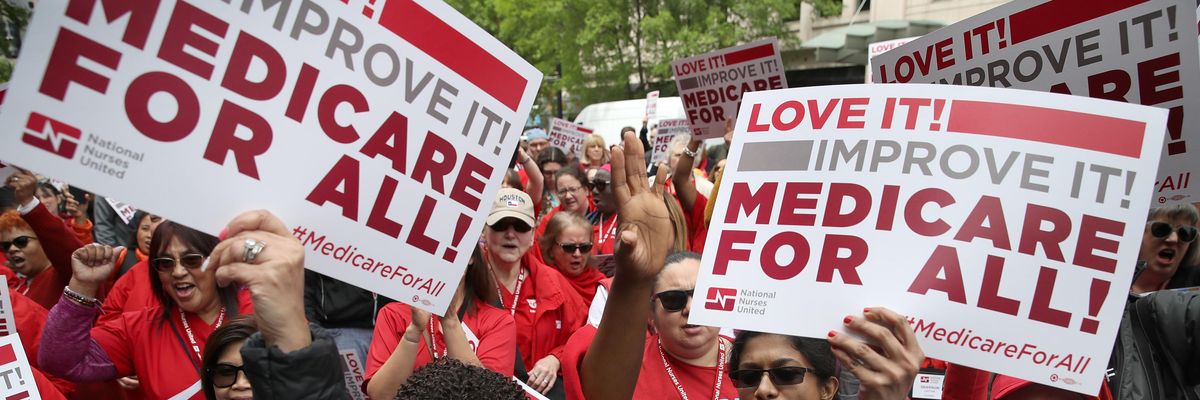
Supporters of Medicare for All protest outside of PhRMA headquarters in Washington, D.C. on April 29, 2019.
If we want to build on the promise of Medicare, then we’re going to have to grapple directly with the power of corporate health insurance: That starts with taking on the so-called “Medicare Advantage” program.
Fifty-nine years ago today, President Lyndon Johnson signed Medicare into law—a high-water mark in the fight for universal healthcare that had started decades before and that continues to this day.
Ever since Medicare became law, it has been a shining example of what is possible in U.S. healthcare: a truly public, truly universal program that has saved countless lives and prevented untold financial ruin among America’s seniors. But alongside this success, corporate health interests have also grown immeasurably more powerful. Insurers like UnitedHealthcare and Blue Cross Blue Shield have erected cruel barriers to care and are laughing all the way to the bank.
If we want to build on the promise of Medicare—and win the best possible version of Medicare for All—then we’re going to have to grapple directly with the power of corporate health insurance. That starts with taking on the so-called “Medicare Advantage” program.
The Strategic Importance of Medicare Advantage
Single-payer advocates understand that there can’t be “Medicare for All” if there is no “Medicare.” And no, Medicare Advantage (MA) doesn’t count as Medicare. The health insurance corporations that run these plans have a business imperative to prioritize profits above all else; this is anathema to any public health program.
Physicians for a National Health Program (PNHP) has compiled overwhelming evidence that MA insurers are harming patients, physicians, and hospitals by delaying and denying care—harms that are virtually unseen in Traditional Medicare. Nor is this cruelty even a trade-off for lowering the cost of healthcare. In fact, these corporations are paid far more than what is spent for similar patients in Traditional Medicare—up to $140 billion per year, or as much as 35% above the funding levels of Traditional Medicare.
There is no road to Medicare for All that ignores this existential threat.
Where we see middlemen standing between patients and the care they need, we should remove them. Where we see limited provider networks, we should expand them. Where we see piles of pre-authorization paperwork, we should shred them.
Thankfully, support for eliminating overpayments to MA extends far beyond those who are already committed to single payer. This fight builds our movement by mobilizing a wide range of people who understand, or can be educated about, the damage insurance companies are doing to patients. When we find common ground, we should walk together.
For that reason, PNHP is exposing MA overpayments and demanding a more fiscally responsible approach from policymakers. We are working closely with several organizations to change the national conversation and provide a badly needed counterweight to the lobbying might of big insurance.
When MA was created, way back in 2003, corporate insurers promised to reduce the cost of healthcare by improving care coordination and health outcomes. A healthier population, they claimed, would be less expensive. We should demand that MA corporations live up to these lofty promises without billions of dollars in overpayments.
We’d like to see them try.
Improved Medicare… for ALL
Winning back $140 billion in annual overpayments begs a tantalizing question: How can we use those funds to improve Medicare for all seniors?
Instead of the paltry benefits that MA plans offer, those funds would help us add robust hearing, vision, and dental benefits; totally eliminate Medicare Part B premiums; and fold in the Medicare Part D prescription drug benefit. Imagine the relief a senior on Medicare Advantage would feel when enrolling in a plan that actually covers the full range of dental care, while also freeing themselves from the narrow provider networks and prior authorization requirements imposed by MA plans.
Most critically, we need to establish a low out-of-pocket maximum for Medicare. Insurance corporations lure seniors and people with disabilities into the MA trap by selling lower up-front costs while hiding substantial barriers to care. It’s a classic bait and switch. Eliminating the need to purchase Medigap would level the playing field and allow everybody to remain in Traditional Medicare.
Let’s work to build a movement of seniors, physicians, students, people with disabilities, and everybody else who cares about Medicare.
Well, not everybody—but that’s our ultimate goal. PNHP advocates for a national single-payer health insurance program, and what better way to get there than through an improved version of the already popular Medicare program?
Where we see middlemen standing between patients and the care they need, we should remove them. Where we see limited provider networks, we should expand them. Where we see piles of pre-authorization paperwork, we should shred them.
We should also expand benefits to include all medically necessary care, and ultimately eliminate out-of-pocket costs that deter people from seeing a doctor. Once these improvements are in place, we will have a program that’s truly worthy of the name Medicare for All.
The advocacy work for these priorities—ending MA overpayments, improving Traditional Medicare, and realizing our vision for single payer—overlap and build on one another.
Let’s work to build a movement of seniors, physicians, students, people with disabilities, and everybody else who cares about Medicare. Together, we can take on the corporate insurers that are wreaking so much havoc in our lives and lay the groundwork for winning a single-payer program that brings everybody in and leaves nobody out.
Dear Common Dreams reader, It’s been nearly 30 years since I co-founded Common Dreams with my late wife, Lina Newhouser. We had the radical notion that journalism should serve the public good, not corporate profits. It was clear to us from the outset what it would take to build such a project. No paid advertisements. No corporate sponsors. No millionaire publisher telling us what to think or do. Many people said we wouldn't last a year, but we proved those doubters wrong. Together with a tremendous team of journalists and dedicated staff, we built an independent media outlet free from the constraints of profits and corporate control. Our mission has always been simple: To inform. To inspire. To ignite change for the common good. Building Common Dreams was not easy. Our survival was never guaranteed. When you take on the most powerful forces—Wall Street greed, fossil fuel industry destruction, Big Tech lobbyists, and uber-rich oligarchs who have spent billions upon billions rigging the economy and democracy in their favor—the only bulwark you have is supporters who believe in your work. But here’s the urgent message from me today. It's never been this bad out there. And it's never been this hard to keep us going. At the very moment Common Dreams is most needed, the threats we face are intensifying. We need your support now more than ever. We don't accept corporate advertising and never will. We don't have a paywall because we don't think people should be blocked from critical news based on their ability to pay. Everything we do is funded by the donations of readers like you. When everyone does the little they can afford, we are strong. But if that support retreats or dries up, so do we. Will you donate now to make sure Common Dreams not only survives but thrives? —Craig Brown, Co-founder |
Fifty-nine years ago today, President Lyndon Johnson signed Medicare into law—a high-water mark in the fight for universal healthcare that had started decades before and that continues to this day.
Ever since Medicare became law, it has been a shining example of what is possible in U.S. healthcare: a truly public, truly universal program that has saved countless lives and prevented untold financial ruin among America’s seniors. But alongside this success, corporate health interests have also grown immeasurably more powerful. Insurers like UnitedHealthcare and Blue Cross Blue Shield have erected cruel barriers to care and are laughing all the way to the bank.
If we want to build on the promise of Medicare—and win the best possible version of Medicare for All—then we’re going to have to grapple directly with the power of corporate health insurance. That starts with taking on the so-called “Medicare Advantage” program.
The Strategic Importance of Medicare Advantage
Single-payer advocates understand that there can’t be “Medicare for All” if there is no “Medicare.” And no, Medicare Advantage (MA) doesn’t count as Medicare. The health insurance corporations that run these plans have a business imperative to prioritize profits above all else; this is anathema to any public health program.
Physicians for a National Health Program (PNHP) has compiled overwhelming evidence that MA insurers are harming patients, physicians, and hospitals by delaying and denying care—harms that are virtually unseen in Traditional Medicare. Nor is this cruelty even a trade-off for lowering the cost of healthcare. In fact, these corporations are paid far more than what is spent for similar patients in Traditional Medicare—up to $140 billion per year, or as much as 35% above the funding levels of Traditional Medicare.
There is no road to Medicare for All that ignores this existential threat.
Where we see middlemen standing between patients and the care they need, we should remove them. Where we see limited provider networks, we should expand them. Where we see piles of pre-authorization paperwork, we should shred them.
Thankfully, support for eliminating overpayments to MA extends far beyond those who are already committed to single payer. This fight builds our movement by mobilizing a wide range of people who understand, or can be educated about, the damage insurance companies are doing to patients. When we find common ground, we should walk together.
For that reason, PNHP is exposing MA overpayments and demanding a more fiscally responsible approach from policymakers. We are working closely with several organizations to change the national conversation and provide a badly needed counterweight to the lobbying might of big insurance.
When MA was created, way back in 2003, corporate insurers promised to reduce the cost of healthcare by improving care coordination and health outcomes. A healthier population, they claimed, would be less expensive. We should demand that MA corporations live up to these lofty promises without billions of dollars in overpayments.
We’d like to see them try.
Improved Medicare… for ALL
Winning back $140 billion in annual overpayments begs a tantalizing question: How can we use those funds to improve Medicare for all seniors?
Instead of the paltry benefits that MA plans offer, those funds would help us add robust hearing, vision, and dental benefits; totally eliminate Medicare Part B premiums; and fold in the Medicare Part D prescription drug benefit. Imagine the relief a senior on Medicare Advantage would feel when enrolling in a plan that actually covers the full range of dental care, while also freeing themselves from the narrow provider networks and prior authorization requirements imposed by MA plans.
Most critically, we need to establish a low out-of-pocket maximum for Medicare. Insurance corporations lure seniors and people with disabilities into the MA trap by selling lower up-front costs while hiding substantial barriers to care. It’s a classic bait and switch. Eliminating the need to purchase Medigap would level the playing field and allow everybody to remain in Traditional Medicare.
Let’s work to build a movement of seniors, physicians, students, people with disabilities, and everybody else who cares about Medicare.
Well, not everybody—but that’s our ultimate goal. PNHP advocates for a national single-payer health insurance program, and what better way to get there than through an improved version of the already popular Medicare program?
Where we see middlemen standing between patients and the care they need, we should remove them. Where we see limited provider networks, we should expand them. Where we see piles of pre-authorization paperwork, we should shred them.
We should also expand benefits to include all medically necessary care, and ultimately eliminate out-of-pocket costs that deter people from seeing a doctor. Once these improvements are in place, we will have a program that’s truly worthy of the name Medicare for All.
The advocacy work for these priorities—ending MA overpayments, improving Traditional Medicare, and realizing our vision for single payer—overlap and build on one another.
Let’s work to build a movement of seniors, physicians, students, people with disabilities, and everybody else who cares about Medicare. Together, we can take on the corporate insurers that are wreaking so much havoc in our lives and lay the groundwork for winning a single-payer program that brings everybody in and leaves nobody out.
Fifty-nine years ago today, President Lyndon Johnson signed Medicare into law—a high-water mark in the fight for universal healthcare that had started decades before and that continues to this day.
Ever since Medicare became law, it has been a shining example of what is possible in U.S. healthcare: a truly public, truly universal program that has saved countless lives and prevented untold financial ruin among America’s seniors. But alongside this success, corporate health interests have also grown immeasurably more powerful. Insurers like UnitedHealthcare and Blue Cross Blue Shield have erected cruel barriers to care and are laughing all the way to the bank.
If we want to build on the promise of Medicare—and win the best possible version of Medicare for All—then we’re going to have to grapple directly with the power of corporate health insurance. That starts with taking on the so-called “Medicare Advantage” program.
The Strategic Importance of Medicare Advantage
Single-payer advocates understand that there can’t be “Medicare for All” if there is no “Medicare.” And no, Medicare Advantage (MA) doesn’t count as Medicare. The health insurance corporations that run these plans have a business imperative to prioritize profits above all else; this is anathema to any public health program.
Physicians for a National Health Program (PNHP) has compiled overwhelming evidence that MA insurers are harming patients, physicians, and hospitals by delaying and denying care—harms that are virtually unseen in Traditional Medicare. Nor is this cruelty even a trade-off for lowering the cost of healthcare. In fact, these corporations are paid far more than what is spent for similar patients in Traditional Medicare—up to $140 billion per year, or as much as 35% above the funding levels of Traditional Medicare.
There is no road to Medicare for All that ignores this existential threat.
Where we see middlemen standing between patients and the care they need, we should remove them. Where we see limited provider networks, we should expand them. Where we see piles of pre-authorization paperwork, we should shred them.
Thankfully, support for eliminating overpayments to MA extends far beyond those who are already committed to single payer. This fight builds our movement by mobilizing a wide range of people who understand, or can be educated about, the damage insurance companies are doing to patients. When we find common ground, we should walk together.
For that reason, PNHP is exposing MA overpayments and demanding a more fiscally responsible approach from policymakers. We are working closely with several organizations to change the national conversation and provide a badly needed counterweight to the lobbying might of big insurance.
When MA was created, way back in 2003, corporate insurers promised to reduce the cost of healthcare by improving care coordination and health outcomes. A healthier population, they claimed, would be less expensive. We should demand that MA corporations live up to these lofty promises without billions of dollars in overpayments.
We’d like to see them try.
Improved Medicare… for ALL
Winning back $140 billion in annual overpayments begs a tantalizing question: How can we use those funds to improve Medicare for all seniors?
Instead of the paltry benefits that MA plans offer, those funds would help us add robust hearing, vision, and dental benefits; totally eliminate Medicare Part B premiums; and fold in the Medicare Part D prescription drug benefit. Imagine the relief a senior on Medicare Advantage would feel when enrolling in a plan that actually covers the full range of dental care, while also freeing themselves from the narrow provider networks and prior authorization requirements imposed by MA plans.
Most critically, we need to establish a low out-of-pocket maximum for Medicare. Insurance corporations lure seniors and people with disabilities into the MA trap by selling lower up-front costs while hiding substantial barriers to care. It’s a classic bait and switch. Eliminating the need to purchase Medigap would level the playing field and allow everybody to remain in Traditional Medicare.
Let’s work to build a movement of seniors, physicians, students, people with disabilities, and everybody else who cares about Medicare.
Well, not everybody—but that’s our ultimate goal. PNHP advocates for a national single-payer health insurance program, and what better way to get there than through an improved version of the already popular Medicare program?
Where we see middlemen standing between patients and the care they need, we should remove them. Where we see limited provider networks, we should expand them. Where we see piles of pre-authorization paperwork, we should shred them.
We should also expand benefits to include all medically necessary care, and ultimately eliminate out-of-pocket costs that deter people from seeing a doctor. Once these improvements are in place, we will have a program that’s truly worthy of the name Medicare for All.
The advocacy work for these priorities—ending MA overpayments, improving Traditional Medicare, and realizing our vision for single payer—overlap and build on one another.
Let’s work to build a movement of seniors, physicians, students, people with disabilities, and everybody else who cares about Medicare. Together, we can take on the corporate insurers that are wreaking so much havoc in our lives and lay the groundwork for winning a single-payer program that brings everybody in and leaves nobody out.