
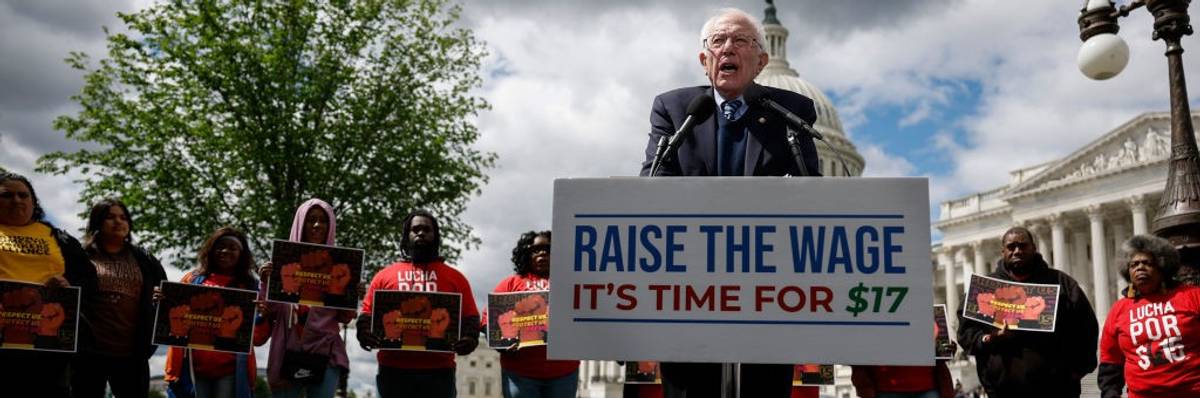
Sen. Bernie Sanders (I-Vt.) speaks at a press conference on raising the federal minimum wage outside the U.S. Capitol Building May 4, 2023 in Washington, D.C.
How Much of a Difference Would the Raise the Wage Act Make for US Workers?
A higher federal minimum wage can build on existing state-level standards and lock in the wage gains made by low-wage workers in the economic recovery from the Covid-19 pandemic.
What Does the Raise the Wage Act of 2023 Do?
The federal minimum hourly wage is just $7.25 and has not increased since 2009. The Raise the Wage Act of 2023, introduced in the U.S. House of Representatives and U.S. Senate on July 25, 2023, would gradually raise the federal minimum wage to $17 an hour by 2028. The bill would also gradually raise and then eliminate subminimum wages for tipped workers, workers with disabilities, and youth workers, so that all workers covered by the Fair Labor Standards Act (FLSA) would be at the same wage level.
What Would its Impact Be?
EPI’s analysis shows that raising the federal minimum wage to $17 by 2028 would impact 27,858,000 workers across the country, or 19% of the U.S. workforce. The increases would provide an additional $86 billion annually in wages for the country’s lowest-paid workers, with the average affected worker who works year-round receiving an extra $3,100 per year.
Who Would Be Affected?
Table 1 shows EPI’s estimates of the population of workers, by demographic and other characteristics, who would benefit from the Raise the Wage Act of 2023.
How Many Workers Would Benefit in Each State?
Table 2 shows the estimated impact of the Raise the Wage Act of 2023 by state.
Why Are Workers in Some States Less Likely to Be Affected?
In summer 2023, 19 states and localities implemented minimum wage increases based on state, local, or municipal laws that already set the minimum wage higher than the federal standard. In total, 30 states and the District of Columbia have a minimum wage above the federal minimum, and many more localities have minimum wages above their state minimum wage. Workers in most of these states will still benefit from a $17 federal minimum wage, but the effect is muted because low-wage workers in those states have already seen wage increases above the federal minimum.
California, the District of Columbia, Hawaii, and Washington all have state- or municipality-level minimum wage laws that will set minimum wages close to, or above, the Raise the Wage Act’s proposal of $17 by 2028. Because of this, only a small number of workers in those states would be directly affected by the federal policy as state/local laws will have already raised the wages of low-wage workers in those jurisdictions. Because of the smaller impacted population, more detailed impact estimates are unavailable for those states. (Cells for which data are unavailable are marked with * in Table 2.)
Why Is It Critical That the Raise the Wage Act Be Passed?
As EPI’s state-by-state minimum wage tracker shows, raising the federal minimum wage is critical to protect workers (especially in the South) who have been left behind. A higher federal minimum wage can build on existing state-level standards and lock in the wage gains made by low-wage workers in the economic recovery from the Covid-19 pandemic.
Assumptions and Documentation for EPI’s Minimum Wage Simulation Model
- The estimates are for the year 2028, when the policy’s regular minimum wage is $17 and the tipped minimum wage is $15.
- The underlying wage distribution is based on the 2022 Current Population Survey.
- The simulation assumes nominal wage growth will be at a 5.0% annual rate between 2022 and 2023, and at an annual rate of 0.5% plus projected CPI growth in subsequent years.
- The simulation accounts for estimated effects of projected state and local minimum wages between 2023 and 2028.
- To read more about the EPI Minimum Wage Simulation Model, see the description in Cooper, Mokhiber, and Zipperer (2019).
An Urgent Message From Our Co-Founder
Dear Common Dreams reader, The U.S. is on a fast track to authoritarianism like nothing I've ever seen. Meanwhile, corporate news outlets are utterly capitulating to Trump, twisting their coverage to avoid drawing his ire while lining up to stuff cash in his pockets. That's why I believe that Common Dreams is doing the best and most consequential reporting that we've ever done. Our small but mighty team is a progressive reporting powerhouse, covering the news every day that the corporate media never will. Our mission has always been simple: To inform. To inspire. And to ignite change for the common good. Now here's the key piece that I want all our readers to understand: None of this would be possible without your financial support. That's not just some fundraising cliche. It's the absolute and literal truth. We don't accept corporate advertising and never will. We don't have a paywall because we don't think people should be blocked from critical news based on their ability to pay. Everything we do is funded by the donations of readers like you. Will you donate now to help power the nonprofit, independent reporting of Common Dreams? Thank you for being a vital member of our community. Together, we can keep independent journalism alive when it’s needed most. - Craig Brown, Co-founder |
What Does the Raise the Wage Act of 2023 Do?
The federal minimum hourly wage is just $7.25 and has not increased since 2009. The Raise the Wage Act of 2023, introduced in the U.S. House of Representatives and U.S. Senate on July 25, 2023, would gradually raise the federal minimum wage to $17 an hour by 2028. The bill would also gradually raise and then eliminate subminimum wages for tipped workers, workers with disabilities, and youth workers, so that all workers covered by the Fair Labor Standards Act (FLSA) would be at the same wage level.
What Would its Impact Be?
EPI’s analysis shows that raising the federal minimum wage to $17 by 2028 would impact 27,858,000 workers across the country, or 19% of the U.S. workforce. The increases would provide an additional $86 billion annually in wages for the country’s lowest-paid workers, with the average affected worker who works year-round receiving an extra $3,100 per year.
Who Would Be Affected?
Table 1 shows EPI’s estimates of the population of workers, by demographic and other characteristics, who would benefit from the Raise the Wage Act of 2023.
How Many Workers Would Benefit in Each State?
Table 2 shows the estimated impact of the Raise the Wage Act of 2023 by state.
Why Are Workers in Some States Less Likely to Be Affected?
In summer 2023, 19 states and localities implemented minimum wage increases based on state, local, or municipal laws that already set the minimum wage higher than the federal standard. In total, 30 states and the District of Columbia have a minimum wage above the federal minimum, and many more localities have minimum wages above their state minimum wage. Workers in most of these states will still benefit from a $17 federal minimum wage, but the effect is muted because low-wage workers in those states have already seen wage increases above the federal minimum.
California, the District of Columbia, Hawaii, and Washington all have state- or municipality-level minimum wage laws that will set minimum wages close to, or above, the Raise the Wage Act’s proposal of $17 by 2028. Because of this, only a small number of workers in those states would be directly affected by the federal policy as state/local laws will have already raised the wages of low-wage workers in those jurisdictions. Because of the smaller impacted population, more detailed impact estimates are unavailable for those states. (Cells for which data are unavailable are marked with * in Table 2.)
Why Is It Critical That the Raise the Wage Act Be Passed?
As EPI’s state-by-state minimum wage tracker shows, raising the federal minimum wage is critical to protect workers (especially in the South) who have been left behind. A higher federal minimum wage can build on existing state-level standards and lock in the wage gains made by low-wage workers in the economic recovery from the Covid-19 pandemic.
Assumptions and Documentation for EPI’s Minimum Wage Simulation Model
- The estimates are for the year 2028, when the policy’s regular minimum wage is $17 and the tipped minimum wage is $15.
- The underlying wage distribution is based on the 2022 Current Population Survey.
- The simulation assumes nominal wage growth will be at a 5.0% annual rate between 2022 and 2023, and at an annual rate of 0.5% plus projected CPI growth in subsequent years.
- The simulation accounts for estimated effects of projected state and local minimum wages between 2023 and 2028.
- To read more about the EPI Minimum Wage Simulation Model, see the description in Cooper, Mokhiber, and Zipperer (2019).
- Grocery Store Workers Stand to Lose Over $300 Million Annually if Kroger and Albertsons Merge ›
- CBO Not Competent to Assess Economics of Minimum Wage in "Unreliable" New Report ›
- With Referendum Off Until 2024, California Lawmakers Must Act on $18 Minimum Wage ›
- Record 88 US Jurisdictions to Raise Minimum Wages in 2025 as Federal Pay Floor Remains Stagnant | Common Dreams ›
What Does the Raise the Wage Act of 2023 Do?
The federal minimum hourly wage is just $7.25 and has not increased since 2009. The Raise the Wage Act of 2023, introduced in the U.S. House of Representatives and U.S. Senate on July 25, 2023, would gradually raise the federal minimum wage to $17 an hour by 2028. The bill would also gradually raise and then eliminate subminimum wages for tipped workers, workers with disabilities, and youth workers, so that all workers covered by the Fair Labor Standards Act (FLSA) would be at the same wage level.
What Would its Impact Be?
EPI’s analysis shows that raising the federal minimum wage to $17 by 2028 would impact 27,858,000 workers across the country, or 19% of the U.S. workforce. The increases would provide an additional $86 billion annually in wages for the country’s lowest-paid workers, with the average affected worker who works year-round receiving an extra $3,100 per year.
Who Would Be Affected?
Table 1 shows EPI’s estimates of the population of workers, by demographic and other characteristics, who would benefit from the Raise the Wage Act of 2023.
How Many Workers Would Benefit in Each State?
Table 2 shows the estimated impact of the Raise the Wage Act of 2023 by state.
Why Are Workers in Some States Less Likely to Be Affected?
In summer 2023, 19 states and localities implemented minimum wage increases based on state, local, or municipal laws that already set the minimum wage higher than the federal standard. In total, 30 states and the District of Columbia have a minimum wage above the federal minimum, and many more localities have minimum wages above their state minimum wage. Workers in most of these states will still benefit from a $17 federal minimum wage, but the effect is muted because low-wage workers in those states have already seen wage increases above the federal minimum.
California, the District of Columbia, Hawaii, and Washington all have state- or municipality-level minimum wage laws that will set minimum wages close to, or above, the Raise the Wage Act’s proposal of $17 by 2028. Because of this, only a small number of workers in those states would be directly affected by the federal policy as state/local laws will have already raised the wages of low-wage workers in those jurisdictions. Because of the smaller impacted population, more detailed impact estimates are unavailable for those states. (Cells for which data are unavailable are marked with * in Table 2.)
Why Is It Critical That the Raise the Wage Act Be Passed?
As EPI’s state-by-state minimum wage tracker shows, raising the federal minimum wage is critical to protect workers (especially in the South) who have been left behind. A higher federal minimum wage can build on existing state-level standards and lock in the wage gains made by low-wage workers in the economic recovery from the Covid-19 pandemic.
Assumptions and Documentation for EPI’s Minimum Wage Simulation Model
- The estimates are for the year 2028, when the policy’s regular minimum wage is $17 and the tipped minimum wage is $15.
- The underlying wage distribution is based on the 2022 Current Population Survey.
- The simulation assumes nominal wage growth will be at a 5.0% annual rate between 2022 and 2023, and at an annual rate of 0.5% plus projected CPI growth in subsequent years.
- The simulation accounts for estimated effects of projected state and local minimum wages between 2023 and 2028.
- To read more about the EPI Minimum Wage Simulation Model, see the description in Cooper, Mokhiber, and Zipperer (2019).
- Grocery Store Workers Stand to Lose Over $300 Million Annually if Kroger and Albertsons Merge ›
- CBO Not Competent to Assess Economics of Minimum Wage in "Unreliable" New Report ›
- With Referendum Off Until 2024, California Lawmakers Must Act on $18 Minimum Wage ›
- Record 88 US Jurisdictions to Raise Minimum Wages in 2025 as Federal Pay Floor Remains Stagnant | Common Dreams ›