
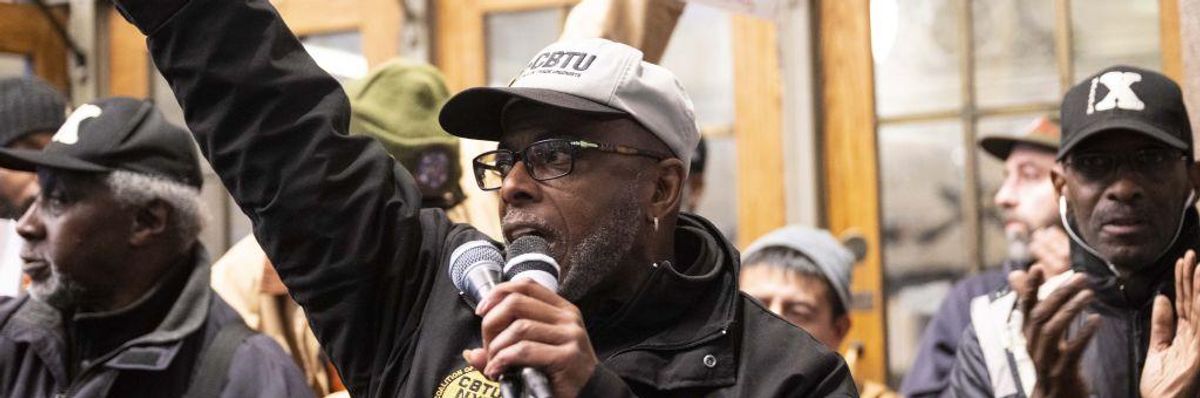
People shout slogans as union activists and workers' rights groups protest, to demand sick pay and union rights for rail workers, at Grand Central Terminal in New York, United States on December 7, 2022.
The Real Lessons From the Railway Labor Dispute
The outrage and alarm produced by the mere threat of these workers to withhold their labor reveal that our economy functions because workers... work.
So, the threatened railway workers strike is over. President Joe Biden used his authority over interstate commerce to impose a settlement. As we all watch CNN and FOX News breath a sign of relief, let’s see if there is a lesson to be learned in these events.
Let’s take a brief look at the background to the dispute. The American railway system was deregulated in the 1980s. And, as always seems to happen, consolidation and profit-taking followed close upon the deregulation. What was once over 30 operating railroad companies was reduced to just seven through buyouts and mergers. These seven firms have all worked to increase their profits by reducing staffing, increasing and intensifying the workload of the remaining workers, and drawing back investment in safety equipment and other costly projects while increasing prices and rates.
The fact that labor’s ability to strike can threaten the normal workings of the economy reveals the true value of workers today.
For example, the companies introduced something called “Precision Scheduled Railroading,” which cut staffing and safety on the rails thereby endangering workers and the surrounding communities. The so-called upside of all these changes was reduced costs and increased profits. And, as usual, the latter were used to make payments to shareholders and investors. Unnoticed by many, these changes also meant that anything that allowed workers unscheduled time off (such as paid sick leave) would seriously disrupt what has become a more or less “bare bones” operation that relies on a minimum of employees to move a lot of stuff crucial to our economy which is built on “just-in-time” production, inventory, and logistics.
These profit-above-all changes made the railroad system especially dependent on a minimized workforce. It could not withstand the paid sick leave system the unions wanted. The new railroad system as a whole relied on the denial of the basic health and safety needs of the workforce. As a result, recent employee surveys showed three of the top five worst employers in the country were rail companies.
The question is: why didn’t President Biden opt to do nothing and simply let the bargaining process continue? Biden said he had to act because the imminent strike of railway workers would have devastated our already troubled economy. He more or less apologized for having to impose a settlement that did not include the seven days of paid sick leave desired by the four unions representing the majority of railroad workers. Their original proposal was for 15 days. His decision seems to have satiated the talking heads in the news media who had spent a couple of weeks underscoring the potential negative effects of a strike on the economy while giving very little by way of historical and sociological analysis. And, of course, it disappointed the 12 unions and 115,000 employees that make up the railway workforce.
But all this hand-wringing overlooks a very important point: the fact that labor’s ability to strike can threaten the normal workings of the economy reveals the true value of workers today. The outrage and alarm produced by the mere threat of these workers to withhold their labor reveal that our economy functions because workers... work. It is the labor of the employees at all the companies and institutions of our society that creates the things that people value and desire. Labor is the lifeblood of the economy.
Trains could run without railroad corporation majority stockholders and their CEOs, but not without maintenance workers and engineers; automobiles could be made without corporate honchos but not without the men and women on the assembly line; oil wells could pump petroleum without the folks who own oil company stocks but not without the workers at the rigs and pipelines; and, food could be grown and harvested without the persons who own the land but not without the farm workers who plant, weed, and harvest.
It is labor that makes the economy go. Amazon is successful because of its drivers and warehouse workers, nor because of Mr. Jeff Bezos. Tesla is able to make electric cars thanks to engineers and line workers, not because of Elon Musk. Walmart is able to sell stuff because of its associates—and they are not part of the Walton Family. And it's very a safe bet that Starbucks CEO Howard Schultz doesn’t even know how to make a decent latte.
So the next time you hear or read some outpouring of praise and admiration for a rich corporate owner or finance mogul just remind yourself what is the real key to a successful economy: the workers, the employees. These are the ordinary people (you and I) who make the economy work.
An Urgent Message From Our Co-Founder
Dear Common Dreams reader, It’s been nearly 30 years since I co-founded Common Dreams with my late wife, Lina Newhouser. We had the radical notion that journalism should serve the public good, not corporate profits. It was clear to us from the outset what it would take to build such a project. No paid advertisements. No corporate sponsors. No millionaire publisher telling us what to think or do. Many people said we wouldn't last a year, but we proved those doubters wrong. Together with a tremendous team of journalists and dedicated staff, we built an independent media outlet free from the constraints of profits and corporate control. Our mission has always been simple: To inform. To inspire. To ignite change for the common good. Building Common Dreams was not easy. Our survival was never guaranteed. When you take on the most powerful forces—Wall Street greed, fossil fuel industry destruction, Big Tech lobbyists, and uber-rich oligarchs who have spent billions upon billions rigging the economy and democracy in their favor—the only bulwark you have is supporters who believe in your work. But here’s the urgent message from me today. It's never been this bad out there. And it's never been this hard to keep us going. At the very moment Common Dreams is most needed, the threats we face are intensifying. We need your support now more than ever. We don't accept corporate advertising and never will. We don't have a paywall because we don't think people should be blocked from critical news based on their ability to pay. Everything we do is funded by the donations of readers like you. When everyone does the little they can afford, we are strong. But if that support retreats or dries up, so do we. Will you donate now to make sure Common Dreams not only survives but thrives? —Craig Brown, Co-founder |
So, the threatened railway workers strike is over. President Joe Biden used his authority over interstate commerce to impose a settlement. As we all watch CNN and FOX News breath a sign of relief, let’s see if there is a lesson to be learned in these events.
Let’s take a brief look at the background to the dispute. The American railway system was deregulated in the 1980s. And, as always seems to happen, consolidation and profit-taking followed close upon the deregulation. What was once over 30 operating railroad companies was reduced to just seven through buyouts and mergers. These seven firms have all worked to increase their profits by reducing staffing, increasing and intensifying the workload of the remaining workers, and drawing back investment in safety equipment and other costly projects while increasing prices and rates.
The fact that labor’s ability to strike can threaten the normal workings of the economy reveals the true value of workers today.
For example, the companies introduced something called “Precision Scheduled Railroading,” which cut staffing and safety on the rails thereby endangering workers and the surrounding communities. The so-called upside of all these changes was reduced costs and increased profits. And, as usual, the latter were used to make payments to shareholders and investors. Unnoticed by many, these changes also meant that anything that allowed workers unscheduled time off (such as paid sick leave) would seriously disrupt what has become a more or less “bare bones” operation that relies on a minimum of employees to move a lot of stuff crucial to our economy which is built on “just-in-time” production, inventory, and logistics.
These profit-above-all changes made the railroad system especially dependent on a minimized workforce. It could not withstand the paid sick leave system the unions wanted. The new railroad system as a whole relied on the denial of the basic health and safety needs of the workforce. As a result, recent employee surveys showed three of the top five worst employers in the country were rail companies.
The question is: why didn’t President Biden opt to do nothing and simply let the bargaining process continue? Biden said he had to act because the imminent strike of railway workers would have devastated our already troubled economy. He more or less apologized for having to impose a settlement that did not include the seven days of paid sick leave desired by the four unions representing the majority of railroad workers. Their original proposal was for 15 days. His decision seems to have satiated the talking heads in the news media who had spent a couple of weeks underscoring the potential negative effects of a strike on the economy while giving very little by way of historical and sociological analysis. And, of course, it disappointed the 12 unions and 115,000 employees that make up the railway workforce.
But all this hand-wringing overlooks a very important point: the fact that labor’s ability to strike can threaten the normal workings of the economy reveals the true value of workers today. The outrage and alarm produced by the mere threat of these workers to withhold their labor reveal that our economy functions because workers... work. It is the labor of the employees at all the companies and institutions of our society that creates the things that people value and desire. Labor is the lifeblood of the economy.
Trains could run without railroad corporation majority stockholders and their CEOs, but not without maintenance workers and engineers; automobiles could be made without corporate honchos but not without the men and women on the assembly line; oil wells could pump petroleum without the folks who own oil company stocks but not without the workers at the rigs and pipelines; and, food could be grown and harvested without the persons who own the land but not without the farm workers who plant, weed, and harvest.
It is labor that makes the economy go. Amazon is successful because of its drivers and warehouse workers, nor because of Mr. Jeff Bezos. Tesla is able to make electric cars thanks to engineers and line workers, not because of Elon Musk. Walmart is able to sell stuff because of its associates—and they are not part of the Walton Family. And it's very a safe bet that Starbucks CEO Howard Schultz doesn’t even know how to make a decent latte.
So the next time you hear or read some outpouring of praise and admiration for a rich corporate owner or finance mogul just remind yourself what is the real key to a successful economy: the workers, the employees. These are the ordinary people (you and I) who make the economy work.
- Railway Workers Fight Shows Need for Paid Sick and Family Leave, Says Economist ›
- As Strike Looms, Sanders Blocks GOP Bill to Force Rail Workers Into Deal With No Sick Days ›
- Sanders Vows to 'Stand With Rail Workers' as Republican Says Congress Will Prevent Strike ›
- Betrayal of Railway Workers Ignites Working-Class Fury Toward Biden and Democrats ›
So, the threatened railway workers strike is over. President Joe Biden used his authority over interstate commerce to impose a settlement. As we all watch CNN and FOX News breath a sign of relief, let’s see if there is a lesson to be learned in these events.
Let’s take a brief look at the background to the dispute. The American railway system was deregulated in the 1980s. And, as always seems to happen, consolidation and profit-taking followed close upon the deregulation. What was once over 30 operating railroad companies was reduced to just seven through buyouts and mergers. These seven firms have all worked to increase their profits by reducing staffing, increasing and intensifying the workload of the remaining workers, and drawing back investment in safety equipment and other costly projects while increasing prices and rates.
The fact that labor’s ability to strike can threaten the normal workings of the economy reveals the true value of workers today.
For example, the companies introduced something called “Precision Scheduled Railroading,” which cut staffing and safety on the rails thereby endangering workers and the surrounding communities. The so-called upside of all these changes was reduced costs and increased profits. And, as usual, the latter were used to make payments to shareholders and investors. Unnoticed by many, these changes also meant that anything that allowed workers unscheduled time off (such as paid sick leave) would seriously disrupt what has become a more or less “bare bones” operation that relies on a minimum of employees to move a lot of stuff crucial to our economy which is built on “just-in-time” production, inventory, and logistics.
These profit-above-all changes made the railroad system especially dependent on a minimized workforce. It could not withstand the paid sick leave system the unions wanted. The new railroad system as a whole relied on the denial of the basic health and safety needs of the workforce. As a result, recent employee surveys showed three of the top five worst employers in the country were rail companies.
The question is: why didn’t President Biden opt to do nothing and simply let the bargaining process continue? Biden said he had to act because the imminent strike of railway workers would have devastated our already troubled economy. He more or less apologized for having to impose a settlement that did not include the seven days of paid sick leave desired by the four unions representing the majority of railroad workers. Their original proposal was for 15 days. His decision seems to have satiated the talking heads in the news media who had spent a couple of weeks underscoring the potential negative effects of a strike on the economy while giving very little by way of historical and sociological analysis. And, of course, it disappointed the 12 unions and 115,000 employees that make up the railway workforce.
But all this hand-wringing overlooks a very important point: the fact that labor’s ability to strike can threaten the normal workings of the economy reveals the true value of workers today. The outrage and alarm produced by the mere threat of these workers to withhold their labor reveal that our economy functions because workers... work. It is the labor of the employees at all the companies and institutions of our society that creates the things that people value and desire. Labor is the lifeblood of the economy.
Trains could run without railroad corporation majority stockholders and their CEOs, but not without maintenance workers and engineers; automobiles could be made without corporate honchos but not without the men and women on the assembly line; oil wells could pump petroleum without the folks who own oil company stocks but not without the workers at the rigs and pipelines; and, food could be grown and harvested without the persons who own the land but not without the farm workers who plant, weed, and harvest.
It is labor that makes the economy go. Amazon is successful because of its drivers and warehouse workers, nor because of Mr. Jeff Bezos. Tesla is able to make electric cars thanks to engineers and line workers, not because of Elon Musk. Walmart is able to sell stuff because of its associates—and they are not part of the Walton Family. And it's very a safe bet that Starbucks CEO Howard Schultz doesn’t even know how to make a decent latte.
So the next time you hear or read some outpouring of praise and admiration for a rich corporate owner or finance mogul just remind yourself what is the real key to a successful economy: the workers, the employees. These are the ordinary people (you and I) who make the economy work.
- Railway Workers Fight Shows Need for Paid Sick and Family Leave, Says Economist ›
- As Strike Looms, Sanders Blocks GOP Bill to Force Rail Workers Into Deal With No Sick Days ›
- Sanders Vows to 'Stand With Rail Workers' as Republican Says Congress Will Prevent Strike ›
- Betrayal of Railway Workers Ignites Working-Class Fury Toward Biden and Democrats ›