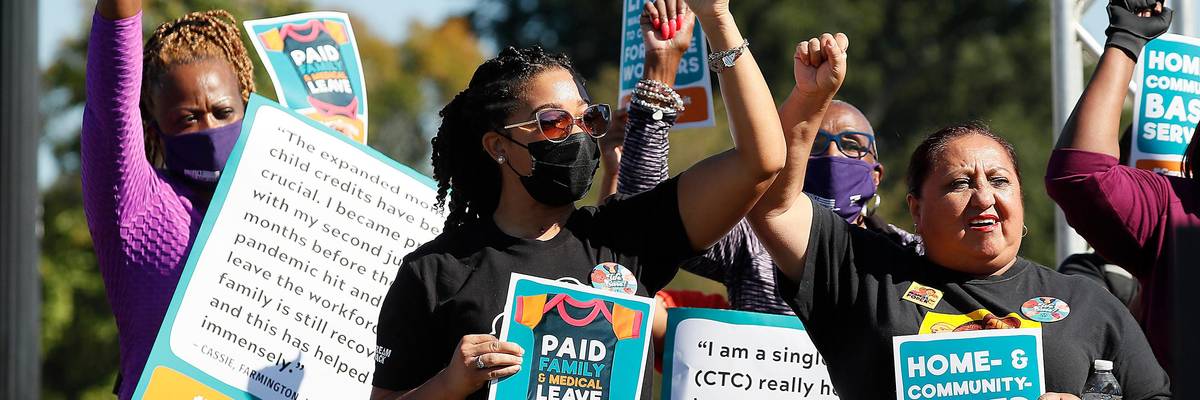
Advocates for paid leave and government investments in programs including homecare, childcare, and expanded tax credits protest outside the U.S. Capitol in Washington, D.C. on October 21, 2021. (Photo: Paul Morigi/Getty Images for MomsRising Together)
Railway Workers Fight Shows Need for Paid Sick and Family Leave, Says Economist
"It staggers the imagination that in September 2022 the workers who keep the trains running did not have even one sick day to care for themselves."
With paid time off for family and medical leave--and the glaring lack thereof--taking center stage Thursday as the Biden administration announced a tentative agreement to avert a crippling railway strike, a leading progressive economist underscored the need for paid leave in the only country in the developed world that doesn't guarantee it.
"Top brass at the railroads were willing to have a strike and plunge the nation back into supply chain hell."
"It staggers the imagination that in September 2022 the workers who keep the trains running did not have even one sick day to care for themselves," Eileen Appelbaum, co-director of the Center for Economic and Policy Research, said in a statement.
"Railroad management was intransigent on this point, a key union demand, until President [Joe] Biden got involved in the negotiations," she continued. "Top brass at the railroads were willing to have a strike and plunge the nation back into supply chain hell, rather than grant this reasonable request."
Sen. Bernie Sanders (I-Vt.) on Wednesday blocked a Republican effort to force 115,000 rail workers to settle for a contract pushed by a nonpartisan presidential panel, an agreement that did not include a single day of paid sick leave.
"The details have not been made public yet," said Appelbaum, "but it appears that railroad workers will get one--let me repeat that--one paid sick day a year."
They had asked for 15. The average among Organization for Economic Cooperation and Development nations is nearly 45 days of paid family leave per year, while paid time off for illness generally runs from five to 15 days, "but can be several weeks or months, as in Austria, Germany, Italy, and Switzerland, and even up to two years in the Netherlands," according to the OECD.
Calls for national paid leave grew during the Covid-19 pandemic as workers--especially lower-income ones--faced the stark choice of staying home without pay at the risk of losing their jobs or reporting to work and possibly infecting colleagues and customers.
"Even in the face of this pandemic, Congress is reluctant to permanently mandate a paid sick leave program," said Appelbaum. "According to the most recent data, there are about 540,000 workers still out due to Covid-19."
"It is very disappointing that the recently passed Inflation Reduction Act left the provisions addressing the care economy on the cutting room floor," she added. "The U.S. came very close to joining the rest of the industrialized world by enacting a national paid family and medical leave program."
Unlike the Build Back Better Act from which it was born, the IRA was largely stripped of its progressive social programs and policies in order to win the support of conservative Democrats like Sens. Joe Manchin (W.Va.) and Kyrsten Sinema (Ariz.).
Paid sick and family leave, universal pre-kindergarten and childcare, free community college--and the tax hike on wealthy individuals that would have paid for it all--were excluded from the package that was passed by Congress and signed by Biden last month.
Appelbaum emphasized "the need for the U.S. to guarantee sick workers some form of paid sick days and paid medical and family leave legislation."
"Not including a robust paid leave program as the nation continues to struggle with public health crises places unreasonable burdens on all workers," she added, "and not just the millions of low-income workers unlikely to have access to benefits through their jobs."
We are at a crossroads
This country and this world are at a monumental crossroads. In a few short weeks, US voters will have an opportunity to beat back the forces of fascism and confront the billionaires who are rigging the economy, our media system, and our democracy, making it increasingly impossible for ordinary people to get by. We’re not just talking about the election. We’re talking about what must be done once these fascist elements are vanquished from power. We need a bolder set of solutions than what either major party has so far been willing to offer and a working-class movement ready to fight like hell for it. Trump didn't emerge from nowhere. The conditions that fueled MAGA authoritarianism were created by decades of radical neoliberal economic policies and a corrupt political system dominated by corporate interests. They slashed taxes on the super-rich, promising that the benefits would trickle down. They said giveaways to the corporate titans would make life more affordable for the rest of us. It was all bullshit. And when a bitter, betrayed populace searches for someone to blame, right-wing demagogues have little trouble finding scapegoats. People know when they're being lied to, but you won't hear any of this from the corporate media. Only independent journalism—powered and funded by people who believe in building a better world—can deliver truly trustworthy daily news. Our Fall Campaign is underway, and we need your help. To power our newsroom through the rest of the year, we need to raise $125,000 by midnight on October 31. So if you share our vision, please contribute whatever you can to sustain our work. |
With paid time off for family and medical leave--and the glaring lack thereof--taking center stage Thursday as the Biden administration announced a tentative agreement to avert a crippling railway strike, a leading progressive economist underscored the need for paid leave in the only country in the developed world that doesn't guarantee it.
"Top brass at the railroads were willing to have a strike and plunge the nation back into supply chain hell."
"It staggers the imagination that in September 2022 the workers who keep the trains running did not have even one sick day to care for themselves," Eileen Appelbaum, co-director of the Center for Economic and Policy Research, said in a statement.
"Railroad management was intransigent on this point, a key union demand, until President [Joe] Biden got involved in the negotiations," she continued. "Top brass at the railroads were willing to have a strike and plunge the nation back into supply chain hell, rather than grant this reasonable request."
Sen. Bernie Sanders (I-Vt.) on Wednesday blocked a Republican effort to force 115,000 rail workers to settle for a contract pushed by a nonpartisan presidential panel, an agreement that did not include a single day of paid sick leave.
"The details have not been made public yet," said Appelbaum, "but it appears that railroad workers will get one--let me repeat that--one paid sick day a year."
They had asked for 15. The average among Organization for Economic Cooperation and Development nations is nearly 45 days of paid family leave per year, while paid time off for illness generally runs from five to 15 days, "but can be several weeks or months, as in Austria, Germany, Italy, and Switzerland, and even up to two years in the Netherlands," according to the OECD.
Calls for national paid leave grew during the Covid-19 pandemic as workers--especially lower-income ones--faced the stark choice of staying home without pay at the risk of losing their jobs or reporting to work and possibly infecting colleagues and customers.
"Even in the face of this pandemic, Congress is reluctant to permanently mandate a paid sick leave program," said Appelbaum. "According to the most recent data, there are about 540,000 workers still out due to Covid-19."
"It is very disappointing that the recently passed Inflation Reduction Act left the provisions addressing the care economy on the cutting room floor," she added. "The U.S. came very close to joining the rest of the industrialized world by enacting a national paid family and medical leave program."
Unlike the Build Back Better Act from which it was born, the IRA was largely stripped of its progressive social programs and policies in order to win the support of conservative Democrats like Sens. Joe Manchin (W.Va.) and Kyrsten Sinema (Ariz.).
Paid sick and family leave, universal pre-kindergarten and childcare, free community college--and the tax hike on wealthy individuals that would have paid for it all--were excluded from the package that was passed by Congress and signed by Biden last month.
Appelbaum emphasized "the need for the U.S. to guarantee sick workers some form of paid sick days and paid medical and family leave legislation."
"Not including a robust paid leave program as the nation continues to struggle with public health crises places unreasonable burdens on all workers," she added, "and not just the millions of low-income workers unlikely to have access to benefits through their jobs."
With paid time off for family and medical leave--and the glaring lack thereof--taking center stage Thursday as the Biden administration announced a tentative agreement to avert a crippling railway strike, a leading progressive economist underscored the need for paid leave in the only country in the developed world that doesn't guarantee it.
"Top brass at the railroads were willing to have a strike and plunge the nation back into supply chain hell."
"It staggers the imagination that in September 2022 the workers who keep the trains running did not have even one sick day to care for themselves," Eileen Appelbaum, co-director of the Center for Economic and Policy Research, said in a statement.
"Railroad management was intransigent on this point, a key union demand, until President [Joe] Biden got involved in the negotiations," she continued. "Top brass at the railroads were willing to have a strike and plunge the nation back into supply chain hell, rather than grant this reasonable request."
Sen. Bernie Sanders (I-Vt.) on Wednesday blocked a Republican effort to force 115,000 rail workers to settle for a contract pushed by a nonpartisan presidential panel, an agreement that did not include a single day of paid sick leave.
"The details have not been made public yet," said Appelbaum, "but it appears that railroad workers will get one--let me repeat that--one paid sick day a year."
They had asked for 15. The average among Organization for Economic Cooperation and Development nations is nearly 45 days of paid family leave per year, while paid time off for illness generally runs from five to 15 days, "but can be several weeks or months, as in Austria, Germany, Italy, and Switzerland, and even up to two years in the Netherlands," according to the OECD.
Calls for national paid leave grew during the Covid-19 pandemic as workers--especially lower-income ones--faced the stark choice of staying home without pay at the risk of losing their jobs or reporting to work and possibly infecting colleagues and customers.
"Even in the face of this pandemic, Congress is reluctant to permanently mandate a paid sick leave program," said Appelbaum. "According to the most recent data, there are about 540,000 workers still out due to Covid-19."
"It is very disappointing that the recently passed Inflation Reduction Act left the provisions addressing the care economy on the cutting room floor," she added. "The U.S. came very close to joining the rest of the industrialized world by enacting a national paid family and medical leave program."
Unlike the Build Back Better Act from which it was born, the IRA was largely stripped of its progressive social programs and policies in order to win the support of conservative Democrats like Sens. Joe Manchin (W.Va.) and Kyrsten Sinema (Ariz.).
Paid sick and family leave, universal pre-kindergarten and childcare, free community college--and the tax hike on wealthy individuals that would have paid for it all--were excluded from the package that was passed by Congress and signed by Biden last month.
Appelbaum emphasized "the need for the U.S. to guarantee sick workers some form of paid sick days and paid medical and family leave legislation."
"Not including a robust paid leave program as the nation continues to struggle with public health crises places unreasonable burdens on all workers," she added, "and not just the millions of low-income workers unlikely to have access to benefits through their jobs."