SUBSCRIBE TO OUR FREE NEWSLETTER
Daily news & progressive opinion—funded by the people, not the corporations—delivered straight to your inbox.
5
#000000
#FFFFFF
To donate by check, phone, or other method, see our More Ways to Give page.
Daily news & progressive opinion—funded by the people, not the corporations—delivered straight to your inbox.
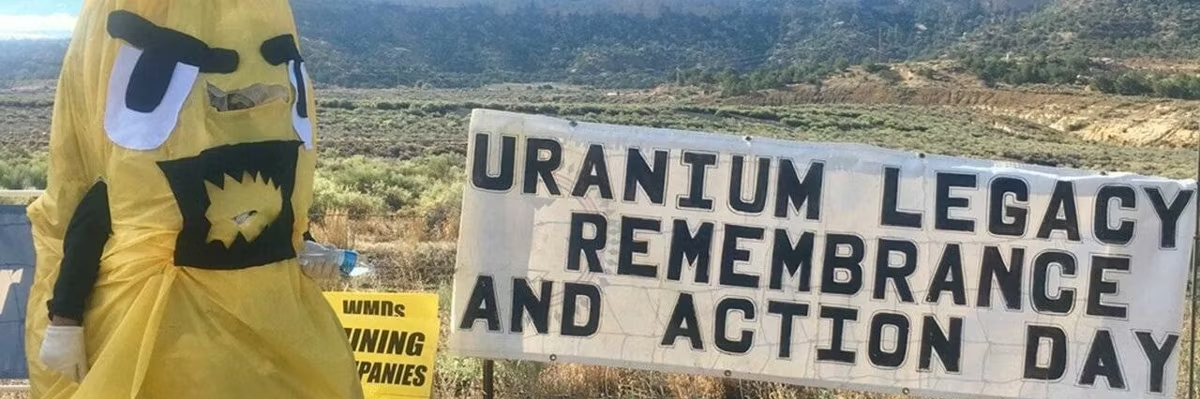
A community member commemorates a uranium tailings spill in Red Water Pond, New Mexico.
Climate change and nuclear weapons reinforce one another in dangerous ways: Environmental stress increases the risk of conflict, while nuclear conflict would produce environmental consequences on a planetary scale.
At 8:15 AM on August 6, 1945, a 9,000-pound atomic bomb detonated 1,900 feet above Hiroshima, instantly killing 70,000 people. Three days later, a second bomb exploded over Nagasaki, killing another 40,000.
The sheer scale of destruction—that humans could annihilate each other by means as violent as a nuclear blast—ensured that Hiroshima and Nagasaki would become the defining images of nuclear weapons in the American imagination. According to a 2025 Pew Research survey, 83% of Americans reported knowing at least something about the use of nuclear weapons in Japan. However, increasingly large numbers of younger Americans don’t know enough about nuclear weapons today to give an opinion on their role in national security.
What is often remembered as the only detonation of nuclear weapons in history remains the sole use of nuclear weapons in warfare. While Americans looked overseas at the devastation in Japan, fewer recognized that nuclear weapons were also transforming the American environment at home.
For decades after World War II, nuclear weapons reshaped landscapes and communities across the United States. Between 1945 and 1992, the United States conducted 1,030 nuclear tests, while producing tens of thousands of warheads during the Cold War. At its height, the US nuclear stockpile comprised 31,255 warheads, with the last fully functional nuclear weapon being produced in 1989. The environmental and human consequences of this effort extended far beyond test sites and production facilities. Yet, the US government kept the public in the dark, leaving a generation born in the 21st century to bear the consequences of its obfuscated proliferation campaign.
Consider that the plutonium used in the first nuclear test in New Mexico and in the Nagasaki bomb was produced at the Hanford Site in Washington State. Between 1945 and 1970, Hanford’s reactors discharged roughly 444 billion gallons of radioactive wastewater into the Columbia River basin, a watershed that today supports over 8 million residents.
Other sites tell similar stories. In South Carolina and Georgia, rural communities were displaced to make way for the Savannah River Site nuclear weapons facility, where millions of gallons of radioactive waste were stored in underground tanks.
Make no mistake, the United States federal government was calculated in its targeting of marginalized communities to isolate radioactive material from the general population. These facilities were often located in rural or economically disadvantaged areas, where political resistance was limited and land was cheaper.
Nuclear weapons represent one of the most profound environmental risks humanity has ever created.
Currently the only permanent waste site for nuclear material in the United States, the Waste Isolation Pilot Plant (WIPP) in Carlsbad, New Mexico, collects plutonium-contaminated waste to be buried over 2,000 feet underground a salt flat formation. Framed as a barren wasteland far from major population centers, WIPP is in Eddy County, New Mexico—home to a population of over 61,000 people, of which 64% identify as people of color. Many communities face contaminated water supplies and elevated rates of respiratory illness, kidney disease, and cancer: a pattern sometimes described as “radioactive colonialism.”
Despite the government’s efforts to isolate nuclear activities and waste disposal, radioactive contamination did not respect geographic boundaries. Research released in 2023 found that nuclear tests conducted between 1945 and 1962 distributed radioactive fallout across 46 of the lower 48 contiguous states in the United States, as well as parts of Canada and Mexico. As a result of nuclear tests conducted by both the United States and other nuclear-armed powers, radioactive isotopes released into the atmosphere spread throughout the world in communities far from test sites. By the 1960s, “there was no place on Earth where the signature of atmospheric nuclear testing could not be found in soil, water, and even polar ice.” Radioactive isotopes entered the food chain through plants and animals, creating pathways of exposure far from any test site.
For most people living far from testing areas, these exposures were small. But they illustrate a fundamental reality of nuclear weapons: Even carefully controlled programs produce global environmental consequences. Even when the government attempted to isolate radioactivity and testing in supposedly remote communities, contamination from weapons production, testing, and disposal still spread far beyond those sites, affecting environments across the world.
While the United States has not conducted a full-scale nuclear test since 1992, nuclear competition is accelerating again.
China is rapidly expanding its nuclear arsenal, with estimates suggesting that its stockpile could exceed 1,000 warheads by the early 2030s. At the same time, arms control agreements that once constrained the world’s largest nuclear powers are eroding. The expiration of the New START treaty in February 2026 removed the last formal limits on US and Russian strategic nuclear forces.
Even if informal limits remain in place, the collapse of binding agreements signals a shift toward a less regulated nuclear environment. Some policymakers have suggested that renewed nuclear testing may be necessary in response to foreign advances, which would risk repeating many of the mistakes of the Cold War.
Consider that for the first time in history, the new nuclear proliferation environment includes a three-way standoff between three major armed powers: the United States, China, and Russia.
A global nuclear war alone would be enough to trigger catastrophic climatic effects. Even a limited nuclear exchange could inject vast quantities of smoke and soot into the upper atmosphere, blocking sunlight and lowering global temperatures. The use of a mere 2% of the world’s current arsenal could trigger severe cooling and agricultural disruption, leaving 2 billion people at risk of starvation in just the following two years. If nuclear winter renders any use of nuclear weapons as unsurvivable, then deterrence may be an inadequate strategy, since the consequences of a miscalculation or accidental launch would increase dramatically.
This erosion of international nonproliferation channels comes as climate change fuels geopolitical instability by intensifying resource competition, migration pressures, and regional conflicts, increasing the risk of confrontation among nuclear-armed states. Climate change and nuclear weapons therefore reinforce one another in dangerous ways: Environmental stress increases the risk of conflict, while nuclear conflict would produce environmental consequences on a planetary scale.
Despite these connections, environmental and social justice concerns remain peripheral in most nuclear policy debates. Discussions of deterrence and arms control typically focus on military balance and strategic stability, while the environmental legacy of nuclear weapons receives far less attention.
This gap may help explain why nuclear policy often struggles to engage younger generations.
Surveys consistently show that climate change is one of the defining concerns of younger voters. Roughly 70% of young people report deep anxiety about environmental degradation and say they are likely to support candidates who prioritize climate policy. Nuclear weapons policy rarely speaks to these concerns directly. Yet nuclear weapons represent one of the most profound environmental risks humanity has ever created.
Reframing nuclear policy to include environmental and social justice considerations would not only reflect historical reality, but also make nuclear policy more relevant to the challenges of the 21st century.
Dear Common Dreams reader, It’s been nearly 30 years since I co-founded Common Dreams with my late wife, Lina Newhouser. We had the radical notion that journalism should serve the public good, not corporate profits. It was clear to us from the outset what it would take to build such a project. No paid advertisements. No corporate sponsors. No millionaire publisher telling us what to think or do. Many people said we wouldn't last a year, but we proved those doubters wrong. Together with a tremendous team of journalists and dedicated staff, we built an independent media outlet free from the constraints of profits and corporate control. Our mission has always been simple: To inform. To inspire. To ignite change for the common good. Building Common Dreams was not easy. Our survival was never guaranteed. When you take on the most powerful forces—Wall Street greed, fossil fuel industry destruction, Big Tech lobbyists, and uber-rich oligarchs who have spent billions upon billions rigging the economy and democracy in their favor—the only bulwark you have is supporters who believe in your work. But here’s the urgent message from me today. It's never been this bad out there. And it's never been this hard to keep us going. At the very moment Common Dreams is most needed, the threats we face are intensifying. We need your support now more than ever. We don't accept corporate advertising and never will. We don't have a paywall because we don't think people should be blocked from critical news based on their ability to pay. Everything we do is funded by the donations of readers like you. When everyone does the little they can afford, we are strong. But if that support retreats or dries up, so do we. Will you donate now to make sure Common Dreams not only survives but thrives? —Craig Brown, Co-founder |
At 8:15 AM on August 6, 1945, a 9,000-pound atomic bomb detonated 1,900 feet above Hiroshima, instantly killing 70,000 people. Three days later, a second bomb exploded over Nagasaki, killing another 40,000.
The sheer scale of destruction—that humans could annihilate each other by means as violent as a nuclear blast—ensured that Hiroshima and Nagasaki would become the defining images of nuclear weapons in the American imagination. According to a 2025 Pew Research survey, 83% of Americans reported knowing at least something about the use of nuclear weapons in Japan. However, increasingly large numbers of younger Americans don’t know enough about nuclear weapons today to give an opinion on their role in national security.
What is often remembered as the only detonation of nuclear weapons in history remains the sole use of nuclear weapons in warfare. While Americans looked overseas at the devastation in Japan, fewer recognized that nuclear weapons were also transforming the American environment at home.
For decades after World War II, nuclear weapons reshaped landscapes and communities across the United States. Between 1945 and 1992, the United States conducted 1,030 nuclear tests, while producing tens of thousands of warheads during the Cold War. At its height, the US nuclear stockpile comprised 31,255 warheads, with the last fully functional nuclear weapon being produced in 1989. The environmental and human consequences of this effort extended far beyond test sites and production facilities. Yet, the US government kept the public in the dark, leaving a generation born in the 21st century to bear the consequences of its obfuscated proliferation campaign.
Consider that the plutonium used in the first nuclear test in New Mexico and in the Nagasaki bomb was produced at the Hanford Site in Washington State. Between 1945 and 1970, Hanford’s reactors discharged roughly 444 billion gallons of radioactive wastewater into the Columbia River basin, a watershed that today supports over 8 million residents.
Other sites tell similar stories. In South Carolina and Georgia, rural communities were displaced to make way for the Savannah River Site nuclear weapons facility, where millions of gallons of radioactive waste were stored in underground tanks.
Make no mistake, the United States federal government was calculated in its targeting of marginalized communities to isolate radioactive material from the general population. These facilities were often located in rural or economically disadvantaged areas, where political resistance was limited and land was cheaper.
Nuclear weapons represent one of the most profound environmental risks humanity has ever created.
Currently the only permanent waste site for nuclear material in the United States, the Waste Isolation Pilot Plant (WIPP) in Carlsbad, New Mexico, collects plutonium-contaminated waste to be buried over 2,000 feet underground a salt flat formation. Framed as a barren wasteland far from major population centers, WIPP is in Eddy County, New Mexico—home to a population of over 61,000 people, of which 64% identify as people of color. Many communities face contaminated water supplies and elevated rates of respiratory illness, kidney disease, and cancer: a pattern sometimes described as “radioactive colonialism.”
Despite the government’s efforts to isolate nuclear activities and waste disposal, radioactive contamination did not respect geographic boundaries. Research released in 2023 found that nuclear tests conducted between 1945 and 1962 distributed radioactive fallout across 46 of the lower 48 contiguous states in the United States, as well as parts of Canada and Mexico. As a result of nuclear tests conducted by both the United States and other nuclear-armed powers, radioactive isotopes released into the atmosphere spread throughout the world in communities far from test sites. By the 1960s, “there was no place on Earth where the signature of atmospheric nuclear testing could not be found in soil, water, and even polar ice.” Radioactive isotopes entered the food chain through plants and animals, creating pathways of exposure far from any test site.
For most people living far from testing areas, these exposures were small. But they illustrate a fundamental reality of nuclear weapons: Even carefully controlled programs produce global environmental consequences. Even when the government attempted to isolate radioactivity and testing in supposedly remote communities, contamination from weapons production, testing, and disposal still spread far beyond those sites, affecting environments across the world.
While the United States has not conducted a full-scale nuclear test since 1992, nuclear competition is accelerating again.
China is rapidly expanding its nuclear arsenal, with estimates suggesting that its stockpile could exceed 1,000 warheads by the early 2030s. At the same time, arms control agreements that once constrained the world’s largest nuclear powers are eroding. The expiration of the New START treaty in February 2026 removed the last formal limits on US and Russian strategic nuclear forces.
Even if informal limits remain in place, the collapse of binding agreements signals a shift toward a less regulated nuclear environment. Some policymakers have suggested that renewed nuclear testing may be necessary in response to foreign advances, which would risk repeating many of the mistakes of the Cold War.
Consider that for the first time in history, the new nuclear proliferation environment includes a three-way standoff between three major armed powers: the United States, China, and Russia.
A global nuclear war alone would be enough to trigger catastrophic climatic effects. Even a limited nuclear exchange could inject vast quantities of smoke and soot into the upper atmosphere, blocking sunlight and lowering global temperatures. The use of a mere 2% of the world’s current arsenal could trigger severe cooling and agricultural disruption, leaving 2 billion people at risk of starvation in just the following two years. If nuclear winter renders any use of nuclear weapons as unsurvivable, then deterrence may be an inadequate strategy, since the consequences of a miscalculation or accidental launch would increase dramatically.
This erosion of international nonproliferation channels comes as climate change fuels geopolitical instability by intensifying resource competition, migration pressures, and regional conflicts, increasing the risk of confrontation among nuclear-armed states. Climate change and nuclear weapons therefore reinforce one another in dangerous ways: Environmental stress increases the risk of conflict, while nuclear conflict would produce environmental consequences on a planetary scale.
Despite these connections, environmental and social justice concerns remain peripheral in most nuclear policy debates. Discussions of deterrence and arms control typically focus on military balance and strategic stability, while the environmental legacy of nuclear weapons receives far less attention.
This gap may help explain why nuclear policy often struggles to engage younger generations.
Surveys consistently show that climate change is one of the defining concerns of younger voters. Roughly 70% of young people report deep anxiety about environmental degradation and say they are likely to support candidates who prioritize climate policy. Nuclear weapons policy rarely speaks to these concerns directly. Yet nuclear weapons represent one of the most profound environmental risks humanity has ever created.
Reframing nuclear policy to include environmental and social justice considerations would not only reflect historical reality, but also make nuclear policy more relevant to the challenges of the 21st century.
At 8:15 AM on August 6, 1945, a 9,000-pound atomic bomb detonated 1,900 feet above Hiroshima, instantly killing 70,000 people. Three days later, a second bomb exploded over Nagasaki, killing another 40,000.
The sheer scale of destruction—that humans could annihilate each other by means as violent as a nuclear blast—ensured that Hiroshima and Nagasaki would become the defining images of nuclear weapons in the American imagination. According to a 2025 Pew Research survey, 83% of Americans reported knowing at least something about the use of nuclear weapons in Japan. However, increasingly large numbers of younger Americans don’t know enough about nuclear weapons today to give an opinion on their role in national security.
What is often remembered as the only detonation of nuclear weapons in history remains the sole use of nuclear weapons in warfare. While Americans looked overseas at the devastation in Japan, fewer recognized that nuclear weapons were also transforming the American environment at home.
For decades after World War II, nuclear weapons reshaped landscapes and communities across the United States. Between 1945 and 1992, the United States conducted 1,030 nuclear tests, while producing tens of thousands of warheads during the Cold War. At its height, the US nuclear stockpile comprised 31,255 warheads, with the last fully functional nuclear weapon being produced in 1989. The environmental and human consequences of this effort extended far beyond test sites and production facilities. Yet, the US government kept the public in the dark, leaving a generation born in the 21st century to bear the consequences of its obfuscated proliferation campaign.
Consider that the plutonium used in the first nuclear test in New Mexico and in the Nagasaki bomb was produced at the Hanford Site in Washington State. Between 1945 and 1970, Hanford’s reactors discharged roughly 444 billion gallons of radioactive wastewater into the Columbia River basin, a watershed that today supports over 8 million residents.
Other sites tell similar stories. In South Carolina and Georgia, rural communities were displaced to make way for the Savannah River Site nuclear weapons facility, where millions of gallons of radioactive waste were stored in underground tanks.
Make no mistake, the United States federal government was calculated in its targeting of marginalized communities to isolate radioactive material from the general population. These facilities were often located in rural or economically disadvantaged areas, where political resistance was limited and land was cheaper.
Nuclear weapons represent one of the most profound environmental risks humanity has ever created.
Currently the only permanent waste site for nuclear material in the United States, the Waste Isolation Pilot Plant (WIPP) in Carlsbad, New Mexico, collects plutonium-contaminated waste to be buried over 2,000 feet underground a salt flat formation. Framed as a barren wasteland far from major population centers, WIPP is in Eddy County, New Mexico—home to a population of over 61,000 people, of which 64% identify as people of color. Many communities face contaminated water supplies and elevated rates of respiratory illness, kidney disease, and cancer: a pattern sometimes described as “radioactive colonialism.”
Despite the government’s efforts to isolate nuclear activities and waste disposal, radioactive contamination did not respect geographic boundaries. Research released in 2023 found that nuclear tests conducted between 1945 and 1962 distributed radioactive fallout across 46 of the lower 48 contiguous states in the United States, as well as parts of Canada and Mexico. As a result of nuclear tests conducted by both the United States and other nuclear-armed powers, radioactive isotopes released into the atmosphere spread throughout the world in communities far from test sites. By the 1960s, “there was no place on Earth where the signature of atmospheric nuclear testing could not be found in soil, water, and even polar ice.” Radioactive isotopes entered the food chain through plants and animals, creating pathways of exposure far from any test site.
For most people living far from testing areas, these exposures were small. But they illustrate a fundamental reality of nuclear weapons: Even carefully controlled programs produce global environmental consequences. Even when the government attempted to isolate radioactivity and testing in supposedly remote communities, contamination from weapons production, testing, and disposal still spread far beyond those sites, affecting environments across the world.
While the United States has not conducted a full-scale nuclear test since 1992, nuclear competition is accelerating again.
China is rapidly expanding its nuclear arsenal, with estimates suggesting that its stockpile could exceed 1,000 warheads by the early 2030s. At the same time, arms control agreements that once constrained the world’s largest nuclear powers are eroding. The expiration of the New START treaty in February 2026 removed the last formal limits on US and Russian strategic nuclear forces.
Even if informal limits remain in place, the collapse of binding agreements signals a shift toward a less regulated nuclear environment. Some policymakers have suggested that renewed nuclear testing may be necessary in response to foreign advances, which would risk repeating many of the mistakes of the Cold War.
Consider that for the first time in history, the new nuclear proliferation environment includes a three-way standoff between three major armed powers: the United States, China, and Russia.
A global nuclear war alone would be enough to trigger catastrophic climatic effects. Even a limited nuclear exchange could inject vast quantities of smoke and soot into the upper atmosphere, blocking sunlight and lowering global temperatures. The use of a mere 2% of the world’s current arsenal could trigger severe cooling and agricultural disruption, leaving 2 billion people at risk of starvation in just the following two years. If nuclear winter renders any use of nuclear weapons as unsurvivable, then deterrence may be an inadequate strategy, since the consequences of a miscalculation or accidental launch would increase dramatically.
This erosion of international nonproliferation channels comes as climate change fuels geopolitical instability by intensifying resource competition, migration pressures, and regional conflicts, increasing the risk of confrontation among nuclear-armed states. Climate change and nuclear weapons therefore reinforce one another in dangerous ways: Environmental stress increases the risk of conflict, while nuclear conflict would produce environmental consequences on a planetary scale.
Despite these connections, environmental and social justice concerns remain peripheral in most nuclear policy debates. Discussions of deterrence and arms control typically focus on military balance and strategic stability, while the environmental legacy of nuclear weapons receives far less attention.
This gap may help explain why nuclear policy often struggles to engage younger generations.
Surveys consistently show that climate change is one of the defining concerns of younger voters. Roughly 70% of young people report deep anxiety about environmental degradation and say they are likely to support candidates who prioritize climate policy. Nuclear weapons policy rarely speaks to these concerns directly. Yet nuclear weapons represent one of the most profound environmental risks humanity has ever created.
Reframing nuclear policy to include environmental and social justice considerations would not only reflect historical reality, but also make nuclear policy more relevant to the challenges of the 21st century.