SUBSCRIBE TO OUR FREE NEWSLETTER
Daily news & progressive opinion—funded by the people, not the corporations—delivered straight to your inbox.
5
#000000
#FFFFFF
To donate by check, phone, or other method, see our More Ways to Give page.
Daily news & progressive opinion—funded by the people, not the corporations—delivered straight to your inbox.
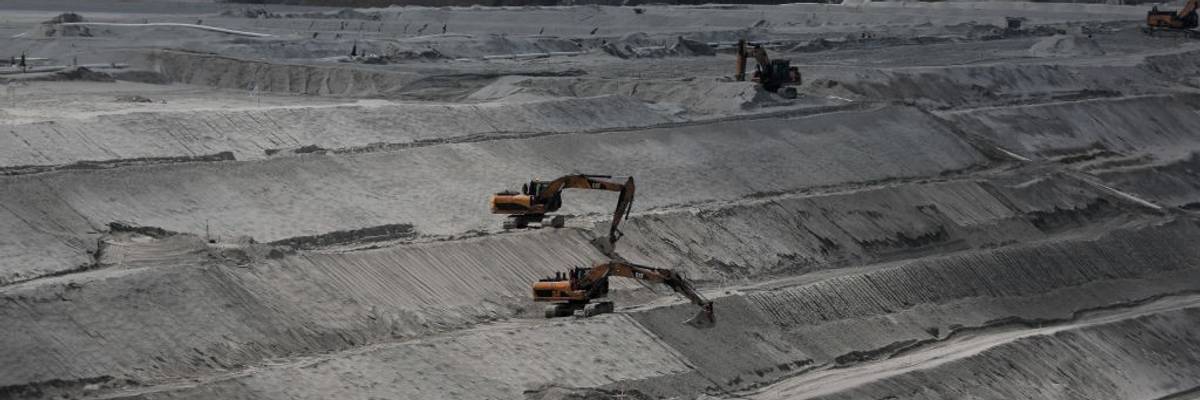
View of the tailing area of the Canadian First Quantum's Panama copper mine in Donoso, Panama on January 11, 2024.
What’s needed to make the Minerals Security Partnership work on the ground
Azure waters and exotic islands are not the only attractions of Cabo Delgado in Mozambique. The province is home to the largest graphite reserve globally, prompting Syrah Resources’ Twigg to open the Balama mine. This is one of the dozen projects across the world chosen by the Minerals Security Partnership to secure and diversify the supply of raw materials.
The energy transition is dependent on critical minerals such as lithium and copper as the world electrifies transport and shifts to renewables. With most minerals currently controlled by China, many western countries are playing catch up. The Minerals Security Partnership (MSP), whose members include Australia, Canada, India, the U.S. and many European countries, is central to this effort.
History is full of not-so-pretty attempts by western nations to capture minerals supply chains, as many living in the Global South know first hand. So how can this partnership offer a truly different value proposition centered on sustainability and deliver truly responsible projects?
Despite some effort, the current situation in the extractive industries is far from adequate. A recent report by the International Energy Agency notes that while governance in the minerals sector has somewhat improved, progress on water and greenhouse gas emissions is at best stagnating. (Add to this a deeply felt mistrust among communities and companies and you quickly realize how complicated the matters are.)
But it does not have to be this way. Most technologies for safer tailings management or better water treatment, rules for robust anti-corruption and human rights due diligence, and practices to engage communities and co-govern with Indigenous peoples all exist. They just need to be applied and upheld consistently. This is where the new minerals partnership can bring real value.
Yet right now the MSP principles lack any such concrete requirements. That’s a big omission. For example in the case of Cabo Delgado, concerns around involuntary resettlement of nearby communities and local value proposition abide. MSP-supported projects like this one will be judged as much by the volumes of critical minerals they supply as by their environmental and social stewardship.
The good news is that the MSP does not have to reinvent the wheel. The answer lies in applying the human right and environmental due diligence practices as stipulated in the Organization for Economic Co-operation and Development’s (OECD) guidelines. The EU has recently done exactly that in its new battery law. This will require tracing, addressing and mitigating all manner of social and environmental risks, alongside upholding global treaties such as on Free, Prior and Informed Consent.
Any global miner, refiner, or recycler whose cobalt, graphite, lithium, and nickel are found in batteries on the European market will already have to track and mitigate all manner of social and environmental risks from 2026, including forced labor, water pollution, and biodiversity. MSP member countries can simply uplift these provisions into the partnership projects.
Setting strong and transparent standards is the first step. These need to also be implemented so that they bring difference on the ground.
This means that the minerals partnership needs to quickly move from vision to a pipeline of responsible projects on the ground. So the focus should be on coordinating with local governments to bring local value and infrastructure, on engaging local communities to have a social license to operate and on bringing in finance instructions to make the projects happen.
Given how far ahead China is, there is no time to waste. A laser sharp focus to scale responsibly managed projects across the world is necessary to build a more diverse supply chain. But this should also come with better environmental stewardship and advancing the rights and livelihoods of those impacted, breaking from past behavior.
The Minerals Security Partnership shows global governments are waking up to the challenge of securing critical minerals responsibly. But whether projects like the Balama mine will become largest suppliers of quality graphite and raise the local community out of poverty will depend on how quickly responsible mining practices are scaled up on the ground.
Dear Common Dreams reader, It’s been nearly 30 years since I co-founded Common Dreams with my late wife, Lina Newhouser. We had the radical notion that journalism should serve the public good, not corporate profits. It was clear to us from the outset what it would take to build such a project. No paid advertisements. No corporate sponsors. No millionaire publisher telling us what to think or do. Many people said we wouldn't last a year, but we proved those doubters wrong. Together with a tremendous team of journalists and dedicated staff, we built an independent media outlet free from the constraints of profits and corporate control. Our mission has always been simple: To inform. To inspire. To ignite change for the common good. Building Common Dreams was not easy. Our survival was never guaranteed. When you take on the most powerful forces—Wall Street greed, fossil fuel industry destruction, Big Tech lobbyists, and uber-rich oligarchs who have spent billions upon billions rigging the economy and democracy in their favor—the only bulwark you have is supporters who believe in your work. But here’s the urgent message from me today. It's never been this bad out there. And it's never been this hard to keep us going. At the very moment Common Dreams is most needed, the threats we face are intensifying. We need your support now more than ever. We don't accept corporate advertising and never will. We don't have a paywall because we don't think people should be blocked from critical news based on their ability to pay. Everything we do is funded by the donations of readers like you. When everyone does the little they can afford, we are strong. But if that support retreats or dries up, so do we. Will you donate now to make sure Common Dreams not only survives but thrives? —Craig Brown, Co-founder |
Azure waters and exotic islands are not the only attractions of Cabo Delgado in Mozambique. The province is home to the largest graphite reserve globally, prompting Syrah Resources’ Twigg to open the Balama mine. This is one of the dozen projects across the world chosen by the Minerals Security Partnership to secure and diversify the supply of raw materials.
The energy transition is dependent on critical minerals such as lithium and copper as the world electrifies transport and shifts to renewables. With most minerals currently controlled by China, many western countries are playing catch up. The Minerals Security Partnership (MSP), whose members include Australia, Canada, India, the U.S. and many European countries, is central to this effort.
History is full of not-so-pretty attempts by western nations to capture minerals supply chains, as many living in the Global South know first hand. So how can this partnership offer a truly different value proposition centered on sustainability and deliver truly responsible projects?
Despite some effort, the current situation in the extractive industries is far from adequate. A recent report by the International Energy Agency notes that while governance in the minerals sector has somewhat improved, progress on water and greenhouse gas emissions is at best stagnating. (Add to this a deeply felt mistrust among communities and companies and you quickly realize how complicated the matters are.)
But it does not have to be this way. Most technologies for safer tailings management or better water treatment, rules for robust anti-corruption and human rights due diligence, and practices to engage communities and co-govern with Indigenous peoples all exist. They just need to be applied and upheld consistently. This is where the new minerals partnership can bring real value.
Yet right now the MSP principles lack any such concrete requirements. That’s a big omission. For example in the case of Cabo Delgado, concerns around involuntary resettlement of nearby communities and local value proposition abide. MSP-supported projects like this one will be judged as much by the volumes of critical minerals they supply as by their environmental and social stewardship.
The good news is that the MSP does not have to reinvent the wheel. The answer lies in applying the human right and environmental due diligence practices as stipulated in the Organization for Economic Co-operation and Development’s (OECD) guidelines. The EU has recently done exactly that in its new battery law. This will require tracing, addressing and mitigating all manner of social and environmental risks, alongside upholding global treaties such as on Free, Prior and Informed Consent.
Any global miner, refiner, or recycler whose cobalt, graphite, lithium, and nickel are found in batteries on the European market will already have to track and mitigate all manner of social and environmental risks from 2026, including forced labor, water pollution, and biodiversity. MSP member countries can simply uplift these provisions into the partnership projects.
Setting strong and transparent standards is the first step. These need to also be implemented so that they bring difference on the ground.
This means that the minerals partnership needs to quickly move from vision to a pipeline of responsible projects on the ground. So the focus should be on coordinating with local governments to bring local value and infrastructure, on engaging local communities to have a social license to operate and on bringing in finance instructions to make the projects happen.
Given how far ahead China is, there is no time to waste. A laser sharp focus to scale responsibly managed projects across the world is necessary to build a more diverse supply chain. But this should also come with better environmental stewardship and advancing the rights and livelihoods of those impacted, breaking from past behavior.
The Minerals Security Partnership shows global governments are waking up to the challenge of securing critical minerals responsibly. But whether projects like the Balama mine will become largest suppliers of quality graphite and raise the local community out of poverty will depend on how quickly responsible mining practices are scaled up on the ground.
Azure waters and exotic islands are not the only attractions of Cabo Delgado in Mozambique. The province is home to the largest graphite reserve globally, prompting Syrah Resources’ Twigg to open the Balama mine. This is one of the dozen projects across the world chosen by the Minerals Security Partnership to secure and diversify the supply of raw materials.
The energy transition is dependent on critical minerals such as lithium and copper as the world electrifies transport and shifts to renewables. With most minerals currently controlled by China, many western countries are playing catch up. The Minerals Security Partnership (MSP), whose members include Australia, Canada, India, the U.S. and many European countries, is central to this effort.
History is full of not-so-pretty attempts by western nations to capture minerals supply chains, as many living in the Global South know first hand. So how can this partnership offer a truly different value proposition centered on sustainability and deliver truly responsible projects?
Despite some effort, the current situation in the extractive industries is far from adequate. A recent report by the International Energy Agency notes that while governance in the minerals sector has somewhat improved, progress on water and greenhouse gas emissions is at best stagnating. (Add to this a deeply felt mistrust among communities and companies and you quickly realize how complicated the matters are.)
But it does not have to be this way. Most technologies for safer tailings management or better water treatment, rules for robust anti-corruption and human rights due diligence, and practices to engage communities and co-govern with Indigenous peoples all exist. They just need to be applied and upheld consistently. This is where the new minerals partnership can bring real value.
Yet right now the MSP principles lack any such concrete requirements. That’s a big omission. For example in the case of Cabo Delgado, concerns around involuntary resettlement of nearby communities and local value proposition abide. MSP-supported projects like this one will be judged as much by the volumes of critical minerals they supply as by their environmental and social stewardship.
The good news is that the MSP does not have to reinvent the wheel. The answer lies in applying the human right and environmental due diligence practices as stipulated in the Organization for Economic Co-operation and Development’s (OECD) guidelines. The EU has recently done exactly that in its new battery law. This will require tracing, addressing and mitigating all manner of social and environmental risks, alongside upholding global treaties such as on Free, Prior and Informed Consent.
Any global miner, refiner, or recycler whose cobalt, graphite, lithium, and nickel are found in batteries on the European market will already have to track and mitigate all manner of social and environmental risks from 2026, including forced labor, water pollution, and biodiversity. MSP member countries can simply uplift these provisions into the partnership projects.
Setting strong and transparent standards is the first step. These need to also be implemented so that they bring difference on the ground.
This means that the minerals partnership needs to quickly move from vision to a pipeline of responsible projects on the ground. So the focus should be on coordinating with local governments to bring local value and infrastructure, on engaging local communities to have a social license to operate and on bringing in finance instructions to make the projects happen.
Given how far ahead China is, there is no time to waste. A laser sharp focus to scale responsibly managed projects across the world is necessary to build a more diverse supply chain. But this should also come with better environmental stewardship and advancing the rights and livelihoods of those impacted, breaking from past behavior.
The Minerals Security Partnership shows global governments are waking up to the challenge of securing critical minerals responsibly. But whether projects like the Balama mine will become largest suppliers of quality graphite and raise the local community out of poverty will depend on how quickly responsible mining practices are scaled up on the ground.