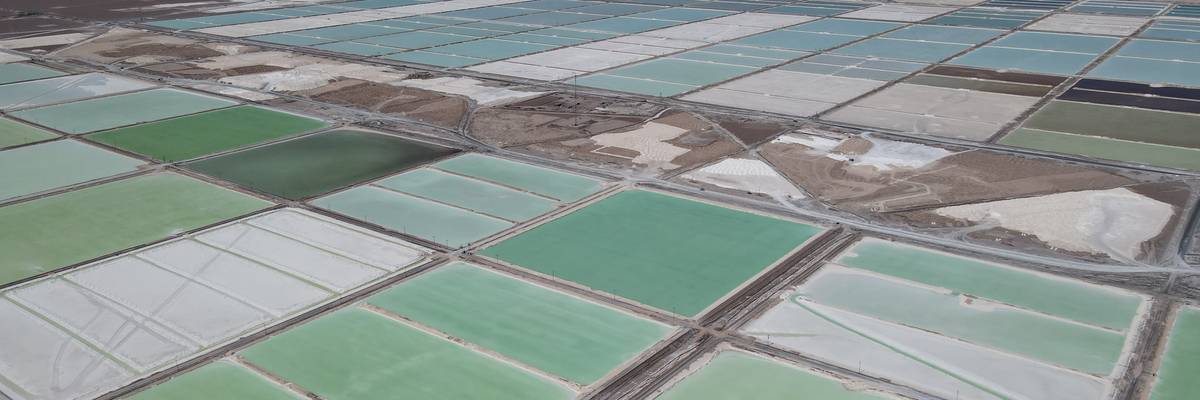
Huge pools of brine containing lithium carbonate and mounds of salt byproducts stretch across a lithium mine in the Atacama Desert in Salar de Atacama, Chili on October 25, 2022.
Chilean President Unveils Plan to Slowly Nationalize Lithium Industry
While striving for "a sustainable and developed economy," the leftist leader must contend with legislative divisions, potential industry opposition, and Indigenous and environmental resistance to large-scale mining.
Leftist Chilean President Gabriel Boric on Thursday announced plans to slowly nationalize the country's lithium industry, aiming to take advantage of massive reserves of the metal, key to electric vehicle batteries and other technology, while protecting the environment.
"Today we present a national lithium strategy that's technically solid and ambitious," Boric declared during a televised address, outlining his plan—which needs congressional approval—to create "a Chile that distributes wealth we all generate in a more just way."
"This is the best chance we have at transitioning to a sustainable and developed economy," he argued. "We can't afford to waste it."
Reuters reported that "Boric said the country would look to protect biodiversity and share mining benefits with Indigenous and surrounding communities."
About 60% of the world's reserves are located in the South American "lithium triangle," which includes Bolivia (21 million tons), Argentina (19.3 million tons), and Chile (9.6 million tons), according to the U.S. Geological Survey. For now, Chile is leading those nations in terms of production and ranked second globally last year, after Australia.
Currently, Chile's lithium operations are limited to the Chilean company SQM and the U.S. firm Albemarle. Under Boric's plan, the government would respect existing contracts with those industry giants—set to expire in 2030 and 2043, respectively.
However, all future contracts for the metal will involve government-controlled public-private partnerships, Boric explained. He ultimately envisions a national company focused on lithium, but because creating one could be delayed by legislative divisions, agreements will initially be led by the state-owned copper mining company, Codelco.
As the AP pointed out:
The minister of mining, Marcela Hernando, recently told Congress that the government cannot advance alone in the exploitation of lithium because "technology and knowledge are in private industry."
A public-private partnership is needed, Hernando said, though he added that "the state is the owner of lithium," which is an "uncompromisable" position of the government.
Boric's plan is part of a global trend. Mexican lawmakers voted last year to make lithium reserves federal property. Additionally, as the Financial Times noted, "Zimbabwe banned unprocessed lithium exports" and "Indonesia is curbing exports of commodities including nickel ore, which is used in batteries."
Thea Riofrancos—an Andrew Carnegie fellow, Providence College associate professor of political science, and Climate and Community Project member—tweeted Friday that resource nationalism is "all the rage" in the "Global South (Mexico, Indonesia, Bolivia) and North ('critical minerals' securitization) albeit from very distinct geoeconomic positions. But there's more to this."
"Boric situates this decision in the long sweep of Chilean history," referencing former President Salvador Allende's nationalization of copper, Riofrancos explained. "But this isn't a classic expropriation," because of the public-private partnership approach.
"Evidence from Latin America's Pink Tide era shows such partnerships can increase state revenues, which can fund social services and public infrastructure. But whether tech transfer and value chain upgrading occur is an open question," she said. "Boric flags both as crucial to his vision."
Riofrancos continued:
Just as importantly, and compared to both mid-century and Pink Tide era nationalizations, Boric cannot ignore the powerful wave of Indigenous and environmental resistance to large-scale mining in Chile and the region, nor the scientific evidence of damage to salt flat ecosystems.
Boric promises environmentally friendly extraction and conservation of 30% of Chile's salt flats (the location of lithium deposits), and promises a new model of public participation, including the first step [of] direct dialogue with representatives of Indigenous communities.
But these goals are in tension with his other key goal, which is to vastly expand lithium extraction in Chile's deserts as well as restore Chile to the position of top producer, a status now occupied by Australia (worth noting Argentina may soon overtake Chile for second place).
"And of course," she added, "all of these plans are subject to congressional approval and what I imagine will be a flurry of lobbying from the incumbent producers, SQM and Albemarle."
While Albemarle said that the development would have "no material impact on our business," Bloomberg highlighted that "SQM and Albemarle shares were down 7% and 4%, respectively, before the start of regular trading in New York on Friday."
We are at a crossroads
This country and this world are at a monumental crossroads. In a few short weeks, US voters will have an opportunity to beat back the forces of fascism and confront the billionaires who are rigging the economy, our media system, and our democracy, making it increasingly impossible for ordinary people to get by. We’re not just talking about the election. We’re talking about what must be done once these fascist elements are vanquished from power. We need a bolder set of solutions than what either major party has so far been willing to offer and a working-class movement ready to fight like hell for it. Trump didn't emerge from nowhere. The conditions that fueled MAGA authoritarianism were created by decades of radical neoliberal economic policies and a corrupt political system dominated by corporate interests. They slashed taxes on the super-rich, promising that the benefits would trickle down. They said giveaways to the corporate titans would make life more affordable for the rest of us. It was all bullshit. And when a bitter, betrayed populace searches for someone to blame, right-wing demagogues have little trouble finding scapegoats. People know when they're being lied to, but you won't hear any of this from the corporate media. Only independent journalism—powered and funded by people who believe in building a better world—can deliver truly trustworthy daily news. Our Fall Campaign is underway, and we need your help. To power our newsroom through the rest of the year, we need to raise $125,000 by midnight on October 31. So if you share our vision, please contribute whatever you can to sustain our work. |
Leftist Chilean President Gabriel Boric on Thursday announced plans to slowly nationalize the country's lithium industry, aiming to take advantage of massive reserves of the metal, key to electric vehicle batteries and other technology, while protecting the environment.
"Today we present a national lithium strategy that's technically solid and ambitious," Boric declared during a televised address, outlining his plan—which needs congressional approval—to create "a Chile that distributes wealth we all generate in a more just way."
"This is the best chance we have at transitioning to a sustainable and developed economy," he argued. "We can't afford to waste it."
Reuters reported that "Boric said the country would look to protect biodiversity and share mining benefits with Indigenous and surrounding communities."
About 60% of the world's reserves are located in the South American "lithium triangle," which includes Bolivia (21 million tons), Argentina (19.3 million tons), and Chile (9.6 million tons), according to the U.S. Geological Survey. For now, Chile is leading those nations in terms of production and ranked second globally last year, after Australia.
Currently, Chile's lithium operations are limited to the Chilean company SQM and the U.S. firm Albemarle. Under Boric's plan, the government would respect existing contracts with those industry giants—set to expire in 2030 and 2043, respectively.
However, all future contracts for the metal will involve government-controlled public-private partnerships, Boric explained. He ultimately envisions a national company focused on lithium, but because creating one could be delayed by legislative divisions, agreements will initially be led by the state-owned copper mining company, Codelco.
As the AP pointed out:
The minister of mining, Marcela Hernando, recently told Congress that the government cannot advance alone in the exploitation of lithium because "technology and knowledge are in private industry."
A public-private partnership is needed, Hernando said, though he added that "the state is the owner of lithium," which is an "uncompromisable" position of the government.
Boric's plan is part of a global trend. Mexican lawmakers voted last year to make lithium reserves federal property. Additionally, as the Financial Times noted, "Zimbabwe banned unprocessed lithium exports" and "Indonesia is curbing exports of commodities including nickel ore, which is used in batteries."
Thea Riofrancos—an Andrew Carnegie fellow, Providence College associate professor of political science, and Climate and Community Project member—tweeted Friday that resource nationalism is "all the rage" in the "Global South (Mexico, Indonesia, Bolivia) and North ('critical minerals' securitization) albeit from very distinct geoeconomic positions. But there's more to this."
"Boric situates this decision in the long sweep of Chilean history," referencing former President Salvador Allende's nationalization of copper, Riofrancos explained. "But this isn't a classic expropriation," because of the public-private partnership approach.
"Evidence from Latin America's Pink Tide era shows such partnerships can increase state revenues, which can fund social services and public infrastructure. But whether tech transfer and value chain upgrading occur is an open question," she said. "Boric flags both as crucial to his vision."
Riofrancos continued:
Just as importantly, and compared to both mid-century and Pink Tide era nationalizations, Boric cannot ignore the powerful wave of Indigenous and environmental resistance to large-scale mining in Chile and the region, nor the scientific evidence of damage to salt flat ecosystems.
Boric promises environmentally friendly extraction and conservation of 30% of Chile's salt flats (the location of lithium deposits), and promises a new model of public participation, including the first step [of] direct dialogue with representatives of Indigenous communities.
But these goals are in tension with his other key goal, which is to vastly expand lithium extraction in Chile's deserts as well as restore Chile to the position of top producer, a status now occupied by Australia (worth noting Argentina may soon overtake Chile for second place).
"And of course," she added, "all of these plans are subject to congressional approval and what I imagine will be a flurry of lobbying from the incumbent producers, SQM and Albemarle."
While Albemarle said that the development would have "no material impact on our business," Bloomberg highlighted that "SQM and Albemarle shares were down 7% and 4%, respectively, before the start of regular trading in New York on Friday."
- Electric Vehicles Are No Silver Bullet—Transportation Fixes Must Go Further ›
- Opinion | We Can Build EV Batteries Better to Meet the Clean Energy Transition’s Needs | Common Dreams ›
- Opinion | The Path Toward a More Just and Sustainable Mineral Supply Chain | Common Dreams ›
- Lithium mining heats up in Chile's desert to quench demand for EV ... ›
- SQM, Albemarle shares slide as Chile targets state control over lithium ›
- Chile leader wants state to share in any lithium extraction | AP News ›
- Chile's president moves to bring lithium under state control ... ›
- Chile plans to nationalize its vast lithium industry – EURACTIV.com ›
- Chile plans to nationalize its vast lithium industry | Reuters ›
Leftist Chilean President Gabriel Boric on Thursday announced plans to slowly nationalize the country's lithium industry, aiming to take advantage of massive reserves of the metal, key to electric vehicle batteries and other technology, while protecting the environment.
"Today we present a national lithium strategy that's technically solid and ambitious," Boric declared during a televised address, outlining his plan—which needs congressional approval—to create "a Chile that distributes wealth we all generate in a more just way."
"This is the best chance we have at transitioning to a sustainable and developed economy," he argued. "We can't afford to waste it."
Reuters reported that "Boric said the country would look to protect biodiversity and share mining benefits with Indigenous and surrounding communities."
About 60% of the world's reserves are located in the South American "lithium triangle," which includes Bolivia (21 million tons), Argentina (19.3 million tons), and Chile (9.6 million tons), according to the U.S. Geological Survey. For now, Chile is leading those nations in terms of production and ranked second globally last year, after Australia.
Currently, Chile's lithium operations are limited to the Chilean company SQM and the U.S. firm Albemarle. Under Boric's plan, the government would respect existing contracts with those industry giants—set to expire in 2030 and 2043, respectively.
However, all future contracts for the metal will involve government-controlled public-private partnerships, Boric explained. He ultimately envisions a national company focused on lithium, but because creating one could be delayed by legislative divisions, agreements will initially be led by the state-owned copper mining company, Codelco.
As the AP pointed out:
The minister of mining, Marcela Hernando, recently told Congress that the government cannot advance alone in the exploitation of lithium because "technology and knowledge are in private industry."
A public-private partnership is needed, Hernando said, though he added that "the state is the owner of lithium," which is an "uncompromisable" position of the government.
Boric's plan is part of a global trend. Mexican lawmakers voted last year to make lithium reserves federal property. Additionally, as the Financial Times noted, "Zimbabwe banned unprocessed lithium exports" and "Indonesia is curbing exports of commodities including nickel ore, which is used in batteries."
Thea Riofrancos—an Andrew Carnegie fellow, Providence College associate professor of political science, and Climate and Community Project member—tweeted Friday that resource nationalism is "all the rage" in the "Global South (Mexico, Indonesia, Bolivia) and North ('critical minerals' securitization) albeit from very distinct geoeconomic positions. But there's more to this."
"Boric situates this decision in the long sweep of Chilean history," referencing former President Salvador Allende's nationalization of copper, Riofrancos explained. "But this isn't a classic expropriation," because of the public-private partnership approach.
"Evidence from Latin America's Pink Tide era shows such partnerships can increase state revenues, which can fund social services and public infrastructure. But whether tech transfer and value chain upgrading occur is an open question," she said. "Boric flags both as crucial to his vision."
Riofrancos continued:
Just as importantly, and compared to both mid-century and Pink Tide era nationalizations, Boric cannot ignore the powerful wave of Indigenous and environmental resistance to large-scale mining in Chile and the region, nor the scientific evidence of damage to salt flat ecosystems.
Boric promises environmentally friendly extraction and conservation of 30% of Chile's salt flats (the location of lithium deposits), and promises a new model of public participation, including the first step [of] direct dialogue with representatives of Indigenous communities.
But these goals are in tension with his other key goal, which is to vastly expand lithium extraction in Chile's deserts as well as restore Chile to the position of top producer, a status now occupied by Australia (worth noting Argentina may soon overtake Chile for second place).
"And of course," she added, "all of these plans are subject to congressional approval and what I imagine will be a flurry of lobbying from the incumbent producers, SQM and Albemarle."
While Albemarle said that the development would have "no material impact on our business," Bloomberg highlighted that "SQM and Albemarle shares were down 7% and 4%, respectively, before the start of regular trading in New York on Friday."
- Electric Vehicles Are No Silver Bullet—Transportation Fixes Must Go Further ›
- Opinion | We Can Build EV Batteries Better to Meet the Clean Energy Transition’s Needs | Common Dreams ›
- Opinion | The Path Toward a More Just and Sustainable Mineral Supply Chain | Common Dreams ›
- Lithium mining heats up in Chile's desert to quench demand for EV ... ›
- SQM, Albemarle shares slide as Chile targets state control over lithium ›
- Chile leader wants state to share in any lithium extraction | AP News ›
- Chile's president moves to bring lithium under state control ... ›
- Chile plans to nationalize its vast lithium industry – EURACTIV.com ›
- Chile plans to nationalize its vast lithium industry | Reuters ›