

SUBSCRIBE TO OUR FREE NEWSLETTER
Daily news & progressive opinion—funded by the people, not the corporations—delivered straight to your inbox.
5
#000000
#FFFFFF
To donate by check, phone, or other method, see our More Ways to Give page.
Daily news & progressive opinion—funded by the people, not the corporations—delivered straight to your inbox.
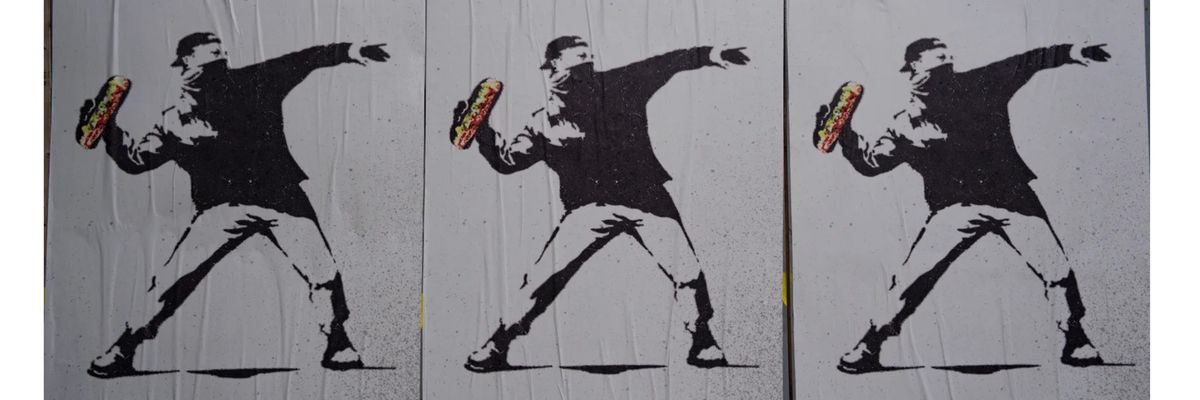
Images of newly acclaimed Sandwich Guy, with hat tip to Banksy, are seen near Dupont Circle.
In cases like that of “Sandwich Guy,” it’s the jury system, with eight centuries of tradition behind it, that has given the American people a last-chance outlet to say “no” to fascism.
It’s a well-worn cliche in the legal world that prosecutors have so much clout in the grand jury room that they could indict a ham sandwich. The currency of this quote only soared in value when the man who first uttered it, a New York State top judge named Sol Wachtler, was subsequently indicted himself.
And maybe the US Justice Department still could indict a ham sandwich. But a salami hoagie from Subway is apparently a bridge too far.
I am talking, of course, about the now notorious Washington, DC case against the man commonly known as “Sandwich Guy”—a now-former Justice Department paralegal (yes, the irony) named Sean Dunn whose anger at the federal surge of law-enforcement officers backed by National Guard troops in the nation’s capital boiled over last month. Dunn verbally quarreled with agents and called them “fascists” before hurling that infamous hoagie at a Customs and Border Protection officer and then getting chased down, with all of it captured on video.
To many in DC and around the country who think the Trump regime’s ostensibly crime-fighting military operation in Washington is a dictatorial overreach, “Sandwich Guy” quickly became a resistance icon, his action celebrated in pop-up posters plastered around Washington like the one at the top of this newsletter.
To Trump’s Justice Department, Dunn’s sub attack and its disrespect for the authority of an authoritarian regime demanded the full hammer of the law. Federal prosecutors went before the DC grand jury seeking a felony indictment against their ex-coworker—a stiff penalty for an attack with a soft roll.
But then something remarkable—or it least it used to be remarkable before January or so—took place. The DC grand jury returned “no bill,” meaning that a majority of the panel (typically between 16 and 23 people) who listened to the Justice Department’s case against Dunn voted against indicting him. Prosecutors later conceded the defeat and said they are instead charging Dunn with a misdemeanor.
We don’t know why the grand jurors rejected a felony charge against Dunn, but we do know that this kind of stand by a grand jury wasn’t an isolated incident. Days earlier, the Justice Department had sought felony charges against a DC woman named Sidney Lori Reid, accused with interfering with federal agents’ arrest of two alleged gang members. Prosecutors claimed Reid, while filming the bust, got in the way of agents and then fought back aggressively when an immigration agent pushed her against a wall, and that an Federal Bureau of Investigation agent suffered a hand bruise in the ensuing scuffle.
In this case, prosecutors tried not once but three separate times to secure a felony indictment of Reid—each time rebuffed by the grand jury—before finally settling on a misdemeanor charge instead. “The US attorney can try to concoct crimes to quiet the people, but in our criminal justice system, the citizens have the last word,” Reid’s two lawyers said in a statement.
We should be inspired by these grand jurors in DC and Los Angeles to get more creative in our own daily lives in resisting American autocracy.
OK, you can blame the “woke,” left-leaning citizens of DC—US President Donald Trump got just 6.5% of the vote there in 2024—except that something similar reportedly happened some 3,000 miles away in Los Angeles earlier this year. There, the US Attorney’s office initially sought felony charges against 38 people related to unrest over stepped-up federal immigration raids, but the Los Angeles Times reported that only seven of the criminal complaints resulted in indictments, with the rest ending in dismissals or misdemeanors. The paper said the US attorney, Bill Essayli, was caught screaming at his subordinates after one felony case collapsed.
To borrow what Stephen Stills wrote after youth riots on LA’s Sunset Strip in 1966, there’s something happening here...
But what it is, ain’t exactly clear. Grand jury proceedings are secret—so much so that even Bob Woodward and Carl Bernstein at the height of their Watergate glory days struggled to lift that veil. In some of these cases, it’s possible—perhaps likely, given the inflated nature of some of the government’s allegations—that the jurors simply felt that the feds lacked evidence to make their case.
Or, it’s also possible that these everyday citizens engaged in a highly unique form of protest that a law professor might call “jury nullification.” This is essentially when a jury elects to clear a defendant not because of a lack of evidence that they did what the government accused them of doing, but because they believed the underlying law is unjust, or that the entire system is thoroughly corrupted.
As Paul Butler, Georgetown University law professor and now frequent MSNBC commentator, argued in a 2016 Washington Post op-ed, the notion of a jury nullification in America carries a rich history that includes the American Revolution, the Fugitive Slave Act, and the movement for LGBTQ rights. Citing aggressive prosecutions of Black Americans for minor offenses, Butler wrote then: “I encourage any juror who thinks the police or prosecutors have crossed the line in a particular case to refuse to convict.”
Nine years later, in jurisdictions that voted heavily against Trump in 2024—and which face armed troops and masked, unbadged federal agents in 2025—jurors seems to be engaged in a quiet, behind-closed-doors revolution against the regime.
Think about this. The right to justice by a jury of your peers—everyday citizens from your own community—is in essence the foundational building block of what over centuries would slowly become democracy. Britain’s Magna Carta—written in 1215 (!)—codified this notion as a defense against its overbearing lords more than 800 years ago, and the idea proved so powerful it has managed to survive the creation of our large institutions that provide Big Government but too often seem removed from the people.
The Trump regime’s push for an authoritarian United States might be the biggest story right now, but rivaling that is the growing gap between our cowardly and failing big institutions—Congress, the Supreme Court, Big Media, university administrations, etc., etc.—and the wisdom of regular folks.
For sure, there’s an unshakable cult of Trump supporters, but one of the many underreported stories of 2025 is the lingering faith in democratic ideals, fairness, equity, and diversity that still holds with the majority of the American people—despite everything that’s happened. We’ve seen it in Trump’s sky-high disapproval rating, and the public rejection of individual policies, and in protests like June’s “No Kings” event that brought a record-setting 5 million folks into the streets.
Yet feckless opposition from Beltway Democrats and an increasingly compromised news media also has the masses realizing they are on their own, still in search of workable outlets to challenge an increasingly repressive regime. Protests can be ignored or put down, while economic boycotts are promising but hard to organize. It’s the jury system, with eight centuries of tradition behind it, that has given the American people a last-chance outlet to say “no” to fascism.
We should be inspired by these grand jurors in DC and Los Angeles to get more creative in our own daily lives in resisting American autocracy. That would be a modern-day miracle, turning a loaf and some salami slices into a feast of democratic resistance.
Dear Common Dreams reader, It’s been nearly 30 years since I co-founded Common Dreams with my late wife, Lina Newhouser. We had the radical notion that journalism should serve the public good, not corporate profits. It was clear to us from the outset what it would take to build such a project. No paid advertisements. No corporate sponsors. No millionaire publisher telling us what to think or do. Many people said we wouldn't last a year, but we proved those doubters wrong. Together with a tremendous team of journalists and dedicated staff, we built an independent media outlet free from the constraints of profits and corporate control. Our mission has always been simple: To inform. To inspire. To ignite change for the common good. Building Common Dreams was not easy. Our survival was never guaranteed. When you take on the most powerful forces—Wall Street greed, fossil fuel industry destruction, Big Tech lobbyists, and uber-rich oligarchs who have spent billions upon billions rigging the economy and democracy in their favor—the only bulwark you have is supporters who believe in your work. But here’s the urgent message from me today. It's never been this bad out there. And it's never been this hard to keep us going. At the very moment Common Dreams is most needed, the threats we face are intensifying. We need your support now more than ever. We don't accept corporate advertising and never will. We don't have a paywall because we don't think people should be blocked from critical news based on their ability to pay. Everything we do is funded by the donations of readers like you. When everyone does the little they can afford, we are strong. But if that support retreats or dries up, so do we. Will you donate now to make sure Common Dreams not only survives but thrives? —Craig Brown, Co-founder |
It’s a well-worn cliche in the legal world that prosecutors have so much clout in the grand jury room that they could indict a ham sandwich. The currency of this quote only soared in value when the man who first uttered it, a New York State top judge named Sol Wachtler, was subsequently indicted himself.
And maybe the US Justice Department still could indict a ham sandwich. But a salami hoagie from Subway is apparently a bridge too far.
I am talking, of course, about the now notorious Washington, DC case against the man commonly known as “Sandwich Guy”—a now-former Justice Department paralegal (yes, the irony) named Sean Dunn whose anger at the federal surge of law-enforcement officers backed by National Guard troops in the nation’s capital boiled over last month. Dunn verbally quarreled with agents and called them “fascists” before hurling that infamous hoagie at a Customs and Border Protection officer and then getting chased down, with all of it captured on video.
To many in DC and around the country who think the Trump regime’s ostensibly crime-fighting military operation in Washington is a dictatorial overreach, “Sandwich Guy” quickly became a resistance icon, his action celebrated in pop-up posters plastered around Washington like the one at the top of this newsletter.
To Trump’s Justice Department, Dunn’s sub attack and its disrespect for the authority of an authoritarian regime demanded the full hammer of the law. Federal prosecutors went before the DC grand jury seeking a felony indictment against their ex-coworker—a stiff penalty for an attack with a soft roll.
But then something remarkable—or it least it used to be remarkable before January or so—took place. The DC grand jury returned “no bill,” meaning that a majority of the panel (typically between 16 and 23 people) who listened to the Justice Department’s case against Dunn voted against indicting him. Prosecutors later conceded the defeat and said they are instead charging Dunn with a misdemeanor.
We don’t know why the grand jurors rejected a felony charge against Dunn, but we do know that this kind of stand by a grand jury wasn’t an isolated incident. Days earlier, the Justice Department had sought felony charges against a DC woman named Sidney Lori Reid, accused with interfering with federal agents’ arrest of two alleged gang members. Prosecutors claimed Reid, while filming the bust, got in the way of agents and then fought back aggressively when an immigration agent pushed her against a wall, and that an Federal Bureau of Investigation agent suffered a hand bruise in the ensuing scuffle.
In this case, prosecutors tried not once but three separate times to secure a felony indictment of Reid—each time rebuffed by the grand jury—before finally settling on a misdemeanor charge instead. “The US attorney can try to concoct crimes to quiet the people, but in our criminal justice system, the citizens have the last word,” Reid’s two lawyers said in a statement.
We should be inspired by these grand jurors in DC and Los Angeles to get more creative in our own daily lives in resisting American autocracy.
OK, you can blame the “woke,” left-leaning citizens of DC—US President Donald Trump got just 6.5% of the vote there in 2024—except that something similar reportedly happened some 3,000 miles away in Los Angeles earlier this year. There, the US Attorney’s office initially sought felony charges against 38 people related to unrest over stepped-up federal immigration raids, but the Los Angeles Times reported that only seven of the criminal complaints resulted in indictments, with the rest ending in dismissals or misdemeanors. The paper said the US attorney, Bill Essayli, was caught screaming at his subordinates after one felony case collapsed.
To borrow what Stephen Stills wrote after youth riots on LA’s Sunset Strip in 1966, there’s something happening here...
But what it is, ain’t exactly clear. Grand jury proceedings are secret—so much so that even Bob Woodward and Carl Bernstein at the height of their Watergate glory days struggled to lift that veil. In some of these cases, it’s possible—perhaps likely, given the inflated nature of some of the government’s allegations—that the jurors simply felt that the feds lacked evidence to make their case.
Or, it’s also possible that these everyday citizens engaged in a highly unique form of protest that a law professor might call “jury nullification.” This is essentially when a jury elects to clear a defendant not because of a lack of evidence that they did what the government accused them of doing, but because they believed the underlying law is unjust, or that the entire system is thoroughly corrupted.
As Paul Butler, Georgetown University law professor and now frequent MSNBC commentator, argued in a 2016 Washington Post op-ed, the notion of a jury nullification in America carries a rich history that includes the American Revolution, the Fugitive Slave Act, and the movement for LGBTQ rights. Citing aggressive prosecutions of Black Americans for minor offenses, Butler wrote then: “I encourage any juror who thinks the police or prosecutors have crossed the line in a particular case to refuse to convict.”
Nine years later, in jurisdictions that voted heavily against Trump in 2024—and which face armed troops and masked, unbadged federal agents in 2025—jurors seems to be engaged in a quiet, behind-closed-doors revolution against the regime.
Think about this. The right to justice by a jury of your peers—everyday citizens from your own community—is in essence the foundational building block of what over centuries would slowly become democracy. Britain’s Magna Carta—written in 1215 (!)—codified this notion as a defense against its overbearing lords more than 800 years ago, and the idea proved so powerful it has managed to survive the creation of our large institutions that provide Big Government but too often seem removed from the people.
The Trump regime’s push for an authoritarian United States might be the biggest story right now, but rivaling that is the growing gap between our cowardly and failing big institutions—Congress, the Supreme Court, Big Media, university administrations, etc., etc.—and the wisdom of regular folks.
For sure, there’s an unshakable cult of Trump supporters, but one of the many underreported stories of 2025 is the lingering faith in democratic ideals, fairness, equity, and diversity that still holds with the majority of the American people—despite everything that’s happened. We’ve seen it in Trump’s sky-high disapproval rating, and the public rejection of individual policies, and in protests like June’s “No Kings” event that brought a record-setting 5 million folks into the streets.
Yet feckless opposition from Beltway Democrats and an increasingly compromised news media also has the masses realizing they are on their own, still in search of workable outlets to challenge an increasingly repressive regime. Protests can be ignored or put down, while economic boycotts are promising but hard to organize. It’s the jury system, with eight centuries of tradition behind it, that has given the American people a last-chance outlet to say “no” to fascism.
We should be inspired by these grand jurors in DC and Los Angeles to get more creative in our own daily lives in resisting American autocracy. That would be a modern-day miracle, turning a loaf and some salami slices into a feast of democratic resistance.
It’s a well-worn cliche in the legal world that prosecutors have so much clout in the grand jury room that they could indict a ham sandwich. The currency of this quote only soared in value when the man who first uttered it, a New York State top judge named Sol Wachtler, was subsequently indicted himself.
And maybe the US Justice Department still could indict a ham sandwich. But a salami hoagie from Subway is apparently a bridge too far.
I am talking, of course, about the now notorious Washington, DC case against the man commonly known as “Sandwich Guy”—a now-former Justice Department paralegal (yes, the irony) named Sean Dunn whose anger at the federal surge of law-enforcement officers backed by National Guard troops in the nation’s capital boiled over last month. Dunn verbally quarreled with agents and called them “fascists” before hurling that infamous hoagie at a Customs and Border Protection officer and then getting chased down, with all of it captured on video.
To many in DC and around the country who think the Trump regime’s ostensibly crime-fighting military operation in Washington is a dictatorial overreach, “Sandwich Guy” quickly became a resistance icon, his action celebrated in pop-up posters plastered around Washington like the one at the top of this newsletter.
To Trump’s Justice Department, Dunn’s sub attack and its disrespect for the authority of an authoritarian regime demanded the full hammer of the law. Federal prosecutors went before the DC grand jury seeking a felony indictment against their ex-coworker—a stiff penalty for an attack with a soft roll.
But then something remarkable—or it least it used to be remarkable before January or so—took place. The DC grand jury returned “no bill,” meaning that a majority of the panel (typically between 16 and 23 people) who listened to the Justice Department’s case against Dunn voted against indicting him. Prosecutors later conceded the defeat and said they are instead charging Dunn with a misdemeanor.
We don’t know why the grand jurors rejected a felony charge against Dunn, but we do know that this kind of stand by a grand jury wasn’t an isolated incident. Days earlier, the Justice Department had sought felony charges against a DC woman named Sidney Lori Reid, accused with interfering with federal agents’ arrest of two alleged gang members. Prosecutors claimed Reid, while filming the bust, got in the way of agents and then fought back aggressively when an immigration agent pushed her against a wall, and that an Federal Bureau of Investigation agent suffered a hand bruise in the ensuing scuffle.
In this case, prosecutors tried not once but three separate times to secure a felony indictment of Reid—each time rebuffed by the grand jury—before finally settling on a misdemeanor charge instead. “The US attorney can try to concoct crimes to quiet the people, but in our criminal justice system, the citizens have the last word,” Reid’s two lawyers said in a statement.
We should be inspired by these grand jurors in DC and Los Angeles to get more creative in our own daily lives in resisting American autocracy.
OK, you can blame the “woke,” left-leaning citizens of DC—US President Donald Trump got just 6.5% of the vote there in 2024—except that something similar reportedly happened some 3,000 miles away in Los Angeles earlier this year. There, the US Attorney’s office initially sought felony charges against 38 people related to unrest over stepped-up federal immigration raids, but the Los Angeles Times reported that only seven of the criminal complaints resulted in indictments, with the rest ending in dismissals or misdemeanors. The paper said the US attorney, Bill Essayli, was caught screaming at his subordinates after one felony case collapsed.
To borrow what Stephen Stills wrote after youth riots on LA’s Sunset Strip in 1966, there’s something happening here...
But what it is, ain’t exactly clear. Grand jury proceedings are secret—so much so that even Bob Woodward and Carl Bernstein at the height of their Watergate glory days struggled to lift that veil. In some of these cases, it’s possible—perhaps likely, given the inflated nature of some of the government’s allegations—that the jurors simply felt that the feds lacked evidence to make their case.
Or, it’s also possible that these everyday citizens engaged in a highly unique form of protest that a law professor might call “jury nullification.” This is essentially when a jury elects to clear a defendant not because of a lack of evidence that they did what the government accused them of doing, but because they believed the underlying law is unjust, or that the entire system is thoroughly corrupted.
As Paul Butler, Georgetown University law professor and now frequent MSNBC commentator, argued in a 2016 Washington Post op-ed, the notion of a jury nullification in America carries a rich history that includes the American Revolution, the Fugitive Slave Act, and the movement for LGBTQ rights. Citing aggressive prosecutions of Black Americans for minor offenses, Butler wrote then: “I encourage any juror who thinks the police or prosecutors have crossed the line in a particular case to refuse to convict.”
Nine years later, in jurisdictions that voted heavily against Trump in 2024—and which face armed troops and masked, unbadged federal agents in 2025—jurors seems to be engaged in a quiet, behind-closed-doors revolution against the regime.
Think about this. The right to justice by a jury of your peers—everyday citizens from your own community—is in essence the foundational building block of what over centuries would slowly become democracy. Britain’s Magna Carta—written in 1215 (!)—codified this notion as a defense against its overbearing lords more than 800 years ago, and the idea proved so powerful it has managed to survive the creation of our large institutions that provide Big Government but too often seem removed from the people.
The Trump regime’s push for an authoritarian United States might be the biggest story right now, but rivaling that is the growing gap between our cowardly and failing big institutions—Congress, the Supreme Court, Big Media, university administrations, etc., etc.—and the wisdom of regular folks.
For sure, there’s an unshakable cult of Trump supporters, but one of the many underreported stories of 2025 is the lingering faith in democratic ideals, fairness, equity, and diversity that still holds with the majority of the American people—despite everything that’s happened. We’ve seen it in Trump’s sky-high disapproval rating, and the public rejection of individual policies, and in protests like June’s “No Kings” event that brought a record-setting 5 million folks into the streets.
Yet feckless opposition from Beltway Democrats and an increasingly compromised news media also has the masses realizing they are on their own, still in search of workable outlets to challenge an increasingly repressive regime. Protests can be ignored or put down, while economic boycotts are promising but hard to organize. It’s the jury system, with eight centuries of tradition behind it, that has given the American people a last-chance outlet to say “no” to fascism.
We should be inspired by these grand jurors in DC and Los Angeles to get more creative in our own daily lives in resisting American autocracy. That would be a modern-day miracle, turning a loaf and some salami slices into a feast of democratic resistance.

