SUBSCRIBE TO OUR FREE NEWSLETTER
Daily news & progressive opinion—funded by the people, not the corporations—delivered straight to your inbox.
5
#000000
#FFFFFF
To donate by check, phone, or other method, see our More Ways to Give page.
Daily news & progressive opinion—funded by the people, not the corporations—delivered straight to your inbox.
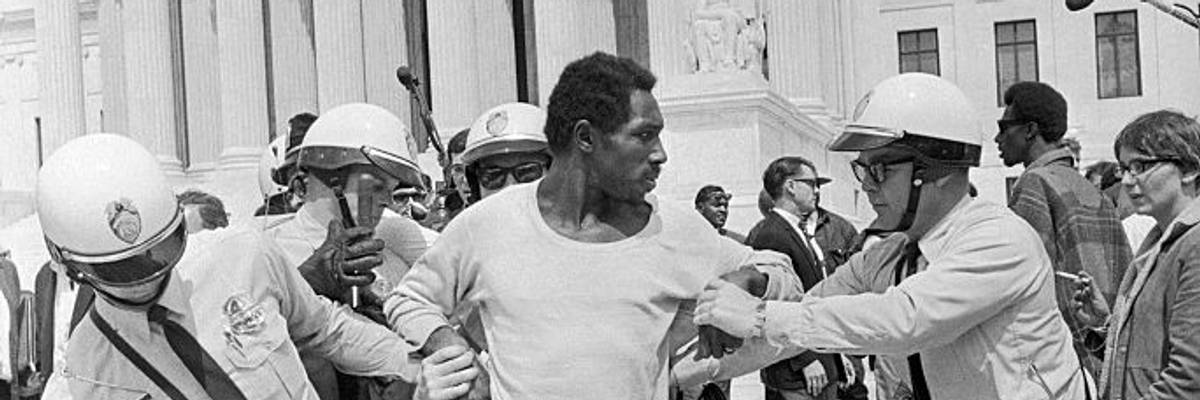
Capitol Police manhandle a supporter of the Poor Peoples Campaign during a demonstration at the U.S. Supreme Court on May 28, 1968.
On Juneteenth's call to justice and the U.S. Supreme Court's role in the eternal quest for Black liberation.
Juneteenth resonates as a symbol of freedom and resilience, encapsulating the enduring struggle against oppression and the relentless pursuit of equality. It’s a day of remembrance, celebration, and reflection on the journey from bondage to liberation. Beyond its cultural significance, Juneteenth challenges the United States to confront its history of racial injustice and commit to building a future where every citizen enjoys true freedom and equality under the law. Juneteenth is a verb.
In the annals of American history, the Supreme Court played a pivotal yet contradictory role in the quest for Black liberation. As we reflect on our Juneteenth journey, it is evident that the Court has been both a catalyst for progress and an obstacle to justice.
From the infamous Dred Scott decision of 1857, which denied citizenship to African Americans, to the landmark Brown v. Board of Education ruling in 1954, which dismantled the legal basis for racial segregation, the Court's decisions have swung like a pendulum, shaping the contours of racial justice in America.
The Supreme Court's rulings have occasionally propelled the nation toward equality. The Brown decision 70 years ago, declaring state laws establishing separate public schools for Black and white students to be unconstitutional, ignited the Civil Rights Movement. This was a moment when the Court stood on the right side of history, challenging entrenched systems of racial oppression and setting a precedent for future advances in civil rights.
As we look to the future, let us draw inspiration from the resilience and courage of those who have fought for justice before us—those who fought for freedom from bondage.
However, the path to Black liberation is not linear, and the Court has often regressed, reinforcing racial hierarchies and undermining progress. The 2013 Shelby County v. Holder decision, which invalidated key provisions of the Voting Rights Act of 1965, serves as a stark reminder. By weakening federal oversight of voting laws, the Court opened the door to a new era of voter suppression, disproportionately affecting Black communities.
This duality underscores a broader truth: legal victories, while crucial, are insufficient on their own. They must be accompanied by sustained activism and grassroots mobilization to ensure that the principles of justice are translated into lived realities. The Court's decisions, influenced by the prevailing political and social climates, highlight the importance of a vigilant and engaged citizenry.
Recent Supreme Court rulings on affirmative action vividly highlight the Court's profound limitations placed on Black liberation, spanning both public and private sectors, with innovations from Black women entrepreneurs poised for continued suppression. Amid decisions that perpetuate systemic inequalities, we confront entrenched patterns of injustice and demand an unwavering judiciary committed to equality and justice for all.
In the context of ongoing struggles against systemic racism and for Black lives, the Supreme Court's role remains pivotal. Advocating for a judiciary that reflects the diverse experiences and needs of the American populace is imperative. This necessitates championing justices who possess not only legal acumen but also a steadfast commitment to social justice.
The conversation about the Court's role in Black liberation must extend beyond the judiciary itself. It requires a holistic approach that includes legislative and policy reforms, educational initiatives, democracy and economic policies aimed at dismantling the structural barriers that perpetuate racial inequities.
It is through the collective efforts of individuals, communities, and public institutions that we can hope to achieve a more just and equitable society.
As we look to the future, let us draw inspiration from the resilience and courage of those who have fought for justice before us—those who fought for freedom from bondage. Juneteenth was not freely given—it was won.
The journey toward Black liberation is far from over, and the Supreme Court, while a powerful institution, is but one arena to reform in this ongoing struggle. It is through the collective efforts of individuals, communities, and public institutions that we can hope to achieve a more just and equitable society.
On this Juneteenth, our task is to remain vigilant, to hold our leaders accountable, and to continue the fight for a society where justice is not merely an ideal, but a reality for all.
Dear Common Dreams reader, It’s been nearly 30 years since I co-founded Common Dreams with my late wife, Lina Newhouser. We had the radical notion that journalism should serve the public good, not corporate profits. It was clear to us from the outset what it would take to build such a project. No paid advertisements. No corporate sponsors. No millionaire publisher telling us what to think or do. Many people said we wouldn't last a year, but we proved those doubters wrong. Together with a tremendous team of journalists and dedicated staff, we built an independent media outlet free from the constraints of profits and corporate control. Our mission has always been simple: To inform. To inspire. To ignite change for the common good. Building Common Dreams was not easy. Our survival was never guaranteed. When you take on the most powerful forces—Wall Street greed, fossil fuel industry destruction, Big Tech lobbyists, and uber-rich oligarchs who have spent billions upon billions rigging the economy and democracy in their favor—the only bulwark you have is supporters who believe in your work. But here’s the urgent message from me today. It's never been this bad out there. And it's never been this hard to keep us going. At the very moment Common Dreams is most needed, the threats we face are intensifying. We need your support now more than ever. We don't accept corporate advertising and never will. We don't have a paywall because we don't think people should be blocked from critical news based on their ability to pay. Everything we do is funded by the donations of readers like you. When everyone does the little they can afford, we are strong. But if that support retreats or dries up, so do we. Will you donate now to make sure Common Dreams not only survives but thrives? —Craig Brown, Co-founder |
Juneteenth resonates as a symbol of freedom and resilience, encapsulating the enduring struggle against oppression and the relentless pursuit of equality. It’s a day of remembrance, celebration, and reflection on the journey from bondage to liberation. Beyond its cultural significance, Juneteenth challenges the United States to confront its history of racial injustice and commit to building a future where every citizen enjoys true freedom and equality under the law. Juneteenth is a verb.
In the annals of American history, the Supreme Court played a pivotal yet contradictory role in the quest for Black liberation. As we reflect on our Juneteenth journey, it is evident that the Court has been both a catalyst for progress and an obstacle to justice.
From the infamous Dred Scott decision of 1857, which denied citizenship to African Americans, to the landmark Brown v. Board of Education ruling in 1954, which dismantled the legal basis for racial segregation, the Court's decisions have swung like a pendulum, shaping the contours of racial justice in America.
The Supreme Court's rulings have occasionally propelled the nation toward equality. The Brown decision 70 years ago, declaring state laws establishing separate public schools for Black and white students to be unconstitutional, ignited the Civil Rights Movement. This was a moment when the Court stood on the right side of history, challenging entrenched systems of racial oppression and setting a precedent for future advances in civil rights.
As we look to the future, let us draw inspiration from the resilience and courage of those who have fought for justice before us—those who fought for freedom from bondage.
However, the path to Black liberation is not linear, and the Court has often regressed, reinforcing racial hierarchies and undermining progress. The 2013 Shelby County v. Holder decision, which invalidated key provisions of the Voting Rights Act of 1965, serves as a stark reminder. By weakening federal oversight of voting laws, the Court opened the door to a new era of voter suppression, disproportionately affecting Black communities.
This duality underscores a broader truth: legal victories, while crucial, are insufficient on their own. They must be accompanied by sustained activism and grassroots mobilization to ensure that the principles of justice are translated into lived realities. The Court's decisions, influenced by the prevailing political and social climates, highlight the importance of a vigilant and engaged citizenry.
Recent Supreme Court rulings on affirmative action vividly highlight the Court's profound limitations placed on Black liberation, spanning both public and private sectors, with innovations from Black women entrepreneurs poised for continued suppression. Amid decisions that perpetuate systemic inequalities, we confront entrenched patterns of injustice and demand an unwavering judiciary committed to equality and justice for all.
In the context of ongoing struggles against systemic racism and for Black lives, the Supreme Court's role remains pivotal. Advocating for a judiciary that reflects the diverse experiences and needs of the American populace is imperative. This necessitates championing justices who possess not only legal acumen but also a steadfast commitment to social justice.
The conversation about the Court's role in Black liberation must extend beyond the judiciary itself. It requires a holistic approach that includes legislative and policy reforms, educational initiatives, democracy and economic policies aimed at dismantling the structural barriers that perpetuate racial inequities.
It is through the collective efforts of individuals, communities, and public institutions that we can hope to achieve a more just and equitable society.
As we look to the future, let us draw inspiration from the resilience and courage of those who have fought for justice before us—those who fought for freedom from bondage. Juneteenth was not freely given—it was won.
The journey toward Black liberation is far from over, and the Supreme Court, while a powerful institution, is but one arena to reform in this ongoing struggle. It is through the collective efforts of individuals, communities, and public institutions that we can hope to achieve a more just and equitable society.
On this Juneteenth, our task is to remain vigilant, to hold our leaders accountable, and to continue the fight for a society where justice is not merely an ideal, but a reality for all.
Juneteenth resonates as a symbol of freedom and resilience, encapsulating the enduring struggle against oppression and the relentless pursuit of equality. It’s a day of remembrance, celebration, and reflection on the journey from bondage to liberation. Beyond its cultural significance, Juneteenth challenges the United States to confront its history of racial injustice and commit to building a future where every citizen enjoys true freedom and equality under the law. Juneteenth is a verb.
In the annals of American history, the Supreme Court played a pivotal yet contradictory role in the quest for Black liberation. As we reflect on our Juneteenth journey, it is evident that the Court has been both a catalyst for progress and an obstacle to justice.
From the infamous Dred Scott decision of 1857, which denied citizenship to African Americans, to the landmark Brown v. Board of Education ruling in 1954, which dismantled the legal basis for racial segregation, the Court's decisions have swung like a pendulum, shaping the contours of racial justice in America.
The Supreme Court's rulings have occasionally propelled the nation toward equality. The Brown decision 70 years ago, declaring state laws establishing separate public schools for Black and white students to be unconstitutional, ignited the Civil Rights Movement. This was a moment when the Court stood on the right side of history, challenging entrenched systems of racial oppression and setting a precedent for future advances in civil rights.
As we look to the future, let us draw inspiration from the resilience and courage of those who have fought for justice before us—those who fought for freedom from bondage.
However, the path to Black liberation is not linear, and the Court has often regressed, reinforcing racial hierarchies and undermining progress. The 2013 Shelby County v. Holder decision, which invalidated key provisions of the Voting Rights Act of 1965, serves as a stark reminder. By weakening federal oversight of voting laws, the Court opened the door to a new era of voter suppression, disproportionately affecting Black communities.
This duality underscores a broader truth: legal victories, while crucial, are insufficient on their own. They must be accompanied by sustained activism and grassroots mobilization to ensure that the principles of justice are translated into lived realities. The Court's decisions, influenced by the prevailing political and social climates, highlight the importance of a vigilant and engaged citizenry.
Recent Supreme Court rulings on affirmative action vividly highlight the Court's profound limitations placed on Black liberation, spanning both public and private sectors, with innovations from Black women entrepreneurs poised for continued suppression. Amid decisions that perpetuate systemic inequalities, we confront entrenched patterns of injustice and demand an unwavering judiciary committed to equality and justice for all.
In the context of ongoing struggles against systemic racism and for Black lives, the Supreme Court's role remains pivotal. Advocating for a judiciary that reflects the diverse experiences and needs of the American populace is imperative. This necessitates championing justices who possess not only legal acumen but also a steadfast commitment to social justice.
The conversation about the Court's role in Black liberation must extend beyond the judiciary itself. It requires a holistic approach that includes legislative and policy reforms, educational initiatives, democracy and economic policies aimed at dismantling the structural barriers that perpetuate racial inequities.
It is through the collective efforts of individuals, communities, and public institutions that we can hope to achieve a more just and equitable society.
As we look to the future, let us draw inspiration from the resilience and courage of those who have fought for justice before us—those who fought for freedom from bondage. Juneteenth was not freely given—it was won.
The journey toward Black liberation is far from over, and the Supreme Court, while a powerful institution, is but one arena to reform in this ongoing struggle. It is through the collective efforts of individuals, communities, and public institutions that we can hope to achieve a more just and equitable society.
On this Juneteenth, our task is to remain vigilant, to hold our leaders accountable, and to continue the fight for a society where justice is not merely an ideal, but a reality for all.