SUBSCRIBE TO OUR FREE NEWSLETTER
Daily news & progressive opinion—funded by the people, not the corporations—delivered straight to your inbox.
5
#000000
#FFFFFF
To donate by check, phone, or other method, see our More Ways to Give page.
Daily news & progressive opinion—funded by the people, not the corporations—delivered straight to your inbox.
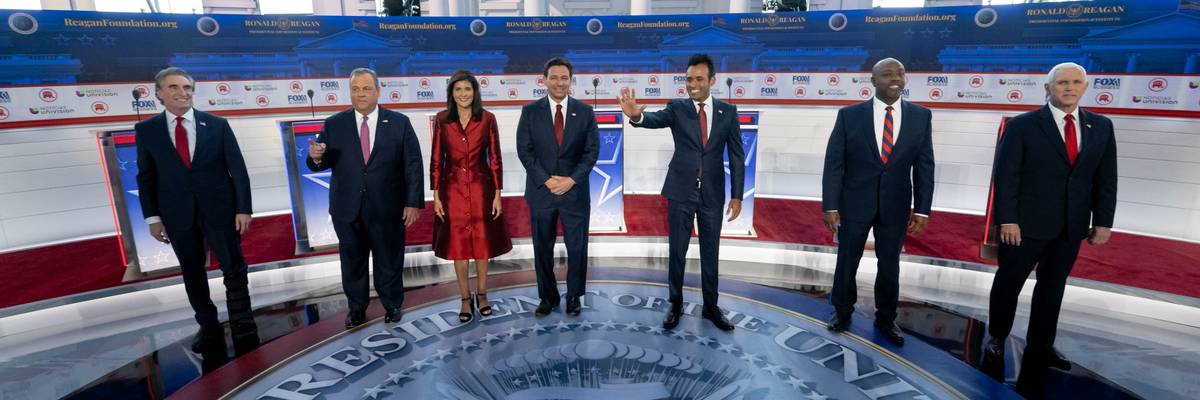
Republican presidential candidates, L to R; Doug Burgum, Chris Christie, Nikki Haley, Ron Desantis, Vivek Ramaswamy, Tim Scott, and Mike Pence pose for photos before the start of the second GOP debate at the Ronald Reagan Presidential Library in Simi Valley, California, Wednesday, September 27, 2023.
Despite their differences, the Republican presidential field found unity in the belief that what America needs is a stronger authoritarian hand ruling over the people.
After two hours of debate during which the 2024 Republican presidential hopefuls mostly shouted over each other, it’s reasonable to ask why the GOP continues to subject itself to so much avoidable humiliation.
Donald Trump, the front-runner for the nomination, made early headlines after announcing he would skip Wednesday’s primary debate. In retrospect that seems like a shrewd decision, because nobody who took the stage in California emerged stronger for their efforts. What the American people saw at the Reagan Presidential Library was a Republican Party in full-on fracture, where none of the feuding candidates could lay claim to a constituency large enough to be taken seriously in the face of Trump’s dominating polling lead.
Faced with the increasingly public brawls between Republicans’ far-right flank and their establishment base—a battle also unfolding as Congress weighs a potential government shutdown—few of the candidates on stage even bothered to frame their campaigns around coherent policy ideas. Those few individuals excepted, Wednesday’s proceedings quickly devolved into a sort of grievance Olympics. Each candidate vied to outdo the others in painting a picture of Republicans as hopelessly oppressed, politically censored, and socially marginalized victims. It was a deeply embarrassing night in a campaign cycle marked by too many embarrassing nights.
This GOP is fixated not on building a better future but on settling scores both foreign and domestic without concern for the long-term consequences.
“Every time I hear you I feel a little bit dumber,” former U.N. Ambassador Nikki Haley sniped at Vivek Ramaswamy after the first-time candidate’s particularly rambling answer to a question about TikTok and national security. The back-and-forth marked an escalation in Haley’s battle with Ramaswamy; Haley’s team clearly felt that if Republican voters liked her attacks on Ramaswamy during the first debate, they’d certainly love even more of the same, delivered with even sharper elbows.
But in a sign of just how valueless the modern Republican Party is, Haley’s critics were quick to note that she held a much brighter opinion of Ramaswamy only a few months ago. In a gushing blurb on the back of Ramaswamy’s book, Capitalist Punishment, Haley confidently declares that “Vivek speaks the truth without fear,” adding, “His combination of honesty, intellect, and foresight are exactly what we need.”
Ramaswamy deserved much of the criticism lobbed his way—his evening was spent pushing obvious falsehoods in true Trumpian style, apparently in the hopes that the sheer volume of untruths would stymie efforts to fact-check any of their dubious accuracy. Ramaswamy seemed confused about the current unemployment rate (among the lowest levels in modern history). Former Vice President Mike Pence slammed his spotty voting record. Ron DeSantis’s struggling Never Back Down PAC kept an almost real-time feed of Ramaswamy’s flip-flops from the first debate. It wasn’t the night Ramaswamy probably expected, but it was certainly the one he deserved.
Despite their differences, the Republican presidential field found unity in the belief that what America needs is a stronger authoritarian hand ruling over the people.
Faced with a question on crime, Pence’s solution was to federally expedite the death penalty to ensure executions happen faster, overlooking entirely the fact that even our slower-paced system has resulted in the deaths of dozens of verifiably innocent Americans falsely convicted of death-eligible crimes. Thirty innocent death row inmates have been exonerated in DeSantis’s home state of Florida alone.
Haley, who tried to position herself after the first debate as the grown-up in the race, openly declared that Mexico was a bad partner to the United States. That would have been cringe-inducing enough, but Haley doubled down, arguing that Mexcio’s struggles policing their illicit drug trade justified invading the nation, an American ally. That was condemnable when DeSantis said it during the first debate; the thought is even less defensible coming from a former top American diplomat.
But the disappointments kept coming for Haley, who followed up her call to send U.S. military forces into Mexico by saying she’d also consider using American special operations forces to combat China. It doesn’t take a foreign policy expert to see that any candidate counseling a warpath against China does not have the best interests of the United States at heart. Whatever good Haley did for her campaign coming out of last month’s debate, she stumbled badly on Wednesday.
Yesterday’s debate showcased a Republican Party consumed by anger: anger at themselves, at Donald Trump, at Mexico, at the whole wide world. Voters looking for a positive conservative vision of the future should look elsewhere. This GOP is fixated not on building a better future but on settling scores both foreign and domestic without concern for the long-term consequences. The American people must reject a Republican ideology that would lead us into civil strife at home and years of global conflict abroad.
Dear Common Dreams reader, It’s been nearly 30 years since I co-founded Common Dreams with my late wife, Lina Newhouser. We had the radical notion that journalism should serve the public good, not corporate profits. It was clear to us from the outset what it would take to build such a project. No paid advertisements. No corporate sponsors. No millionaire publisher telling us what to think or do. Many people said we wouldn't last a year, but we proved those doubters wrong. Together with a tremendous team of journalists and dedicated staff, we built an independent media outlet free from the constraints of profits and corporate control. Our mission has always been simple: To inform. To inspire. To ignite change for the common good. Building Common Dreams was not easy. Our survival was never guaranteed. When you take on the most powerful forces—Wall Street greed, fossil fuel industry destruction, Big Tech lobbyists, and uber-rich oligarchs who have spent billions upon billions rigging the economy and democracy in their favor—the only bulwark you have is supporters who believe in your work. But here’s the urgent message from me today. It's never been this bad out there. And it's never been this hard to keep us going. At the very moment Common Dreams is most needed, the threats we face are intensifying. We need your support now more than ever. We don't accept corporate advertising and never will. We don't have a paywall because we don't think people should be blocked from critical news based on their ability to pay. Everything we do is funded by the donations of readers like you. When everyone does the little they can afford, we are strong. But if that support retreats or dries up, so do we. Will you donate now to make sure Common Dreams not only survives but thrives? —Craig Brown, Co-founder |
After two hours of debate during which the 2024 Republican presidential hopefuls mostly shouted over each other, it’s reasonable to ask why the GOP continues to subject itself to so much avoidable humiliation.
Donald Trump, the front-runner for the nomination, made early headlines after announcing he would skip Wednesday’s primary debate. In retrospect that seems like a shrewd decision, because nobody who took the stage in California emerged stronger for their efforts. What the American people saw at the Reagan Presidential Library was a Republican Party in full-on fracture, where none of the feuding candidates could lay claim to a constituency large enough to be taken seriously in the face of Trump’s dominating polling lead.
Faced with the increasingly public brawls between Republicans’ far-right flank and their establishment base—a battle also unfolding as Congress weighs a potential government shutdown—few of the candidates on stage even bothered to frame their campaigns around coherent policy ideas. Those few individuals excepted, Wednesday’s proceedings quickly devolved into a sort of grievance Olympics. Each candidate vied to outdo the others in painting a picture of Republicans as hopelessly oppressed, politically censored, and socially marginalized victims. It was a deeply embarrassing night in a campaign cycle marked by too many embarrassing nights.
This GOP is fixated not on building a better future but on settling scores both foreign and domestic without concern for the long-term consequences.
“Every time I hear you I feel a little bit dumber,” former U.N. Ambassador Nikki Haley sniped at Vivek Ramaswamy after the first-time candidate’s particularly rambling answer to a question about TikTok and national security. The back-and-forth marked an escalation in Haley’s battle with Ramaswamy; Haley’s team clearly felt that if Republican voters liked her attacks on Ramaswamy during the first debate, they’d certainly love even more of the same, delivered with even sharper elbows.
But in a sign of just how valueless the modern Republican Party is, Haley’s critics were quick to note that she held a much brighter opinion of Ramaswamy only a few months ago. In a gushing blurb on the back of Ramaswamy’s book, Capitalist Punishment, Haley confidently declares that “Vivek speaks the truth without fear,” adding, “His combination of honesty, intellect, and foresight are exactly what we need.”
Ramaswamy deserved much of the criticism lobbed his way—his evening was spent pushing obvious falsehoods in true Trumpian style, apparently in the hopes that the sheer volume of untruths would stymie efforts to fact-check any of their dubious accuracy. Ramaswamy seemed confused about the current unemployment rate (among the lowest levels in modern history). Former Vice President Mike Pence slammed his spotty voting record. Ron DeSantis’s struggling Never Back Down PAC kept an almost real-time feed of Ramaswamy’s flip-flops from the first debate. It wasn’t the night Ramaswamy probably expected, but it was certainly the one he deserved.
Despite their differences, the Republican presidential field found unity in the belief that what America needs is a stronger authoritarian hand ruling over the people.
Faced with a question on crime, Pence’s solution was to federally expedite the death penalty to ensure executions happen faster, overlooking entirely the fact that even our slower-paced system has resulted in the deaths of dozens of verifiably innocent Americans falsely convicted of death-eligible crimes. Thirty innocent death row inmates have been exonerated in DeSantis’s home state of Florida alone.
Haley, who tried to position herself after the first debate as the grown-up in the race, openly declared that Mexico was a bad partner to the United States. That would have been cringe-inducing enough, but Haley doubled down, arguing that Mexcio’s struggles policing their illicit drug trade justified invading the nation, an American ally. That was condemnable when DeSantis said it during the first debate; the thought is even less defensible coming from a former top American diplomat.
But the disappointments kept coming for Haley, who followed up her call to send U.S. military forces into Mexico by saying she’d also consider using American special operations forces to combat China. It doesn’t take a foreign policy expert to see that any candidate counseling a warpath against China does not have the best interests of the United States at heart. Whatever good Haley did for her campaign coming out of last month’s debate, she stumbled badly on Wednesday.
Yesterday’s debate showcased a Republican Party consumed by anger: anger at themselves, at Donald Trump, at Mexico, at the whole wide world. Voters looking for a positive conservative vision of the future should look elsewhere. This GOP is fixated not on building a better future but on settling scores both foreign and domestic without concern for the long-term consequences. The American people must reject a Republican ideology that would lead us into civil strife at home and years of global conflict abroad.
After two hours of debate during which the 2024 Republican presidential hopefuls mostly shouted over each other, it’s reasonable to ask why the GOP continues to subject itself to so much avoidable humiliation.
Donald Trump, the front-runner for the nomination, made early headlines after announcing he would skip Wednesday’s primary debate. In retrospect that seems like a shrewd decision, because nobody who took the stage in California emerged stronger for their efforts. What the American people saw at the Reagan Presidential Library was a Republican Party in full-on fracture, where none of the feuding candidates could lay claim to a constituency large enough to be taken seriously in the face of Trump’s dominating polling lead.
Faced with the increasingly public brawls between Republicans’ far-right flank and their establishment base—a battle also unfolding as Congress weighs a potential government shutdown—few of the candidates on stage even bothered to frame their campaigns around coherent policy ideas. Those few individuals excepted, Wednesday’s proceedings quickly devolved into a sort of grievance Olympics. Each candidate vied to outdo the others in painting a picture of Republicans as hopelessly oppressed, politically censored, and socially marginalized victims. It was a deeply embarrassing night in a campaign cycle marked by too many embarrassing nights.
This GOP is fixated not on building a better future but on settling scores both foreign and domestic without concern for the long-term consequences.
“Every time I hear you I feel a little bit dumber,” former U.N. Ambassador Nikki Haley sniped at Vivek Ramaswamy after the first-time candidate’s particularly rambling answer to a question about TikTok and national security. The back-and-forth marked an escalation in Haley’s battle with Ramaswamy; Haley’s team clearly felt that if Republican voters liked her attacks on Ramaswamy during the first debate, they’d certainly love even more of the same, delivered with even sharper elbows.
But in a sign of just how valueless the modern Republican Party is, Haley’s critics were quick to note that she held a much brighter opinion of Ramaswamy only a few months ago. In a gushing blurb on the back of Ramaswamy’s book, Capitalist Punishment, Haley confidently declares that “Vivek speaks the truth without fear,” adding, “His combination of honesty, intellect, and foresight are exactly what we need.”
Ramaswamy deserved much of the criticism lobbed his way—his evening was spent pushing obvious falsehoods in true Trumpian style, apparently in the hopes that the sheer volume of untruths would stymie efforts to fact-check any of their dubious accuracy. Ramaswamy seemed confused about the current unemployment rate (among the lowest levels in modern history). Former Vice President Mike Pence slammed his spotty voting record. Ron DeSantis’s struggling Never Back Down PAC kept an almost real-time feed of Ramaswamy’s flip-flops from the first debate. It wasn’t the night Ramaswamy probably expected, but it was certainly the one he deserved.
Despite their differences, the Republican presidential field found unity in the belief that what America needs is a stronger authoritarian hand ruling over the people.
Faced with a question on crime, Pence’s solution was to federally expedite the death penalty to ensure executions happen faster, overlooking entirely the fact that even our slower-paced system has resulted in the deaths of dozens of verifiably innocent Americans falsely convicted of death-eligible crimes. Thirty innocent death row inmates have been exonerated in DeSantis’s home state of Florida alone.
Haley, who tried to position herself after the first debate as the grown-up in the race, openly declared that Mexico was a bad partner to the United States. That would have been cringe-inducing enough, but Haley doubled down, arguing that Mexcio’s struggles policing their illicit drug trade justified invading the nation, an American ally. That was condemnable when DeSantis said it during the first debate; the thought is even less defensible coming from a former top American diplomat.
But the disappointments kept coming for Haley, who followed up her call to send U.S. military forces into Mexico by saying she’d also consider using American special operations forces to combat China. It doesn’t take a foreign policy expert to see that any candidate counseling a warpath against China does not have the best interests of the United States at heart. Whatever good Haley did for her campaign coming out of last month’s debate, she stumbled badly on Wednesday.
Yesterday’s debate showcased a Republican Party consumed by anger: anger at themselves, at Donald Trump, at Mexico, at the whole wide world. Voters looking for a positive conservative vision of the future should look elsewhere. This GOP is fixated not on building a better future but on settling scores both foreign and domestic without concern for the long-term consequences. The American people must reject a Republican ideology that would lead us into civil strife at home and years of global conflict abroad.