SUBSCRIBE TO OUR FREE NEWSLETTER
Daily news & progressive opinion—funded by the people, not the corporations—delivered straight to your inbox.
5
#000000
#FFFFFF
To donate by check, phone, or other method, see our More Ways to Give page.
Daily news & progressive opinion—funded by the people, not the corporations—delivered straight to your inbox.
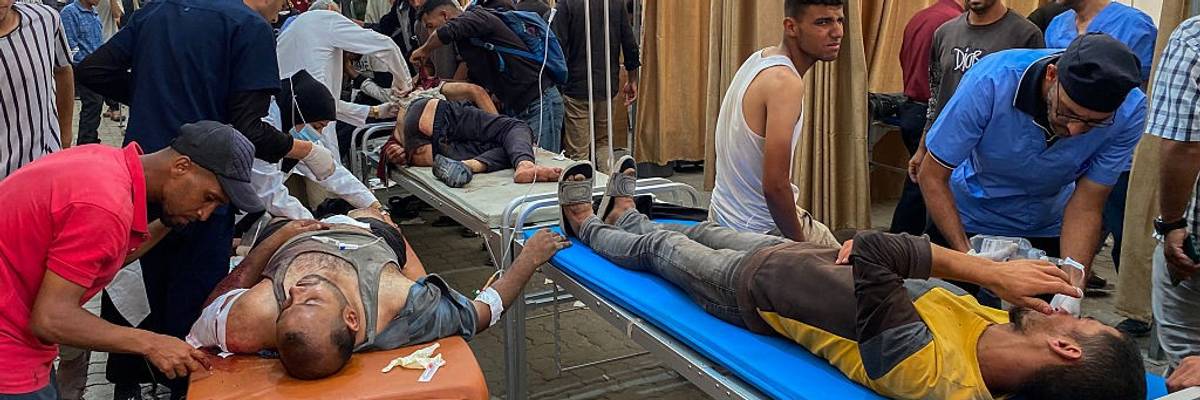
Palestinians who were injured in Israeli fire as they gathered near a food aid center receive care at Khan Younis' Nasser hospital in the southern Gaza Strip on June 17, 2025.
On the television show The Pitt, the fictional “never-ending” mass casualty scene featured 112 patients. We saw nearly four times that number in a single afternoon.
On Tuesday, June 17, the staff at Nasser Hospital in Khan Younis, Gaza, experienced a mass casualty event that began at around 9:00 am in the morning and didn’t stop until nearly 6 in the afternoon. It wasn’t one incident. It was a continuous flood of broken, bleeding, dying human beings.
By the end of the day, we had seen over 400 patients. Around 250 were critically injured. Ninety died in the resuscitation room, many on the floor.
I’m a doctor and I was in Gaza as a volunteer with an organization called Rahma Worldwide. Before Gaza, I had never worked a true mass casualty. The only ones I’d ever experienced were at Nasser itself in the days leading up to this one, trauma surges that already felt unbearable. But this was different. This was so much more. This wasn’t a surge. This was a human tide.
To put it into perspective, on the television show The Pitt, the fictional “never-ending” mass casualty scene featured 112 patients. We saw nearly four times that number in a single afternoon. And every one of them was real. Every injury was real. Every death was real.
It wasn’t an unfortunate consequence of war. It was the logical outcome of a system that has decided some lives are worth less than others.
Moreover, these weren’t random wartime injuries. This was the result of deliberate, targeted violence. People were shot while waiting for food at Gaza Humanitarian Foundation distribution points. Tanks opened fire on crowds. Families just trying to survive were torn apart by weapons never meant for civilians. Some of the bodies came to us in pieces. Many had no names.
Inside Nasser’s emergency department, the conditions were beyond description. Patients were laid on top of each other, not because of neglect or lack of care, but because there was simply no space left. The floor became our only option. Blood from multiple patients pooled across the tile, thick and dark, mixing with dust and sand and bits of shrapnel. I remember crouching over one patient while reaching to clamp another’s bleeding artery. There was nowhere to move without stepping in blood.
At one point, I swung around quickly trying not to slip, and my elbow struck one of the nurses directly in the face. She took two steps back, lifted her head, and just smiled at me and moved on. That was the kind of day it was. That’s the kind of people I worked with.
The injuries were horrific. Gunshots to the chest, neck, and face. Limbs blasted off. Pregnant women with abdominal wounds and no fetal heart tones. Toddlers with missing eyes, fractured skulls, or no pulse at all. We intubated and transfused nonstop. Massive transfusion protocols ran dry. Every resource was pushed past its limit.
And still, the staff kept working.
Local emergency physicians, residents, and medical students. International volunteers like me, working through organizations like Rahma Worldwide and Glia. And above all, the nurses. These nurses, many unpaid and all overworked, showed up anyway. They stood in the blood and fire and brought order to hell. They triaged, charted, held hands, cleaned wounds, comforted children, and kept going long after the rest of us were spent.
The surgical teams on the floor above us moved at a nearly impossible pace. One after another, they attended to the worst of the worst casualties and tried to save them. When the day finally slowed, many of the doctors rinsed off what they could, stepped over rubble, and walked back to their tents to sleep for a few hours. Then they came back a few hours later to do it again.
This is not medicine. This is something entirely different. It is not war in the way most people think of war. It is something colder. It is targeted, purposeful, mechanized human erasure.
What happened at Nasser Hospital that day in June was not an accident. It wasn’t an unfortunate consequence of war. It was the logical outcome of a system that has decided some lives are worth less than others. The world needs to stop pretending this is too complicated to understand.
The Pitt is fictional. Gaza is not.
Let’s stop the genocide. Let’s stop the funding to the Israel Defense Forces (IDF) using the only recognized and well established U.S. law designed to do this: the Leahy Law. To sign the petition go to https://sign.moveon.org/p/LeahyReviewNow. For more background information go to www.LeahyReviewNow.org.
Dear Common Dreams reader, It’s been nearly 30 years since I co-founded Common Dreams with my late wife, Lina Newhouser. We had the radical notion that journalism should serve the public good, not corporate profits. It was clear to us from the outset what it would take to build such a project. No paid advertisements. No corporate sponsors. No millionaire publisher telling us what to think or do. Many people said we wouldn't last a year, but we proved those doubters wrong. Together with a tremendous team of journalists and dedicated staff, we built an independent media outlet free from the constraints of profits and corporate control. Our mission has always been simple: To inform. To inspire. To ignite change for the common good. Building Common Dreams was not easy. Our survival was never guaranteed. When you take on the most powerful forces—Wall Street greed, fossil fuel industry destruction, Big Tech lobbyists, and uber-rich oligarchs who have spent billions upon billions rigging the economy and democracy in their favor—the only bulwark you have is supporters who believe in your work. But here’s the urgent message from me today. It's never been this bad out there. And it's never been this hard to keep us going. At the very moment Common Dreams is most needed, the threats we face are intensifying. We need your support now more than ever. We don't accept corporate advertising and never will. We don't have a paywall because we don't think people should be blocked from critical news based on their ability to pay. Everything we do is funded by the donations of readers like you. When everyone does the little they can afford, we are strong. But if that support retreats or dries up, so do we. Will you donate now to make sure Common Dreams not only survives but thrives? —Craig Brown, Co-founder |
On Tuesday, June 17, the staff at Nasser Hospital in Khan Younis, Gaza, experienced a mass casualty event that began at around 9:00 am in the morning and didn’t stop until nearly 6 in the afternoon. It wasn’t one incident. It was a continuous flood of broken, bleeding, dying human beings.
By the end of the day, we had seen over 400 patients. Around 250 were critically injured. Ninety died in the resuscitation room, many on the floor.
I’m a doctor and I was in Gaza as a volunteer with an organization called Rahma Worldwide. Before Gaza, I had never worked a true mass casualty. The only ones I’d ever experienced were at Nasser itself in the days leading up to this one, trauma surges that already felt unbearable. But this was different. This was so much more. This wasn’t a surge. This was a human tide.
To put it into perspective, on the television show The Pitt, the fictional “never-ending” mass casualty scene featured 112 patients. We saw nearly four times that number in a single afternoon. And every one of them was real. Every injury was real. Every death was real.
It wasn’t an unfortunate consequence of war. It was the logical outcome of a system that has decided some lives are worth less than others.
Moreover, these weren’t random wartime injuries. This was the result of deliberate, targeted violence. People were shot while waiting for food at Gaza Humanitarian Foundation distribution points. Tanks opened fire on crowds. Families just trying to survive were torn apart by weapons never meant for civilians. Some of the bodies came to us in pieces. Many had no names.
Inside Nasser’s emergency department, the conditions were beyond description. Patients were laid on top of each other, not because of neglect or lack of care, but because there was simply no space left. The floor became our only option. Blood from multiple patients pooled across the tile, thick and dark, mixing with dust and sand and bits of shrapnel. I remember crouching over one patient while reaching to clamp another’s bleeding artery. There was nowhere to move without stepping in blood.
At one point, I swung around quickly trying not to slip, and my elbow struck one of the nurses directly in the face. She took two steps back, lifted her head, and just smiled at me and moved on. That was the kind of day it was. That’s the kind of people I worked with.
The injuries were horrific. Gunshots to the chest, neck, and face. Limbs blasted off. Pregnant women with abdominal wounds and no fetal heart tones. Toddlers with missing eyes, fractured skulls, or no pulse at all. We intubated and transfused nonstop. Massive transfusion protocols ran dry. Every resource was pushed past its limit.
And still, the staff kept working.
Local emergency physicians, residents, and medical students. International volunteers like me, working through organizations like Rahma Worldwide and Glia. And above all, the nurses. These nurses, many unpaid and all overworked, showed up anyway. They stood in the blood and fire and brought order to hell. They triaged, charted, held hands, cleaned wounds, comforted children, and kept going long after the rest of us were spent.
The surgical teams on the floor above us moved at a nearly impossible pace. One after another, they attended to the worst of the worst casualties and tried to save them. When the day finally slowed, many of the doctors rinsed off what they could, stepped over rubble, and walked back to their tents to sleep for a few hours. Then they came back a few hours later to do it again.
This is not medicine. This is something entirely different. It is not war in the way most people think of war. It is something colder. It is targeted, purposeful, mechanized human erasure.
What happened at Nasser Hospital that day in June was not an accident. It wasn’t an unfortunate consequence of war. It was the logical outcome of a system that has decided some lives are worth less than others. The world needs to stop pretending this is too complicated to understand.
The Pitt is fictional. Gaza is not.
Let’s stop the genocide. Let’s stop the funding to the Israel Defense Forces (IDF) using the only recognized and well established U.S. law designed to do this: the Leahy Law. To sign the petition go to https://sign.moveon.org/p/LeahyReviewNow. For more background information go to www.LeahyReviewNow.org.
On Tuesday, June 17, the staff at Nasser Hospital in Khan Younis, Gaza, experienced a mass casualty event that began at around 9:00 am in the morning and didn’t stop until nearly 6 in the afternoon. It wasn’t one incident. It was a continuous flood of broken, bleeding, dying human beings.
By the end of the day, we had seen over 400 patients. Around 250 were critically injured. Ninety died in the resuscitation room, many on the floor.
I’m a doctor and I was in Gaza as a volunteer with an organization called Rahma Worldwide. Before Gaza, I had never worked a true mass casualty. The only ones I’d ever experienced were at Nasser itself in the days leading up to this one, trauma surges that already felt unbearable. But this was different. This was so much more. This wasn’t a surge. This was a human tide.
To put it into perspective, on the television show The Pitt, the fictional “never-ending” mass casualty scene featured 112 patients. We saw nearly four times that number in a single afternoon. And every one of them was real. Every injury was real. Every death was real.
It wasn’t an unfortunate consequence of war. It was the logical outcome of a system that has decided some lives are worth less than others.
Moreover, these weren’t random wartime injuries. This was the result of deliberate, targeted violence. People were shot while waiting for food at Gaza Humanitarian Foundation distribution points. Tanks opened fire on crowds. Families just trying to survive were torn apart by weapons never meant for civilians. Some of the bodies came to us in pieces. Many had no names.
Inside Nasser’s emergency department, the conditions were beyond description. Patients were laid on top of each other, not because of neglect or lack of care, but because there was simply no space left. The floor became our only option. Blood from multiple patients pooled across the tile, thick and dark, mixing with dust and sand and bits of shrapnel. I remember crouching over one patient while reaching to clamp another’s bleeding artery. There was nowhere to move without stepping in blood.
At one point, I swung around quickly trying not to slip, and my elbow struck one of the nurses directly in the face. She took two steps back, lifted her head, and just smiled at me and moved on. That was the kind of day it was. That’s the kind of people I worked with.
The injuries were horrific. Gunshots to the chest, neck, and face. Limbs blasted off. Pregnant women with abdominal wounds and no fetal heart tones. Toddlers with missing eyes, fractured skulls, or no pulse at all. We intubated and transfused nonstop. Massive transfusion protocols ran dry. Every resource was pushed past its limit.
And still, the staff kept working.
Local emergency physicians, residents, and medical students. International volunteers like me, working through organizations like Rahma Worldwide and Glia. And above all, the nurses. These nurses, many unpaid and all overworked, showed up anyway. They stood in the blood and fire and brought order to hell. They triaged, charted, held hands, cleaned wounds, comforted children, and kept going long after the rest of us were spent.
The surgical teams on the floor above us moved at a nearly impossible pace. One after another, they attended to the worst of the worst casualties and tried to save them. When the day finally slowed, many of the doctors rinsed off what they could, stepped over rubble, and walked back to their tents to sleep for a few hours. Then they came back a few hours later to do it again.
This is not medicine. This is something entirely different. It is not war in the way most people think of war. It is something colder. It is targeted, purposeful, mechanized human erasure.
What happened at Nasser Hospital that day in June was not an accident. It wasn’t an unfortunate consequence of war. It was the logical outcome of a system that has decided some lives are worth less than others. The world needs to stop pretending this is too complicated to understand.
The Pitt is fictional. Gaza is not.
Let’s stop the genocide. Let’s stop the funding to the Israel Defense Forces (IDF) using the only recognized and well established U.S. law designed to do this: the Leahy Law. To sign the petition go to https://sign.moveon.org/p/LeahyReviewNow. For more background information go to www.LeahyReviewNow.org.