SUBSCRIBE TO OUR FREE NEWSLETTER
Daily news & progressive opinion—funded by the people, not the corporations—delivered straight to your inbox.
5
#000000
#FFFFFF
To donate by check, phone, or other method, see our More Ways to Give page.

While some prominent Democrats are calling on party to reconnect with the working class by embracing economic populism, Fareed Zakaria, the host of a CNN news show and a Washington Post columnist, argues in a recent op-ed that it’s lost cause:
“[The Democrats] have a solid base of college-educated professionals, women and minorities. Many of the swing voters who have helped them win the popular vote in seven of the past nine presidential elections are registered independents and suburbanites. Perhaps they should lean into their new base and shape a policy agenda around them, rather than pining for the working-class Whites whom they lost decades ago.”
It's eerily reminiscent of what Senator Chuck Schumer infamously said eight years ago just before Hillary Clinton lost to Trump:
“For every blue-collar Democrat we lose in western Pennsylvania, we will pick up two moderate Republicans in the suburbs in Philadelphia, and you can repeat that in Ohio and Illinois and Wisconsin.”
Zakaria, however, claims that Biden didn’t follow Schumer’s advice and instead enacted massive infrastructure investments that were intended to please the entire working class. Biden, he writes, “presided over the creation of almost 17 million jobs with inflation nearing the Fed’s 2 percent target….wage inequality is down…and wage growth is outpacing inflation.”
To counter the blooming oligarchy which appears to have planted itself firmly in both parties, working people need a new political home, one of their own making.
But despite all this economic assistance, the working class increased its vote for Trump. For Zakaria, the Democrats’ electoral failure illustrates the futility of pandering to the working class.
We might better understand working-class alienation if we look at how Zakaria cherry picked his facts and ignored those that didn’t fit his story.
Zakaria loads the dice because he is sure that the White working-class cares more about race, immigration, gender, and sexual preference than it does about its own economic well-being. Hillary Clinton in 2016 ungracefully called half of the Trump voters “deplorables.” Zakaria means much the same when he writes that the Democratic Party “has been slowly losing the votes of the White working class, largely on issues related to race, identity and culture.”
The data from long-term voter surveys tell a different story. The White working-class has become more liberal, not more deplorable, on these issues. While researching my book, Wall Street’s War on Workers, I identified 23 controversial questions put to tens of thousands of White working-class voters over the last several decades. In no case did the White working-class become more illiberal. On thirteen of those controversial questions workers became more liberal. Here are five examples:
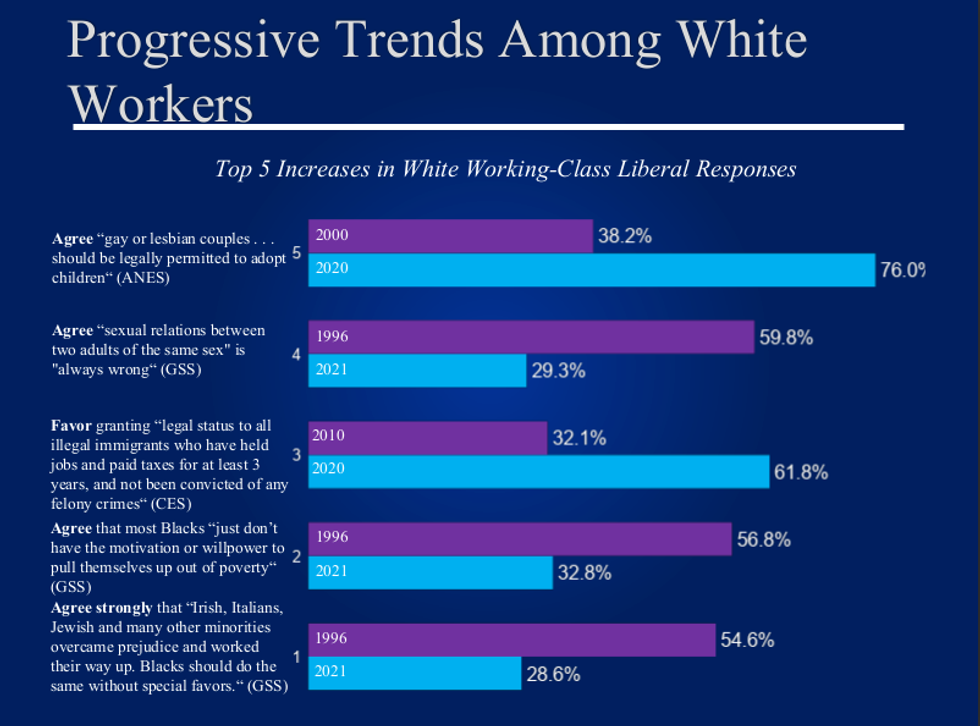
Zakaria’s laments the Democrats leftward shift, but the Democrats have not in recent years put forth a strong populist agenda. (See “Are You Still Wondering Why Workers Voted for Trump?”)
Zakaria, nevertheless, has no trouble pushing these alienated workers into the MAGA movement. No big loss. But such abandonment is a loss for members of the working class. The MAGA oligarchs did not become billionaires by protecting the economic needs and interests of working people.
To counter the blooming oligarchy which appears to have planted itself firmly in both parties, working people need a new political home, one of their own making. Although the process is extremely difficult in our two-party system, working people and labor unions may have no choice but to build a new political formation of and by working people, just like the Populists did at the end of the 19th century to battle the robber barons of that era.
Their party’s name is as appropriate today as it was then: The People’s Party.
While some prominent Democrats are calling on party to reconnect with the working class by embracing economic populism, Fareed Zakaria, the host of a CNN news show and a Washington Post columnist, argues in a recent op-ed that it’s lost cause:
“[The Democrats] have a solid base of college-educated professionals, women and minorities. Many of the swing voters who have helped them win the popular vote in seven of the past nine presidential elections are registered independents and suburbanites. Perhaps they should lean into their new base and shape a policy agenda around them, rather than pining for the working-class Whites whom they lost decades ago.”
It's eerily reminiscent of what Senator Chuck Schumer infamously said eight years ago just before Hillary Clinton lost to Trump:
“For every blue-collar Democrat we lose in western Pennsylvania, we will pick up two moderate Republicans in the suburbs in Philadelphia, and you can repeat that in Ohio and Illinois and Wisconsin.”
Zakaria, however, claims that Biden didn’t follow Schumer’s advice and instead enacted massive infrastructure investments that were intended to please the entire working class. Biden, he writes, “presided over the creation of almost 17 million jobs with inflation nearing the Fed’s 2 percent target….wage inequality is down…and wage growth is outpacing inflation.”
To counter the blooming oligarchy which appears to have planted itself firmly in both parties, working people need a new political home, one of their own making.
But despite all this economic assistance, the working class increased its vote for Trump. For Zakaria, the Democrats’ electoral failure illustrates the futility of pandering to the working class.
We might better understand working-class alienation if we look at how Zakaria cherry picked his facts and ignored those that didn’t fit his story.
Zakaria loads the dice because he is sure that the White working-class cares more about race, immigration, gender, and sexual preference than it does about its own economic well-being. Hillary Clinton in 2016 ungracefully called half of the Trump voters “deplorables.” Zakaria means much the same when he writes that the Democratic Party “has been slowly losing the votes of the White working class, largely on issues related to race, identity and culture.”
The data from long-term voter surveys tell a different story. The White working-class has become more liberal, not more deplorable, on these issues. While researching my book, Wall Street’s War on Workers, I identified 23 controversial questions put to tens of thousands of White working-class voters over the last several decades. In no case did the White working-class become more illiberal. On thirteen of those controversial questions workers became more liberal. Here are five examples:
Zakaria’s laments the Democrats leftward shift, but the Democrats have not in recent years put forth a strong populist agenda. (See “Are You Still Wondering Why Workers Voted for Trump?”)
Zakaria, nevertheless, has no trouble pushing these alienated workers into the MAGA movement. No big loss. But such abandonment is a loss for members of the working class. The MAGA oligarchs did not become billionaires by protecting the economic needs and interests of working people.
To counter the blooming oligarchy which appears to have planted itself firmly in both parties, working people need a new political home, one of their own making. Although the process is extremely difficult in our two-party system, working people and labor unions may have no choice but to build a new political formation of and by working people, just like the Populists did at the end of the 19th century to battle the robber barons of that era.
Their party’s name is as appropriate today as it was then: The People’s Party.
While some prominent Democrats are calling on party to reconnect with the working class by embracing economic populism, Fareed Zakaria, the host of a CNN news show and a Washington Post columnist, argues in a recent op-ed that it’s lost cause:
“[The Democrats] have a solid base of college-educated professionals, women and minorities. Many of the swing voters who have helped them win the popular vote in seven of the past nine presidential elections are registered independents and suburbanites. Perhaps they should lean into their new base and shape a policy agenda around them, rather than pining for the working-class Whites whom they lost decades ago.”
It's eerily reminiscent of what Senator Chuck Schumer infamously said eight years ago just before Hillary Clinton lost to Trump:
“For every blue-collar Democrat we lose in western Pennsylvania, we will pick up two moderate Republicans in the suburbs in Philadelphia, and you can repeat that in Ohio and Illinois and Wisconsin.”
Zakaria, however, claims that Biden didn’t follow Schumer’s advice and instead enacted massive infrastructure investments that were intended to please the entire working class. Biden, he writes, “presided over the creation of almost 17 million jobs with inflation nearing the Fed’s 2 percent target….wage inequality is down…and wage growth is outpacing inflation.”
To counter the blooming oligarchy which appears to have planted itself firmly in both parties, working people need a new political home, one of their own making.
But despite all this economic assistance, the working class increased its vote for Trump. For Zakaria, the Democrats’ electoral failure illustrates the futility of pandering to the working class.
We might better understand working-class alienation if we look at how Zakaria cherry picked his facts and ignored those that didn’t fit his story.
Zakaria loads the dice because he is sure that the White working-class cares more about race, immigration, gender, and sexual preference than it does about its own economic well-being. Hillary Clinton in 2016 ungracefully called half of the Trump voters “deplorables.” Zakaria means much the same when he writes that the Democratic Party “has been slowly losing the votes of the White working class, largely on issues related to race, identity and culture.”
The data from long-term voter surveys tell a different story. The White working-class has become more liberal, not more deplorable, on these issues. While researching my book, Wall Street’s War on Workers, I identified 23 controversial questions put to tens of thousands of White working-class voters over the last several decades. In no case did the White working-class become more illiberal. On thirteen of those controversial questions workers became more liberal. Here are five examples:
Zakaria’s laments the Democrats leftward shift, but the Democrats have not in recent years put forth a strong populist agenda. (See “Are You Still Wondering Why Workers Voted for Trump?”)
Zakaria, nevertheless, has no trouble pushing these alienated workers into the MAGA movement. No big loss. But such abandonment is a loss for members of the working class. The MAGA oligarchs did not become billionaires by protecting the economic needs and interests of working people.
To counter the blooming oligarchy which appears to have planted itself firmly in both parties, working people need a new political home, one of their own making. Although the process is extremely difficult in our two-party system, working people and labor unions may have no choice but to build a new political formation of and by working people, just like the Populists did at the end of the 19th century to battle the robber barons of that era.
Their party’s name is as appropriate today as it was then: The People’s Party.