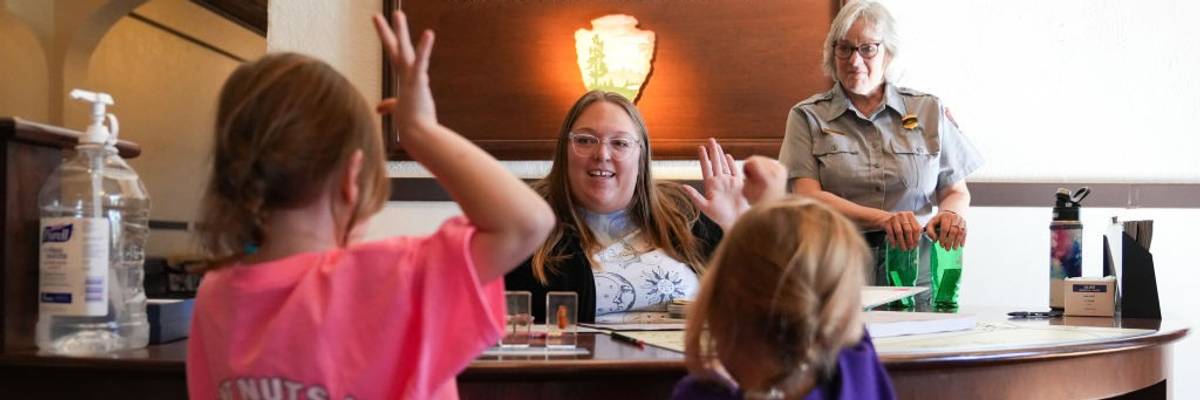
Two young girls get their Junior Ranger badges at the Jimmy Carter National Historical Park while visiting former President Jimmy Carter's home town after he passed away, on December 30, 2024 in Plains, Georgia.
Attacking Public Service Dismantles the Infrastructure of Democracy
When billionaires like Musk ally with political forces to dismantle public institutions, they're not just eliminating jobs—they're attempting to redefine freedom as nothing more than market choice.
Last Friday, an estimated 14,000 federal workers were fired from their positions across multiple agencies. Among them was Brian Gibbs, a National Park Service ranger whose heartbreaking account of losing his "dream job" puts a human face on a crisis that threatens the very fabric of American life. "I am the smiling face that greets you at the front door," Gibbs wrote. "I am your family vacation planner... I am the Band-Aid for a skinned knee."
This generous offering of his words reveals an essential truth: Public service is not about bureaucracy—it's about the careful, often invisible, undervalued work of maintaining our society's fundamental freedoms.
These thoughtless mass firings represent more than a reduction in excess workforce. They are an assault on what sociologists call "connective labor"—the deep interpersonal work that underlies all public service. As researcher Allison Pugh explains, this represents a "layer of labor beneath the labor," the essential but often invisible work of building trust and maintaining human connections. When a park ranger comforts a lost child or a cybersecurity expert coordinates across agencies to protect our infrastructure, they're not just performing tasks listed in a job description—they're engaging in the profound work of caring for one another that makes our public institutions function.
Our collective survival depends on workers who prioritize public good over private profit.
This connective labor is the foundation of what we might call care infrastructure—the essential work of maintaining systems that make our daily lives possible and our shared spaces safe. From the Veterans Affairs data scientist developing machine-learning algorithms to serve veterans, to the Forest Service trail crews maintaining backcountry access for rural communities, to the USDA loan technicians supporting small-town development, these federal employees perform work that transcends mere employment. They create the web of trust and mutual recognition that holds our society together. They show up, they maintain a disciplined commitment to public service so that we can be free.
The implications are both immediate and far-reaching. As one ranger warned about the summer season in the National Parks, "There will be nobody to clean the bathrooms, nobody to manage parking, nobody to collect fees, nobody to issue permits, nobody to ensure mountaineers entering steep glaciated terrain have the requisite skills and equipment... nobody to rescue injured or lost hikers. People will die from incidents that would otherwise be just another Tuesday for us."
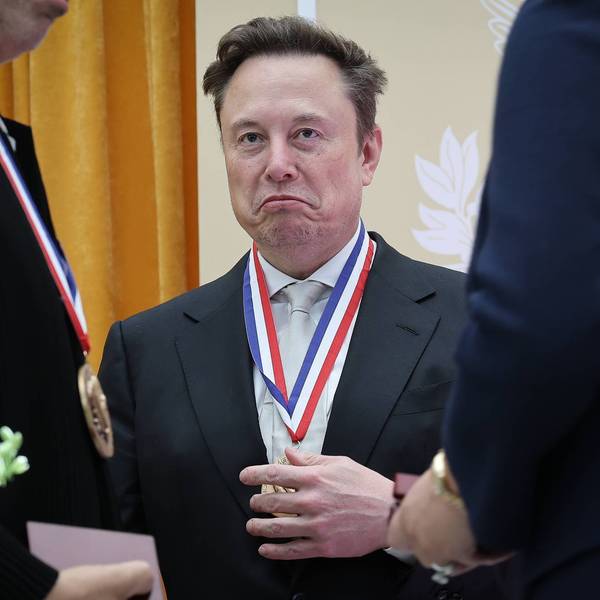
This crisis reveals a dangerous shift in how we value public service. When billionaires like Elon Musk pressure federal workers to abandon their posts for more lucrative private sector positions, and disturbingly compare federal workers to weeds that have to be eradicated by the root, they demonstrate a fundamental misunderstanding of what freedom means in America. True freedom isn't just about what we're against—whether that's fascism or authoritarianism—but also what we're for. Timothy Snyder argues freedom requires five essential elements: sovereignty (the ability to make meaningful choices about our lives), unpredictability (the power to act outside algorithmic control), mobility (the chance for people to grow beyond their circumstances), factuality (a grip on reality that enables us to challenge it), and solidarity (the recognition that these freedoms must be universal).
Our federal workers are not just employees—they are the guardians of these freedoms, but humble guardians who rarely seek the spotlight. You won't find them giving press conferences or cultivating personal brands. Instead, they show up day after day, maintaining the invisible infrastructure of democracy through quiet dedication rather than grandstanding. This humility isn't a weakness—it's their strength. It allows them to operate beyond political pressures and partisan loyalties, focused solely on their mission of public service.
These are the people who process veterans' benefits without fanfare, who conduct critical medical research at the National Institutes of Health without recognition, who maintain our nation's nuclear security without acclaim. When FEMA workers respond to natural disasters, when Centers for Disease Control and Prevention scientists track disease outbreaks, when Rural Development officers help fund vital infrastructure in small towns—they do so not for glory or profit, but because they believe in the promise of collective well-being. Through their steady, often unseen labor, they create the conditions that make genuine freedom possible. They build the foundation for what Snyder calls "sovereignty"—not the narrow nationalism of isolationists, but the creation of conditions where all individuals, regardless of their circumstances, can make meaningful choices about their lives.
These freedoms don't exist in a vacuum. They require maintenance, protection, and care—the very work being dismissed as "fat on the bone" by those orchestrating these firings. The Environmental Protection Agency scientist who monitors air quality in our cities, the Education Department specialist making education accessible for disabled students, the IRS worker ensuring corporations pay their fair share—these are not luxuries we can afford to lose. They are the essential guardians of our collective freedom.
The timing of these firings is particularly cruel, coming on Valentine's Day and affecting workers like Gibbs, whose wife is expecting a child, and others who have relocated across the country for their dream jobs. There are at least 14,000 stories of dreams destroyed in these 14,000 firings. But beyond the personal tragedies lies a broader threat to our collective democratic values. When we allow unelected billionaires to influence the dismantling of public services, we surrender a piece of our democratic control over the systems that maintain our quality of life.
During the pandemic, a crisis laid bare what had long been invisible: the essential infrastructure of care that sustains our society. We stood at our windows at 7:00 pm to applaud healthcare workers, celebrated delivery drivers as heroes, and finally saw the vital work of public health officials who tracked disease spread and coordinated emergency responses. That moment of recognition revealed a fundamental truth: Our collective survival depends on workers who prioritize public good over private profit.
Yet now, barely three years later, we're witnessing an orchestrated assault on the very concept of public service. This isn't merely about budget cuts or government efficiency—it's about a fundamental attack on the infrastructure of democracy itself. When billionaires like Musk ally with political forces to dismantle public institutions, they're not just eliminating jobs—they're attempting to redefine freedom as nothing more than market choice. This convergence of oligarchic wealth and authoritarian politics threatens not just our government services, but our very capacity to exist as a democratic society. Our freedom to thrive—to access public spaces, to trust our infrastructure, to rely on essential services—hangs in the balance.
The effects of these firings will ripple through our communities for months, perhaps years to come. When national parks become dangerous or inaccessible due to understaffing, when public utilities face increased vulnerability to cyber attacks, when basic government services break down, we'll all feel the impact. But by then, it may be too late to reverse the damage.
We must recognize this moment for what it is: a critical juncture in the fight for American democracy. The question isn't just about government jobs—it's about what kind of society we want to be. Do we want to live in a country where public service is devalued and dismantled, where the careful work of maintaining our shared spaces and systems is abandoned in favor of private profit? Or do we want to preserve and protect the essential care labor that makes our freedoms possible?
The answer to these questions will determine not just the fate of 14,000 federal workers, but the future of American democracy itself. As Ranger Gibbs reminded us, we must "stay present, don't avert your gaze." But what does it mean to truly stay present in this moment of crisis? Timothy Snyder, writing about tyranny in 2017, provided an answer: "Power wants your body softening in your chair and your emotions dissipating on a screen... Get outside. Put your body in unfamiliar places with unfamiliar people."
This is how we defend our freedoms—not through passive observation, but through active solidarity with those who maintain our democratic infrastructure. We must stand alongside the park rangers who protect our public lands, the cybersecurity experts who safeguard our systems, and all the federal workers whose invisibilized care labor has long been the bedrock of our democracy. Their fight is our fight. Their freedom is our freedom. The time to act is now. Not just to protest these firings, but to reaffirm our commitment to the very idea of public service—to recognize that our collective freedom depends on the careful, committed work of those who choose to serve their communities rather than chase private profit. In defending these workers, we defend the possibility of a democracy built on care, connection, and collective well-being.
We are at a crossroads
This country and this world are at a monumental crossroads. In a few short weeks, US voters will have an opportunity to beat back the forces of fascism and confront the billionaires who are rigging the economy, our media system, and our democracy, making it increasingly impossible for ordinary people to get by. We’re not just talking about the election. We’re talking about what must be done once these fascist elements are vanquished from power. We need a bolder set of solutions than what either major party has so far been willing to offer and a working-class movement ready to fight like hell for it. Trump didn't emerge from nowhere. The conditions that fueled MAGA authoritarianism were created by decades of radical neoliberal economic policies and a corrupt political system dominated by corporate interests. They slashed taxes on the super-rich, promising that the benefits would trickle down. They said giveaways to the corporate titans would make life more affordable for the rest of us. It was all bullshit. And when a bitter, betrayed populace searches for someone to blame, right-wing demagogues have little trouble finding scapegoats. People know when they're being lied to, but you won't hear any of this from the corporate media. Only independent journalism—powered and funded by people who believe in building a better world—can deliver truly trustworthy daily news. Our Fall Campaign is underway, and we need your help. To power our newsroom through the rest of the year, we need to raise $125,000 by midnight on October 31. So if you share our vision, please contribute whatever you can to sustain our work. |
Last Friday, an estimated 14,000 federal workers were fired from their positions across multiple agencies. Among them was Brian Gibbs, a National Park Service ranger whose heartbreaking account of losing his "dream job" puts a human face on a crisis that threatens the very fabric of American life. "I am the smiling face that greets you at the front door," Gibbs wrote. "I am your family vacation planner... I am the Band-Aid for a skinned knee."
This generous offering of his words reveals an essential truth: Public service is not about bureaucracy—it's about the careful, often invisible, undervalued work of maintaining our society's fundamental freedoms.
These thoughtless mass firings represent more than a reduction in excess workforce. They are an assault on what sociologists call "connective labor"—the deep interpersonal work that underlies all public service. As researcher Allison Pugh explains, this represents a "layer of labor beneath the labor," the essential but often invisible work of building trust and maintaining human connections. When a park ranger comforts a lost child or a cybersecurity expert coordinates across agencies to protect our infrastructure, they're not just performing tasks listed in a job description—they're engaging in the profound work of caring for one another that makes our public institutions function.
Our collective survival depends on workers who prioritize public good over private profit.
This connective labor is the foundation of what we might call care infrastructure—the essential work of maintaining systems that make our daily lives possible and our shared spaces safe. From the Veterans Affairs data scientist developing machine-learning algorithms to serve veterans, to the Forest Service trail crews maintaining backcountry access for rural communities, to the USDA loan technicians supporting small-town development, these federal employees perform work that transcends mere employment. They create the web of trust and mutual recognition that holds our society together. They show up, they maintain a disciplined commitment to public service so that we can be free.
The implications are both immediate and far-reaching. As one ranger warned about the summer season in the National Parks, "There will be nobody to clean the bathrooms, nobody to manage parking, nobody to collect fees, nobody to issue permits, nobody to ensure mountaineers entering steep glaciated terrain have the requisite skills and equipment... nobody to rescue injured or lost hikers. People will die from incidents that would otherwise be just another Tuesday for us."
This crisis reveals a dangerous shift in how we value public service. When billionaires like Elon Musk pressure federal workers to abandon their posts for more lucrative private sector positions, and disturbingly compare federal workers to weeds that have to be eradicated by the root, they demonstrate a fundamental misunderstanding of what freedom means in America. True freedom isn't just about what we're against—whether that's fascism or authoritarianism—but also what we're for. Timothy Snyder argues freedom requires five essential elements: sovereignty (the ability to make meaningful choices about our lives), unpredictability (the power to act outside algorithmic control), mobility (the chance for people to grow beyond their circumstances), factuality (a grip on reality that enables us to challenge it), and solidarity (the recognition that these freedoms must be universal).
Our federal workers are not just employees—they are the guardians of these freedoms, but humble guardians who rarely seek the spotlight. You won't find them giving press conferences or cultivating personal brands. Instead, they show up day after day, maintaining the invisible infrastructure of democracy through quiet dedication rather than grandstanding. This humility isn't a weakness—it's their strength. It allows them to operate beyond political pressures and partisan loyalties, focused solely on their mission of public service.
These are the people who process veterans' benefits without fanfare, who conduct critical medical research at the National Institutes of Health without recognition, who maintain our nation's nuclear security without acclaim. When FEMA workers respond to natural disasters, when Centers for Disease Control and Prevention scientists track disease outbreaks, when Rural Development officers help fund vital infrastructure in small towns—they do so not for glory or profit, but because they believe in the promise of collective well-being. Through their steady, often unseen labor, they create the conditions that make genuine freedom possible. They build the foundation for what Snyder calls "sovereignty"—not the narrow nationalism of isolationists, but the creation of conditions where all individuals, regardless of their circumstances, can make meaningful choices about their lives.
These freedoms don't exist in a vacuum. They require maintenance, protection, and care—the very work being dismissed as "fat on the bone" by those orchestrating these firings. The Environmental Protection Agency scientist who monitors air quality in our cities, the Education Department specialist making education accessible for disabled students, the IRS worker ensuring corporations pay their fair share—these are not luxuries we can afford to lose. They are the essential guardians of our collective freedom.
The timing of these firings is particularly cruel, coming on Valentine's Day and affecting workers like Gibbs, whose wife is expecting a child, and others who have relocated across the country for their dream jobs. There are at least 14,000 stories of dreams destroyed in these 14,000 firings. But beyond the personal tragedies lies a broader threat to our collective democratic values. When we allow unelected billionaires to influence the dismantling of public services, we surrender a piece of our democratic control over the systems that maintain our quality of life.
During the pandemic, a crisis laid bare what had long been invisible: the essential infrastructure of care that sustains our society. We stood at our windows at 7:00 pm to applaud healthcare workers, celebrated delivery drivers as heroes, and finally saw the vital work of public health officials who tracked disease spread and coordinated emergency responses. That moment of recognition revealed a fundamental truth: Our collective survival depends on workers who prioritize public good over private profit.
Yet now, barely three years later, we're witnessing an orchestrated assault on the very concept of public service. This isn't merely about budget cuts or government efficiency—it's about a fundamental attack on the infrastructure of democracy itself. When billionaires like Musk ally with political forces to dismantle public institutions, they're not just eliminating jobs—they're attempting to redefine freedom as nothing more than market choice. This convergence of oligarchic wealth and authoritarian politics threatens not just our government services, but our very capacity to exist as a democratic society. Our freedom to thrive—to access public spaces, to trust our infrastructure, to rely on essential services—hangs in the balance.
The effects of these firings will ripple through our communities for months, perhaps years to come. When national parks become dangerous or inaccessible due to understaffing, when public utilities face increased vulnerability to cyber attacks, when basic government services break down, we'll all feel the impact. But by then, it may be too late to reverse the damage.
We must recognize this moment for what it is: a critical juncture in the fight for American democracy. The question isn't just about government jobs—it's about what kind of society we want to be. Do we want to live in a country where public service is devalued and dismantled, where the careful work of maintaining our shared spaces and systems is abandoned in favor of private profit? Or do we want to preserve and protect the essential care labor that makes our freedoms possible?
The answer to these questions will determine not just the fate of 14,000 federal workers, but the future of American democracy itself. As Ranger Gibbs reminded us, we must "stay present, don't avert your gaze." But what does it mean to truly stay present in this moment of crisis? Timothy Snyder, writing about tyranny in 2017, provided an answer: "Power wants your body softening in your chair and your emotions dissipating on a screen... Get outside. Put your body in unfamiliar places with unfamiliar people."
This is how we defend our freedoms—not through passive observation, but through active solidarity with those who maintain our democratic infrastructure. We must stand alongside the park rangers who protect our public lands, the cybersecurity experts who safeguard our systems, and all the federal workers whose invisibilized care labor has long been the bedrock of our democracy. Their fight is our fight. Their freedom is our freedom. The time to act is now. Not just to protest these firings, but to reaffirm our commitment to the very idea of public service—to recognize that our collective freedom depends on the careful, committed work of those who choose to serve their communities rather than chase private profit. In defending these workers, we defend the possibility of a democracy built on care, connection, and collective well-being.
Last Friday, an estimated 14,000 federal workers were fired from their positions across multiple agencies. Among them was Brian Gibbs, a National Park Service ranger whose heartbreaking account of losing his "dream job" puts a human face on a crisis that threatens the very fabric of American life. "I am the smiling face that greets you at the front door," Gibbs wrote. "I am your family vacation planner... I am the Band-Aid for a skinned knee."
This generous offering of his words reveals an essential truth: Public service is not about bureaucracy—it's about the careful, often invisible, undervalued work of maintaining our society's fundamental freedoms.
These thoughtless mass firings represent more than a reduction in excess workforce. They are an assault on what sociologists call "connective labor"—the deep interpersonal work that underlies all public service. As researcher Allison Pugh explains, this represents a "layer of labor beneath the labor," the essential but often invisible work of building trust and maintaining human connections. When a park ranger comforts a lost child or a cybersecurity expert coordinates across agencies to protect our infrastructure, they're not just performing tasks listed in a job description—they're engaging in the profound work of caring for one another that makes our public institutions function.
Our collective survival depends on workers who prioritize public good over private profit.
This connective labor is the foundation of what we might call care infrastructure—the essential work of maintaining systems that make our daily lives possible and our shared spaces safe. From the Veterans Affairs data scientist developing machine-learning algorithms to serve veterans, to the Forest Service trail crews maintaining backcountry access for rural communities, to the USDA loan technicians supporting small-town development, these federal employees perform work that transcends mere employment. They create the web of trust and mutual recognition that holds our society together. They show up, they maintain a disciplined commitment to public service so that we can be free.
The implications are both immediate and far-reaching. As one ranger warned about the summer season in the National Parks, "There will be nobody to clean the bathrooms, nobody to manage parking, nobody to collect fees, nobody to issue permits, nobody to ensure mountaineers entering steep glaciated terrain have the requisite skills and equipment... nobody to rescue injured or lost hikers. People will die from incidents that would otherwise be just another Tuesday for us."
This crisis reveals a dangerous shift in how we value public service. When billionaires like Elon Musk pressure federal workers to abandon their posts for more lucrative private sector positions, and disturbingly compare federal workers to weeds that have to be eradicated by the root, they demonstrate a fundamental misunderstanding of what freedom means in America. True freedom isn't just about what we're against—whether that's fascism or authoritarianism—but also what we're for. Timothy Snyder argues freedom requires five essential elements: sovereignty (the ability to make meaningful choices about our lives), unpredictability (the power to act outside algorithmic control), mobility (the chance for people to grow beyond their circumstances), factuality (a grip on reality that enables us to challenge it), and solidarity (the recognition that these freedoms must be universal).
Our federal workers are not just employees—they are the guardians of these freedoms, but humble guardians who rarely seek the spotlight. You won't find them giving press conferences or cultivating personal brands. Instead, they show up day after day, maintaining the invisible infrastructure of democracy through quiet dedication rather than grandstanding. This humility isn't a weakness—it's their strength. It allows them to operate beyond political pressures and partisan loyalties, focused solely on their mission of public service.
These are the people who process veterans' benefits without fanfare, who conduct critical medical research at the National Institutes of Health without recognition, who maintain our nation's nuclear security without acclaim. When FEMA workers respond to natural disasters, when Centers for Disease Control and Prevention scientists track disease outbreaks, when Rural Development officers help fund vital infrastructure in small towns—they do so not for glory or profit, but because they believe in the promise of collective well-being. Through their steady, often unseen labor, they create the conditions that make genuine freedom possible. They build the foundation for what Snyder calls "sovereignty"—not the narrow nationalism of isolationists, but the creation of conditions where all individuals, regardless of their circumstances, can make meaningful choices about their lives.
These freedoms don't exist in a vacuum. They require maintenance, protection, and care—the very work being dismissed as "fat on the bone" by those orchestrating these firings. The Environmental Protection Agency scientist who monitors air quality in our cities, the Education Department specialist making education accessible for disabled students, the IRS worker ensuring corporations pay their fair share—these are not luxuries we can afford to lose. They are the essential guardians of our collective freedom.
The timing of these firings is particularly cruel, coming on Valentine's Day and affecting workers like Gibbs, whose wife is expecting a child, and others who have relocated across the country for their dream jobs. There are at least 14,000 stories of dreams destroyed in these 14,000 firings. But beyond the personal tragedies lies a broader threat to our collective democratic values. When we allow unelected billionaires to influence the dismantling of public services, we surrender a piece of our democratic control over the systems that maintain our quality of life.
During the pandemic, a crisis laid bare what had long been invisible: the essential infrastructure of care that sustains our society. We stood at our windows at 7:00 pm to applaud healthcare workers, celebrated delivery drivers as heroes, and finally saw the vital work of public health officials who tracked disease spread and coordinated emergency responses. That moment of recognition revealed a fundamental truth: Our collective survival depends on workers who prioritize public good over private profit.
Yet now, barely three years later, we're witnessing an orchestrated assault on the very concept of public service. This isn't merely about budget cuts or government efficiency—it's about a fundamental attack on the infrastructure of democracy itself. When billionaires like Musk ally with political forces to dismantle public institutions, they're not just eliminating jobs—they're attempting to redefine freedom as nothing more than market choice. This convergence of oligarchic wealth and authoritarian politics threatens not just our government services, but our very capacity to exist as a democratic society. Our freedom to thrive—to access public spaces, to trust our infrastructure, to rely on essential services—hangs in the balance.
The effects of these firings will ripple through our communities for months, perhaps years to come. When national parks become dangerous or inaccessible due to understaffing, when public utilities face increased vulnerability to cyber attacks, when basic government services break down, we'll all feel the impact. But by then, it may be too late to reverse the damage.
We must recognize this moment for what it is: a critical juncture in the fight for American democracy. The question isn't just about government jobs—it's about what kind of society we want to be. Do we want to live in a country where public service is devalued and dismantled, where the careful work of maintaining our shared spaces and systems is abandoned in favor of private profit? Or do we want to preserve and protect the essential care labor that makes our freedoms possible?
The answer to these questions will determine not just the fate of 14,000 federal workers, but the future of American democracy itself. As Ranger Gibbs reminded us, we must "stay present, don't avert your gaze." But what does it mean to truly stay present in this moment of crisis? Timothy Snyder, writing about tyranny in 2017, provided an answer: "Power wants your body softening in your chair and your emotions dissipating on a screen... Get outside. Put your body in unfamiliar places with unfamiliar people."
This is how we defend our freedoms—not through passive observation, but through active solidarity with those who maintain our democratic infrastructure. We must stand alongside the park rangers who protect our public lands, the cybersecurity experts who safeguard our systems, and all the federal workers whose invisibilized care labor has long been the bedrock of our democracy. Their fight is our fight. Their freedom is our freedom. The time to act is now. Not just to protest these firings, but to reaffirm our commitment to the very idea of public service—to recognize that our collective freedom depends on the careful, committed work of those who choose to serve their communities rather than chase private profit. In defending these workers, we defend the possibility of a democracy built on care, connection, and collective well-being.