SUBSCRIBE TO OUR FREE NEWSLETTER
Daily news & progressive opinion—funded by the people, not the corporations—delivered straight to your inbox.
5
#000000
#FFFFFF
To donate by check, phone, or other method, see our More Ways to Give page.
Daily news & progressive opinion—funded by the people, not the corporations—delivered straight to your inbox.
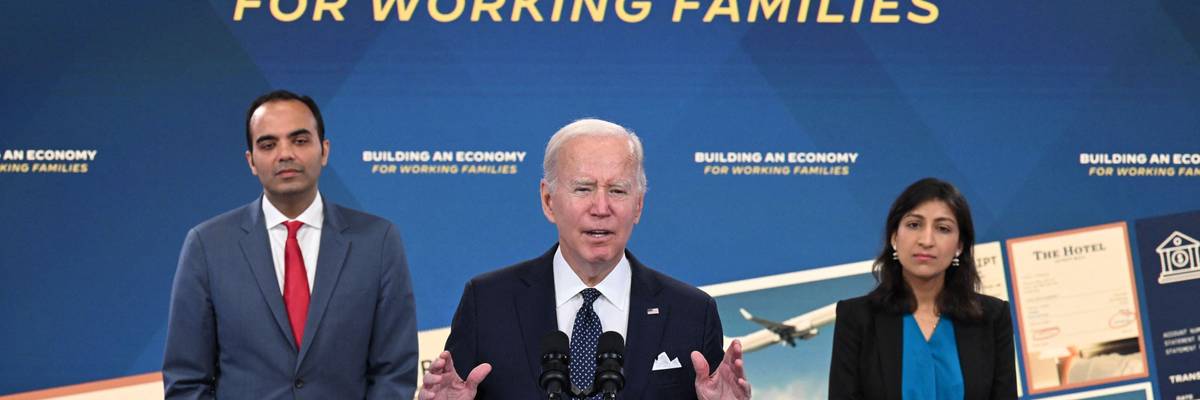
Consumer Financial Protection Bureau Director Rohit Chopra (L) and Federal Trade Commission Chair Lina Khan (R) listen as U.S. President Joe Biden speaks in Washington, D.C. on October 26, 2022.
A coalition of 25 progressive advocacy groups sent a letter Wednesday urging the Federal Trade Commission to immediately begin working on a rule to prohibit the use of non-compete clauses in employment contracts, arguing that such agreements disempower tens of millions of workers.
"Employers' use of non-compete clauses inflict real and substantial harms on the American worker and the overall U.S. economy without any legitimate justification," states the letter to the FTC. "By limiting workers' mobility, non-competes drive down wages, reduce the formation of new businesses, and keep workers stuck in unsafe or hostile workplaces."
"These one-sided contracts can also unfairly restrain competition in downstream markets by allowing dominant firms to hold on to specialized workers--think of monopolistic hospitals and surgeons," the groups wrote. "Instead of retaining workers through coercive non-compete clauses, employers should maintain a loyal workforce by offering good wages, regular raises and promotions, and fair treatment."
The coalition, which includes Public Citizen, AFL-CIO, and the National Employment Law Project, continued:
The FTC has made clear it is contemplating action, but time is running short. It is vital that the FTC begin the rulemaking process to signal to the public, courts, and corporate America that it is committed to fair competition in the labor market. Additionally, further delay in issuing an NPRM [notice of proposed rulemaking] may result in legal jeopardy. An NPRM is only the first step toward prohibiting non-compete clauses--reviewing and responding to comments and developing the final rule will take significant time. Lawmakers have historically depended on the Congressional Review Act to overturn agency actions with which they disagree. Should there be unified control of Congress and the White House following the 2024 election, any agency action completed in the second half of 2024 will be open to repeal.
The country is in the midst of a widespread re-empowerment of labor, [and] the Biden administration has made clear that reviving employer competition for workers' services is a key plank of its policy program. We cannot waste a historic opportunity to use federal authority to eliminate pernicious non-compete clauses. We call on the FTC to begin its important work by issuing a strong rule proposal now.
"President [Joe] Biden made clear in his executive order on competition that federal action on non-competes was a part of his administration's approach to keep labor markets fair and open," Matt Kent, competition policy advocate at Public Citizen and author of the letter, said in a statement, referring to a July 2021 directive from the White House.
"The FTC must follow through and start the process. Banning this pervasive anti-worker practice is urgent and will only become more challenging as we approach the uncertainty of the 2024 election cycle," he added. "It would be a tragedy for FTC to waste the moment. The time to issue a proposed rule is now."
Dear Common Dreams reader, It’s been nearly 30 years since I co-founded Common Dreams with my late wife, Lina Newhouser. We had the radical notion that journalism should serve the public good, not corporate profits. It was clear to us from the outset what it would take to build such a project. No paid advertisements. No corporate sponsors. No millionaire publisher telling us what to think or do. Many people said we wouldn't last a year, but we proved those doubters wrong. Together with a tremendous team of journalists and dedicated staff, we built an independent media outlet free from the constraints of profits and corporate control. Our mission has always been simple: To inform. To inspire. To ignite change for the common good. Building Common Dreams was not easy. Our survival was never guaranteed. When you take on the most powerful forces—Wall Street greed, fossil fuel industry destruction, Big Tech lobbyists, and uber-rich oligarchs who have spent billions upon billions rigging the economy and democracy in their favor—the only bulwark you have is supporters who believe in your work. But here’s the urgent message from me today. It's never been this bad out there. And it's never been this hard to keep us going. At the very moment Common Dreams is most needed, the threats we face are intensifying. We need your support now more than ever. We don't accept corporate advertising and never will. We don't have a paywall because we don't think people should be blocked from critical news based on their ability to pay. Everything we do is funded by the donations of readers like you. When everyone does the little they can afford, we are strong. But if that support retreats or dries up, so do we. Will you donate now to make sure Common Dreams not only survives but thrives? —Craig Brown, Co-founder |
A coalition of 25 progressive advocacy groups sent a letter Wednesday urging the Federal Trade Commission to immediately begin working on a rule to prohibit the use of non-compete clauses in employment contracts, arguing that such agreements disempower tens of millions of workers.
"Employers' use of non-compete clauses inflict real and substantial harms on the American worker and the overall U.S. economy without any legitimate justification," states the letter to the FTC. "By limiting workers' mobility, non-competes drive down wages, reduce the formation of new businesses, and keep workers stuck in unsafe or hostile workplaces."
"These one-sided contracts can also unfairly restrain competition in downstream markets by allowing dominant firms to hold on to specialized workers--think of monopolistic hospitals and surgeons," the groups wrote. "Instead of retaining workers through coercive non-compete clauses, employers should maintain a loyal workforce by offering good wages, regular raises and promotions, and fair treatment."
The coalition, which includes Public Citizen, AFL-CIO, and the National Employment Law Project, continued:
The FTC has made clear it is contemplating action, but time is running short. It is vital that the FTC begin the rulemaking process to signal to the public, courts, and corporate America that it is committed to fair competition in the labor market. Additionally, further delay in issuing an NPRM [notice of proposed rulemaking] may result in legal jeopardy. An NPRM is only the first step toward prohibiting non-compete clauses--reviewing and responding to comments and developing the final rule will take significant time. Lawmakers have historically depended on the Congressional Review Act to overturn agency actions with which they disagree. Should there be unified control of Congress and the White House following the 2024 election, any agency action completed in the second half of 2024 will be open to repeal.
The country is in the midst of a widespread re-empowerment of labor, [and] the Biden administration has made clear that reviving employer competition for workers' services is a key plank of its policy program. We cannot waste a historic opportunity to use federal authority to eliminate pernicious non-compete clauses. We call on the FTC to begin its important work by issuing a strong rule proposal now.
"President [Joe] Biden made clear in his executive order on competition that federal action on non-competes was a part of his administration's approach to keep labor markets fair and open," Matt Kent, competition policy advocate at Public Citizen and author of the letter, said in a statement, referring to a July 2021 directive from the White House.
"The FTC must follow through and start the process. Banning this pervasive anti-worker practice is urgent and will only become more challenging as we approach the uncertainty of the 2024 election cycle," he added. "It would be a tragedy for FTC to waste the moment. The time to issue a proposed rule is now."
A coalition of 25 progressive advocacy groups sent a letter Wednesday urging the Federal Trade Commission to immediately begin working on a rule to prohibit the use of non-compete clauses in employment contracts, arguing that such agreements disempower tens of millions of workers.
"Employers' use of non-compete clauses inflict real and substantial harms on the American worker and the overall U.S. economy without any legitimate justification," states the letter to the FTC. "By limiting workers' mobility, non-competes drive down wages, reduce the formation of new businesses, and keep workers stuck in unsafe or hostile workplaces."
"These one-sided contracts can also unfairly restrain competition in downstream markets by allowing dominant firms to hold on to specialized workers--think of monopolistic hospitals and surgeons," the groups wrote. "Instead of retaining workers through coercive non-compete clauses, employers should maintain a loyal workforce by offering good wages, regular raises and promotions, and fair treatment."
The coalition, which includes Public Citizen, AFL-CIO, and the National Employment Law Project, continued:
The FTC has made clear it is contemplating action, but time is running short. It is vital that the FTC begin the rulemaking process to signal to the public, courts, and corporate America that it is committed to fair competition in the labor market. Additionally, further delay in issuing an NPRM [notice of proposed rulemaking] may result in legal jeopardy. An NPRM is only the first step toward prohibiting non-compete clauses--reviewing and responding to comments and developing the final rule will take significant time. Lawmakers have historically depended on the Congressional Review Act to overturn agency actions with which they disagree. Should there be unified control of Congress and the White House following the 2024 election, any agency action completed in the second half of 2024 will be open to repeal.
The country is in the midst of a widespread re-empowerment of labor, [and] the Biden administration has made clear that reviving employer competition for workers' services is a key plank of its policy program. We cannot waste a historic opportunity to use federal authority to eliminate pernicious non-compete clauses. We call on the FTC to begin its important work by issuing a strong rule proposal now.
"President [Joe] Biden made clear in his executive order on competition that federal action on non-competes was a part of his administration's approach to keep labor markets fair and open," Matt Kent, competition policy advocate at Public Citizen and author of the letter, said in a statement, referring to a July 2021 directive from the White House.
"The FTC must follow through and start the process. Banning this pervasive anti-worker practice is urgent and will only become more challenging as we approach the uncertainty of the 2024 election cycle," he added. "It would be a tragedy for FTC to waste the moment. The time to issue a proposed rule is now."