

SUBSCRIBE TO OUR FREE NEWSLETTER
Daily news & progressive opinion—funded by the people, not the corporations—delivered straight to your inbox.
5
#000000
#FFFFFF
To donate by check, phone, or other method, see our More Ways to Give page.
Daily news & progressive opinion—funded by the people, not the corporations—delivered straight to your inbox.
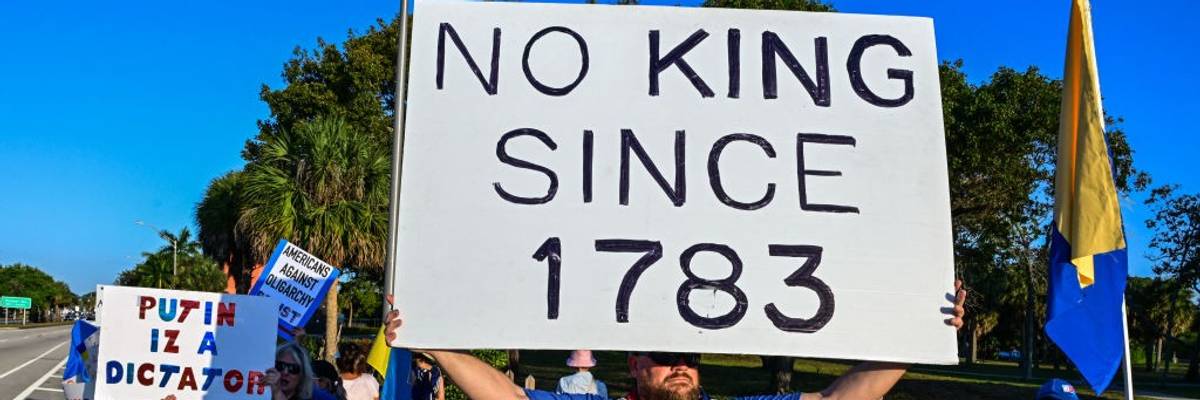
A man holds a "No King Since 1783" as activists attend the "Ukraine will never surrender" protest near US President Donald Trump's Mar-a-Lago resort in West Palm Beach, Florida, on March 14, 2025.
If this deportation case goes to the Supreme Court and the president ignores its ruling, every American should take to the street to secure his ouster.
After a federal judge pressed the Trump administration to provide evidence by 5 pm Monday about whether the White House had violated the court’s order in deporting migrants with little to no due process, so-called border czar Tom Homan said that the flights would continue regardless. “We’re not stopping,” he said. “I don’t care what the judges think.”
In our system, judges don’t just “think.” They have the final say, unless their rulings are appealed to the Supreme Court, in which case the high court’s majority has the final final say.
On Monday afternoon, it became apparent that Trump’s Justice Department shares Homan’s odd view of our judicial system. DOJ lawyers filed papers telling the judge that the administration would not provide any further information about the deportation flights, and that the court should vacate the hearing.
Later, speaking Monday evening on Fox News, Attorney General Pam Bondi criticized the judge, saying “What he’s done is an intrusion on the president’s authority.”
What’s going on here?
A very dangerous game.
On Sunday night, Trump told reporters that a federal judge in California who ordered the administration to rehire thousands of fired probationary workers was “putting himself in the position of the president of the United States, who was elected by close to 80 million votes.”
Excuse me? In our system of government, courts pass judgment on actions of a president and the executive branch. Courts don’t put themselves in the “position” of a president. They act as the Constitution empowers them to act — as a co-equal branch of government.
If the executive branch doesn’t agree with what a lower-court judge decides, it can appeal to a higher court and ultimately to the Supreme Court.
Trump isn’t the only one to make this unconstitutional claim. In early February, Trump’s vice president, JD Vance, declared that “judges aren’t allowed to control the executive’s legitimate power.” It was an odd statement coming from someone who has studied at one of America’s preeminent law schools — and it was logically absurd, since it’s up to judges (and eventually the Supreme Court’s justices) to determine a president’s “legitimate power.”
Let’s be clear. Trump has openly violated numerous laws and constitutional provisions — such as ending birthright citizenship; giving associates of Elon Musk’s government-slashing effort access to a sensitive Treasury Department system; transferring transgender female inmates to male prisons; placing thousands of U.S. Agency for International Development employees on leave; and effectively dismantling USAID and folding it into the State Department.
In response, federal judges have temporarily barred a slew of Trump orders from taking effect.
But not until now has Trump or his regime blatantly refused to follow a judge’s order.
What happens when this or another lower-court ruling goes to the Supreme Court, and the high court rules against Trump?
Vance has said that if this occurs, Trump should “stand before the country like Andrew Jackson did and say, ‘The chief justice has made his ruling. Now let him enforce it.’”
Never mind that the quote attributed to Jackson is, as one scholar has noted, “probably apocryphal.” It’s heard more and more from Trump appointees these days, as exemplified by Homan’s remark this morning and this afternoon’s Justice Department filing.
Trump’s appointments in his second term are having the opposite effect of his first-term appointees. In his first term, they restrained him somewhat. Recall that the Justice Department’s top brass threatened to resign en masse if he appointed as attorney general the one assistant attorney general who was prepared to sell his soul to Trump and say the 2020 election was stolen from him.
This time, his appointees are magnifying his worst instincts. Rather than act as guardrails, they are egging Trump on.
Many people wonder if we’re in a “constitutional crisis.” Definitions of that phrase vary considerably, as do opinions about whether we’re in one now.
My worry is that Trump is surrounded by extremist anti-democracy nihilists, including his vice president, who are encouraging him to defy the Supreme Court.
If and when he does, we’ll be in a constitutional crisis that should cause every American to take to the streets.
Dear Common Dreams reader, It’s been nearly 30 years since I co-founded Common Dreams with my late wife, Lina Newhouser. We had the radical notion that journalism should serve the public good, not corporate profits. It was clear to us from the outset what it would take to build such a project. No paid advertisements. No corporate sponsors. No millionaire publisher telling us what to think or do. Many people said we wouldn't last a year, but we proved those doubters wrong. Together with a tremendous team of journalists and dedicated staff, we built an independent media outlet free from the constraints of profits and corporate control. Our mission has always been simple: To inform. To inspire. To ignite change for the common good. Building Common Dreams was not easy. Our survival was never guaranteed. When you take on the most powerful forces—Wall Street greed, fossil fuel industry destruction, Big Tech lobbyists, and uber-rich oligarchs who have spent billions upon billions rigging the economy and democracy in their favor—the only bulwark you have is supporters who believe in your work. But here’s the urgent message from me today. It's never been this bad out there. And it's never been this hard to keep us going. At the very moment Common Dreams is most needed, the threats we face are intensifying. We need your support now more than ever. We don't accept corporate advertising and never will. We don't have a paywall because we don't think people should be blocked from critical news based on their ability to pay. Everything we do is funded by the donations of readers like you. When everyone does the little they can afford, we are strong. But if that support retreats or dries up, so do we. Will you donate now to make sure Common Dreams not only survives but thrives? —Craig Brown, Co-founder |
After a federal judge pressed the Trump administration to provide evidence by 5 pm Monday about whether the White House had violated the court’s order in deporting migrants with little to no due process, so-called border czar Tom Homan said that the flights would continue regardless. “We’re not stopping,” he said. “I don’t care what the judges think.”
In our system, judges don’t just “think.” They have the final say, unless their rulings are appealed to the Supreme Court, in which case the high court’s majority has the final final say.
On Monday afternoon, it became apparent that Trump’s Justice Department shares Homan’s odd view of our judicial system. DOJ lawyers filed papers telling the judge that the administration would not provide any further information about the deportation flights, and that the court should vacate the hearing.
Later, speaking Monday evening on Fox News, Attorney General Pam Bondi criticized the judge, saying “What he’s done is an intrusion on the president’s authority.”
What’s going on here?
A very dangerous game.
On Sunday night, Trump told reporters that a federal judge in California who ordered the administration to rehire thousands of fired probationary workers was “putting himself in the position of the president of the United States, who was elected by close to 80 million votes.”
Excuse me? In our system of government, courts pass judgment on actions of a president and the executive branch. Courts don’t put themselves in the “position” of a president. They act as the Constitution empowers them to act — as a co-equal branch of government.
If the executive branch doesn’t agree with what a lower-court judge decides, it can appeal to a higher court and ultimately to the Supreme Court.
Trump isn’t the only one to make this unconstitutional claim. In early February, Trump’s vice president, JD Vance, declared that “judges aren’t allowed to control the executive’s legitimate power.” It was an odd statement coming from someone who has studied at one of America’s preeminent law schools — and it was logically absurd, since it’s up to judges (and eventually the Supreme Court’s justices) to determine a president’s “legitimate power.”
Let’s be clear. Trump has openly violated numerous laws and constitutional provisions — such as ending birthright citizenship; giving associates of Elon Musk’s government-slashing effort access to a sensitive Treasury Department system; transferring transgender female inmates to male prisons; placing thousands of U.S. Agency for International Development employees on leave; and effectively dismantling USAID and folding it into the State Department.
In response, federal judges have temporarily barred a slew of Trump orders from taking effect.
But not until now has Trump or his regime blatantly refused to follow a judge’s order.
What happens when this or another lower-court ruling goes to the Supreme Court, and the high court rules against Trump?
Vance has said that if this occurs, Trump should “stand before the country like Andrew Jackson did and say, ‘The chief justice has made his ruling. Now let him enforce it.’”
Never mind that the quote attributed to Jackson is, as one scholar has noted, “probably apocryphal.” It’s heard more and more from Trump appointees these days, as exemplified by Homan’s remark this morning and this afternoon’s Justice Department filing.
Trump’s appointments in his second term are having the opposite effect of his first-term appointees. In his first term, they restrained him somewhat. Recall that the Justice Department’s top brass threatened to resign en masse if he appointed as attorney general the one assistant attorney general who was prepared to sell his soul to Trump and say the 2020 election was stolen from him.
This time, his appointees are magnifying his worst instincts. Rather than act as guardrails, they are egging Trump on.
Many people wonder if we’re in a “constitutional crisis.” Definitions of that phrase vary considerably, as do opinions about whether we’re in one now.
My worry is that Trump is surrounded by extremist anti-democracy nihilists, including his vice president, who are encouraging him to defy the Supreme Court.
If and when he does, we’ll be in a constitutional crisis that should cause every American to take to the streets.
After a federal judge pressed the Trump administration to provide evidence by 5 pm Monday about whether the White House had violated the court’s order in deporting migrants with little to no due process, so-called border czar Tom Homan said that the flights would continue regardless. “We’re not stopping,” he said. “I don’t care what the judges think.”
In our system, judges don’t just “think.” They have the final say, unless their rulings are appealed to the Supreme Court, in which case the high court’s majority has the final final say.
On Monday afternoon, it became apparent that Trump’s Justice Department shares Homan’s odd view of our judicial system. DOJ lawyers filed papers telling the judge that the administration would not provide any further information about the deportation flights, and that the court should vacate the hearing.
Later, speaking Monday evening on Fox News, Attorney General Pam Bondi criticized the judge, saying “What he’s done is an intrusion on the president’s authority.”
What’s going on here?
A very dangerous game.
On Sunday night, Trump told reporters that a federal judge in California who ordered the administration to rehire thousands of fired probationary workers was “putting himself in the position of the president of the United States, who was elected by close to 80 million votes.”
Excuse me? In our system of government, courts pass judgment on actions of a president and the executive branch. Courts don’t put themselves in the “position” of a president. They act as the Constitution empowers them to act — as a co-equal branch of government.
If the executive branch doesn’t agree with what a lower-court judge decides, it can appeal to a higher court and ultimately to the Supreme Court.
Trump isn’t the only one to make this unconstitutional claim. In early February, Trump’s vice president, JD Vance, declared that “judges aren’t allowed to control the executive’s legitimate power.” It was an odd statement coming from someone who has studied at one of America’s preeminent law schools — and it was logically absurd, since it’s up to judges (and eventually the Supreme Court’s justices) to determine a president’s “legitimate power.”
Let’s be clear. Trump has openly violated numerous laws and constitutional provisions — such as ending birthright citizenship; giving associates of Elon Musk’s government-slashing effort access to a sensitive Treasury Department system; transferring transgender female inmates to male prisons; placing thousands of U.S. Agency for International Development employees on leave; and effectively dismantling USAID and folding it into the State Department.
In response, federal judges have temporarily barred a slew of Trump orders from taking effect.
But not until now has Trump or his regime blatantly refused to follow a judge’s order.
What happens when this or another lower-court ruling goes to the Supreme Court, and the high court rules against Trump?
Vance has said that if this occurs, Trump should “stand before the country like Andrew Jackson did and say, ‘The chief justice has made his ruling. Now let him enforce it.’”
Never mind that the quote attributed to Jackson is, as one scholar has noted, “probably apocryphal.” It’s heard more and more from Trump appointees these days, as exemplified by Homan’s remark this morning and this afternoon’s Justice Department filing.
Trump’s appointments in his second term are having the opposite effect of his first-term appointees. In his first term, they restrained him somewhat. Recall that the Justice Department’s top brass threatened to resign en masse if he appointed as attorney general the one assistant attorney general who was prepared to sell his soul to Trump and say the 2020 election was stolen from him.
This time, his appointees are magnifying his worst instincts. Rather than act as guardrails, they are egging Trump on.
Many people wonder if we’re in a “constitutional crisis.” Definitions of that phrase vary considerably, as do opinions about whether we’re in one now.
My worry is that Trump is surrounded by extremist anti-democracy nihilists, including his vice president, who are encouraging him to defy the Supreme Court.
If and when he does, we’ll be in a constitutional crisis that should cause every American to take to the streets.

