

SUBSCRIBE TO OUR FREE NEWSLETTER
Daily news & progressive opinion—funded by the people, not the corporations—delivered straight to your inbox.
5
#000000
#FFFFFF
To donate by check, phone, or other method, see our More Ways to Give page.
Daily news & progressive opinion—funded by the people, not the corporations—delivered straight to your inbox.
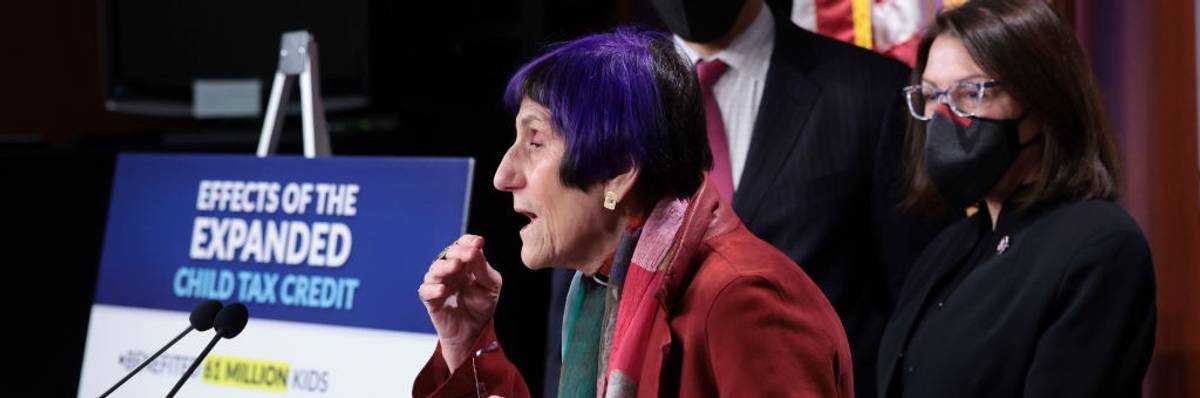
Rep. Rosa DeLaura (L) (D-Conn.) speaks during a press conference at the U.S. Capitol February 8, 2022, in Washington, D.C. on renewing the Child Tax Credit.
A bill introduced by Rep. Rosa DeLauro is similar to the pandemic expansion of the CTC, which reduced child poverty nearly by half in the short time it was active.
When I was born into poverty, the deck was stacked against me in all aspects of life—from educational opportunities and health care to the future earnings I could expect. Now I’ve graduated from college and I’m poised to start my first post-college job.
What made the difference? Hard work, yes—but also public investment. Public programs helped keep me fed, healthy, and learning as I grew up. Kids growing up today deserve the same chance.
SNAP benefits allowed me to eat breakfast before school, eat dinner after work, and ensured that food would not be added to my list of anxieties. Programs like Free and Reduced Meals made sure I got lunch at school, too.
We’ve seen that expanding the Child Tax Credit works. So choosing not to will harm children’s development and widen the educational disparities we already see in this country based on race and class.
Medicaid allowed me to be a healthy student. It covered visits to my dentist, who identified two tooth infections before they spread to my brain. It made sure I could see my doctor, who diagnosed me with asthma so I could get treatment and play sports with other kids.
Funding for Advanced Placement exams at my low-income Title I school helped me prepare for college. And with my family’s income falling far short of tuition costs, the Pell Grant program allowed me to pursue a college education—and escape generational poverty.
Without this help, I wouldn’t have become the first person in my father’s family to graduate high school—nor the first person in my entire family to graduate college. Our safety net is still frayed and underfunded, and escaping poverty is still the exception. But my story shows what’s possible when we’re given equitable resources and opportunities to succeed.
One new policy could make even greater strides towards equity—if it can overcome fierce opposition from conservative lawmakers.
Rep. Rosa DeLauro (D-Conn.) has introduced legislation that would increase the Child Tax Credit (CTC) to $3,000 for children ages 6-17 and to $3,600 for children under 5. DeLauro’s proposal would deliver installments of that credit monthly (rather than once a year at tax time) and make it fully refundable so the lowest income families are eligible for the full value.
This proposal is similar to the pandemic expansion of the CTC, which reduced child poverty nearly by half in the short time it was active.
The Brookings Institution uncovered that the credit was particularly effective in conservative, high poverty states such as West Virginia, Oklahoma, and Alabama. But when conservative lawmakers let it expire at the end of 2021, the expanded CTC expired and sent 3.7 million children into poverty.
According to the Institute on Taxation and Economic Policy, expanding the CTC again would benefit more than 60 million children, especially those with the lowest incomes.
The CTC also has powerful implications for racial justice. The Center for Budget and Policy Priorities found that roughly half of Black children, 40% of Indigenous children, 40% of Latinx children, 17% of white children, and 15% of Asian children get less than the full credit—or no credit at all. Expanding it would narrow racial economic divides while benefiting kids of every race.
Opponents of the CTC argue that it will discourage parents from working. However, most studies predict that 99% of working parents will continue to work. The tangible benefits to children living in poverty outweigh these hypothetical, unproven complaints.
We’ve seen that expanding the Child Tax Credit works. So choosing not to will harm children’s development and widen the educational disparities we already see in this country based on race and class. In an already uneven playing field, programs like this have the opportunity to give low-income students a chance to succeed.
To give more kids a chance to escape poverty, we need to invest in the kids who need it the most. Now we have another chance to get it right.
Dear Common Dreams reader, It’s been nearly 30 years since I co-founded Common Dreams with my late wife, Lina Newhouser. We had the radical notion that journalism should serve the public good, not corporate profits. It was clear to us from the outset what it would take to build such a project. No paid advertisements. No corporate sponsors. No millionaire publisher telling us what to think or do. Many people said we wouldn't last a year, but we proved those doubters wrong. Together with a tremendous team of journalists and dedicated staff, we built an independent media outlet free from the constraints of profits and corporate control. Our mission has always been simple: To inform. To inspire. To ignite change for the common good. Building Common Dreams was not easy. Our survival was never guaranteed. When you take on the most powerful forces—Wall Street greed, fossil fuel industry destruction, Big Tech lobbyists, and uber-rich oligarchs who have spent billions upon billions rigging the economy and democracy in their favor—the only bulwark you have is supporters who believe in your work. But here’s the urgent message from me today. It's never been this bad out there. And it's never been this hard to keep us going. At the very moment Common Dreams is most needed, the threats we face are intensifying. We need your support now more than ever. We don't accept corporate advertising and never will. We don't have a paywall because we don't think people should be blocked from critical news based on their ability to pay. Everything we do is funded by the donations of readers like you. When everyone does the little they can afford, we are strong. But if that support retreats or dries up, so do we. Will you donate now to make sure Common Dreams not only survives but thrives? —Craig Brown, Co-founder |
When I was born into poverty, the deck was stacked against me in all aspects of life—from educational opportunities and health care to the future earnings I could expect. Now I’ve graduated from college and I’m poised to start my first post-college job.
What made the difference? Hard work, yes—but also public investment. Public programs helped keep me fed, healthy, and learning as I grew up. Kids growing up today deserve the same chance.
SNAP benefits allowed me to eat breakfast before school, eat dinner after work, and ensured that food would not be added to my list of anxieties. Programs like Free and Reduced Meals made sure I got lunch at school, too.
We’ve seen that expanding the Child Tax Credit works. So choosing not to will harm children’s development and widen the educational disparities we already see in this country based on race and class.
Medicaid allowed me to be a healthy student. It covered visits to my dentist, who identified two tooth infections before they spread to my brain. It made sure I could see my doctor, who diagnosed me with asthma so I could get treatment and play sports with other kids.
Funding for Advanced Placement exams at my low-income Title I school helped me prepare for college. And with my family’s income falling far short of tuition costs, the Pell Grant program allowed me to pursue a college education—and escape generational poverty.
Without this help, I wouldn’t have become the first person in my father’s family to graduate high school—nor the first person in my entire family to graduate college. Our safety net is still frayed and underfunded, and escaping poverty is still the exception. But my story shows what’s possible when we’re given equitable resources and opportunities to succeed.
One new policy could make even greater strides towards equity—if it can overcome fierce opposition from conservative lawmakers.
Rep. Rosa DeLauro (D-Conn.) has introduced legislation that would increase the Child Tax Credit (CTC) to $3,000 for children ages 6-17 and to $3,600 for children under 5. DeLauro’s proposal would deliver installments of that credit monthly (rather than once a year at tax time) and make it fully refundable so the lowest income families are eligible for the full value.
This proposal is similar to the pandemic expansion of the CTC, which reduced child poverty nearly by half in the short time it was active.
The Brookings Institution uncovered that the credit was particularly effective in conservative, high poverty states such as West Virginia, Oklahoma, and Alabama. But when conservative lawmakers let it expire at the end of 2021, the expanded CTC expired and sent 3.7 million children into poverty.
According to the Institute on Taxation and Economic Policy, expanding the CTC again would benefit more than 60 million children, especially those with the lowest incomes.
The CTC also has powerful implications for racial justice. The Center for Budget and Policy Priorities found that roughly half of Black children, 40% of Indigenous children, 40% of Latinx children, 17% of white children, and 15% of Asian children get less than the full credit—or no credit at all. Expanding it would narrow racial economic divides while benefiting kids of every race.
Opponents of the CTC argue that it will discourage parents from working. However, most studies predict that 99% of working parents will continue to work. The tangible benefits to children living in poverty outweigh these hypothetical, unproven complaints.
We’ve seen that expanding the Child Tax Credit works. So choosing not to will harm children’s development and widen the educational disparities we already see in this country based on race and class. In an already uneven playing field, programs like this have the opportunity to give low-income students a chance to succeed.
To give more kids a chance to escape poverty, we need to invest in the kids who need it the most. Now we have another chance to get it right.
When I was born into poverty, the deck was stacked against me in all aspects of life—from educational opportunities and health care to the future earnings I could expect. Now I’ve graduated from college and I’m poised to start my first post-college job.
What made the difference? Hard work, yes—but also public investment. Public programs helped keep me fed, healthy, and learning as I grew up. Kids growing up today deserve the same chance.
SNAP benefits allowed me to eat breakfast before school, eat dinner after work, and ensured that food would not be added to my list of anxieties. Programs like Free and Reduced Meals made sure I got lunch at school, too.
We’ve seen that expanding the Child Tax Credit works. So choosing not to will harm children’s development and widen the educational disparities we already see in this country based on race and class.
Medicaid allowed me to be a healthy student. It covered visits to my dentist, who identified two tooth infections before they spread to my brain. It made sure I could see my doctor, who diagnosed me with asthma so I could get treatment and play sports with other kids.
Funding for Advanced Placement exams at my low-income Title I school helped me prepare for college. And with my family’s income falling far short of tuition costs, the Pell Grant program allowed me to pursue a college education—and escape generational poverty.
Without this help, I wouldn’t have become the first person in my father’s family to graduate high school—nor the first person in my entire family to graduate college. Our safety net is still frayed and underfunded, and escaping poverty is still the exception. But my story shows what’s possible when we’re given equitable resources and opportunities to succeed.
One new policy could make even greater strides towards equity—if it can overcome fierce opposition from conservative lawmakers.
Rep. Rosa DeLauro (D-Conn.) has introduced legislation that would increase the Child Tax Credit (CTC) to $3,000 for children ages 6-17 and to $3,600 for children under 5. DeLauro’s proposal would deliver installments of that credit monthly (rather than once a year at tax time) and make it fully refundable so the lowest income families are eligible for the full value.
This proposal is similar to the pandemic expansion of the CTC, which reduced child poverty nearly by half in the short time it was active.
The Brookings Institution uncovered that the credit was particularly effective in conservative, high poverty states such as West Virginia, Oklahoma, and Alabama. But when conservative lawmakers let it expire at the end of 2021, the expanded CTC expired and sent 3.7 million children into poverty.
According to the Institute on Taxation and Economic Policy, expanding the CTC again would benefit more than 60 million children, especially those with the lowest incomes.
The CTC also has powerful implications for racial justice. The Center for Budget and Policy Priorities found that roughly half of Black children, 40% of Indigenous children, 40% of Latinx children, 17% of white children, and 15% of Asian children get less than the full credit—or no credit at all. Expanding it would narrow racial economic divides while benefiting kids of every race.
Opponents of the CTC argue that it will discourage parents from working. However, most studies predict that 99% of working parents will continue to work. The tangible benefits to children living in poverty outweigh these hypothetical, unproven complaints.
We’ve seen that expanding the Child Tax Credit works. So choosing not to will harm children’s development and widen the educational disparities we already see in this country based on race and class. In an already uneven playing field, programs like this have the opportunity to give low-income students a chance to succeed.
To give more kids a chance to escape poverty, we need to invest in the kids who need it the most. Now we have another chance to get it right.

