SUBSCRIBE TO OUR FREE NEWSLETTER
Daily news & progressive opinion—funded by the people, not the corporations—delivered straight to your inbox.
5
#000000
#FFFFFF
To donate by check, phone, or other method, see our More Ways to Give page.
Daily news & progressive opinion—funded by the people, not the corporations—delivered straight to your inbox.
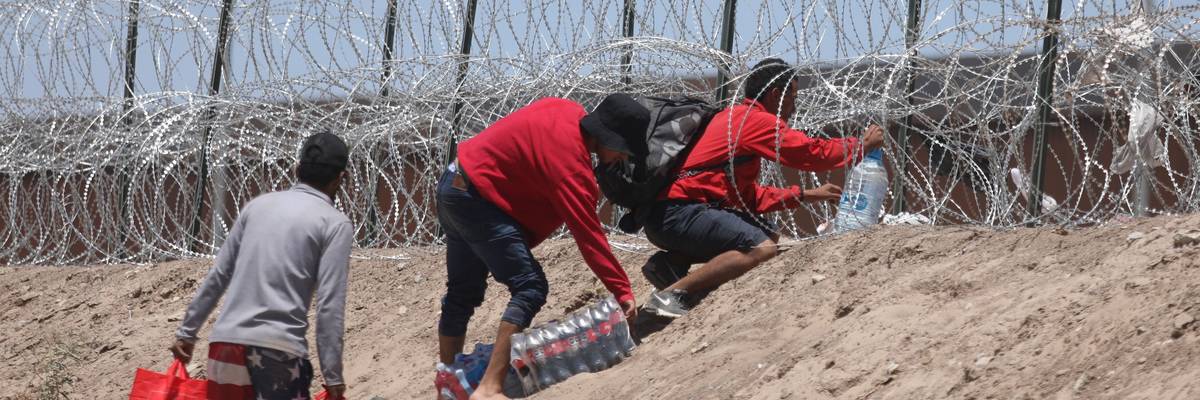
Migrant people cross on the banks of the Rio Grande as they wait to be processed by the Border Patrol of El Paso Sector, Texas, after crossing from Ciudad Juarez, Mexico on May 11, 2023.
The possibility of nuclear war plus the continuing reality of climate change ought to push all of us beyond the borders of our minds. These matters will only be solved collectively: trans-nationally. And we must solve them.
“While there is broad support across the political spectrum for removing criminal aliens...”
Screech! My connection to the words I’m reading grinds to a sudden halt, an inner alarm goes off, I look away from my computer screen and briefly clutch my soul. Oh God...
The words are from a Forbes article highly critical of Stephen Miller, President Donald Trump’s deporter-in-chief. I was mostly in sync with it as I read. Indeed, the above sentence continues, pointing out that “the vast majority of individuals in the country without legal status have not committed serious crimes.”
Yeah, absolutely. So what’s my problem here? It amounts to this: A false, unchallenged assumption quietly emerged, manifested in the word “aliens.” Do we support the rights of aliens or do we just want them (and their children) dragged out of the United States, especially if they’re non-white? Apparently, this is the context of the major debate of the moment. Who belongs here? What remains unquestioned in the article is the significance of an imaginary line, known as the border, without which there would be no such thing as aliens. The line separates “us” from the rest of the world and severely trivializes the scope of the debate.
My call in this moment is for humanity, especially those who define themselves as Americans, to stand up not just to Trump and Miller and Immigration and Customs Enforcement, but to the false reality of nationalism itself.
But a planet divided into nations is just the way things are, right? This is certainly not questioned politically. But my scream in this moment is for the media, mainstream or otherwise, to look beyond the assumed certainty of nationalism, however discomforting that may seem, and acknowledge that the human race has no “aliens.”
The larger reality here—understood by anyone with a brain—is that this is one planet. One planet! We are a collective whole. All of us are connected. I do not write these words with naïveté. Knowing this is simply the starting point, as we continue to evolve. I’m not downplaying the need we all feel for security, just eliminating the word “national” from the phrase.
As Karabi Acharya writes: “In fact, over half of all national borders were created in the 20th century. The creation of borders is for the most part a sad history marked by conflict, colonialism, and war. Borders create unnecessary and harmful barriers not just between people and resources but also ideas.”
Yeah, war—in the nuclear age. The Bulletin of the Atomic Scientists recently moved its metaphorical Doomsday Clock to 85 seconds to midnight, as close to the zero hour as it’s ever been. The possibility of nuclear war plus the continuing reality of climate change ought to push all of us beyond the borders of our minds. These matters will only be solved collectively: trans-nationally. And we must solve them.
Acharya goes on:
Finally, and perhaps most importantly, there is a moral imperative to be open to new ideas from around the world and to question the origins of old ideas we take for granted. Global learning provides an important inflection point to question the morality of how and who decides what knowledge others see and share.
Not only have borders been historical constructs of wealth and power; they unfairly reflect whose ideas have mattered, what languages have been preferred. As places throughout history have been colonized, people were told that their own traditions don't matter and what’s important, what is to be prioritized, are the norms and concepts of the colonizers. Part of the process of setting up borders includes erasing not only people but other knowledge traditions.
I understand that national governments need borders to continue to exist, at least as they understand themselves. The world’s governments—in particular, the American government—need the help of we the people. My call in this moment is for humanity, especially those who define themselves as Americans, to stand up not just to Trump and Miller and Immigration and Customs Enforcement, but to the false reality of nationalism itself. How do we open the borders of this planet? How do we start acknowledging, and healing, the consequences of two-plus millennia of colonial land theft? How do we start valuing—and learning from—those who are different from us?
What if we began opening our borders? What if we began governing nonviolently... with respect and awe for our world and its occupants? Perhaps we’d start freeing ourselves from the suicidal hell we’re caught in today. We’d definitely start pushing the hands of the Doomsday Clock backwards.
Dear Common Dreams reader, It’s been nearly 30 years since I co-founded Common Dreams with my late wife, Lina Newhouser. We had the radical notion that journalism should serve the public good, not corporate profits. It was clear to us from the outset what it would take to build such a project. No paid advertisements. No corporate sponsors. No millionaire publisher telling us what to think or do. Many people said we wouldn't last a year, but we proved those doubters wrong. Together with a tremendous team of journalists and dedicated staff, we built an independent media outlet free from the constraints of profits and corporate control. Our mission has always been simple: To inform. To inspire. To ignite change for the common good. Building Common Dreams was not easy. Our survival was never guaranteed. When you take on the most powerful forces—Wall Street greed, fossil fuel industry destruction, Big Tech lobbyists, and uber-rich oligarchs who have spent billions upon billions rigging the economy and democracy in their favor—the only bulwark you have is supporters who believe in your work. But here’s the urgent message from me today. It's never been this bad out there. And it's never been this hard to keep us going. At the very moment Common Dreams is most needed, the threats we face are intensifying. We need your support now more than ever. We don't accept corporate advertising and never will. We don't have a paywall because we don't think people should be blocked from critical news based on their ability to pay. Everything we do is funded by the donations of readers like you. When everyone does the little they can afford, we are strong. But if that support retreats or dries up, so do we. Will you donate now to make sure Common Dreams not only survives but thrives? —Craig Brown, Co-founder |
“While there is broad support across the political spectrum for removing criminal aliens...”
Screech! My connection to the words I’m reading grinds to a sudden halt, an inner alarm goes off, I look away from my computer screen and briefly clutch my soul. Oh God...
The words are from a Forbes article highly critical of Stephen Miller, President Donald Trump’s deporter-in-chief. I was mostly in sync with it as I read. Indeed, the above sentence continues, pointing out that “the vast majority of individuals in the country without legal status have not committed serious crimes.”
Yeah, absolutely. So what’s my problem here? It amounts to this: A false, unchallenged assumption quietly emerged, manifested in the word “aliens.” Do we support the rights of aliens or do we just want them (and their children) dragged out of the United States, especially if they’re non-white? Apparently, this is the context of the major debate of the moment. Who belongs here? What remains unquestioned in the article is the significance of an imaginary line, known as the border, without which there would be no such thing as aliens. The line separates “us” from the rest of the world and severely trivializes the scope of the debate.
My call in this moment is for humanity, especially those who define themselves as Americans, to stand up not just to Trump and Miller and Immigration and Customs Enforcement, but to the false reality of nationalism itself.
But a planet divided into nations is just the way things are, right? This is certainly not questioned politically. But my scream in this moment is for the media, mainstream or otherwise, to look beyond the assumed certainty of nationalism, however discomforting that may seem, and acknowledge that the human race has no “aliens.”
The larger reality here—understood by anyone with a brain—is that this is one planet. One planet! We are a collective whole. All of us are connected. I do not write these words with naïveté. Knowing this is simply the starting point, as we continue to evolve. I’m not downplaying the need we all feel for security, just eliminating the word “national” from the phrase.
As Karabi Acharya writes: “In fact, over half of all national borders were created in the 20th century. The creation of borders is for the most part a sad history marked by conflict, colonialism, and war. Borders create unnecessary and harmful barriers not just between people and resources but also ideas.”
Yeah, war—in the nuclear age. The Bulletin of the Atomic Scientists recently moved its metaphorical Doomsday Clock to 85 seconds to midnight, as close to the zero hour as it’s ever been. The possibility of nuclear war plus the continuing reality of climate change ought to push all of us beyond the borders of our minds. These matters will only be solved collectively: trans-nationally. And we must solve them.
Acharya goes on:
Finally, and perhaps most importantly, there is a moral imperative to be open to new ideas from around the world and to question the origins of old ideas we take for granted. Global learning provides an important inflection point to question the morality of how and who decides what knowledge others see and share.
Not only have borders been historical constructs of wealth and power; they unfairly reflect whose ideas have mattered, what languages have been preferred. As places throughout history have been colonized, people were told that their own traditions don't matter and what’s important, what is to be prioritized, are the norms and concepts of the colonizers. Part of the process of setting up borders includes erasing not only people but other knowledge traditions.
I understand that national governments need borders to continue to exist, at least as they understand themselves. The world’s governments—in particular, the American government—need the help of we the people. My call in this moment is for humanity, especially those who define themselves as Americans, to stand up not just to Trump and Miller and Immigration and Customs Enforcement, but to the false reality of nationalism itself. How do we open the borders of this planet? How do we start acknowledging, and healing, the consequences of two-plus millennia of colonial land theft? How do we start valuing—and learning from—those who are different from us?
What if we began opening our borders? What if we began governing nonviolently... with respect and awe for our world and its occupants? Perhaps we’d start freeing ourselves from the suicidal hell we’re caught in today. We’d definitely start pushing the hands of the Doomsday Clock backwards.
“While there is broad support across the political spectrum for removing criminal aliens...”
Screech! My connection to the words I’m reading grinds to a sudden halt, an inner alarm goes off, I look away from my computer screen and briefly clutch my soul. Oh God...
The words are from a Forbes article highly critical of Stephen Miller, President Donald Trump’s deporter-in-chief. I was mostly in sync with it as I read. Indeed, the above sentence continues, pointing out that “the vast majority of individuals in the country without legal status have not committed serious crimes.”
Yeah, absolutely. So what’s my problem here? It amounts to this: A false, unchallenged assumption quietly emerged, manifested in the word “aliens.” Do we support the rights of aliens or do we just want them (and their children) dragged out of the United States, especially if they’re non-white? Apparently, this is the context of the major debate of the moment. Who belongs here? What remains unquestioned in the article is the significance of an imaginary line, known as the border, without which there would be no such thing as aliens. The line separates “us” from the rest of the world and severely trivializes the scope of the debate.
My call in this moment is for humanity, especially those who define themselves as Americans, to stand up not just to Trump and Miller and Immigration and Customs Enforcement, but to the false reality of nationalism itself.
But a planet divided into nations is just the way things are, right? This is certainly not questioned politically. But my scream in this moment is for the media, mainstream or otherwise, to look beyond the assumed certainty of nationalism, however discomforting that may seem, and acknowledge that the human race has no “aliens.”
The larger reality here—understood by anyone with a brain—is that this is one planet. One planet! We are a collective whole. All of us are connected. I do not write these words with naïveté. Knowing this is simply the starting point, as we continue to evolve. I’m not downplaying the need we all feel for security, just eliminating the word “national” from the phrase.
As Karabi Acharya writes: “In fact, over half of all national borders were created in the 20th century. The creation of borders is for the most part a sad history marked by conflict, colonialism, and war. Borders create unnecessary and harmful barriers not just between people and resources but also ideas.”
Yeah, war—in the nuclear age. The Bulletin of the Atomic Scientists recently moved its metaphorical Doomsday Clock to 85 seconds to midnight, as close to the zero hour as it’s ever been. The possibility of nuclear war plus the continuing reality of climate change ought to push all of us beyond the borders of our minds. These matters will only be solved collectively: trans-nationally. And we must solve them.
Acharya goes on:
Finally, and perhaps most importantly, there is a moral imperative to be open to new ideas from around the world and to question the origins of old ideas we take for granted. Global learning provides an important inflection point to question the morality of how and who decides what knowledge others see and share.
Not only have borders been historical constructs of wealth and power; they unfairly reflect whose ideas have mattered, what languages have been preferred. As places throughout history have been colonized, people were told that their own traditions don't matter and what’s important, what is to be prioritized, are the norms and concepts of the colonizers. Part of the process of setting up borders includes erasing not only people but other knowledge traditions.
I understand that national governments need borders to continue to exist, at least as they understand themselves. The world’s governments—in particular, the American government—need the help of we the people. My call in this moment is for humanity, especially those who define themselves as Americans, to stand up not just to Trump and Miller and Immigration and Customs Enforcement, but to the false reality of nationalism itself. How do we open the borders of this planet? How do we start acknowledging, and healing, the consequences of two-plus millennia of colonial land theft? How do we start valuing—and learning from—those who are different from us?
What if we began opening our borders? What if we began governing nonviolently... with respect and awe for our world and its occupants? Perhaps we’d start freeing ourselves from the suicidal hell we’re caught in today. We’d definitely start pushing the hands of the Doomsday Clock backwards.