SUBSCRIBE TO OUR FREE NEWSLETTER
Daily news & progressive opinion—funded by the people, not the corporations—delivered straight to your inbox.
5
#000000
#FFFFFF
To donate by check, phone, or other method, see our More Ways to Give page.
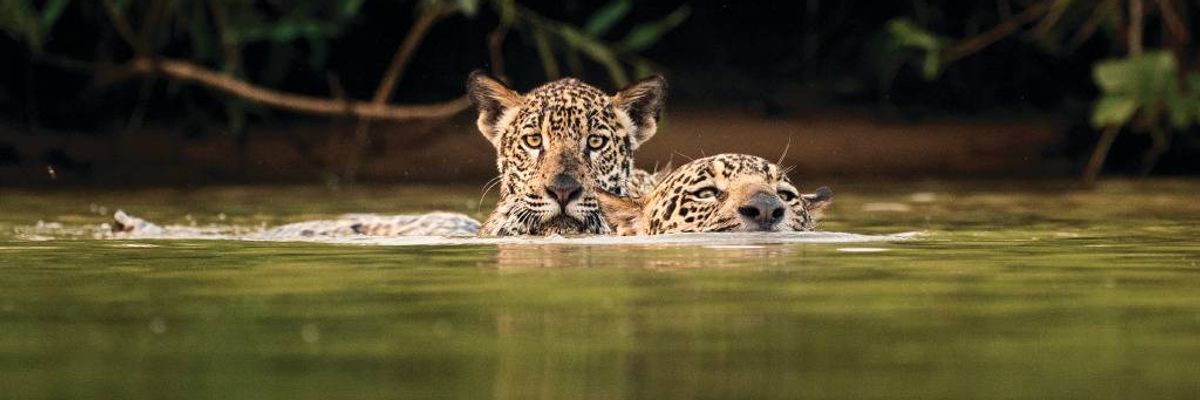
Across the world, efforts to reintroduce imperiled animals to their natural habitats have gained momentum, but in the Madrean Sky Islands of Arizona, jaguars are doing it on their own.
Less than a month ago, Chris Schnaufer, a citizen scientist volunteer with the University of Arizona Wild Cat Research and Conservation Center, and another volunteer, were checking one of their remote trail cameras. Schnaufer, a long-distance hiker, often got the center’s toughest assignments, and both men were tired when they reached the mountain camera site. They replaced batteries and collected the SD card and hiked back to the trailhead. That night, at home, Schnaufer scrolled through the images of deer, bear, bobcats, mountain lions, foxes, owls, skunks, and a coatimundi. And then, there it was, in the semidarkness of early morning, the striking image of a jaguar drinking from a waterhole. The photos showed its muscular shoulder and its distinctive inky-black rosettes.
When the University of Arizona Wild Cat Research and Conservation Center released the photographs of the jaguar roaming the rugged mountains of southern Arizona, it confirmed that it was a never-before-recorded big cat. Jaguars have their own unique markings, as singular as a human’s fingerprint, and this was one new to the center’s database. Though it has not yet identified its sex, the center is calling it Jaguar No. 5, dubbed Cinco, the fifth jaguar to be photographed in the Sky Islands since 2011, the second one discovered since 2023, and the ninth one spotted in the US since 1996.
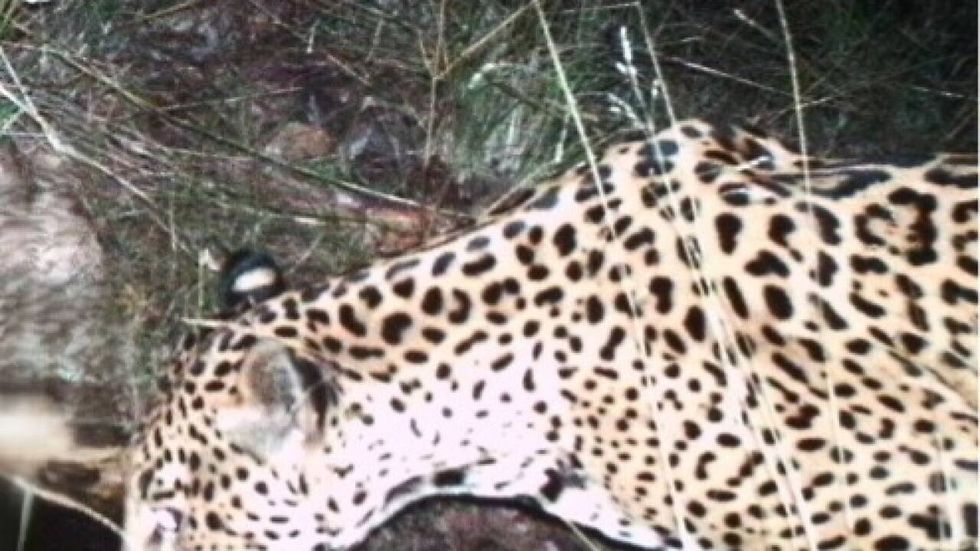 Jaguar No. 5. (Photo by UA Wild Cat Research and Conservation Center)
When the photos were made public, and news agencies across the country buzzed with excitement about the future of the state’s wild jaguar population, Schnaufer still felt the existential thrill of knowing he had been hiking in jaguar country.
Three-quarters of a century ago, Aldo Leopold penned his essay “The Green Lagoons,” which chronicles a 1923 canoeing adventure in the Delta region of the Colorado River. He and his brother Carl hoped to “find sign of the… the great mottled jaguar, el tigre.” They “saw neither hide nor hair of him, but his personality pervaded the wilderness.”
While I was researching my book, Heart of the Jaguar, and backpacking sections of the Sky Islands, three jaguars called the Sky Islands home—Cochise, Sombra, and O:ṣhad Ñu:kudam. I never saw so much as a track, but what mattered most to me was what the presence of a big, spotted cat prowling the mountains of southern Arizona implied: a kind of wildness.
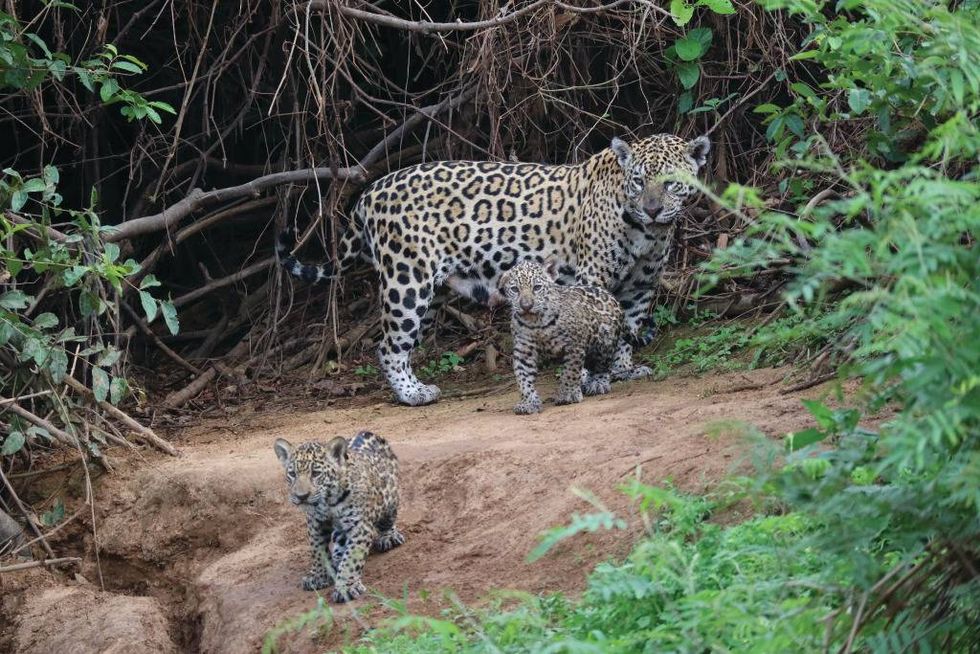 A jaguar and cubs are seen in Corixo Negro, Encontro das Aguas State Park. (Photo by April Kelly)
The Sky Islands, situated at the northern edge of a 5,000-mile jaguar range that extends as far south as Argentina, are indeed wild. More than a century ago, they were prime jaguar habitat. Some biologists and conservationists, including Susan Malusa, director of the Wild Cat Research and Conservation Center for the last 13 years, think they still are. “The picture of Jaguar No. 5 is a moment in time,” Malusa says. “But it’s part of a greater story, and that story is that the Sky Islands are part of the jaguar’s historical range. Jaguars wouldn’t be coming here if they weren’t finding what they need.”
The entire jaguar range is based on the principle of connection. Alan Rabinowitz, the celebrated zoologist and co-founder of Panthera, the global wild cat conservation organization, (who passed away in 2018), envisioned the jaguar realm as a mammal’s circulatory system. The core areas of jaguar production are its heart; the corridors linking them are its veins and arteries. A functioning system would nurture the species, while at the same time allowing nomadic, individual cats the freedom to spread their genetics across the corridor.
Susan Malusa believes it could be just a matter of time before other jaguars cross over from Mexico into the United States. “The cats are coming,” she says. “This is our chance to get it right; we have an obligation. Essentially, our job is not to screw it up.”
But screwing it up is exactly what we are doing. Currently, construction crews are dynamiting huge swaths of the unspoiled Coronado National Memorial and building hulking, 30-foot walls in the San Rafael Valley, creating what will be the longest unbroken stretch of border wall in an area of Arizona that serves as a critical wildlife corridor.
The Trump administration, which is not known for its love of wild places, waived the Endangered Species Act, the National Environmental Policy Act, and a host of other laws, to build a wall that will stop jaguars and dozens of other species in their tracks. And southern Arizona will be poorer for it. Apex predators like jaguars maintain ecosystem health, balance prey populations, and sustain biodiversity. They also change the spirit of the land. They contribute to what Aldo Leopold described as a “vast pulsing harmony.” And when they are gone, a “glory has departed.”
But perhaps in spite of the obstacles in their path, that glory is beginning to come back, as exemplified by Jaguar No.5.
Across the world, efforts to reintroduce imperiled animals to their natural habitats have gained momentum, but in the Madrean Sky Islands of Arizona, jaguars are doing it on their own.
Less than a month ago, Chris Schnaufer, a citizen scientist volunteer with the University of Arizona Wild Cat Research and Conservation Center, and another volunteer, were checking one of their remote trail cameras. Schnaufer, a long-distance hiker, often got the center’s toughest assignments, and both men were tired when they reached the mountain camera site. They replaced batteries and collected the SD card and hiked back to the trailhead. That night, at home, Schnaufer scrolled through the images of deer, bear, bobcats, mountain lions, foxes, owls, skunks, and a coatimundi. And then, there it was, in the semidarkness of early morning, the striking image of a jaguar drinking from a waterhole. The photos showed its muscular shoulder and its distinctive inky-black rosettes.
When the University of Arizona Wild Cat Research and Conservation Center released the photographs of the jaguar roaming the rugged mountains of southern Arizona, it confirmed that it was a never-before-recorded big cat. Jaguars have their own unique markings, as singular as a human’s fingerprint, and this was one new to the center’s database. Though it has not yet identified its sex, the center is calling it Jaguar No. 5, dubbed Cinco, the fifth jaguar to be photographed in the Sky Islands since 2011, the second one discovered since 2023, and the ninth one spotted in the US since 1996.
Jaguar No. 5. (Photo by UA Wild Cat Research and Conservation Center)
When the photos were made public, and news agencies across the country buzzed with excitement about the future of the state’s wild jaguar population, Schnaufer still felt the existential thrill of knowing he had been hiking in jaguar country.
Three-quarters of a century ago, Aldo Leopold penned his essay “The Green Lagoons,” which chronicles a 1923 canoeing adventure in the Delta region of the Colorado River. He and his brother Carl hoped to “find sign of the… the great mottled jaguar, el tigre.” They “saw neither hide nor hair of him, but his personality pervaded the wilderness.”
While I was researching my book, Heart of the Jaguar, and backpacking sections of the Sky Islands, three jaguars called the Sky Islands home—Cochise, Sombra, and O:ṣhad Ñu:kudam. I never saw so much as a track, but what mattered most to me was what the presence of a big, spotted cat prowling the mountains of southern Arizona implied: a kind of wildness.
A jaguar and cubs are seen in Corixo Negro, Encontro das Aguas State Park. (Photo by April Kelly)
The Sky Islands, situated at the northern edge of a 5,000-mile jaguar range that extends as far south as Argentina, are indeed wild. More than a century ago, they were prime jaguar habitat. Some biologists and conservationists, including Susan Malusa, director of the Wild Cat Research and Conservation Center for the last 13 years, think they still are. “The picture of Jaguar No. 5 is a moment in time,” Malusa says. “But it’s part of a greater story, and that story is that the Sky Islands are part of the jaguar’s historical range. Jaguars wouldn’t be coming here if they weren’t finding what they need.”
The entire jaguar range is based on the principle of connection. Alan Rabinowitz, the celebrated zoologist and co-founder of Panthera, the global wild cat conservation organization, (who passed away in 2018), envisioned the jaguar realm as a mammal’s circulatory system. The core areas of jaguar production are its heart; the corridors linking them are its veins and arteries. A functioning system would nurture the species, while at the same time allowing nomadic, individual cats the freedom to spread their genetics across the corridor.
Susan Malusa believes it could be just a matter of time before other jaguars cross over from Mexico into the United States. “The cats are coming,” she says. “This is our chance to get it right; we have an obligation. Essentially, our job is not to screw it up.”
But screwing it up is exactly what we are doing. Currently, construction crews are dynamiting huge swaths of the unspoiled Coronado National Memorial and building hulking, 30-foot walls in the San Rafael Valley, creating what will be the longest unbroken stretch of border wall in an area of Arizona that serves as a critical wildlife corridor.
The Trump administration, which is not known for its love of wild places, waived the Endangered Species Act, the National Environmental Policy Act, and a host of other laws, to build a wall that will stop jaguars and dozens of other species in their tracks. And southern Arizona will be poorer for it. Apex predators like jaguars maintain ecosystem health, balance prey populations, and sustain biodiversity. They also change the spirit of the land. They contribute to what Aldo Leopold described as a “vast pulsing harmony.” And when they are gone, a “glory has departed.”
But perhaps in spite of the obstacles in their path, that glory is beginning to come back, as exemplified by Jaguar No.5.
Across the world, efforts to reintroduce imperiled animals to their natural habitats have gained momentum, but in the Madrean Sky Islands of Arizona, jaguars are doing it on their own.
Less than a month ago, Chris Schnaufer, a citizen scientist volunteer with the University of Arizona Wild Cat Research and Conservation Center, and another volunteer, were checking one of their remote trail cameras. Schnaufer, a long-distance hiker, often got the center’s toughest assignments, and both men were tired when they reached the mountain camera site. They replaced batteries and collected the SD card and hiked back to the trailhead. That night, at home, Schnaufer scrolled through the images of deer, bear, bobcats, mountain lions, foxes, owls, skunks, and a coatimundi. And then, there it was, in the semidarkness of early morning, the striking image of a jaguar drinking from a waterhole. The photos showed its muscular shoulder and its distinctive inky-black rosettes.
When the University of Arizona Wild Cat Research and Conservation Center released the photographs of the jaguar roaming the rugged mountains of southern Arizona, it confirmed that it was a never-before-recorded big cat. Jaguars have their own unique markings, as singular as a human’s fingerprint, and this was one new to the center’s database. Though it has not yet identified its sex, the center is calling it Jaguar No. 5, dubbed Cinco, the fifth jaguar to be photographed in the Sky Islands since 2011, the second one discovered since 2023, and the ninth one spotted in the US since 1996.
Jaguar No. 5. (Photo by UA Wild Cat Research and Conservation Center)
When the photos were made public, and news agencies across the country buzzed with excitement about the future of the state’s wild jaguar population, Schnaufer still felt the existential thrill of knowing he had been hiking in jaguar country.
Three-quarters of a century ago, Aldo Leopold penned his essay “The Green Lagoons,” which chronicles a 1923 canoeing adventure in the Delta region of the Colorado River. He and his brother Carl hoped to “find sign of the… the great mottled jaguar, el tigre.” They “saw neither hide nor hair of him, but his personality pervaded the wilderness.”
While I was researching my book, Heart of the Jaguar, and backpacking sections of the Sky Islands, three jaguars called the Sky Islands home—Cochise, Sombra, and O:ṣhad Ñu:kudam. I never saw so much as a track, but what mattered most to me was what the presence of a big, spotted cat prowling the mountains of southern Arizona implied: a kind of wildness.
A jaguar and cubs are seen in Corixo Negro, Encontro das Aguas State Park. (Photo by April Kelly)
The Sky Islands, situated at the northern edge of a 5,000-mile jaguar range that extends as far south as Argentina, are indeed wild. More than a century ago, they were prime jaguar habitat. Some biologists and conservationists, including Susan Malusa, director of the Wild Cat Research and Conservation Center for the last 13 years, think they still are. “The picture of Jaguar No. 5 is a moment in time,” Malusa says. “But it’s part of a greater story, and that story is that the Sky Islands are part of the jaguar’s historical range. Jaguars wouldn’t be coming here if they weren’t finding what they need.”
The entire jaguar range is based on the principle of connection. Alan Rabinowitz, the celebrated zoologist and co-founder of Panthera, the global wild cat conservation organization, (who passed away in 2018), envisioned the jaguar realm as a mammal’s circulatory system. The core areas of jaguar production are its heart; the corridors linking them are its veins and arteries. A functioning system would nurture the species, while at the same time allowing nomadic, individual cats the freedom to spread their genetics across the corridor.
Susan Malusa believes it could be just a matter of time before other jaguars cross over from Mexico into the United States. “The cats are coming,” she says. “This is our chance to get it right; we have an obligation. Essentially, our job is not to screw it up.”
But screwing it up is exactly what we are doing. Currently, construction crews are dynamiting huge swaths of the unspoiled Coronado National Memorial and building hulking, 30-foot walls in the San Rafael Valley, creating what will be the longest unbroken stretch of border wall in an area of Arizona that serves as a critical wildlife corridor.
The Trump administration, which is not known for its love of wild places, waived the Endangered Species Act, the National Environmental Policy Act, and a host of other laws, to build a wall that will stop jaguars and dozens of other species in their tracks. And southern Arizona will be poorer for it. Apex predators like jaguars maintain ecosystem health, balance prey populations, and sustain biodiversity. They also change the spirit of the land. They contribute to what Aldo Leopold described as a “vast pulsing harmony.” And when they are gone, a “glory has departed.”
But perhaps in spite of the obstacles in their path, that glory is beginning to come back, as exemplified by Jaguar No.5.