SUBSCRIBE TO OUR FREE NEWSLETTER
Daily news & progressive opinion—funded by the people, not the corporations—delivered straight to your inbox.
5
#000000
#FFFFFF
To donate by check, phone, or other method, see our More Ways to Give page.
Daily news & progressive opinion—funded by the people, not the corporations—delivered straight to your inbox.
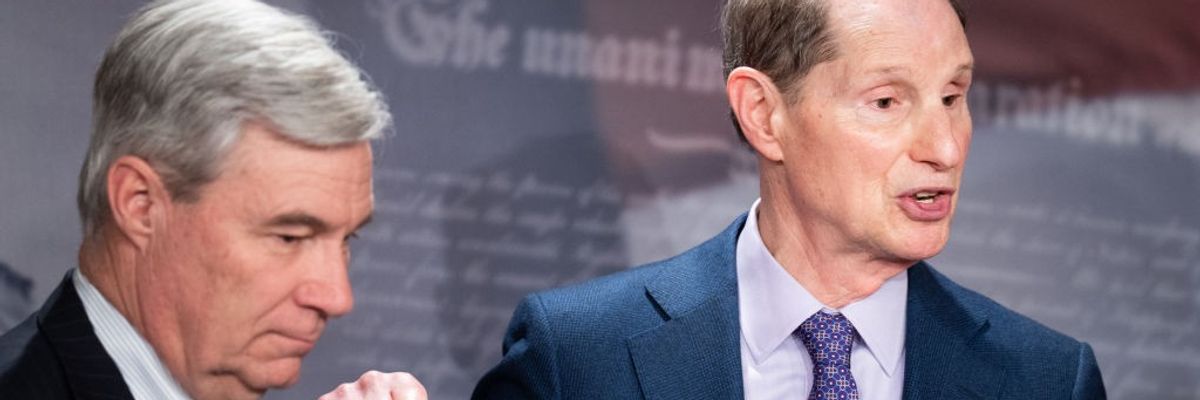
U.S. Sens. Sheldon Whitehouse (D-R.I.) and Ron Wyden (D-Ore.) participate in the news conference in the Capitol in Washington, D.C. on March 9, 2023.
As the election nears, Senate Democrats could capture the narrative by holding high-profile hearings interrogating oil industry bigshots.
With a divided Congress and an election fast approaching, congressional Democrats have little opportunity to enact any landmark legislation, but they need not sit on their hands. Congressional committees have the power to conduct hearings, investigations, and issue subpoenas. As the majority party in the Senate, Democrats should be using this authority to aggressively critique corporations that harm the public’s health and pocketbooks.
Public hearings bring issues to the forefront of conversation and create an opportunity to leverage successes electorally. Ideally, committee chairs would regularly harness this power to hold industries or specific bad actors accountable. In practice, it’s more of a mixed bag, representing a massive missed opportunity politically.
Nowhere is this clearer than the lack of hearings on oil and gas industry malfeasance and pollution. In May, the FTC accused ex-Pioneer CEO Scott Sheffield of a price fixing scheme with OPEC. A week later, Trump initiated an outrageous quid pro quo with industry executives when he requested $1 billion in campaign contributions in exchange for a rollback of environmental regulations. In March, a Stanford study found that methane leaks account for 3 percent of gas produced in the U.S., three times greater than the EPA’s 1 percent estimation. The result? A cost of at least $9.3 billion in climate damage per year.
If asking nicely isn’t inducing cooperation, perhaps a subpoena and the specter of jail time will.
Surely the Senate Committee on Energy and Natural Resources has something to say about collusion and bribery in the energy sector, right? Obviously the Senate Committee on Environment and Public Work investigated the causes of excess methane emissions? Sadly, no. It’s hardly surprising for the Energy and Natural Resources committee—Senator Joe Manchin (I-WV) is the chair. Rather than hold the oil industry to account, Sen. Manchin would rather grill Interior Secretary Deb Haaland over the administration's plan to reduce oil and gas leases on federal lands.
Delaware Senator Tom Carper’s leadership of the Environment and Public Works committee is less explicable. To be fair, the committee has conducted oversight in the past: they brought in the CEO of Norfolk Southern to testify in the wake of the East Palestine derailment in March 2023. But there have been no hearings of that sort since, despite ample opportunity to do so.
One month after the study on methane emissions was released and widely covered in the press, the committee held a hearing “Examining the State of Air Quality Monitoring Technology.” This was a great opportunity to probe why the EPA estimates of methane emissions were drastically lower than actual emmisions and question whether companies took proper precautions to prevent leaks. Instead, methane was mentioned only once during the two hour hearing.
While these committees sat idly by, the Budget and Finance committees actually took steps to address Trump’s quid pro quo. In May, the committees jointly sent letters to industry leaders, including Chevron and ExxonMobil, requesting materials from the event, information about campaign donations, and copies of draft policy proposals. It was a good first step. But what happens when asking nicely doesn’t work?
Surely the Senate Committee on Energy and Natural Resources has something to say about collusion and bribery in the energy sector, right?
Nearly four months after their first letters, having received “insufficient” responses with “inaccurate claims,” Senate Democrats followed up with … more letters. “Inaccurate claims” is merely a polite way of saying “lying” and, last I checked, lying to Congress is against the law. If oil and gas executives did not cooperate the first time, and are willing to lie in their statements to Congress, there’s no reason to believe they’ll do anything different two months out from an election that their partner-in-crime may win.
Democrats need to hold them accountable before it's too late, and the only way to do so is with subpoenas, both for the documents they’re seeking and appearances of the executives in front of Congress. Polling from More Perfect Union and Data For Progress showed that voters want Big Oil to face consequences for their role in pollution and high gas prices, but don’t think the government is taking action. Hearings that interrogate oil executives would signal to the public that Democrats in Congress aren’t letting oil companies off the hook and raise awareness of Trump’s promise to let oil interests run roughshod over Americans.
Thankfully, some Senate Democrats understand the importance of aggressively conducting oversight. In July, the Senate Committee on Health, Education, Labor and Pensions’ (HELP) issued a subpoena to hospital executive Ralph de la Torre. As The American Prosepct previously reported, Torre is accused of woefully undersupplying his hospital chain while extracting millions to finance his extravagant lifestyle that features multiple yachts and private jets. Torre is defying the subpoena, but the HELP committee is not simply giving up—or asking again nicely. Committee Chair Bernie Sanders issued a statement stating that the HELP committee “will not accept” Torre’s efforts to skirt the subpoena. Senators Elizabeth Warren and Ed Markey called for Torre to be held in contempt of Congress, which could lead to jail time, if he fails to appear.
Senate Democrats overseeing the oil and gas industry would be wise to learn from the HELP committee’s examples. Americans are fed up with corporate abuses across the economy, and they need to see their representatives in Congress cracking down on bad actors. Letters requesting information are good, but rolling over when executives refuse to comply is unacceptable. If asking nicely isn’t inducing cooperation, perhaps a subpoena and the specter of jail time will.
Dear Common Dreams reader, It’s been nearly 30 years since I co-founded Common Dreams with my late wife, Lina Newhouser. We had the radical notion that journalism should serve the public good, not corporate profits. It was clear to us from the outset what it would take to build such a project. No paid advertisements. No corporate sponsors. No millionaire publisher telling us what to think or do. Many people said we wouldn't last a year, but we proved those doubters wrong. Together with a tremendous team of journalists and dedicated staff, we built an independent media outlet free from the constraints of profits and corporate control. Our mission has always been simple: To inform. To inspire. To ignite change for the common good. Building Common Dreams was not easy. Our survival was never guaranteed. When you take on the most powerful forces—Wall Street greed, fossil fuel industry destruction, Big Tech lobbyists, and uber-rich oligarchs who have spent billions upon billions rigging the economy and democracy in their favor—the only bulwark you have is supporters who believe in your work. But here’s the urgent message from me today. It's never been this bad out there. And it's never been this hard to keep us going. At the very moment Common Dreams is most needed, the threats we face are intensifying. We need your support now more than ever. We don't accept corporate advertising and never will. We don't have a paywall because we don't think people should be blocked from critical news based on their ability to pay. Everything we do is funded by the donations of readers like you. When everyone does the little they can afford, we are strong. But if that support retreats or dries up, so do we. Will you donate now to make sure Common Dreams not only survives but thrives? —Craig Brown, Co-founder |
With a divided Congress and an election fast approaching, congressional Democrats have little opportunity to enact any landmark legislation, but they need not sit on their hands. Congressional committees have the power to conduct hearings, investigations, and issue subpoenas. As the majority party in the Senate, Democrats should be using this authority to aggressively critique corporations that harm the public’s health and pocketbooks.
Public hearings bring issues to the forefront of conversation and create an opportunity to leverage successes electorally. Ideally, committee chairs would regularly harness this power to hold industries or specific bad actors accountable. In practice, it’s more of a mixed bag, representing a massive missed opportunity politically.
Nowhere is this clearer than the lack of hearings on oil and gas industry malfeasance and pollution. In May, the FTC accused ex-Pioneer CEO Scott Sheffield of a price fixing scheme with OPEC. A week later, Trump initiated an outrageous quid pro quo with industry executives when he requested $1 billion in campaign contributions in exchange for a rollback of environmental regulations. In March, a Stanford study found that methane leaks account for 3 percent of gas produced in the U.S., three times greater than the EPA’s 1 percent estimation. The result? A cost of at least $9.3 billion in climate damage per year.
If asking nicely isn’t inducing cooperation, perhaps a subpoena and the specter of jail time will.
Surely the Senate Committee on Energy and Natural Resources has something to say about collusion and bribery in the energy sector, right? Obviously the Senate Committee on Environment and Public Work investigated the causes of excess methane emissions? Sadly, no. It’s hardly surprising for the Energy and Natural Resources committee—Senator Joe Manchin (I-WV) is the chair. Rather than hold the oil industry to account, Sen. Manchin would rather grill Interior Secretary Deb Haaland over the administration's plan to reduce oil and gas leases on federal lands.
Delaware Senator Tom Carper’s leadership of the Environment and Public Works committee is less explicable. To be fair, the committee has conducted oversight in the past: they brought in the CEO of Norfolk Southern to testify in the wake of the East Palestine derailment in March 2023. But there have been no hearings of that sort since, despite ample opportunity to do so.
One month after the study on methane emissions was released and widely covered in the press, the committee held a hearing “Examining the State of Air Quality Monitoring Technology.” This was a great opportunity to probe why the EPA estimates of methane emissions were drastically lower than actual emmisions and question whether companies took proper precautions to prevent leaks. Instead, methane was mentioned only once during the two hour hearing.
While these committees sat idly by, the Budget and Finance committees actually took steps to address Trump’s quid pro quo. In May, the committees jointly sent letters to industry leaders, including Chevron and ExxonMobil, requesting materials from the event, information about campaign donations, and copies of draft policy proposals. It was a good first step. But what happens when asking nicely doesn’t work?
Surely the Senate Committee on Energy and Natural Resources has something to say about collusion and bribery in the energy sector, right?
Nearly four months after their first letters, having received “insufficient” responses with “inaccurate claims,” Senate Democrats followed up with … more letters. “Inaccurate claims” is merely a polite way of saying “lying” and, last I checked, lying to Congress is against the law. If oil and gas executives did not cooperate the first time, and are willing to lie in their statements to Congress, there’s no reason to believe they’ll do anything different two months out from an election that their partner-in-crime may win.
Democrats need to hold them accountable before it's too late, and the only way to do so is with subpoenas, both for the documents they’re seeking and appearances of the executives in front of Congress. Polling from More Perfect Union and Data For Progress showed that voters want Big Oil to face consequences for their role in pollution and high gas prices, but don’t think the government is taking action. Hearings that interrogate oil executives would signal to the public that Democrats in Congress aren’t letting oil companies off the hook and raise awareness of Trump’s promise to let oil interests run roughshod over Americans.
Thankfully, some Senate Democrats understand the importance of aggressively conducting oversight. In July, the Senate Committee on Health, Education, Labor and Pensions’ (HELP) issued a subpoena to hospital executive Ralph de la Torre. As The American Prosepct previously reported, Torre is accused of woefully undersupplying his hospital chain while extracting millions to finance his extravagant lifestyle that features multiple yachts and private jets. Torre is defying the subpoena, but the HELP committee is not simply giving up—or asking again nicely. Committee Chair Bernie Sanders issued a statement stating that the HELP committee “will not accept” Torre’s efforts to skirt the subpoena. Senators Elizabeth Warren and Ed Markey called for Torre to be held in contempt of Congress, which could lead to jail time, if he fails to appear.
Senate Democrats overseeing the oil and gas industry would be wise to learn from the HELP committee’s examples. Americans are fed up with corporate abuses across the economy, and they need to see their representatives in Congress cracking down on bad actors. Letters requesting information are good, but rolling over when executives refuse to comply is unacceptable. If asking nicely isn’t inducing cooperation, perhaps a subpoena and the specter of jail time will.
With a divided Congress and an election fast approaching, congressional Democrats have little opportunity to enact any landmark legislation, but they need not sit on their hands. Congressional committees have the power to conduct hearings, investigations, and issue subpoenas. As the majority party in the Senate, Democrats should be using this authority to aggressively critique corporations that harm the public’s health and pocketbooks.
Public hearings bring issues to the forefront of conversation and create an opportunity to leverage successes electorally. Ideally, committee chairs would regularly harness this power to hold industries or specific bad actors accountable. In practice, it’s more of a mixed bag, representing a massive missed opportunity politically.
Nowhere is this clearer than the lack of hearings on oil and gas industry malfeasance and pollution. In May, the FTC accused ex-Pioneer CEO Scott Sheffield of a price fixing scheme with OPEC. A week later, Trump initiated an outrageous quid pro quo with industry executives when he requested $1 billion in campaign contributions in exchange for a rollback of environmental regulations. In March, a Stanford study found that methane leaks account for 3 percent of gas produced in the U.S., three times greater than the EPA’s 1 percent estimation. The result? A cost of at least $9.3 billion in climate damage per year.
If asking nicely isn’t inducing cooperation, perhaps a subpoena and the specter of jail time will.
Surely the Senate Committee on Energy and Natural Resources has something to say about collusion and bribery in the energy sector, right? Obviously the Senate Committee on Environment and Public Work investigated the causes of excess methane emissions? Sadly, no. It’s hardly surprising for the Energy and Natural Resources committee—Senator Joe Manchin (I-WV) is the chair. Rather than hold the oil industry to account, Sen. Manchin would rather grill Interior Secretary Deb Haaland over the administration's plan to reduce oil and gas leases on federal lands.
Delaware Senator Tom Carper’s leadership of the Environment and Public Works committee is less explicable. To be fair, the committee has conducted oversight in the past: they brought in the CEO of Norfolk Southern to testify in the wake of the East Palestine derailment in March 2023. But there have been no hearings of that sort since, despite ample opportunity to do so.
One month after the study on methane emissions was released and widely covered in the press, the committee held a hearing “Examining the State of Air Quality Monitoring Technology.” This was a great opportunity to probe why the EPA estimates of methane emissions were drastically lower than actual emmisions and question whether companies took proper precautions to prevent leaks. Instead, methane was mentioned only once during the two hour hearing.
While these committees sat idly by, the Budget and Finance committees actually took steps to address Trump’s quid pro quo. In May, the committees jointly sent letters to industry leaders, including Chevron and ExxonMobil, requesting materials from the event, information about campaign donations, and copies of draft policy proposals. It was a good first step. But what happens when asking nicely doesn’t work?
Surely the Senate Committee on Energy and Natural Resources has something to say about collusion and bribery in the energy sector, right?
Nearly four months after their first letters, having received “insufficient” responses with “inaccurate claims,” Senate Democrats followed up with … more letters. “Inaccurate claims” is merely a polite way of saying “lying” and, last I checked, lying to Congress is against the law. If oil and gas executives did not cooperate the first time, and are willing to lie in their statements to Congress, there’s no reason to believe they’ll do anything different two months out from an election that their partner-in-crime may win.
Democrats need to hold them accountable before it's too late, and the only way to do so is with subpoenas, both for the documents they’re seeking and appearances of the executives in front of Congress. Polling from More Perfect Union and Data For Progress showed that voters want Big Oil to face consequences for their role in pollution and high gas prices, but don’t think the government is taking action. Hearings that interrogate oil executives would signal to the public that Democrats in Congress aren’t letting oil companies off the hook and raise awareness of Trump’s promise to let oil interests run roughshod over Americans.
Thankfully, some Senate Democrats understand the importance of aggressively conducting oversight. In July, the Senate Committee on Health, Education, Labor and Pensions’ (HELP) issued a subpoena to hospital executive Ralph de la Torre. As The American Prosepct previously reported, Torre is accused of woefully undersupplying his hospital chain while extracting millions to finance his extravagant lifestyle that features multiple yachts and private jets. Torre is defying the subpoena, but the HELP committee is not simply giving up—or asking again nicely. Committee Chair Bernie Sanders issued a statement stating that the HELP committee “will not accept” Torre’s efforts to skirt the subpoena. Senators Elizabeth Warren and Ed Markey called for Torre to be held in contempt of Congress, which could lead to jail time, if he fails to appear.
Senate Democrats overseeing the oil and gas industry would be wise to learn from the HELP committee’s examples. Americans are fed up with corporate abuses across the economy, and they need to see their representatives in Congress cracking down on bad actors. Letters requesting information are good, but rolling over when executives refuse to comply is unacceptable. If asking nicely isn’t inducing cooperation, perhaps a subpoena and the specter of jail time will.