
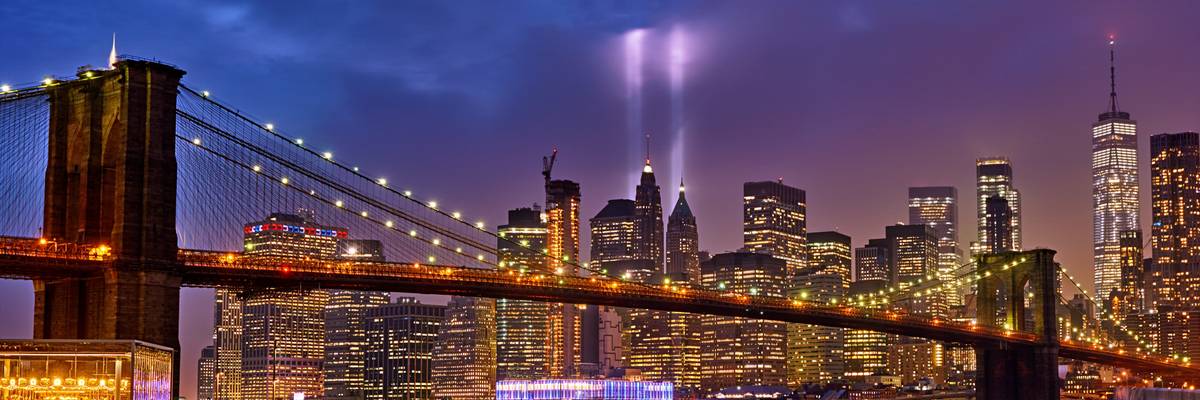
Two lights shine in the place of the Twin Towers in New York City.
23 Years After 9/11, Are We Any Safer?
True justice for the lives lost on 9/11 and during the U.S.’ war on terror would require us to put an end to overfunding violence and war, and instead prioritize safety and security through investing in our communities.
It is hard to forget the burning stares of people in the airport that look at you with suspicion and disdain, to the point that your eyes close in shame. I remember feeling deeply embarrassed as a teenager when the Transportation Security Administration officers took my family and I aside to do a secondary screening at the airport. It wasn’t until many years later I realized that this was just a small cost of being Muslim in America after 9/11.
It has been 23 years since September 11, 2001. The phrase “Never Forget” is echoed nationally to memorialize the nearly 3,000 lives lost that day. Instead of building a safer world after 9/11, the United States government responded with misplaced vengeance on multiple civilian populations, the consequences of which continue to be felt at home and globally.
Following the attacks on 9/11, the U.S. government launched an international military campaign, called the “Global War on Terror,” under then President George W. Bush’s leadership. It was a campaign with no end date that included “large-scale surveillance measures in the U.S., torture, global drone strikes, blacksites, and the Guantánamo Bay military prison.”
If investing money in militarism and incarceration was meant to serve as a measure of justice for a post 9/11 world, then our communities would be safe and thriving.
The U.S. government’s response included wars in Afghanistan, Iraq, Syria, Yemen, and Pakistan that killed 940,000 people directly, while 3.6-3.8 million people died indirectly in post-9/11 war zones. The names of the people killed may never be known and memorialized. At the same time, 38 million people in and from Afghanistan, Iraq, Pakistan, Yemen, Somalia, the Philippines, Libya and Syria were forcibly displaced. Over 7,000 U.S. service members also lost their lives due to our government’s foreign policy since the 9/11 attacks.
Since 2002, 780 Muslim men and boys have been detained at Guantánamo Bay, which claims to hold terrorist suspects. However, most were released without being convicted of a crime, and many are survivors of torture at the hands of U.S. officials. Thirty individuals still remain there.
Due to decades of dehumanization and propaganda, the American people have become conditioned to believe that death and violence among Black, African, Arab, Middle Eastern, Muslim, and South Asian (BAMEMSA) communities is inevitable. These Islamophobic and anti-Muslim tropes continue today, as we witness the genocide of Palestinians with increasing normalization.
The U.S. government also spent $8 trillion on wars in Afghanistan, Iraq, Pakistan, and other countries. Over $21 trillion has been spent on militarism since 9/11; militarism expenditure includes funding for the Pentagon, detentions and deportations, and policing and prisons. Our priorities become clear too when we see that the U.S. has the highest incarceration rate and largest immigrant detention system in the world.
If investing money in militarism and incarceration was meant to serve as a measure of justice for a post 9/11 world, then our communities would be safe and thriving. Instead, Americans feel less safe than 30 years ago, while 78% of Americans live paycheck to paycheck.
Oftentimes the U.S.’ global war on terror and intervention in other countries is seen as “an over there problem.” However, the general American public must also pay attention to how the military-industrial complex influences how we are governed, and firmly reject it. The military-industrial complex is a term used to describe the influence of those who profit from war such as contractors who produce weapons, our policymakers, and armed forces. Defense contractors have spent over $60 million in donations to politicians in the 2024 and 2022 election cycles.
During the Democratic National Convention (DNC), we saw a clear example of how Vice President Kamala Harris would continue this pattern of brute American force and militarism. She said, “As commander in chief, I will ensure America always has the strongest, most lethal fighting force in the world.”
Lethal is defined as: deadly, mortal, fatal, causing or capable of causing death. Criticisms of the Democratic Presidential candidate or party are often accompanied by “Trump would not be any better.” No politician is exempt from accountability when embracing death and destruction as values to lead with. Other realities are possible. How else have oppressed communities fought for their freedoms in the U.S.? Visionaries challenged the choices given to them by fighting for new ones. Power does not only lie in the hands of defense contractors and lobbyists, but among all of us too.
In a moment when our politicians are paying close attention to the issues voters care about, we cannot separate the genocide in Palestine from police brutality, or issues like access to abortion from the economy. Each issue is inextricably linked because of how our government chooses to prioritize its budget, and the domestic or foreign policies we employ always have a domino effect. During the DNC, Prism interviewed Cherrene Horazuk, the former president of a union at the University of Minnesota. Cherrene shares, “Palestine is a workers’ issue first because money that goes for war is not available for jobs.”
Pro-Palestine advocates understand the interconnectedness of struggles for all people. Their moral compass exemplifies that if we don’t reject this cycle of violence now, we are signaling to those in power that we condone and are willing to continue the U.S.’ culture of forceful domination that has existed since its inception.
The Institute for Social Policy and Understanding examined 3,100 bills in 50 U.S. state legislatures across several years and issue areas including abortion, LGBTQ+ rights, immigrant rights, and more. Eighty-five percent of legislators that supported anti-Shariah or anti-“foreign law” bills also supported restrictive bills against other marginalized communities. When we understand that any form of injustice threatens all of us, we can act to advance our collective needs.
What does real justice look like for all those who have been harmed by the legacy of the U.S.’ war on terror since 9/11? Reparations for the lives lost that day some may argue could be revenge, but families advocating for a peaceful response to end the cycle of harm and violence are also showing us another way. True justice must include demanding our government to:
- Invest our taxpayer dollars in programs and services that actually lead to safety and healing;
- Repay our debt to the Afghan people who suffered immensely due to U.S. intervention and policy;
- Shut down and free the men detained at Guantánamo Bay;
- Ensure a cease-fire and enact an arms embargo on Israel; and
- Enact campaign finance reforms to end the influence of special corporate interests in our elections, such as lobbying by weapons manufacturing companies.
Islamophobia is not just a threat to Muslims—it’s a threat to all marginalized communities in the U.S. and globally. We must end the war on terror, and the violence U.S. government has inflicted on its people and elsewhere. Through our collective power and action, we can create a world that prioritizes and benefits from life, not death.
We are at a crossroads
This country and this world are at a monumental crossroads. In a few short weeks, US voters will have an opportunity to beat back the forces of fascism and confront the billionaires who are rigging the economy, our media system, and our democracy, making it increasingly impossible for ordinary people to get by. We’re not just talking about the election. We’re talking about what must be done once these fascist elements are vanquished from power. We need a bolder set of solutions than what either major party has so far been willing to offer and a working-class movement ready to fight like hell for it. Trump didn't emerge from nowhere. The conditions that fueled MAGA authoritarianism were created by decades of radical neoliberal economic policies and a corrupt political system dominated by corporate interests. They slashed taxes on the super-rich, promising that the benefits would trickle down. They said giveaways to the corporate titans would make life more affordable for the rest of us. It was all bullshit. And when a bitter, betrayed populace searches for someone to blame, right-wing demagogues have little trouble finding scapegoats. People know when they're being lied to, but you won't hear any of this from the corporate media. Only independent journalism—powered and funded by people who believe in building a better world—can deliver truly trustworthy daily news. Our Fall Campaign is underway, and we need your help. To power our newsroom through the rest of the year, we need to raise $125,000 by midnight on October 31. So if you share our vision, please contribute whatever you can to sustain our work. |
It is hard to forget the burning stares of people in the airport that look at you with suspicion and disdain, to the point that your eyes close in shame. I remember feeling deeply embarrassed as a teenager when the Transportation Security Administration officers took my family and I aside to do a secondary screening at the airport. It wasn’t until many years later I realized that this was just a small cost of being Muslim in America after 9/11.
It has been 23 years since September 11, 2001. The phrase “Never Forget” is echoed nationally to memorialize the nearly 3,000 lives lost that day. Instead of building a safer world after 9/11, the United States government responded with misplaced vengeance on multiple civilian populations, the consequences of which continue to be felt at home and globally.
Following the attacks on 9/11, the U.S. government launched an international military campaign, called the “Global War on Terror,” under then President George W. Bush’s leadership. It was a campaign with no end date that included “large-scale surveillance measures in the U.S., torture, global drone strikes, blacksites, and the Guantánamo Bay military prison.”
If investing money in militarism and incarceration was meant to serve as a measure of justice for a post 9/11 world, then our communities would be safe and thriving.
The U.S. government’s response included wars in Afghanistan, Iraq, Syria, Yemen, and Pakistan that killed 940,000 people directly, while 3.6-3.8 million people died indirectly in post-9/11 war zones. The names of the people killed may never be known and memorialized. At the same time, 38 million people in and from Afghanistan, Iraq, Pakistan, Yemen, Somalia, the Philippines, Libya and Syria were forcibly displaced. Over 7,000 U.S. service members also lost their lives due to our government’s foreign policy since the 9/11 attacks.
Since 2002, 780 Muslim men and boys have been detained at Guantánamo Bay, which claims to hold terrorist suspects. However, most were released without being convicted of a crime, and many are survivors of torture at the hands of U.S. officials. Thirty individuals still remain there.
Due to decades of dehumanization and propaganda, the American people have become conditioned to believe that death and violence among Black, African, Arab, Middle Eastern, Muslim, and South Asian (BAMEMSA) communities is inevitable. These Islamophobic and anti-Muslim tropes continue today, as we witness the genocide of Palestinians with increasing normalization.
The U.S. government also spent $8 trillion on wars in Afghanistan, Iraq, Pakistan, and other countries. Over $21 trillion has been spent on militarism since 9/11; militarism expenditure includes funding for the Pentagon, detentions and deportations, and policing and prisons. Our priorities become clear too when we see that the U.S. has the highest incarceration rate and largest immigrant detention system in the world.
If investing money in militarism and incarceration was meant to serve as a measure of justice for a post 9/11 world, then our communities would be safe and thriving. Instead, Americans feel less safe than 30 years ago, while 78% of Americans live paycheck to paycheck.
Oftentimes the U.S.’ global war on terror and intervention in other countries is seen as “an over there problem.” However, the general American public must also pay attention to how the military-industrial complex influences how we are governed, and firmly reject it. The military-industrial complex is a term used to describe the influence of those who profit from war such as contractors who produce weapons, our policymakers, and armed forces. Defense contractors have spent over $60 million in donations to politicians in the 2024 and 2022 election cycles.
During the Democratic National Convention (DNC), we saw a clear example of how Vice President Kamala Harris would continue this pattern of brute American force and militarism. She said, “As commander in chief, I will ensure America always has the strongest, most lethal fighting force in the world.”
Lethal is defined as: deadly, mortal, fatal, causing or capable of causing death. Criticisms of the Democratic Presidential candidate or party are often accompanied by “Trump would not be any better.” No politician is exempt from accountability when embracing death and destruction as values to lead with. Other realities are possible. How else have oppressed communities fought for their freedoms in the U.S.? Visionaries challenged the choices given to them by fighting for new ones. Power does not only lie in the hands of defense contractors and lobbyists, but among all of us too.
In a moment when our politicians are paying close attention to the issues voters care about, we cannot separate the genocide in Palestine from police brutality, or issues like access to abortion from the economy. Each issue is inextricably linked because of how our government chooses to prioritize its budget, and the domestic or foreign policies we employ always have a domino effect. During the DNC, Prism interviewed Cherrene Horazuk, the former president of a union at the University of Minnesota. Cherrene shares, “Palestine is a workers’ issue first because money that goes for war is not available for jobs.”
Pro-Palestine advocates understand the interconnectedness of struggles for all people. Their moral compass exemplifies that if we don’t reject this cycle of violence now, we are signaling to those in power that we condone and are willing to continue the U.S.’ culture of forceful domination that has existed since its inception.
The Institute for Social Policy and Understanding examined 3,100 bills in 50 U.S. state legislatures across several years and issue areas including abortion, LGBTQ+ rights, immigrant rights, and more. Eighty-five percent of legislators that supported anti-Shariah or anti-“foreign law” bills also supported restrictive bills against other marginalized communities. When we understand that any form of injustice threatens all of us, we can act to advance our collective needs.
What does real justice look like for all those who have been harmed by the legacy of the U.S.’ war on terror since 9/11? Reparations for the lives lost that day some may argue could be revenge, but families advocating for a peaceful response to end the cycle of harm and violence are also showing us another way. True justice must include demanding our government to:
- Invest our taxpayer dollars in programs and services that actually lead to safety and healing;
- Repay our debt to the Afghan people who suffered immensely due to U.S. intervention and policy;
- Shut down and free the men detained at Guantánamo Bay;
- Ensure a cease-fire and enact an arms embargo on Israel; and
- Enact campaign finance reforms to end the influence of special corporate interests in our elections, such as lobbying by weapons manufacturing companies.
Islamophobia is not just a threat to Muslims—it’s a threat to all marginalized communities in the U.S. and globally. We must end the war on terror, and the violence U.S. government has inflicted on its people and elsewhere. Through our collective power and action, we can create a world that prioritizes and benefits from life, not death.
- 'Dirty Move': Pentagon Chief Ditches Plea Deals With Tortured 9/11 Defendants ›
- The Selling of the Iraq War Involved Mass Gullibility Atop Mass Hysteria ›
- Since 9/11 the US Has Increased Military Interventions to Historic Levels ›
- 22 Years, 4 Presidents, and Just 1 Conviction Later, Dozens Still Jailed at Guantánamo ›
- Only a Reckoning With the Disastrous Legacy of the So-called 'War on Terror' Can Heal the United States ›
- 22 Years After Authorization for Endless War, It Is Time to Turn the Page ›
It is hard to forget the burning stares of people in the airport that look at you with suspicion and disdain, to the point that your eyes close in shame. I remember feeling deeply embarrassed as a teenager when the Transportation Security Administration officers took my family and I aside to do a secondary screening at the airport. It wasn’t until many years later I realized that this was just a small cost of being Muslim in America after 9/11.
It has been 23 years since September 11, 2001. The phrase “Never Forget” is echoed nationally to memorialize the nearly 3,000 lives lost that day. Instead of building a safer world after 9/11, the United States government responded with misplaced vengeance on multiple civilian populations, the consequences of which continue to be felt at home and globally.
Following the attacks on 9/11, the U.S. government launched an international military campaign, called the “Global War on Terror,” under then President George W. Bush’s leadership. It was a campaign with no end date that included “large-scale surveillance measures in the U.S., torture, global drone strikes, blacksites, and the Guantánamo Bay military prison.”
If investing money in militarism and incarceration was meant to serve as a measure of justice for a post 9/11 world, then our communities would be safe and thriving.
The U.S. government’s response included wars in Afghanistan, Iraq, Syria, Yemen, and Pakistan that killed 940,000 people directly, while 3.6-3.8 million people died indirectly in post-9/11 war zones. The names of the people killed may never be known and memorialized. At the same time, 38 million people in and from Afghanistan, Iraq, Pakistan, Yemen, Somalia, the Philippines, Libya and Syria were forcibly displaced. Over 7,000 U.S. service members also lost their lives due to our government’s foreign policy since the 9/11 attacks.
Since 2002, 780 Muslim men and boys have been detained at Guantánamo Bay, which claims to hold terrorist suspects. However, most were released without being convicted of a crime, and many are survivors of torture at the hands of U.S. officials. Thirty individuals still remain there.
Due to decades of dehumanization and propaganda, the American people have become conditioned to believe that death and violence among Black, African, Arab, Middle Eastern, Muslim, and South Asian (BAMEMSA) communities is inevitable. These Islamophobic and anti-Muslim tropes continue today, as we witness the genocide of Palestinians with increasing normalization.
The U.S. government also spent $8 trillion on wars in Afghanistan, Iraq, Pakistan, and other countries. Over $21 trillion has been spent on militarism since 9/11; militarism expenditure includes funding for the Pentagon, detentions and deportations, and policing and prisons. Our priorities become clear too when we see that the U.S. has the highest incarceration rate and largest immigrant detention system in the world.
If investing money in militarism and incarceration was meant to serve as a measure of justice for a post 9/11 world, then our communities would be safe and thriving. Instead, Americans feel less safe than 30 years ago, while 78% of Americans live paycheck to paycheck.
Oftentimes the U.S.’ global war on terror and intervention in other countries is seen as “an over there problem.” However, the general American public must also pay attention to how the military-industrial complex influences how we are governed, and firmly reject it. The military-industrial complex is a term used to describe the influence of those who profit from war such as contractors who produce weapons, our policymakers, and armed forces. Defense contractors have spent over $60 million in donations to politicians in the 2024 and 2022 election cycles.
During the Democratic National Convention (DNC), we saw a clear example of how Vice President Kamala Harris would continue this pattern of brute American force and militarism. She said, “As commander in chief, I will ensure America always has the strongest, most lethal fighting force in the world.”
Lethal is defined as: deadly, mortal, fatal, causing or capable of causing death. Criticisms of the Democratic Presidential candidate or party are often accompanied by “Trump would not be any better.” No politician is exempt from accountability when embracing death and destruction as values to lead with. Other realities are possible. How else have oppressed communities fought for their freedoms in the U.S.? Visionaries challenged the choices given to them by fighting for new ones. Power does not only lie in the hands of defense contractors and lobbyists, but among all of us too.
In a moment when our politicians are paying close attention to the issues voters care about, we cannot separate the genocide in Palestine from police brutality, or issues like access to abortion from the economy. Each issue is inextricably linked because of how our government chooses to prioritize its budget, and the domestic or foreign policies we employ always have a domino effect. During the DNC, Prism interviewed Cherrene Horazuk, the former president of a union at the University of Minnesota. Cherrene shares, “Palestine is a workers’ issue first because money that goes for war is not available for jobs.”
Pro-Palestine advocates understand the interconnectedness of struggles for all people. Their moral compass exemplifies that if we don’t reject this cycle of violence now, we are signaling to those in power that we condone and are willing to continue the U.S.’ culture of forceful domination that has existed since its inception.
The Institute for Social Policy and Understanding examined 3,100 bills in 50 U.S. state legislatures across several years and issue areas including abortion, LGBTQ+ rights, immigrant rights, and more. Eighty-five percent of legislators that supported anti-Shariah or anti-“foreign law” bills also supported restrictive bills against other marginalized communities. When we understand that any form of injustice threatens all of us, we can act to advance our collective needs.
What does real justice look like for all those who have been harmed by the legacy of the U.S.’ war on terror since 9/11? Reparations for the lives lost that day some may argue could be revenge, but families advocating for a peaceful response to end the cycle of harm and violence are also showing us another way. True justice must include demanding our government to:
- Invest our taxpayer dollars in programs and services that actually lead to safety and healing;
- Repay our debt to the Afghan people who suffered immensely due to U.S. intervention and policy;
- Shut down and free the men detained at Guantánamo Bay;
- Ensure a cease-fire and enact an arms embargo on Israel; and
- Enact campaign finance reforms to end the influence of special corporate interests in our elections, such as lobbying by weapons manufacturing companies.
Islamophobia is not just a threat to Muslims—it’s a threat to all marginalized communities in the U.S. and globally. We must end the war on terror, and the violence U.S. government has inflicted on its people and elsewhere. Through our collective power and action, we can create a world that prioritizes and benefits from life, not death.
- 'Dirty Move': Pentagon Chief Ditches Plea Deals With Tortured 9/11 Defendants ›
- The Selling of the Iraq War Involved Mass Gullibility Atop Mass Hysteria ›
- Since 9/11 the US Has Increased Military Interventions to Historic Levels ›
- 22 Years, 4 Presidents, and Just 1 Conviction Later, Dozens Still Jailed at Guantánamo ›
- Only a Reckoning With the Disastrous Legacy of the So-called 'War on Terror' Can Heal the United States ›
- 22 Years After Authorization for Endless War, It Is Time to Turn the Page ›