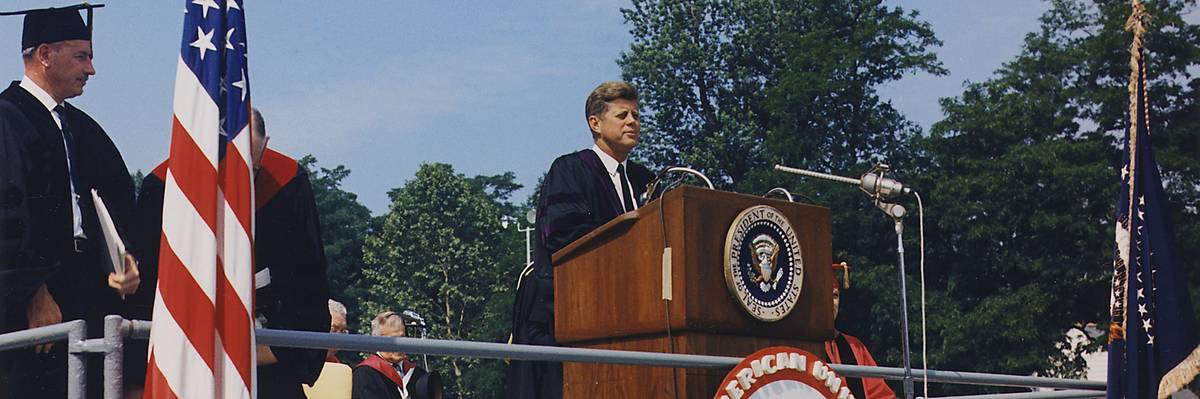
John F. Kennedy speaks at American University on June 10, 1963.
60 Years After Kennedy’s Speech, We Still Seek Peace for All Time
President John F. Kennedy’s 1963 speech now stands as an important indictment of how far in the wrong direction recent Democratic administrations have traveled in the decades since.
June 10 marks 60 years since American President John F. Kennedy delivered a searing critique of the Cold War and its mindset at a commencement address on the campus of American University (AU) in Washington, D.C.
In it, Kennedy expounded upon his vision of what peace might look like in the nuclear age.
“What kind of peace do we seek?,” he asked.
“Not a Pax Americana enforced on the world by American weapons of war. Not the peace of the grave or the security of the slave. I am talking about genuine peace, the kind of peace that makes life on earth worth living, the kind that enables men and nations to grow and to hope and to build a better life for their children—not merely peace for Americans but peace for all men and women—not merely peace in our time but peace for all time.”
For Kennedy, the specter of nuclear war, to which the United States and the U.S.S.R. came within a hair’s breadth the previous October during the Cuban Missile Crisis, made the pursuit of peace with the Soviet adversary an imperative. Yet it was one that put the young president at odds, perhaps fatally so, with his own national security-military-intelligence establishment.
But at AU, Kennedy took his case for a sane, rational, and above all ethical Cold War policy directly to the American people.
“I speak of peace,” said Kennedy, “as the necessary, rational end of rational men. I realize that the pursuit of peace is not as dramatic as the pursuit of war—and frequently the words of the pursuer fall on deaf ears. But we have no more urgent task.”
And Kennedy had, over the course of his presidency, and to the great consternation of the Pentagon and CIA, found a most unlikely partner in that pursuit, Soviet leader Nikita Khrushchev. Over the course of a series of U.S.-Soviet crises (the Bay of Pigs, the Vienna summit, and the Berlin Crisis) Kennedy and Khrushchev had developed a rapport which helped steer us away from apocalypse during the Cuban Missile Crisis. And in the aftermath of that crisis, the two began working toward a Nuclear Test Ban Treaty.
Kennedy realized that progress was contingent upon seeing the other as we might wish to be seen, in other words, upon empathy.
“No government or social system is so evil,” said Kennedy, “that its people must be considered as lacking in virtue.”
“So, let us not be blind to our differences but let us also direct attention to our common interests and to the means by which those differences can be resolved. And if we cannot end now our differences, at least we can help make the world safe for diversity. For, in the final analysis, our most basic common link is that we all inhabit this small planet. We all breathe the same air. We all cherish our children’s future. And we are all mortal.”
Such a way of thinking about the current Russian adversary is now notably absent in the corridors of power of President Joe Biden’s Washington.
Indeed, in our view, Kennedy’s speech now stands as an important indictment of how far in the wrong direction recent Democratic administrations have traveled in the decades since. While we are both on record condemning Putin’s invasion, we are mindful of the Biden administration’s failure to pursue diplomatic avenues to both prevent and end the war.
Today we stand perilously close to nuclear escalation as the administration ignores the red lines it set and succumbs to assorted hawks by agreeing to send F-16s to Ukraine. One can only hope President Kennedy’s message, delivered six decades ago this Saturday, somehow and in some way is understood by a new generation inside and outside Washington D.C., and has an impact on the course of war—and peace.
We are at a crossroads
This country and this world are at a monumental crossroads. In a few short weeks, US voters will have an opportunity to beat back the forces of fascism and confront the billionaires who are rigging the economy, our media system, and our democracy, making it increasingly impossible for ordinary people to get by. We’re not just talking about the election. We’re talking about what must be done once these fascist elements are vanquished from power. We need a bolder set of solutions than what either major party has so far been willing to offer and a working-class movement ready to fight like hell for it. Trump didn't emerge from nowhere. The conditions that fueled MAGA authoritarianism were created by decades of radical neoliberal economic policies and a corrupt political system dominated by corporate interests. They slashed taxes on the super-rich, promising that the benefits would trickle down. They said giveaways to the corporate titans would make life more affordable for the rest of us. It was all bullshit. And when a bitter, betrayed populace searches for someone to blame, right-wing demagogues have little trouble finding scapegoats. People know when they're being lied to, but you won't hear any of this from the corporate media. Only independent journalism—powered and funded by people who believe in building a better world—can deliver truly trustworthy daily news. Our Fall Campaign is underway, and we need your help. To power our newsroom through the rest of the year, we need to raise $125,000 by midnight on October 31. So if you share our vision, please contribute whatever you can to sustain our work. |
June 10 marks 60 years since American President John F. Kennedy delivered a searing critique of the Cold War and its mindset at a commencement address on the campus of American University (AU) in Washington, D.C.
In it, Kennedy expounded upon his vision of what peace might look like in the nuclear age.
“What kind of peace do we seek?,” he asked.
“Not a Pax Americana enforced on the world by American weapons of war. Not the peace of the grave or the security of the slave. I am talking about genuine peace, the kind of peace that makes life on earth worth living, the kind that enables men and nations to grow and to hope and to build a better life for their children—not merely peace for Americans but peace for all men and women—not merely peace in our time but peace for all time.”
For Kennedy, the specter of nuclear war, to which the United States and the U.S.S.R. came within a hair’s breadth the previous October during the Cuban Missile Crisis, made the pursuit of peace with the Soviet adversary an imperative. Yet it was one that put the young president at odds, perhaps fatally so, with his own national security-military-intelligence establishment.
But at AU, Kennedy took his case for a sane, rational, and above all ethical Cold War policy directly to the American people.
“I speak of peace,” said Kennedy, “as the necessary, rational end of rational men. I realize that the pursuit of peace is not as dramatic as the pursuit of war—and frequently the words of the pursuer fall on deaf ears. But we have no more urgent task.”
And Kennedy had, over the course of his presidency, and to the great consternation of the Pentagon and CIA, found a most unlikely partner in that pursuit, Soviet leader Nikita Khrushchev. Over the course of a series of U.S.-Soviet crises (the Bay of Pigs, the Vienna summit, and the Berlin Crisis) Kennedy and Khrushchev had developed a rapport which helped steer us away from apocalypse during the Cuban Missile Crisis. And in the aftermath of that crisis, the two began working toward a Nuclear Test Ban Treaty.
Kennedy realized that progress was contingent upon seeing the other as we might wish to be seen, in other words, upon empathy.
“No government or social system is so evil,” said Kennedy, “that its people must be considered as lacking in virtue.”
“So, let us not be blind to our differences but let us also direct attention to our common interests and to the means by which those differences can be resolved. And if we cannot end now our differences, at least we can help make the world safe for diversity. For, in the final analysis, our most basic common link is that we all inhabit this small planet. We all breathe the same air. We all cherish our children’s future. And we are all mortal.”
Such a way of thinking about the current Russian adversary is now notably absent in the corridors of power of President Joe Biden’s Washington.
Indeed, in our view, Kennedy’s speech now stands as an important indictment of how far in the wrong direction recent Democratic administrations have traveled in the decades since. While we are both on record condemning Putin’s invasion, we are mindful of the Biden administration’s failure to pursue diplomatic avenues to both prevent and end the war.
Today we stand perilously close to nuclear escalation as the administration ignores the red lines it set and succumbs to assorted hawks by agreeing to send F-16s to Ukraine. One can only hope President Kennedy’s message, delivered six decades ago this Saturday, somehow and in some way is understood by a new generation inside and outside Washington D.C., and has an impact on the course of war—and peace.
- Ukraine and The Tunnel at the End of the Light ›
- Opinion | What Comes After Pax Americana? | Common Dreams ›
- Opinion | Waging Peace in an Uncertain World | Common Dreams ›
- Opinion | Venture Capitalists Are Looking for a Fight | Common Dreams ›
- Opinion | In Gaza and Beyond, the Peace of the Graveyard Is Not Peace | Common Dreams ›
- RFK Jr Running Mate Floats Joining 'Forces With Trump' to Thwart Harris-Walz | Common Dreams ›
- Opinion | Bold New Proposals for Peace on Earth | Common Dreams ›
June 10 marks 60 years since American President John F. Kennedy delivered a searing critique of the Cold War and its mindset at a commencement address on the campus of American University (AU) in Washington, D.C.
In it, Kennedy expounded upon his vision of what peace might look like in the nuclear age.
“What kind of peace do we seek?,” he asked.
“Not a Pax Americana enforced on the world by American weapons of war. Not the peace of the grave or the security of the slave. I am talking about genuine peace, the kind of peace that makes life on earth worth living, the kind that enables men and nations to grow and to hope and to build a better life for their children—not merely peace for Americans but peace for all men and women—not merely peace in our time but peace for all time.”
For Kennedy, the specter of nuclear war, to which the United States and the U.S.S.R. came within a hair’s breadth the previous October during the Cuban Missile Crisis, made the pursuit of peace with the Soviet adversary an imperative. Yet it was one that put the young president at odds, perhaps fatally so, with his own national security-military-intelligence establishment.
But at AU, Kennedy took his case for a sane, rational, and above all ethical Cold War policy directly to the American people.
“I speak of peace,” said Kennedy, “as the necessary, rational end of rational men. I realize that the pursuit of peace is not as dramatic as the pursuit of war—and frequently the words of the pursuer fall on deaf ears. But we have no more urgent task.”
And Kennedy had, over the course of his presidency, and to the great consternation of the Pentagon and CIA, found a most unlikely partner in that pursuit, Soviet leader Nikita Khrushchev. Over the course of a series of U.S.-Soviet crises (the Bay of Pigs, the Vienna summit, and the Berlin Crisis) Kennedy and Khrushchev had developed a rapport which helped steer us away from apocalypse during the Cuban Missile Crisis. And in the aftermath of that crisis, the two began working toward a Nuclear Test Ban Treaty.
Kennedy realized that progress was contingent upon seeing the other as we might wish to be seen, in other words, upon empathy.
“No government or social system is so evil,” said Kennedy, “that its people must be considered as lacking in virtue.”
“So, let us not be blind to our differences but let us also direct attention to our common interests and to the means by which those differences can be resolved. And if we cannot end now our differences, at least we can help make the world safe for diversity. For, in the final analysis, our most basic common link is that we all inhabit this small planet. We all breathe the same air. We all cherish our children’s future. And we are all mortal.”
Such a way of thinking about the current Russian adversary is now notably absent in the corridors of power of President Joe Biden’s Washington.
Indeed, in our view, Kennedy’s speech now stands as an important indictment of how far in the wrong direction recent Democratic administrations have traveled in the decades since. While we are both on record condemning Putin’s invasion, we are mindful of the Biden administration’s failure to pursue diplomatic avenues to both prevent and end the war.
Today we stand perilously close to nuclear escalation as the administration ignores the red lines it set and succumbs to assorted hawks by agreeing to send F-16s to Ukraine. One can only hope President Kennedy’s message, delivered six decades ago this Saturday, somehow and in some way is understood by a new generation inside and outside Washington D.C., and has an impact on the course of war—and peace.
- Ukraine and The Tunnel at the End of the Light ›
- Opinion | What Comes After Pax Americana? | Common Dreams ›
- Opinion | Waging Peace in an Uncertain World | Common Dreams ›
- Opinion | Venture Capitalists Are Looking for a Fight | Common Dreams ›
- Opinion | In Gaza and Beyond, the Peace of the Graveyard Is Not Peace | Common Dreams ›
- RFK Jr Running Mate Floats Joining 'Forces With Trump' to Thwart Harris-Walz | Common Dreams ›
- Opinion | Bold New Proposals for Peace on Earth | Common Dreams ›