August, 17 2020, 12:00am EDT
For Immediate Release
Contact:
WASHINGTON
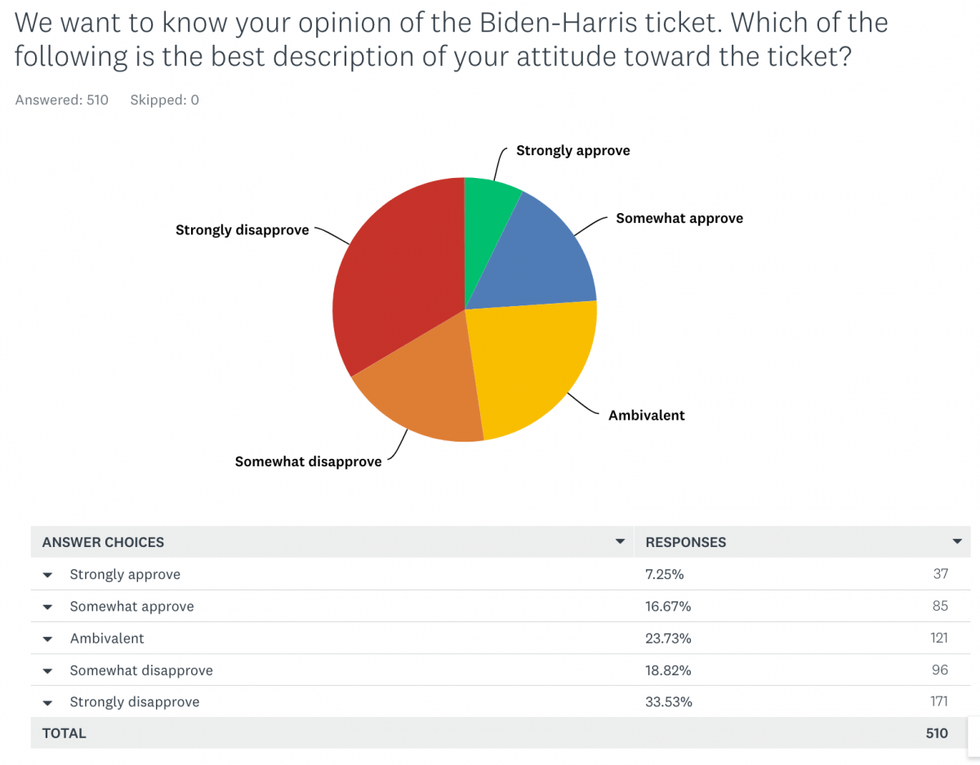
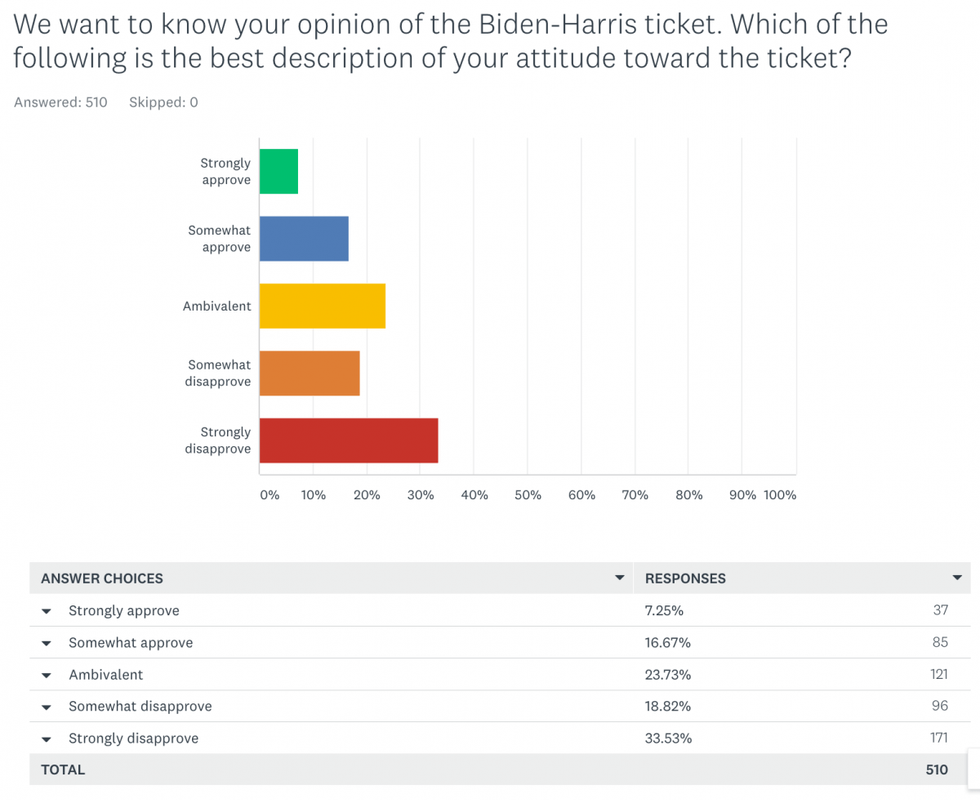
A just-completed survey of Bernie Sanders delegates to the national convention gauged opinions of the Biden-Harris ticket. The survey, conducted by the Bernie Delegates Network, found that 33 percent "strongly disapprove" of the ticket, while 19 percent "somewhat disapprove," 24 percent are "ambivalent," 17 percent "somewhat approve" and 7 percent "strongly approve." (Charts are below.)
The survey is by far the largest sampling ever conducted of the Sanders delegates to the 2020 convention. A total of 510 Sanders delegates completed the survey online (each using a unique link that prevented duplicate voting). The survey was conducted Aug. 14-16.
"It's unclear whether Biden realizes the political realities that are reflected in these numbers -- and how they could hurt him in swing states if he mistakenly believes he has the left adequately on board for the Biden-Harris ticket," said Norman Solomon, a Sanders delegate from California who is national director of RootsAction.org, one of the groups sponsoring the Bernie Delegates Network. "This should be a wakeup call for the Biden strategists."
Jeff Cohen, a Sanders delegate from New York and co-founder of RootsAction.org, commented: "This survey shows that the Biden-Harris team needs to go further to unify the party in order to crush Trump in November. Bernie delegates are some of the most dedicated activists and respected Democrats in their communities, and hundreds of them are influential grassroots leaders in battleground states. Go-slow tepid liberalism may satisfy party power brokers and excite corporate media pundits, but it isn't getting the job done with important activists who know how to reach swing voters on the left."
Alan Minsky, executive director of Progressive Democrats of America, said: "This is hard data and the message is clear. To this group of core progressives, the Biden-Harris ticket has yet to close the deal adequately. We, at PDA, understand it is essential that Donald Trump be defeated this fall. We also feel that the huge progressive constituency is key to achieving that result. These poll results suggest that progressive activists are looking for the Democratic ticket to signal greater commitment to progressive goals. I do think that would be a winning approach, especially since progressive policies fit our emergency needs during the pandemic."
A former chair of the Progressive Caucus of the California Democratic Party who is a Sanders delegate, Karen Bernal, said: "The challenge the ticket represents is that we are fighting for something that goes well beyond returning to the days before Trump -- that's what sets us apart from establishment Democrats who pine for the days of Obama. We are committed to the push for changes that are necessary and foundational if our nation and the planet are to survive and have any sense of well-being. Improved Medicare for All, a Green New Deal, ending a racist criminal injustice system at home and militarism abroad -- if Biden is inaugurated, expect the honeymoon to last about 30 seconds."
The survey offered respondents the option of adding their comments, and 170 of the delegates chose to do so. Here is a sampling of comments:
** "I, of course, would have 100% preferred Bernie as President but at this point I am focusing my efforts on getting Biden elected and other progressives in office."
** "I think the ticket has the potential to defeat Trump/Pence, but that alone is insufficient. I am unconvinced that this ticket will lead to necessary structural change to how our government works for its citizens (and not corporations). I am troubled that the ticket has not (yet?) embraced M4A [Medicare for All]."
** "Excited to have a black and South Asian woman on the ticket. But not convinced the policies we need will be forwarded by this administration."
** "I will support the ticket but would like to see bolder candidates supporting MFA [Medicare for All] and GND [Green New Deal]. These are the transformative issues for the next generation and this ticket does not speak to these issues."
** "It'd be great if they could extend an olive branch to progressives but they keep missing the opportunity."
** "I think it's incredibly tone deaf to pick a former prosecutor and AG after an entire summer of the largest social uprisings since the 1960s, protesting police brutality and systemic racism. I believe Harris brings more baggage to the table and doesn't do enough to unite the party. There were plenty of other women of color who would have been exceptional choices, that would bring everyone to the table and mobilize thousands of grassroots activists around the country."
** "This country needs leaders who are not taking big money from or are aligned with corporate interests. We need Medicare for All, a Green New Deal, real criminal justice system reform, and to get big corporate money out of politics."
RootsAction is dedicated to galvanizing people who are committed to economic fairness, equal rights for all, civil liberties, environmental protection -- and defunding endless wars. We mobilize on these issues no matter whether Democrats or Republicans control Washington D.C.
LATEST NEWS



Trump Doesn't 'Give a Damn' About Iran War Price Hikes—His Oil and Gas Holdings Are Up to $81.6 Million
Just how much extra is the public paying at the pump because of the eight-month conflict? As of Monday, the national average was $4.29 a gallon for gasoline and $6.35 for diesel, according to the American Automobile Association.
An online tracker from the Costs of War Project at Brown University estimates US residents have paid at least $144.6 billion more for fuel—$79.8 billion for gasoline and $64.79 billion for diesel. That's over $609 per household, just for gasoline.
Data from the congressional Joint Economic Committee suggest the impact could be even worse. As JEC Democrats' Monday report notes, the panel found that US households "have now spent an additional $101 billion on gasoline since the start of the Iran War, or an average of $856 in gas costs per family."
A state-by-state breakdown in the report—released just days ahead of the midterm elections that will determine control of Congress for the remainder of Trump's second term—reveals that price increases for gasoline have hit some areas particularly hard. Wyoming, a Republican stronghold, has had the highest hike per household, at $1,454.
Rounding out the top 10 are Utah ($1,240), Alabama ($1,232), Montana ($1,180), Mississippi ($1,141), South Dakota ($1,122), Idaho at ($1,108), North Dakota ($1,087), New Hampshire ($1,029), and Iowa ($1,010). Trump won all of those states but New Hampshire in 2024—when he campaigned on a promise to serve the interests of the climate-wrecking fossil fuel industry if its executives dumped $1 billion into his run, while also claiming he would lower costs for working people.
Meanwhile, the report stresses, Trump's oil and gas holdings could have nearly doubled this year, growing by as much as $35.8 million, for a total of up to $81.6 million—and 94% of his 2026 industry stock purchases occurred after he went to war with Iran, which has restricted ship traffic through the Strait of Hormuz.
The document details Trump's holdings—which are reported in ranges—in Chevron, ConocoPhillips, ExxonMobil, Marathon Petroleum, Occidental Petroleum, Phillips 66, Valero Energy, and Williams Companies. It also warns that "the true value may in fact be higher given that Trump has yet to report stock transactions for September or October, and because he has a history of filing his transactions much later than the law requires."
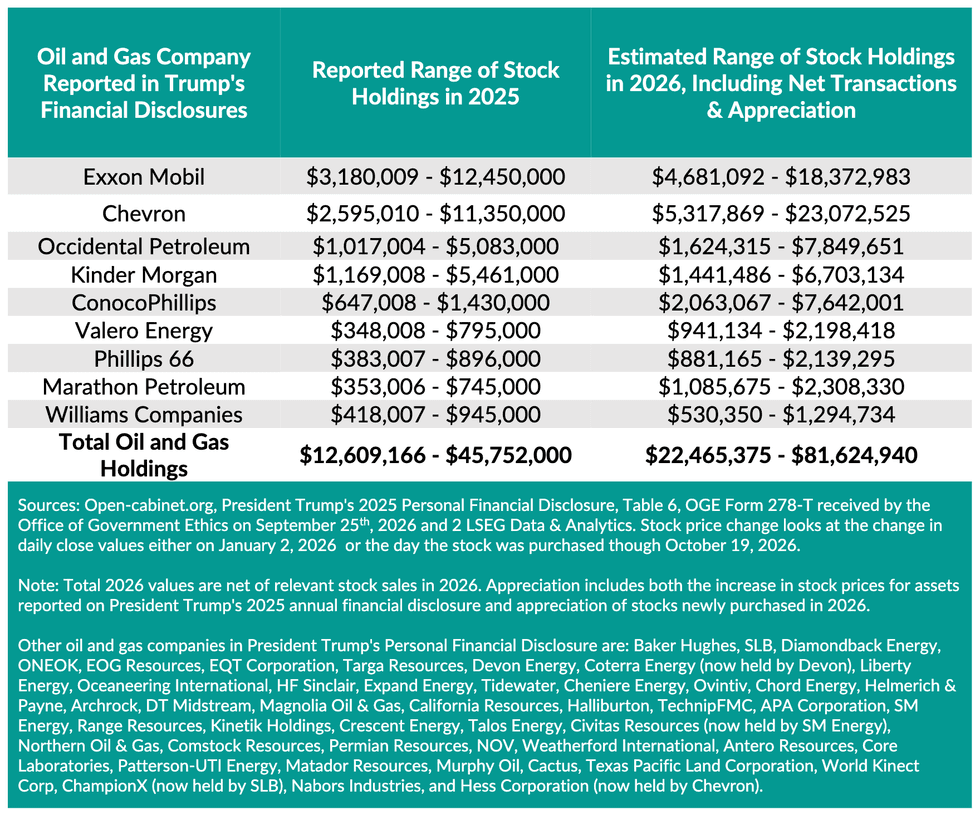 The graph published by the congressional Joint Economic Committee on October 26, 2026 shows US President Donald Trump's stock holdings in oil and gas companies.
Sen. Maggie Hassan (D-NH), the JEC's ranking member, declared that "Trump's Iran War has forced Americans to pay much more at the pump while Big Oil rakes in profits and the president's own stock wealth in the oil and gas industry continues to balloon."
Trump has faced scrutiny and criticism for cashing in on the conflict he created, which the White House has tried to dismiss by pointing out that the president's "stock and bond portfolio is independently managed by third-party financial institutions."
Such comments have not appeased critics, including Hassan, who said that "as Trump—the country's highest-ranking public employee—continues to own and trade stocks in companies that stand to benefit from his decisions, his actions raise major concerns about conflicts of interest. Unfortunately, this is nothing new from this administration and only reinforces that the president puts his own financial interests above the American people."
Most Popular