SUBSCRIBE TO OUR FREE NEWSLETTER
Daily news & progressive opinion—funded by the people, not the corporations—delivered straight to your inbox.
5
#000000
#FFFFFF
To donate by check, phone, or other method, see our More Ways to Give page.


Daily news & progressive opinion—funded by the people, not the corporations—delivered straight to your inbox.

Darcey Rakestraw, 202-683-2467; drakestraw@fwwatch.org
Yesterday, the Senate approved the conference report for the Farm Bill, less than 24 hours after the text of the bill was released. The House is expected to vote on the bill soon.
The following is a statement Wenonah Hauter, Executive Director of Food & Water Watch:
"Once again, Congress has come up with a Farm Bill that fails to fix critical problems in our food system.
Yesterday, the Senate approved the conference report for the Farm Bill, less than 24 hours after the text of the bill was released. The House is expected to vote on the bill soon.
The following is a statement Wenonah Hauter, Executive Director of Food & Water Watch:
"Once again, Congress has come up with a Farm Bill that fails to fix critical problems in our food system.
"We are glad to see that the final bill does not include many of the horrible provisions from the House bill that would have gutted the safety net provided by SNAP, preempted local and state regulations that are stronger than federal standards, and rolled back pesticide regulations. The final bill also contains some important progress for organic programs, including a long-overdue focus on strengthening enforcement of organic standards for imported products and funding for organic research, as well as important programs for beginning and social disadvantaged farmers.
"But just avoiding the worst parts of the terrible House bill isn't good enough. The final bill fails to rein in the factory farm system, and will continue to allow the meat industry to take advantage of guaranteed loans and conservation programs to subsidize their factory farms. And this farm bill continues to rely on the failed approach of crop insurance instead of the real reforms we need like restoring grain reserve and supply management programs that could be used to provide stability for farmers and rein in overproduction of the commodity crops that end up as cheap feed for factory farms."
Food & Water Watch mobilizes regular people to build political power to move bold and uncompromised solutions to the most pressing food, water, and climate problems of our time. We work to protect people's health, communities, and democracy from the growing destructive power of the most powerful economic interests.
(202) 683-2500One House Democrat said the appointment of former GEO Group executive David Venturella "is to ensure Trump's corporate bosses continue profiting from our communities' pain."
The Trump administration announced Tuesday that former private prison executive David Venturella will lead US Immigration and Customs Enforcement in an acting capacity after the agency's current director departs at the end of the month.
Venturella has been a senior adviser to ICE since February 2025 and previously worked at the private prison giant GEO Group for more than a decade, most recently serving as the company's senior vice president of client relations until 2023. GEO Group is a major beneficiary of federal contracts, running immigration detention centers for ICE.
The Washington Post noted that GEO Group also "owns the only company with an ICE contract to track immigrants through GPS ankle monitors."
"A federal ethics rule generally bars government employees from working on contracts awarded to their former employers for one year, but the administration granted him a waiver from this rule," the Post observed.
GEO Group's PAC donated heavily to President Donald Trump's 2024 campaign and has seen a hefty return on its investment. The company reported $254 million in profits for fiscal year 2025—a 700% increase compared to the previous year—and boasted "record-setting new contract wins totaling up to $520 million."
As an ICE adviser, Venturella has advocated for the use of warehouses to detain immigrants, a practice that has drawn nationwide outrage. NBC News noted that "after he retired from GEO, Venturella was a consultant for the company, advising on new and existing contracts, according to a filing with the Securities and Exchange Commission."
The Trump administration's decision to elevate Venturella to the head of ICE comes as congressional Republicans are working to approve tens of billions of dollars in additional funding for the agency, even as deaths in detention rise and immigration officers unleashed by the president continue to face backlash for fatal abuses across the country.
The GOP's budget reconciliation proposal, according to an analysis by the American Immigration Council, includes over $38 billion for ICE to "expand and sustain enforcement operations by hiring and equipping personnel across its divisions, supporting detention and removal transportation, upgrading technology and facilities, and expanding 287(g) agreements with local law enforcement."
Rep. Delia Ramirez (D-Ill.), a lead sponsor of legislation that would terminate all existing federal contracts for immigration detention, said Tuesday that Venturella's appointment as acting ICE chief "is to ensure Trump's corporate bosses continue profiting from our communities' pain."
"But Americans demand oversight and accountability," said Ramirez. "We must Melt ICE, end detention, and dismantle [the Department of Homeland Security]."
"MAGA loyalists are using every lever they control, from legislatures to courts, to rig the system and lock voters out of fair representation," said the National Democratic Redistricting Committee.
While five Republican South Carolina senators joined Democrats in blocking a GOP effort to advance President Donald Trump's national gerrymandering push in the state on Tuesday, the Missouri Supreme Court handed him a key win, approving a rigged congressional map forced through last year.
"MAGA loyalists are using every lever they control, from legislatures to courts, to rig the system and lock voters out of fair representation," said the National Democratic Redistricting Committee after Missouri's top court rejected multiple challenges to the map that targets the 5th Congressional District, currently represented by Democratic Rep. Emanuel Cleaver.
In one consolidated case, the court found that opponents of the map failed to show that it "clearly and undoubtedly violates the requirements of Article III, Section 45 of the Missouri Constitution."
Marina Jenkins, executive director of the National Redistricting Foundation, said in a statement that "the arguments in this case, which were presented before the Missouri Supreme Court just this morning, took less than an hour and elicited zero questions from the court for the lawyers for either the plaintiffs or defendants."
"While one might be inclined to hope that these justices managed to grapple with a highly complex, nuanced, and consequential issue in just six hours, it seems clear the justices were not interested in the day's proceedings and simply had their opinion already finalized even before this morning's argument," Jenkins continued. "With this decision, the Missouri Supreme Court has shown Missourians the lack of seriousness with which it takes cases that pertain to protecting their right to vote—a complete and dangerous abdication of the judiciary's role."
Another case stems from a political group that has collected signatures to force a referendum vote on the state's redistricting. The court found that the filing did not automatically suspend the map under the state constitution.
As KOMU reported Tuesday, People Not Politicians Missouri has submitted over 300,000 signatures to Secretary of State Denny Hoskins, but the Republican has not yet said whether his office will approve or reject its inclusion on the ballot.
"The secretary of state's own data confirms what more than 305,000 Missourians already made clear: This referendum is sufficient, and the people have a right to vote," Richard von Glahn, executive director of People Not Politicians Missouri, said in the statement after the state court's decisions on Tuesday.
"Today's ruling from the Supreme Court confirms this fact. A sufficient petition suspends the law the day it is turned in," he continued. "Unnecessary delays by politicians do not change this fact. If he continues to delay, then he is moving forward under a map that has been suspended by the people."
Missouri Republicans won’t stop trying to illegally rig our maps. We collected 305,968 signatures to put their rigged map to a vote of the people, and they still refuse to do their job.So my name is Laura, and I’m here to bully my government. #FairMaps #Missouri #moleg
[image or embed]
— Laura Burkhardt (@lauraannstl.bsky.social) May 12, 2026 at 12:04 PM
Meanwhile, in South Carolina—a state already known for Republican map-rigging—the state Senate voted 29-17, two votes short of the two-thirds majority needed to move forward on redistricting to help the GOP, despite Trump's public call to "GET IT DONE!"
Welcoming the result, the state's Senate Democrats said that it "sent a clear message that South Carolina should not be dragged into another unnecessary and divisive redistricting battle driven by Washington insiders."
"South Carolina rejected a politically motivated power grab orchestrated by a White House shaped by perpetually online New York City activists with little understanding of South Carolina," the Senate Democrats continued. "The people of this state expect us to focus on the real issues affecting their daily lives, not carry out an outside political agenda."
They pledged that "Senate Democrats will continue fighting for fair representation, transparency, and a government focused on the needs of South Carolina families rather than national political gamesmanship."
While the Republican-led Indiana state Senate similarly rejected a Trump-backed gerrymander last December, GOP legislators in Florida, North Carolina, Missouri, Tennessee, and Texas have caved to pressure from the president and enacted new maps ahead of November's midterm elections, in which Democrats hope to claim majorities in both chambers of Congress.
Tennessee's redistricting came after the right-wing US Supreme Court last month found that Louisiana's map was an "unconstitutional racial gerrymander" and gutted what remained of Section 2 of the Voting Rights Act. The nation's top court on Monday also paved a path for Alabama lawmakers to break up their state’s majority-Black district.
In response to GOP attacks on voting rights across the South, "All Roads Lead to the South," the No Kings coalition, community members, faith leaders, and other organizations are planning demonstrations at the Alabama State Capitol in Montgomery as well as Selma's Edmund Pettus Bridge on Saturday, May 16, with solidarity actions across the country.
"It cannot be said enough that people aren't being 'lifted' or 'moved off' SNAP—struggling families are losing the help they need to afford groceries because of HR 1's cuts," said one expert.
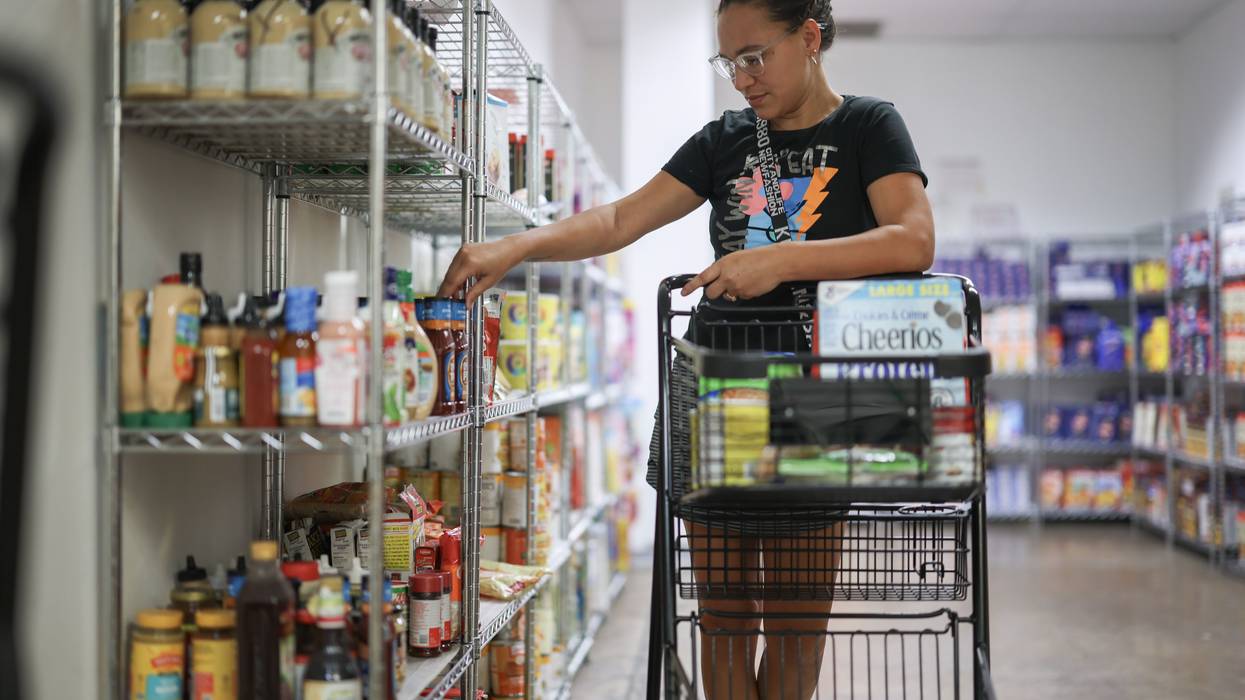
Food banks across the United States are experiencing increased demand not seen since the Covid-19 pandemic as higher consumer prices and food aid cuts enacted by congressional Republicans and President Donald Trump cause pain for millions of vulnerable families.
The so-called One Big Beautiful Bill (OBBBA, or HR 1) passed by the Republican-controlled Congress and signed into law by Trump last July 4 contains the biggest cuts to Supplemental Nutrition Assistance Program (SNAP), or food stamps, in the nation's history.
According to US Department of Agriculture data, participation in SNAP dropped by 8% nationwide in the six months following the law's signing. A recent analysis by the Center for Budget and Policy Priorities found that around 2.5 million people have lost food aid since the legislation took effect.
Laura Lester, CEO of Feeding Alabama, told Al.com that the state is "on track to lose up to 100,000 people off of SNAP benefits by the end of this year."
“We are already hearing from those impacted who no longer have access to food,” said Lester. “Homeless children and seniors are the ones who are suffering. We have absolutely seen an increase in the number of people who don’t have enough to eat coming to our pantries.”
The OBBBA contains new qualification requirements for people experiencing homelessness, veterans, former foster youth, and older adults. The Trump administration says the new rules are meant to ensure that only the truly needy receive benefits. However, the more stringent requirements are harming some of the most vulnerable people.
“To see seniors and young women with children lose their benefits, it’s heartbreaking,” Dan Saltzman, president of Dave’s Markets, a Cleveland-area grocery store chain, told Signal Cleveland. Saltzman said his business' revenue from SNAP has declined by about 10% over the past year.
Compliance procedures are proving an exclusionary barrier to qualified aid applicants.
“Tens of thousands of SNAP participants are facing new hurdles just to maintain assistance,” New Jersey Human Services Commissioner Stephen Cha said last week. “Many residents who remain eligible for assistance could still lose coverage or food support because complex paperwork or missed deadlines prevent them from completing required steps."
Kristin Warzocha, CEO of Greater Cleveland Food Bank—which served more than 400,000 people last year—said that she has "talked to quite a number of people lately who are seniors who are struggling to get by with rising prices."
“They’re worried about the cost of groceries. They’re worried because their rent has gone up. And they just can’t make ends meet anymore," she added. "They just can’t do it. So they’re coming here for food.”
Jennie Jean Davidson, executive director at Neighborhood House, a Louisville food bank, told Spectrum News 1 that "honestly, demand for what we do is up in every area."
"We have waiting lists in our child development center and in our youth programming," she explained. "Demand in our food pantry has been going up month-over-month for about three years now and it’s just continuing to climb. We’re seeing a lot of need in the community.”
Trump's tariffs, war of choice on Iran, and attacks on the social safety net are driving up inflation, and household debt, exacerbating the struggles of millions of Americans. While he campaigned on promises to lower prices on "day one," Trump admitted Tuesday that Americans' financial struggles aren't on his mind, "not even a little bit," as he tries to negotiate an end to the war he started with Israel against Iran.
"We're seeing a lot of uneasiness amongst people in general," Community Food Bank of Southern Arizona president and CEO Natalie Jayroe told KGUN on Tuesday. "So many things are changing. Nobody knows when this inflation is going to stop. They don't know when the price of gas is going to start to go down again. We've had cuts in some of the funding that families normally depend on."
“Right now, we're reaching about 6,200 children and we do that primarily through our summer feeding programs that take place in schools and other camps," she added. “So many of our children depend on school breakfast and lunch during the year. In our case here in Southern Arizona and the five counties that we serve, that's 88,000 children."