SUBSCRIBE TO OUR FREE NEWSLETTER
Daily news & progressive opinion—funded by the people, not the corporations—delivered straight to your inbox.
5
#000000
#FFFFFF
To donate by check, phone, or other method, see our More Ways to Give page.
Daily news & progressive opinion—funded by the people, not the corporations—delivered straight to your inbox.
Carolyn Eisenberg
Department of History
347-743-8401, hiscze@aol.com
Martin Melkonian
Department of Economics
516-741-4360, Martin.Melkonian@Hofstra.edu
Debra Goodman
Department of Teaching, Literacy and Leadership
516-505-5062, Debra.goodman@hofstra.edu
With the second Presidential Debate scheduled for this evening at Hofstra University, members of its faculty and staff are calling upon the two candidates and moderator Candy Crowley to hold a "real debate over how we can best protect human rights, advance social justice and end unnecessary wars. "
Observing that both campaigns have essentially ignored these concerns, the group emphasized that "with forty-six million people now living in poverty, it is a stunning abdication of responsibility" for the candidates to focus exclusive attention on the middle class.
At a time when worries over the deficit are driving demands for draconian cuts in vital human services, the educators challenged President Obama and Governor Romney to explain why they support a military budget in FY 2013, which is in excess of $600 billion.
Noting that on average one American soldier is committing suicide every day, another 2000 have been killed, and an estimated 15,000 Afghan civilians have perished in the conflict, group spokesman Professor Martin Melkonian asked, "why is the United States government planning to keep its troops in Afghanistan for another two years?"
And why, the Hofstra educators wanted to know, is it acceptable to use Predator drones, over the villages of Pakistan, Yemen and elsewhere, terrorizing the inhabitants and assassinating alleged "militants" without proof or accountability? "Who will protect our people from the rage such attacks inspire?"
Hofstra Debate Should Focus on Social Justice, Peace and Human Rights!
Statement by Long Island Teachers and Friends for Human Rights
In this election year, we are concerned that neither campaign has addressed vital issues of peace, social justice and human rights.
With forty-six million Americans now in poverty, it is a stunning abdication of responsibility to refer exclusively to problems of the middle class. What shall be done for the 22% of children in the richest country of the world, who lack adequate food, housing and access to quality education?
With states and cities across the United States laying off hundreds of thousands of teachers, firemen, hospital workers and other public employees, why is there no acknowledgement by either candidate that this is not an imagined future but a contemporary reality? And why are there no serious proposals on the table for reversing these losses?
With heightened alarm about the deficit, and the curtailment of essential human services from day care facilities, to senior citizens centers, to repair of our bridges, roads and transportation network, why are candidates from both parties advocating military expenditures for FY 2013 that are in excess of $600 billion?
With one American soldier committing suicide every day, another 2000 killed, an estimated 15,000 Afghan civilians who have perished in violent attacks, $500 billion already spent, why is the United States government planning to remain in Afghanistan for another two years? Can either candidate explain how this will achieve any practical goal? And if there is none, why are we continuing to forfeit money and lives?
With American Predator drones, hovering over foreign territory in Pakistan and Yemen, terrorizing the inhabitants and assassinating individuals for unstated, undocumented reasons, can either candidate explain why this will make our country more secure? Or how this will protect our people from the anger that such attacks inspire?
These urgent questions require forthright answers. And we call upon both candidates and the Town Hall moderator to provide the American public with a real debate over how we can best protect human rights, advance social justice and end unnecessary wars.
Signed:
Faculty, Staff and Friends
Johan Ahr (History)
Iska Alter (English)
Valerie Barr (friend)
Cindy L. Bell (Music)
Robert Brinkman (Geology, Environment and Sustainability)
Ann M. Burlein (Religion)
Jacqueline Grennon Brooks (Education)
John L. Bryant (English)
Chandler Carter (Music)
Sally Charnow (History)
Judy D'Angio (History)
Timothy P. Daniels (Sociology)
Tom DelGudice (Economics)
Neil Donahue (German and Comparative Literature)
Simon Doubleday (History)
Carolyn Eisenberg (History)
Rosebud Elijah (Education)
Brenda Elsey (History)
Anita Feldman (Dance)
Laurie Fendrich (Fine Arts)
Massoud Fazuli (Economics)
Ann Feuerbach (Anthropology)
David Friedkin (Writing Studies)
Esther Fusco (Education)
Ignacio L. Gotz (emeritus)
Debra Goodman (Education)
David Green (Political Science)
Robert Guttmann (Economics)
Russ Harrison (Writing Studies)
Conrad Herold (Economics)
Kari P. Jensen (Global Studies and Geography)
Elena Jurasaite-Harbison (Education)
Jessica Karmen (Sociology)
Sharryn M. Kasmir (Anthropology)
Judy Kaufman (Education)
Louis J. Kern (History)
Stefan Krieger (Law)
James P. Levy (History)
Barbara Lekatsas (Comp Lit and Languages)
Charles F. Levinthal (Psychology)
Andrea Libresco (Education)
Rick Ligouri (Education)
Linda Longmire (Global Studies and Geography)
Michael J. Ludwig (Health Professions)
Greg Maney (Sociology)
Martin Melkonian (Economics)
Cheryl B. Mwaria (Anthropology)
John Munz (History)
Mario Murillo (Radio, Television, Film)
Stefanie E. Nanes (Political Science)
Christopher Niedt (Sociology)
Edward Ostling (Mathematics)
Irene Plonczak (STEM, Science, Technology and Math)
Erica Percorale
Stan Pugliese (History)
Cindy Rosenthal (Drama)
Benita Sampedro (Romance Languages)
Sabina Sawhney (English)
Eileen Simons (Education)
Alan Singer (Education)
Judy Singer (Friend)
Tim Smith (Education)
Sandra L. Stacki (Education)
John Teehan (Religion)
Daniel Martin Varisco (Anthropology)
Sharon Whitton (Education)
Susan Yohn (History)
Lee Zimmerman (English)
Paul Zimmerman (English)
"This is our God: Jesus, King of Peace, who rejects war, whom no one can use to justify war."
Pope Leo XIV used his Palm Sunday sermon to take what appears to be a shot at US Defense Secretary Pete Hegseth.
In his sermon, excerpts of which he published on social media, the pope emphasized Christian teachings against violence while criticizing anyone who would invoke Jesus Christ to justify a war.
"This is our God: Jesus, King of Peace, who rejects war, whom no one can use to justify war," Pope Leo said. "He does not listen to the prayers of those who wage war, but rejects them."
The pope also encouraged followers to "raise our prayers to the Prince of Peace so that he may support people wounded by war and open concrete paths of reconciliation and peace."
While speaking at the Pentagon last week, Hegseth directly invoked Jesus when discussing the Trump administration's unprovoked and unconstitutional war with Iran.
Specifically, Hegseth offered up a prayer in which he asked God to give US soldiers "wisdom in every decision, endurance for the trial ahead, unbreakable unity, and overwhelming violence of action against those who deserve no mercy," adding that "we ask these things with bold confidence in the mighty and powerful name of Jesus Christ."
Mother Jones contributing writer Alex Nguyen described the pope's sermon as a "rebuke" of Hegseth, whom he noted "has been open about his support for a Christian crusade" in the Middle East.
Pope Leo is not the only Catholic leader speaking against using Christian faith to justify wars of aggression. Two weeks ago, Cardinal Pierbattista Pizzaballa, the Latin patriarch of Jerusalem, said "the abuse and manipulation of God’s name to justify this and any other war is the gravest sin we can commit at this time."
“War is first and foremost political and has very material interests, like most wars," Cardinal Pizzaballa added.
"Trump’s problem is that whatever the claims he might make about the damage to Iran’s nuclear and military capacity, which is substantial, the regime survives, the international economy has been severely disrupted, and the bills keep on coming in."
President Donald Trump is reportedly preparing to launch some kind of ground assault on Iran in the coming weeks, but one prominent military strategy expert believes he's heading straight for defeat.
The Washington Post on Saturday reported that the Pentagon is preparing for "weeks" of ground operations in Iran, which for the last month has disrupted global energy markets by shutting down the Strait of Hormuz in response to aerial assaults by the US and Israel.
The Post's sources revealed that "any potential ground operation would fall short of a full-scale invasion and could instead involve raids by a mixture of Special Operations forces and conventional infantry troops" that could be used to seize Kharg Island, a key Iranian oil export hub, or to search out and destroy weapons systems that could be used by the Iranians to target ships along the strait.
Michael Eisenstadt, director of the Military and Security Studies Program at the Washington Institute for Near East Policy, told the Post that taking over Kharg Island would be a highly risky operation for American troops, even if initially successful.
“I just wouldn’t want to be in that small place with Iran’s ability to rain down drones and maybe artillery,” said Eisenstadt.
Eisenstadt's analysis was echoed by Ret. Gen. Joseph Votel, former head of US Central Command, who told ABC News that seizing and occupying Kharg Island would put US troops in a state of constant danger, warning they could be "very, very vulnerable" to drones and missiles launched from the shore.
Lawrence Freedman, professor emeritus of war studies at King's College London, believes that the president has already checkmated himself regardless of what shape any ground operation takes.
In an analysis published Sunday, Freedman declared Trump had run "out of options" for victory, as there have been no signs of the Iranian regime crumbling due to US-Israeli attacks.
Freedman wrote that Trump now "appears to inhabit an alternative reality," noting that "his utterances have become increasingly incoherent, with contradictory statements following quickly one after the other, and frankly delusional claims."
Trump's loan real option at this point, Freedman continued, would to simply declare that he had achieved an unprecedented victory and just walk away. But even in that case, wrote Freedman, "this would mean leaving behind a mess in the Gulf" with no guarantee that Iran would re-open the Strait of Hormuz.
"Success in war is judged not by damage caused but by political objectives realized," Freedman wrote in his conclusion. "Here the objective was regime change, or at least the emergence of a new compliant leader... Trump’s problem is that whatever the claims he might make about the damage to Iran’s nuclear and military capacity, which is substantial, the regime survives, the international economy has been severely disrupted, and the bills keep on coming in."
"The NY Times saves its harshest skepticism for progressives," said one critic.
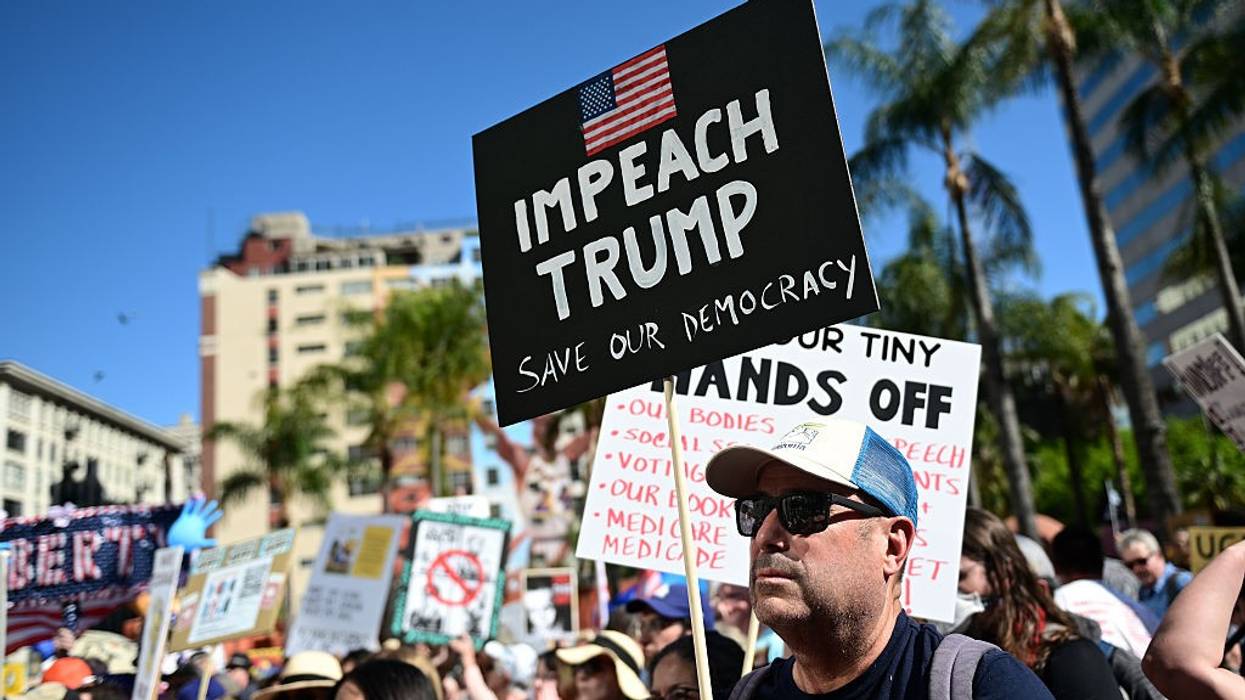
The New York Times is drawing criticism for publishing articles that downplayed the significance of Saturday's No Kings protests, which initial estimates suggest was the largest protest event in US history.
In a Times article that drew particular ire, reporter Jeremy Peters questioned whether nationwide events that drew an estimated 8 million people to the streets "would be enough to influence the course of the nation’s politics."
"Can the protests harness that energy and turn it into victories in the November midterm elections?" Peters asked rhetorically. "How can they avoid a primal scream that fades into a whimper?"
Journalist and author Mark Harris called Peters' take on the protests "predictable" and said it was framed so that the protests would appear insignificant no matter how many people turned out.
"There's a long, bad journalistic tradition," noted Harris. "All conservative grass-roots political movements are fascinating heartland phenomena, all progressive grass-roots political movements are ineffectual bleating. This one is written off as powered by white female college grads—the wine-moms slur, basically."
Media critic Dan Froomkin was event blunter in his criticism of the Peters piece.
"Putting anti-woke hack Jeremy Peters on this story is an act of war by the NYT against No Kings," he wrote.
Mark Jacob, former metro editor at the Chicago Tribune, also took a hatchet to Peters' analysis.
"The NY Times saves its harshest skepticism for progressives," he wrote. "Instead of being impressed by 3,000-plus coordinated protests, NYT dismisses the value of 'hitting a number' and asks if No Kings will be 'a primal scream that fades into a whimper.' F off, NY Times. We'll defeat fascism without you."
The Media and Democracy Project slammed the Times for putting Peters' analysis of the protests on its front page while burying straight news coverage of the events on page A18.
"NYT editors CHOSE that Jeremy Peters's opinions would frame the No Kings demonstrations and pro-democracy movement to millions of NYT readers," the group commented.
Joe Adalian, west coast editor for New York Mag's Vulture, criticized a Times report on the No Kings demonstrations that quoted a "skeptic" of the protests without noting that said skeptic was the chairman of the Ole Miss College Republicans.
"Of course, the Times doesn’t ID him as such," remarked Adalian. "He's just a Concerned Youth."
Jeff Jarvis, professor emeritus at the CUNY Graduate School of Journalism, took issue with a Times piece that offered five "takeaways" from the No Kings events that somehow managed to miss their broader significance.
"I despise the five-takeaways journalistic trope the Broken Times loves so," Jarvis wrote. "It is reductionist, hubristic in its claim to summarize any complex event. This one leaves out much, like the defense of democracy against fascism."
Journalist Miranda Spencer took stock of the Times' entire coverage of the No Kings demonstrations and declared it "clueless," while noting that USA Today did a far better job of communicating their significance to readers.
Harper's Magazine contributing editor Scott Horton similarly argued that international news organizations were giving the No Kings events more substantive coverage than the Times.
"In Le Monde and dozens of serious newspapers around the world, prominent coverage of No Kings 3, which brought millions of Americans on to the streets to protest Trump," Horton observed. "In NYT, an illiterate rant from Jeremy W Peters and no meaningful coverage of the protests. Something very strange going on here."