

SUBSCRIBE TO OUR FREE NEWSLETTER
Daily news & progressive opinion—funded by the people, not the corporations—delivered straight to your inbox.
5
#000000
#FFFFFF
To donate by check, phone, or other method, see our More Ways to Give page.
Daily news & progressive opinion—funded by the people, not the corporations—delivered straight to your inbox.

According to media reports, Senate Republicans have agreed to confirm at least 19 of the 38 judicial nominations pending on the Senate's calendar at the beginning of the lame duck session in exchange for a commitment that Senate Democrats refrain from holding votes on four others. These four nominations plus an additional 15 pending nominations not acted upon would be returned to the President when Congress adjourns.
According to media reports, Senate Republicans have agreed to confirm at least 19 of the 38 judicial nominations pending on the Senate's calendar at the beginning of the lame duck session in exchange for a commitment that Senate Democrats refrain from holding votes on four others. These four nominations plus an additional 15 pending nominations not acted upon would be returned to the President when Congress adjourns.
"With these confirmations, the Senate will put a dent in the extraordinary number of vacancies on the federal bench, but it's nowhere near what we need," said Marge Baker of People For the American Way. "It's deeply disappointing that so many qualified nominees will be refused a vote. Of the nominees confirmed, the vast majority were approved by the Judiciary Committee without a single vote of opposition. Winning approval for these 19 nominees in the full Senate is a consolation prize at best, especially given the absence of any significant opposition to most of those confirmed. These nominees should have been confirmed months ago."
Of the nominees to be confirmed, some have been waiting for as long as a year for a vote. Among the nominees to be sent back to the White House without a vote are four of the eminently qualified-and mainstream-nominees who have been tagged as "controversial" by Republicans:
* Rhode Island nominee John McConnell, who has been opposed by the U.S. Chamber of Commerce for his willingness to represent victims of lead paint poisoning
* Former Wisconsin Supreme Court Justice Louis Butler, whose work as a judge irked business interests so much, they spent $1 million to prevent his reelection
* U.S. Magistrate Edward Chen, who has been attacked for his work fighting discrimination against Asian Americans for the American Civil Liberties Union
* Ninth Circuit Appeals Court nominee Goodwin Liu, who, as the New York Times editorial page has pointed out, has been opposed mainly from fear that he's so qualified, he might end up on the Supreme Court
All four nominees would have garnered enough support to overcome a Republican filibuster.
"Not only will the Senate Democrats fail to confirm nominees who could easily have been approved, they will have allowed Senate Republicans to walk away with their hands clean," said Baker. "By never calling a vote on Butler, McConnell, Liu and Chen, Senator Reid will let Republicans block qualified nominees without even putting their opposition on the record. In the next Congress, the White House and Senate leadership have to make judicial nominations a far greater priority and prevent this kind of backlog from building up again. That means calling up nominees and taking cloture votes early and often.
"Republicans have spent decades putting jurists on the bench who bend the law to privilege corporate interests over the rights of individual Americans. By slow walking President Obama's nominees, GOP senators are trying to maintain the pro-corporate, anti-regulation bias they've worked so hard to embed in the federal judiciary. Senators shouldn't be fighting against nominees who understand that the rights of individual Americans can't be tossed aside to appease corporate interests."
People For the American Way works to build a democratic society that implements the ideals of freedom, equality, opportunity and justice for all. We encourage civic participation, defend fundamental rights, and fight to dismantle systemic barriers to equitable opportunity. We fight against right-wing extremism and the injustice it fosters.
1 (800) 326-7329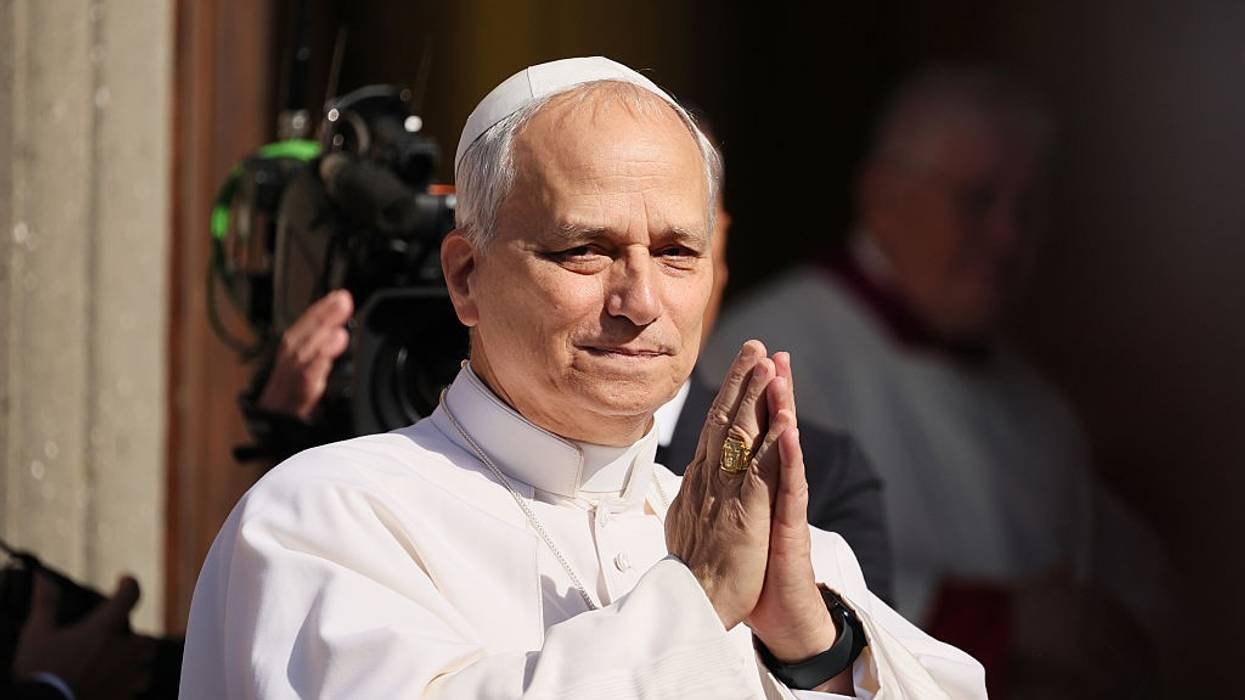
"Violence can never lead to the justice, stability, and peace that the people are waiting for,” the pope said during a prayer.
Pope Leo XIV called for a ceasefire in the Middle East on Sunday, in his most direct appeal for peace since the US and Israel launched a war on Iran on February 28.
While the pope did not mention either US President Donald Trump or Israeli Prime Minister Benjamin Netanyahu by name, he directly addressed those driving hostilities.
“On behalf of the Christians of the Middle East and all women and men of good will, I appeal to those responsible for this conflict,” Leo said, according to The Associated Press. “Cease fire so that avenues for dialogue may be reopened. Violence can never lead to the justice, stability, and peace that the people are waiting for.”
The remarks came following his recital of the Angelus Prayer from the Vatican at 12:00 pm local time.
“Some claim to involve the name of God in these deadly decisions, but God cannot be enlisted by darkness."
"The people of the Middle East for two weeks have been suffering the atrocious violence of war," he began.
He continued: “Thousands of innocent people have been killed, and many others have been forced to abandon their homes. I renew my prayerful closeness to all those who have lost their loved ones in the attacks that have struck schools, hospitals, and residential areas."
According to AP, the mentioned school strike likely referred to the US bombing of an elementary school in Minab, Iran on the first day of the war, which killed at least 175 people, the majority of whom were children.
Pope Leo also repeated concerns about the situation in Lebanon, and called for "paths of dialogue that can support the country’s authorities in implementing lasting solutions to the serious crisis underway."
Israeli attacks on that country have forced about 1 million people to abandon their homes and killed more than 800, The Guardian reported.
The pope's remarks came two days after a Israeli strikes killed 12 healthcare workers at the primary healthcare facility in Burj Qalaouiyah, Lebanon, an attack that the country's health ministry said "violated all international humanitarian laws.”
Director-General of the World Health Organization Tedros Adhanom Ghebreyesus said in a statement Saturday: "WHO condemns this tragic loss of life and emphasizes that health workers must always be protected. According to international humanitarian law, medical personnel and facilities should never be attacked or militarized."
He continued: "The intensification of conflict in Lebanon and the broader Middle East increases the likelihood of such tragedies. Urgent action is required to de-escalate the crisis and protect the health of people throughout the region."
In Iran, meanwhile, US and Israeli attacks on the city of Isfahan killed at least 15 people Sunday morning, and the total death toll for the country is around 1,400, according to Al Jazeera.
Following his remarks during the Angelus Prayer, Pope Leo also addressed the war while conducting a pastoral visit to a suburb of Rome.
“Currently, many of our brothers and sisters in the world are suffering from violent conflicts, caused by the absurd claim that problems and differences can be resolved through war,” he said, as Agence France-Presse reported.
He also criticized those who use religion to justify violence: “Some claim to involve the name of God in these deadly decisions, but God cannot be enlisted by darkness. It is peace that those who invoke him must seek.”
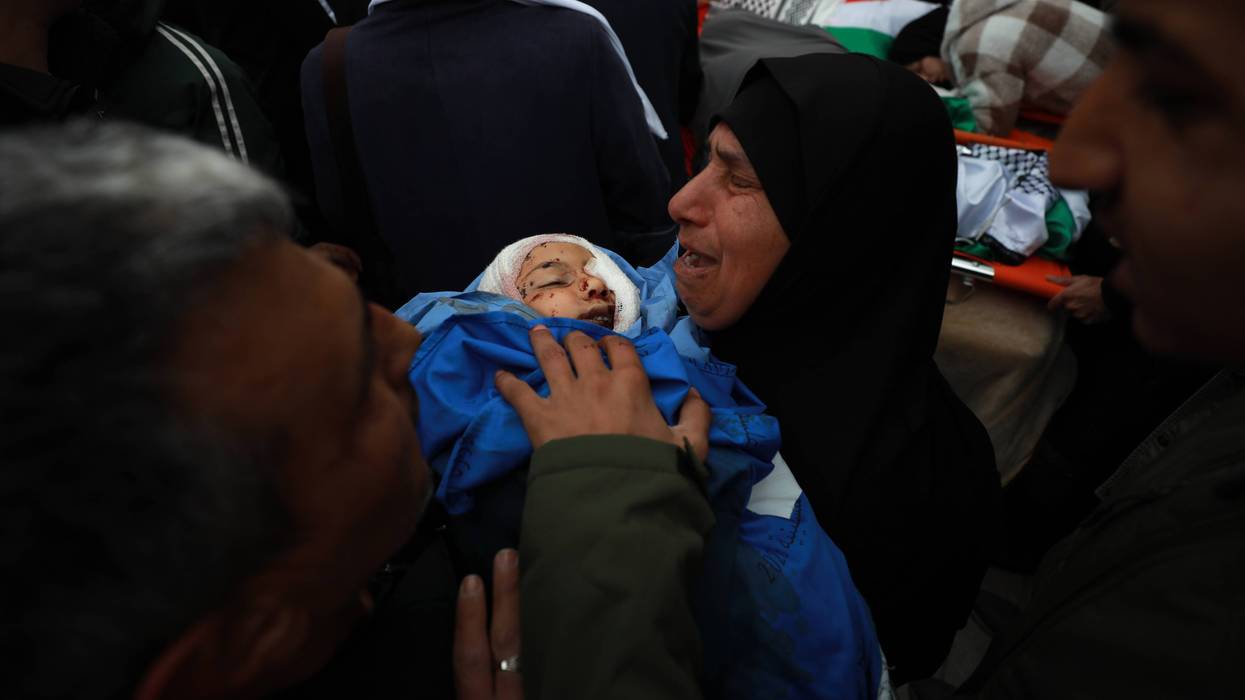
"Targeting an entire family in this savage manner reveals the true nature of the Israeli occupation and its policies based on killing and extermination, destruction and displacement," the Palestinian Ministry of Foreign Affairs said.
The Israeli Defense Forces killed a Palestinian couple and two of their children in the West Bank on Sunday, on one of the deadliest days for Palestinians in Gaza and the West Bank in weeks.
The soldiers opened fire on a car in the village of Tammun in which 37-year-old Ali Khaled Bani Odeh, his 35-year-old wife Waad, and their four sons Mohammad, Othman, Mustafa, and Khaled were traveling. Odeh, Waad, 5-year-old Mohammad, and 7-year-old Othman were shot in the head and died, leaving behind two injured children.
"We came under direct fire, we didn't know the source. Everyone in the car was martyred, except my brother Mustafa and me," one of the surviving children, 12-year-old Khaled, told Reuters from the hospital.
He said that after the shooting was over, the Israeli soldiers pulled him out of the car and began to beat him, telling him, "We killed dogs."
"These crimes occur within a systematic policy pursued by the occupation authorities using lethal force against Palestinian civilians."
The soldiers also beat his other surviving brother, according to Al Jazeera.
The Israeli military said that it had been operating in Tammun to make arrests on "terrorist" charges and that soldiers had fired on a vehicle when it accelerated toward them, according to Reuters. It said it was reviewing the incident.
Al Jazeera journalist Nida Ibrahim said that the family had been totally shocked by the shooting.
“The extended family says the father and the mother did not know that Israeli forces were there as they were in a Palestinian car,” she said.
The Palestinian Ministry of Foreign Affairs condemned the killing on social media as a "terrifying arbitrary execution crime that targeted an entire Palestinian family inside their vehicle."
The Israeli soldiers also prevented Red Crescent workers from reaching the family, the ministry said, leading to the families' "deliberate and cold-blooded execution."
The ministry continued: "The Ministry affirms that targeting an entire family in this savage manner reveals the true nature of the Israeli occupation and its policies based on killing and extermination, destruction and displacement, amid a systematic impunity, and it further affirms that these crimes, concurrent with the escalation of settler crimes and their organized terrorism in the occupied West Bank, are not isolated incidents, but part of a comprehensive and systematic aggression aimed at exterminating the Palestinian people and displacing them, in clear exploitation of the escalation occurring in the region."
In a statement issued on social media, the Palestinian Centre for Human Rights (PCHR) also blamed the deaths on the Israeli occupation of the West Bank, which has been deemed illegal by the International Court of Justice.
"This escalation in these crimes comes as a direct result of the expansion of shooting instructions in the Israeli army, the rising violence of settlers amid the prevalence of an impunity policy, and the entrenchment of ethnic cleansing amid unprecedented international silence," PCHR said.
It continued: "While the Palestinian Centre for Human Rights condemns the unjustified murder crimes committed by occupation forces and settlers, it affirms that these crimes occur within a systematic policy pursued by the occupation authorities using lethal force against Palestinian civilians, in flagrant violation of the principles of necessity and distinction that form fundamental pillars of international humanitarian law and international human rights law. Moreover, they come as part of a pattern aimed at terrorizing citizens, intimidating them, and entrenching ethnic cleansing policies, and replicating acts of genocide, albeit in a less overt manner."
Also on Sunday, Israeli settlers killed a Palestinian man in Nablus Governorate, making him the sixth man killed by settlers since the US and Israel launched their war on Iran. Movement restrictions imposed due the war have emboldened setters to attack, knowing that ambulances will be delayed in reaching their victims, human rights advocates and healthcare workers told Reuters.
In total, Israeli settlers and soldiers have killed 25 Palestinians in the West Bank since the beginning of the year, PCHR said.
In Gaza, where Israeli strikes at first declined following the beginning of the Iran war, the death toll is rising again. On Sunday, Israeli strikes killed nine police officers in Zawayda and a pregnant woman, her husband, and son in Nuseirat.
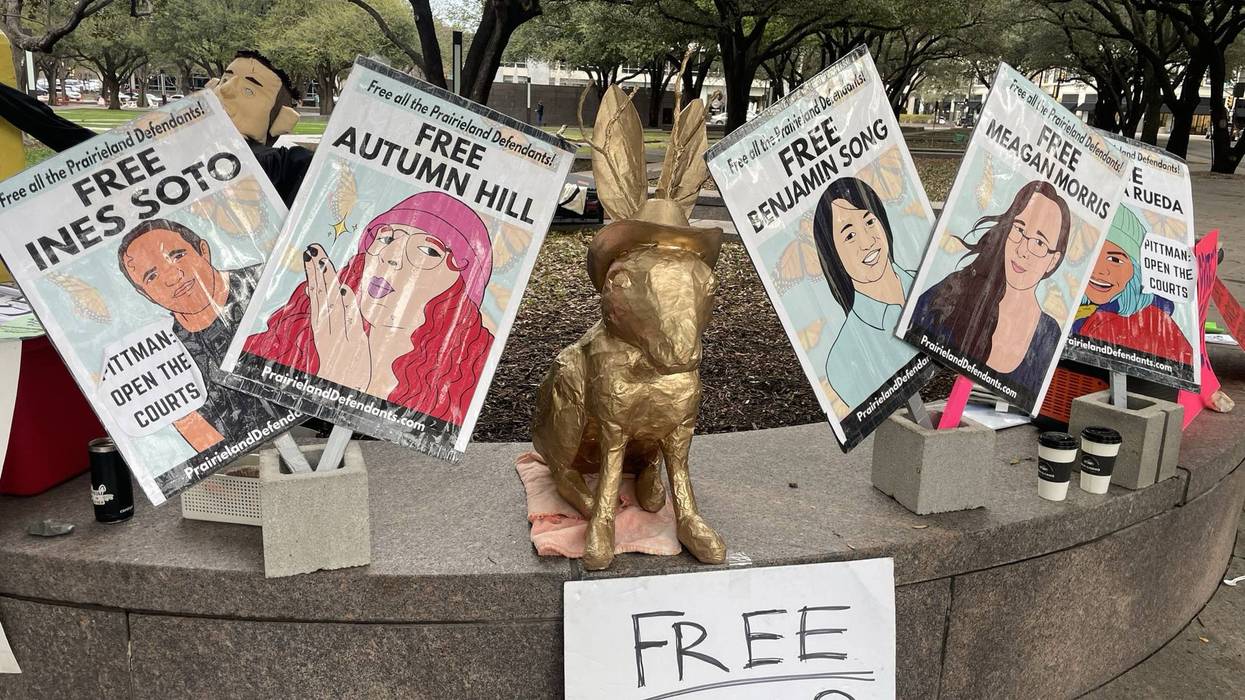
"A case like this helps the government kind of see how far they can go in criminalizing constitutionally protected protest," one legal advocate said.
The government has largely won its first case bringing material-support-for-terrorism charges against protesters alleged to belong to "antifa," which President Donald Trump designated as a domestic terror group in 2025 despite the fact that no such organized group exists and the president has no legal authority to designate organizations as domestic terror groups.
A federal jury in Fort Worth, Texas agreed on Friday to convict eight people of domestic terrorism because they wore all black to a protest outside Immigration and Customs Enforcement's (ICE) Prairieland Detention Facility in Alvarado, Texas on July 4, 2025, at which one of the protesters shot and wounded a police officer. Legal experts say the verdict could bolster attempts by the administration to stifle dissent.
"A case like this helps the government kind of see how far they can go in criminalizing constitutionally protected protests and also helps them kind of intimidate, increase the fear, hoping that folks in other cities then will think twice over protesting,” Suzanne Adely, interim president of the National Lawyers Guild, told The Associated Press.
The administration promised it would be the first such case of many.
"The US lost today with this verdict."
“Antifa is a domestic terrorist organization that has been allowed to flourish in Democrat-led cities—not under President Trump,” Attorney General Pam Bondi said in a statement Friday. “Today’s verdict on terrorism charges will not be the last as the Trump administration systematically dismantles Antifa and finally halts their violence on America’s streets.”
The trial revolved around a nighttime protest at which participants planned to set off fireworks in solidarity with the around 1,000 migrants detained inside the Prarieland ICE facility. Some participants brought guns, which is legal in Texas, as The Intercept reported.
Sam Levine explained in The Guardian what happened next:
Shortly after arriving at the facility, two or three of the protesters broke away from the larger group and began spray painting cars in the parking lot, a guard shack, slashed the tires on a government van, and broke a security camera. Two ICE detention guards came out and told the protesters to stop. A police officer arrived on the scene shortly after and drew his weapon at one of the people allegedly doing vandalism. One of the protesters was standing in the woods with an AR-15 and hit him in the shoulder. The officer would survive.
At first, the federal government charged those arrested after the event with "attempted murder of a police officer," according to NOTUS.
However, that changed after Trump's designation of antifa as a terror group in September and the release of National Security Presidential Memorandum 7 (NSPM-7), which directs federal law enforcement to target left-leaning groups and activities. The next month, the government's case expanded to include terrorism charges.
“This wouldn’t be a terrorism case if it weren’t for that memo,” one defense lawyer told NOTUS on background.
The prosecution argued that the fact that the protesters wore black clothes to the protest was enough to convict them of material support for terrorism.
“Providing your body as camouflage for others to do the enumerated acts is providing support,” Assistant US Attorney Shawn Smith said during closing arguments, as The Intercept reported on Thursday. “It’s impossible to tell who is doing what. That’s the point.”
The defense, meanwhile, warned the jury about the free speech implications of the charge.
“The government is asking you to put protesters in prison as terrorists. You are the only people who can stop that,” Blake Burns, an attorney for defendant Elizabeth Soto, said, according to The Guardian.
"When the villain is a made-up boogeyman then the target becomes 'anyone who disagrees with Trump'—and this is the result."
Ultimately, the jury decided to convict eight defendants of material support for terrorism as well as riot, conspiracy to use and carry an explosive, and use and carry of an explosive. However, they dismissed attempts by the state to argue that the protest constituted a pre-planned ambush and charge four people who had not shot at the police officer with attempted murder and discharging a firearm during a crime. Only Benjamin Song, the alleged shooter, was charged with one count of attempted murder and three counts of discharging a firearm.
The jury also convicted a ninth defendant, Daniel Rolando Sanchez Estrada, of conspiracy to conceal documents. Sanchez Estrada, who was not at the protest, had simply moved a box of zines out of his wife's home after she was arrested for the protest, according to The Intercept.
"The US lost today with this verdict,” Sanchez Estrada’s attorney, Christopher Weinbel, said, as AP reported.
Support the Prarieland Defendants said in a statement, "Everything about this trial from beginning to end has proven what we have said all along: This is a sham trial, built on political persecution and ideological attacks coming from the top."
However, the group commended the solidarity that had sprung up among the defendants and their allies and vowed to continue to support them.
"We have a long journey ahead of us to continue fighting these charges along with the state level charges," they said. "What happens here sets the tone for what’s to come. We are here and we won’t give up."
Outside observers warned about the implication for the right to protest under Trump.
"Remember all the people who dismissed the alarm over NSPM-7 because 'ANTIFA isn't even a real organization'? We told you that didn't matter. When the villain is a made-up boogeyman then the target becomes 'anyone who disagrees with Trump'—and this is the result," said Cory Archibald, the co-founder of Track AIPAC [American Israel Public Affairs Committee].
Content creator Austin MacNamara said: "The Prairieland trial was given almost zero media coverage because of the blatant lies by DHS [Department of Homeland Security] and Police. This verdict now sets a precedent for criminalization of dissent across the board. Noise demos, Black-Bloc, pamphlets/zines/red cards, all of this can be used to imprison you."
Academic Nathan Goodman wrote that convicting people of terrorism based on clothing was a "serious threat to the First Amendment."
The verdict gives new poignancy to what defendant Meagan Morris told NOTUS ahead of the jury's decision: “If we win, I think it shows that Trump’s mandate is not working, that the people understand that you can’t criminalize, you know, First and Second Amendment-protected activities. And I think if we lose, then… a lot of the country is OK with what’s going on. And it will be a much darker time, it’ll just signify a much increased crackdown on political opposition and free speech."