SUBSCRIBE TO OUR FREE NEWSLETTER
Daily news & progressive opinion—funded by the people, not the corporations—delivered straight to your inbox.
5
#000000
#FFFFFF
To donate by check, phone, or other method, see our More Ways to Give page.
Daily news & progressive opinion—funded by the people, not the corporations—delivered straight to your inbox.
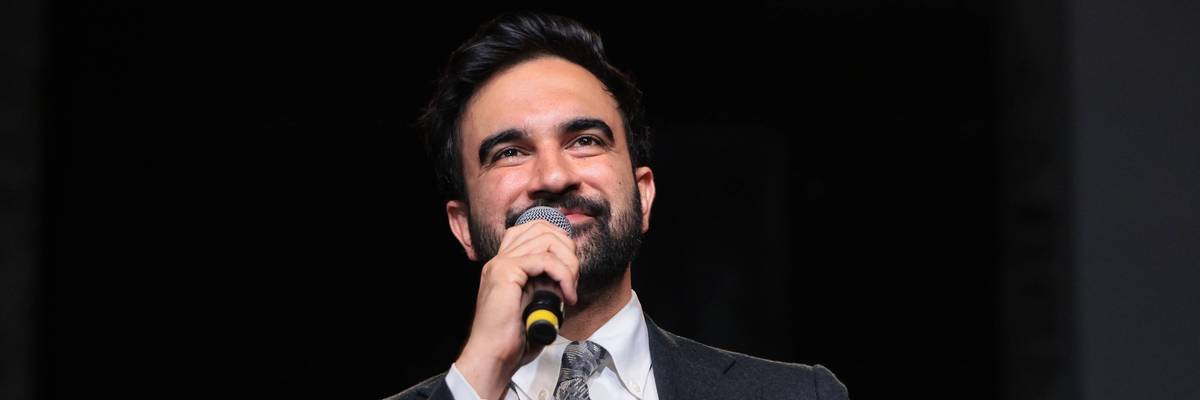
New York City Mayor Zohran Mamdani speaks during a primary-night watch party for NYC Congressional candidate Claire Valdez on June 23, 2026 in New York City.
"Above all, it means time returned to New Yorkers who don't have nearly enough of it."
New York City Mayor Zohran Mamdani touted progress on fulfilling one of his top campaign promises on Wednesday by highlighting a new plan to speed up the city's bus service.
During a press event, Mamdani talked about the improvements that commuters are projected to see from the new "Faster Buses, Better Service" plan, a joint initiative created by the mayor and New York Gov. Kathy Hochul.
The plan's goal is to speed up buses by an average of six minutes per ride on priority routes, which Mamdani said would make a major long-term difference in New Yorkers' lives.
"Now if you take the bus to work, that adds up fast," he said. "But in six months, you will have spent 24 fewer hours on the bus. By the time a year rolls around, you will have saved more than two days of commuting time."
Mamdani: By the time a year rolls around, you will have saved more than two days of commuting time. That means breakfast with your family. That means getting home in time for bedtime. It means agreeing with your friends that Egypt was robbed yesterday. pic.twitter.com/DQtn5PqNwx
— Acyn (@Acyn) July 8, 2026
The mayor put this into perspective by listing other activities that New Yorkers can do when they don't have to spend as much time on the bus.
"That means breakfast with your family," he said. "It means having the time to argue balls and strikes at your kids' little league game. It means getting home for bedtime... Above all, it means time returned to New Yorkers who don't have nearly enough of it."
The 51-page Mamdani-Hochul plan envisions a number of changes to the bus system to speed up service.
Among other things, the plan includes building five "rapid bus corridors" in Brooklyn and Queens by 2030; adding 28 more priority bus lanes throughout the city by the end of the year; allowing "all-door boarding" on all buses to ease passenger bottlenecks by the end of 2027; and establishing dozens of "queue jump" traffic signals that give buses a head start over other vehicles.
"New York City sets a global standard for culture, innovation, and excellence," Mamdani said in a statement accompanying the plan. "Let us set the same standard for bus service—and prove that government can deliver real results for the people who call this city home."
The bus plan earned a thumbs up from Tahra Hoops, director of economic analysis at Chamber of Progress, who wrote in a Wednesday social media post that it could have a real positive impact on city life.
"A focus on faster, more reliable service is of more use to New Yorkers," Hoops wrote. "Nothing is more frustrating than after a long day at work to wait 30 minutes plus for the Q55 to come and then all of a sudden four show up at once."
In addition to speeding up buses, Mamdani vowed during his mayoral campaign to make them free to ride, which could be more difficult to deliver. The Metropolitan Transit Authority has estimated that delivering free bus service in the city would cost roughly $1 billion per year.
Dear Common Dreams reader, It’s been nearly 30 years since I co-founded Common Dreams with my late wife, Lina Newhouser. We had the radical notion that journalism should serve the public good, not corporate profits. It was clear to us from the outset what it would take to build such a project. No paid advertisements. No corporate sponsors. No millionaire publisher telling us what to think or do. Many people said we wouldn't last a year, but we proved those doubters wrong. Together with a tremendous team of journalists and dedicated staff, we built an independent media outlet free from the constraints of profits and corporate control. Our mission has always been simple: To inform. To inspire. To ignite change for the common good. Building Common Dreams was not easy. Our survival was never guaranteed. When you take on the most powerful forces—Wall Street greed, fossil fuel industry destruction, Big Tech lobbyists, and uber-rich oligarchs who have spent billions upon billions rigging the economy and democracy in their favor—the only bulwark you have is supporters who believe in your work. But here’s the urgent message from me today. It's never been this bad out there. And it's never been this hard to keep us going. At the very moment Common Dreams is most needed, the threats we face are intensifying. We need your support now more than ever. We don't accept corporate advertising and never will. We don't have a paywall because we don't think people should be blocked from critical news based on their ability to pay. Everything we do is funded by the donations of readers like you. When everyone does the little they can afford, we are strong. But if that support retreats or dries up, so do we. Will you donate now to make sure Common Dreams not only survives but thrives? —Craig Brown, Co-founder |
New York City Mayor Zohran Mamdani touted progress on fulfilling one of his top campaign promises on Wednesday by highlighting a new plan to speed up the city's bus service.
During a press event, Mamdani talked about the improvements that commuters are projected to see from the new "Faster Buses, Better Service" plan, a joint initiative created by the mayor and New York Gov. Kathy Hochul.
The plan's goal is to speed up buses by an average of six minutes per ride on priority routes, which Mamdani said would make a major long-term difference in New Yorkers' lives.
"Now if you take the bus to work, that adds up fast," he said. "But in six months, you will have spent 24 fewer hours on the bus. By the time a year rolls around, you will have saved more than two days of commuting time."
Mamdani: By the time a year rolls around, you will have saved more than two days of commuting time. That means breakfast with your family. That means getting home in time for bedtime. It means agreeing with your friends that Egypt was robbed yesterday. pic.twitter.com/DQtn5PqNwx
— Acyn (@Acyn) July 8, 2026
The mayor put this into perspective by listing other activities that New Yorkers can do when they don't have to spend as much time on the bus.
"That means breakfast with your family," he said. "It means having the time to argue balls and strikes at your kids' little league game. It means getting home for bedtime... Above all, it means time returned to New Yorkers who don't have nearly enough of it."
The 51-page Mamdani-Hochul plan envisions a number of changes to the bus system to speed up service.
Among other things, the plan includes building five "rapid bus corridors" in Brooklyn and Queens by 2030; adding 28 more priority bus lanes throughout the city by the end of the year; allowing "all-door boarding" on all buses to ease passenger bottlenecks by the end of 2027; and establishing dozens of "queue jump" traffic signals that give buses a head start over other vehicles.
"New York City sets a global standard for culture, innovation, and excellence," Mamdani said in a statement accompanying the plan. "Let us set the same standard for bus service—and prove that government can deliver real results for the people who call this city home."
The bus plan earned a thumbs up from Tahra Hoops, director of economic analysis at Chamber of Progress, who wrote in a Wednesday social media post that it could have a real positive impact on city life.
"A focus on faster, more reliable service is of more use to New Yorkers," Hoops wrote. "Nothing is more frustrating than after a long day at work to wait 30 minutes plus for the Q55 to come and then all of a sudden four show up at once."
In addition to speeding up buses, Mamdani vowed during his mayoral campaign to make them free to ride, which could be more difficult to deliver. The Metropolitan Transit Authority has estimated that delivering free bus service in the city would cost roughly $1 billion per year.
New York City Mayor Zohran Mamdani touted progress on fulfilling one of his top campaign promises on Wednesday by highlighting a new plan to speed up the city's bus service.
During a press event, Mamdani talked about the improvements that commuters are projected to see from the new "Faster Buses, Better Service" plan, a joint initiative created by the mayor and New York Gov. Kathy Hochul.
The plan's goal is to speed up buses by an average of six minutes per ride on priority routes, which Mamdani said would make a major long-term difference in New Yorkers' lives.
"Now if you take the bus to work, that adds up fast," he said. "But in six months, you will have spent 24 fewer hours on the bus. By the time a year rolls around, you will have saved more than two days of commuting time."
Mamdani: By the time a year rolls around, you will have saved more than two days of commuting time. That means breakfast with your family. That means getting home in time for bedtime. It means agreeing with your friends that Egypt was robbed yesterday. pic.twitter.com/DQtn5PqNwx
— Acyn (@Acyn) July 8, 2026
The mayor put this into perspective by listing other activities that New Yorkers can do when they don't have to spend as much time on the bus.
"That means breakfast with your family," he said. "It means having the time to argue balls and strikes at your kids' little league game. It means getting home for bedtime... Above all, it means time returned to New Yorkers who don't have nearly enough of it."
The 51-page Mamdani-Hochul plan envisions a number of changes to the bus system to speed up service.
Among other things, the plan includes building five "rapid bus corridors" in Brooklyn and Queens by 2030; adding 28 more priority bus lanes throughout the city by the end of the year; allowing "all-door boarding" on all buses to ease passenger bottlenecks by the end of 2027; and establishing dozens of "queue jump" traffic signals that give buses a head start over other vehicles.
"New York City sets a global standard for culture, innovation, and excellence," Mamdani said in a statement accompanying the plan. "Let us set the same standard for bus service—and prove that government can deliver real results for the people who call this city home."
The bus plan earned a thumbs up from Tahra Hoops, director of economic analysis at Chamber of Progress, who wrote in a Wednesday social media post that it could have a real positive impact on city life.
"A focus on faster, more reliable service is of more use to New Yorkers," Hoops wrote. "Nothing is more frustrating than after a long day at work to wait 30 minutes plus for the Q55 to come and then all of a sudden four show up at once."
In addition to speeding up buses, Mamdani vowed during his mayoral campaign to make them free to ride, which could be more difficult to deliver. The Metropolitan Transit Authority has estimated that delivering free bus service in the city would cost roughly $1 billion per year.