SUBSCRIBE TO OUR FREE NEWSLETTER
Daily news & progressive opinion—funded by the people, not the corporations—delivered straight to your inbox.
5
#000000
#FFFFFF
To donate by check, phone, or other method, see our More Ways to Give page.
Daily news & progressive opinion—funded by the people, not the corporations—delivered straight to your inbox.
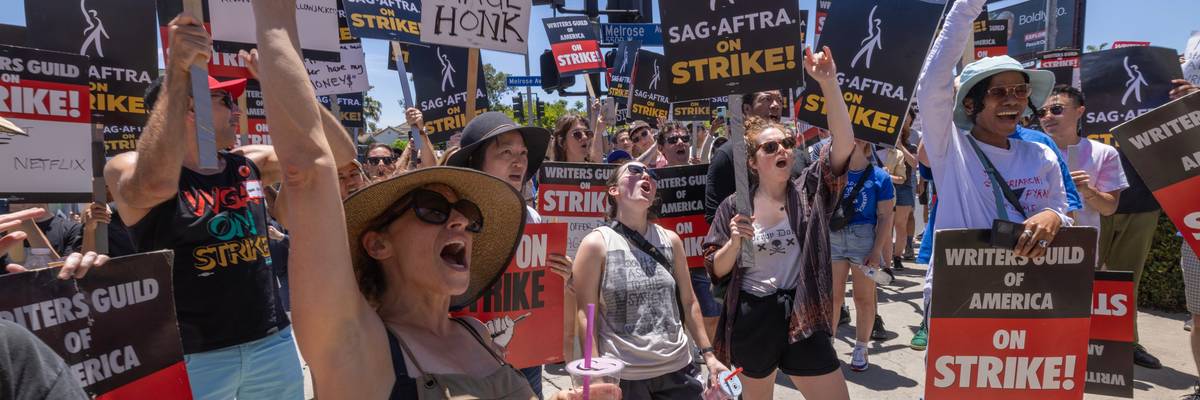
Members of SAG-AFTRA and WGA rally on the picket line in Los Angeles on July 14, 2023.
"Even a plurality of voters who have an unfavorable opinion of labor unions (48%) support the strikes."
Two-thirds of likely U.S. voters support the ongoing writers' and actors' union strikes, while an overwhelming majority of voters across party lines agree with the strikers' demands, according to a Data For Progress poll published Friday.
The poll found 67% overall support for the Writers Guild of America (WGA) and Screen Actors Guild-American Federation of Television and Radio Artists (SAG-AFTRA) strikes, while just 18% of respondents opposed the actions.
Likely Democratic voters showed the strongest support for the strikes, at 82%, while 68% of Independents and 49% of Republicans back the labor stoppage.
"Even a plurality of voters who have an unfavorable opinion of labor unions (48%) support the strikes," Data for Progress noted.
Voters also overwhelmingly agree with the strikers' demands:
On the other hand, only 21% of survey respondents said they have a favorable view of Hollywood studios.
SAG-AFTRA national executive director and chief negotiator Duncan Crabtree-Ireland said in a statement: "The data shows that most people understand why the union was forced to go on strike. I suspect many are seeing the same dynamic playing out in their own lives, with employers undervaluing their contributions."
"That's why this fight is so important," he added. "Our demands aren't unreasonable, and it's a fundamental principle of fairness that workers should be fairly compensated for the value they bring their employer—in every industry."
Dear Common Dreams reader, It’s been nearly 30 years since I co-founded Common Dreams with my late wife, Lina Newhouser. We had the radical notion that journalism should serve the public good, not corporate profits. It was clear to us from the outset what it would take to build such a project. No paid advertisements. No corporate sponsors. No millionaire publisher telling us what to think or do. Many people said we wouldn't last a year, but we proved those doubters wrong. Together with a tremendous team of journalists and dedicated staff, we built an independent media outlet free from the constraints of profits and corporate control. Our mission has always been simple: To inform. To inspire. To ignite change for the common good. Building Common Dreams was not easy. Our survival was never guaranteed. When you take on the most powerful forces—Wall Street greed, fossil fuel industry destruction, Big Tech lobbyists, and uber-rich oligarchs who have spent billions upon billions rigging the economy and democracy in their favor—the only bulwark you have is supporters who believe in your work. But here’s the urgent message from me today. It's never been this bad out there. And it's never been this hard to keep us going. At the very moment Common Dreams is most needed, the threats we face are intensifying. We need your support now more than ever. We don't accept corporate advertising and never will. We don't have a paywall because we don't think people should be blocked from critical news based on their ability to pay. Everything we do is funded by the donations of readers like you. When everyone does the little they can afford, we are strong. But if that support retreats or dries up, so do we. Will you donate now to make sure Common Dreams not only survives but thrives? —Craig Brown, Co-founder |
Two-thirds of likely U.S. voters support the ongoing writers' and actors' union strikes, while an overwhelming majority of voters across party lines agree with the strikers' demands, according to a Data For Progress poll published Friday.
The poll found 67% overall support for the Writers Guild of America (WGA) and Screen Actors Guild-American Federation of Television and Radio Artists (SAG-AFTRA) strikes, while just 18% of respondents opposed the actions.
Likely Democratic voters showed the strongest support for the strikes, at 82%, while 68% of Independents and 49% of Republicans back the labor stoppage.
"Even a plurality of voters who have an unfavorable opinion of labor unions (48%) support the strikes," Data for Progress noted.
Voters also overwhelmingly agree with the strikers' demands:
On the other hand, only 21% of survey respondents said they have a favorable view of Hollywood studios.
SAG-AFTRA national executive director and chief negotiator Duncan Crabtree-Ireland said in a statement: "The data shows that most people understand why the union was forced to go on strike. I suspect many are seeing the same dynamic playing out in their own lives, with employers undervaluing their contributions."
"That's why this fight is so important," he added. "Our demands aren't unreasonable, and it's a fundamental principle of fairness that workers should be fairly compensated for the value they bring their employer—in every industry."
Two-thirds of likely U.S. voters support the ongoing writers' and actors' union strikes, while an overwhelming majority of voters across party lines agree with the strikers' demands, according to a Data For Progress poll published Friday.
The poll found 67% overall support for the Writers Guild of America (WGA) and Screen Actors Guild-American Federation of Television and Radio Artists (SAG-AFTRA) strikes, while just 18% of respondents opposed the actions.
Likely Democratic voters showed the strongest support for the strikes, at 82%, while 68% of Independents and 49% of Republicans back the labor stoppage.
"Even a plurality of voters who have an unfavorable opinion of labor unions (48%) support the strikes," Data for Progress noted.
Voters also overwhelmingly agree with the strikers' demands:
On the other hand, only 21% of survey respondents said they have a favorable view of Hollywood studios.
SAG-AFTRA national executive director and chief negotiator Duncan Crabtree-Ireland said in a statement: "The data shows that most people understand why the union was forced to go on strike. I suspect many are seeing the same dynamic playing out in their own lives, with employers undervaluing their contributions."
"That's why this fight is so important," he added. "Our demands aren't unreasonable, and it's a fundamental principle of fairness that workers should be fairly compensated for the value they bring their employer—in every industry."