SUBSCRIBE TO OUR FREE NEWSLETTER
Daily news & progressive opinion—funded by the people, not the corporations—delivered straight to your inbox.
5
#000000
#FFFFFF
To donate by check, phone, or other method, see our More Ways to Give page.
Daily news & progressive opinion—funded by the people, not the corporations—delivered straight to your inbox.
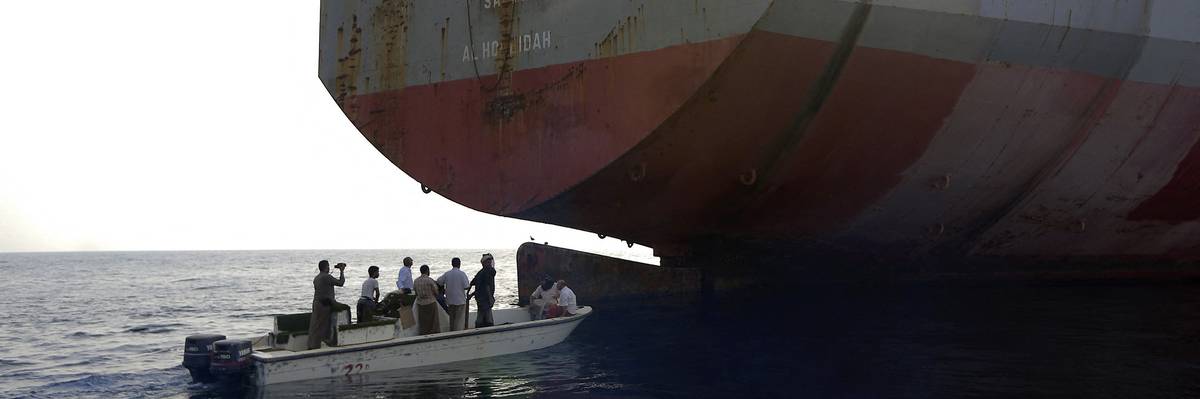
People in a small boat approach the beleaguered FSO Safer oil tanker in the Red Sea off the coast of Yemen on July 15, 2023.
U.N. chief António Guterres called the initiative to transfer oil from the decaying FSO Safer to another tanker "the critical next step in avoiding an environmental and humanitarian catastrophe on a colossal scale."
"The United Nations has begun an operation to defuse what might be the world's largest ticking time bomb," U.N. Secretary-General António Guterres announced Tuesday.
"A complex maritime salvage effort is now underway in the Red Sea off the coast of war-torn Yemen to transfer one million barrels of oil from the decaying
FSO Safer to a replacement vessel," said Guterres.
If all goes as planned, the oil will be pumped from the abandoned supertanker to the Nautica over the next three weeks, UN News reported.
"In the absence of anyone else willing or able to perform this task, the United Nations stepped up and assumed the risk to conduct this very delicate operation," Guterres explained. "This is an all-hands-on-deck mission and the culmination of nearly two years of political groundwork, fundraising, and project development."
The U.N. chief called the oil transfer initiative "the critical next step in avoiding an environmental and humanitarian catastrophe on a colossal scale."
"Without action," he warned, "the vessel could have exploded or broken apart, spilling as much as four times the oil released in the Exxon Valdez disaster. Fishing communities would be wiped out. Hundreds of thousands of jobs would instantly disappear. Whole communities would be exposed to deadly toxins."
Moreover, "major ports including Hodeidah and Saleef would be forced to close indefinitely. Food, fuel, and life-saving supplies for millions would halt," Guterres continued. "Water, coral reefs, [and] sea life would be utterly devastated. Shipping all the way to the Suez Canal could be disrupted for weeks. The potential clean-up bill alone could easily run into the tens of billions of dollars."
"That is why we have been raising the alarm and working to mobilize support to avoid this nightmare," he added.
Peer-reviewed research published in October 2021 warned that an "increasingly likely" oil spill from the slowly corroding Safer into the Red Sea could cut off access to clean water and food aid for millions of people in a matter of days and completely decimate the region's fishing stocks within three weeks.
The 47-year-old supertanker has been moored roughly five nautical miles southwest of the Ras Issa peninsula on Yemen's west coast for more than 30 years. Maintenance of the vessel ground to a halt in 2015 amid the U.S.-backed, Saudi-led coalition's ongoing war on Yemen. As a result, it has deteriorated to a state beyond repair.
Despite several warnings about the life-threatening dangers posed by the decaying ship—including one made in June 2020 by the head of the U.N. Environment Program to the U.N. Security Council—it has taken years to finalize a plan to remove the 1.1 million barrels of crude it is holding.
According to Guterres, "The United Nations enlisted the best in the business: a team of world-leading experts in maritime law, oil spills, salvage operations, marine engineers, naval architects, insurance brokers and underwriters, chemists, surveyors, and more."
"This operation required relentless political work in a country devastated by eight years of war," Guterres noted. "It depended on generous financial support."
"The ship-to-ship transfer of oil is an important milestone, but it is far from the end of the journey," the U.N. chief continued. "The next critical step is arrangement for the delivery of a specialized buoy to which the replacement vessel will be safely and securely tethered."
"Looking immediately ahead, we will need about $20 million to finish the project, which includes cleaning and scrapping the FSO Safer and removing any remaining environmental threat to the Red Sea," he added. "I urge donors to act at this crucial time."
Dear Common Dreams reader, It’s been nearly 30 years since I co-founded Common Dreams with my late wife, Lina Newhouser. We had the radical notion that journalism should serve the public good, not corporate profits. It was clear to us from the outset what it would take to build such a project. No paid advertisements. No corporate sponsors. No millionaire publisher telling us what to think or do. Many people said we wouldn't last a year, but we proved those doubters wrong. Together with a tremendous team of journalists and dedicated staff, we built an independent media outlet free from the constraints of profits and corporate control. Our mission has always been simple: To inform. To inspire. To ignite change for the common good. Building Common Dreams was not easy. Our survival was never guaranteed. When you take on the most powerful forces—Wall Street greed, fossil fuel industry destruction, Big Tech lobbyists, and uber-rich oligarchs who have spent billions upon billions rigging the economy and democracy in their favor—the only bulwark you have is supporters who believe in your work. But here’s the urgent message from me today. It's never been this bad out there. And it's never been this hard to keep us going. At the very moment Common Dreams is most needed, the threats we face are intensifying. We need your support now more than ever. We don't accept corporate advertising and never will. We don't have a paywall because we don't think people should be blocked from critical news based on their ability to pay. Everything we do is funded by the donations of readers like you. When everyone does the little they can afford, we are strong. But if that support retreats or dries up, so do we. Will you donate now to make sure Common Dreams not only survives but thrives? —Craig Brown, Co-founder |
"The United Nations has begun an operation to defuse what might be the world's largest ticking time bomb," U.N. Secretary-General António Guterres announced Tuesday.
"A complex maritime salvage effort is now underway in the Red Sea off the coast of war-torn Yemen to transfer one million barrels of oil from the decaying
FSO Safer to a replacement vessel," said Guterres.
If all goes as planned, the oil will be pumped from the abandoned supertanker to the Nautica over the next three weeks, UN News reported.
"In the absence of anyone else willing or able to perform this task, the United Nations stepped up and assumed the risk to conduct this very delicate operation," Guterres explained. "This is an all-hands-on-deck mission and the culmination of nearly two years of political groundwork, fundraising, and project development."
The U.N. chief called the oil transfer initiative "the critical next step in avoiding an environmental and humanitarian catastrophe on a colossal scale."
"Without action," he warned, "the vessel could have exploded or broken apart, spilling as much as four times the oil released in the Exxon Valdez disaster. Fishing communities would be wiped out. Hundreds of thousands of jobs would instantly disappear. Whole communities would be exposed to deadly toxins."
Moreover, "major ports including Hodeidah and Saleef would be forced to close indefinitely. Food, fuel, and life-saving supplies for millions would halt," Guterres continued. "Water, coral reefs, [and] sea life would be utterly devastated. Shipping all the way to the Suez Canal could be disrupted for weeks. The potential clean-up bill alone could easily run into the tens of billions of dollars."
"That is why we have been raising the alarm and working to mobilize support to avoid this nightmare," he added.
Peer-reviewed research published in October 2021 warned that an "increasingly likely" oil spill from the slowly corroding Safer into the Red Sea could cut off access to clean water and food aid for millions of people in a matter of days and completely decimate the region's fishing stocks within three weeks.
The 47-year-old supertanker has been moored roughly five nautical miles southwest of the Ras Issa peninsula on Yemen's west coast for more than 30 years. Maintenance of the vessel ground to a halt in 2015 amid the U.S.-backed, Saudi-led coalition's ongoing war on Yemen. As a result, it has deteriorated to a state beyond repair.
Despite several warnings about the life-threatening dangers posed by the decaying ship—including one made in June 2020 by the head of the U.N. Environment Program to the U.N. Security Council—it has taken years to finalize a plan to remove the 1.1 million barrels of crude it is holding.
According to Guterres, "The United Nations enlisted the best in the business: a team of world-leading experts in maritime law, oil spills, salvage operations, marine engineers, naval architects, insurance brokers and underwriters, chemists, surveyors, and more."
"This operation required relentless political work in a country devastated by eight years of war," Guterres noted. "It depended on generous financial support."
"The ship-to-ship transfer of oil is an important milestone, but it is far from the end of the journey," the U.N. chief continued. "The next critical step is arrangement for the delivery of a specialized buoy to which the replacement vessel will be safely and securely tethered."
"Looking immediately ahead, we will need about $20 million to finish the project, which includes cleaning and scrapping the FSO Safer and removing any remaining environmental threat to the Red Sea," he added. "I urge donors to act at this crucial time."
"The United Nations has begun an operation to defuse what might be the world's largest ticking time bomb," U.N. Secretary-General António Guterres announced Tuesday.
"A complex maritime salvage effort is now underway in the Red Sea off the coast of war-torn Yemen to transfer one million barrels of oil from the decaying
FSO Safer to a replacement vessel," said Guterres.
If all goes as planned, the oil will be pumped from the abandoned supertanker to the Nautica over the next three weeks, UN News reported.
"In the absence of anyone else willing or able to perform this task, the United Nations stepped up and assumed the risk to conduct this very delicate operation," Guterres explained. "This is an all-hands-on-deck mission and the culmination of nearly two years of political groundwork, fundraising, and project development."
The U.N. chief called the oil transfer initiative "the critical next step in avoiding an environmental and humanitarian catastrophe on a colossal scale."
"Without action," he warned, "the vessel could have exploded or broken apart, spilling as much as four times the oil released in the Exxon Valdez disaster. Fishing communities would be wiped out. Hundreds of thousands of jobs would instantly disappear. Whole communities would be exposed to deadly toxins."
Moreover, "major ports including Hodeidah and Saleef would be forced to close indefinitely. Food, fuel, and life-saving supplies for millions would halt," Guterres continued. "Water, coral reefs, [and] sea life would be utterly devastated. Shipping all the way to the Suez Canal could be disrupted for weeks. The potential clean-up bill alone could easily run into the tens of billions of dollars."
"That is why we have been raising the alarm and working to mobilize support to avoid this nightmare," he added.
Peer-reviewed research published in October 2021 warned that an "increasingly likely" oil spill from the slowly corroding Safer into the Red Sea could cut off access to clean water and food aid for millions of people in a matter of days and completely decimate the region's fishing stocks within three weeks.
The 47-year-old supertanker has been moored roughly five nautical miles southwest of the Ras Issa peninsula on Yemen's west coast for more than 30 years. Maintenance of the vessel ground to a halt in 2015 amid the U.S.-backed, Saudi-led coalition's ongoing war on Yemen. As a result, it has deteriorated to a state beyond repair.
Despite several warnings about the life-threatening dangers posed by the decaying ship—including one made in June 2020 by the head of the U.N. Environment Program to the U.N. Security Council—it has taken years to finalize a plan to remove the 1.1 million barrels of crude it is holding.
According to Guterres, "The United Nations enlisted the best in the business: a team of world-leading experts in maritime law, oil spills, salvage operations, marine engineers, naval architects, insurance brokers and underwriters, chemists, surveyors, and more."
"This operation required relentless political work in a country devastated by eight years of war," Guterres noted. "It depended on generous financial support."
"The ship-to-ship transfer of oil is an important milestone, but it is far from the end of the journey," the U.N. chief continued. "The next critical step is arrangement for the delivery of a specialized buoy to which the replacement vessel will be safely and securely tethered."
"Looking immediately ahead, we will need about $20 million to finish the project, which includes cleaning and scrapping the FSO Safer and removing any remaining environmental threat to the Red Sea," he added. "I urge donors to act at this crucial time."