

SUBSCRIBE TO OUR FREE NEWSLETTER
Daily news & progressive opinion—funded by the people, not the corporations—delivered straight to your inbox.
5
#000000
#FFFFFF
To donate by check, phone, or other method, see our More Ways to Give page.
Daily news & progressive opinion—funded by the people, not the corporations—delivered straight to your inbox.
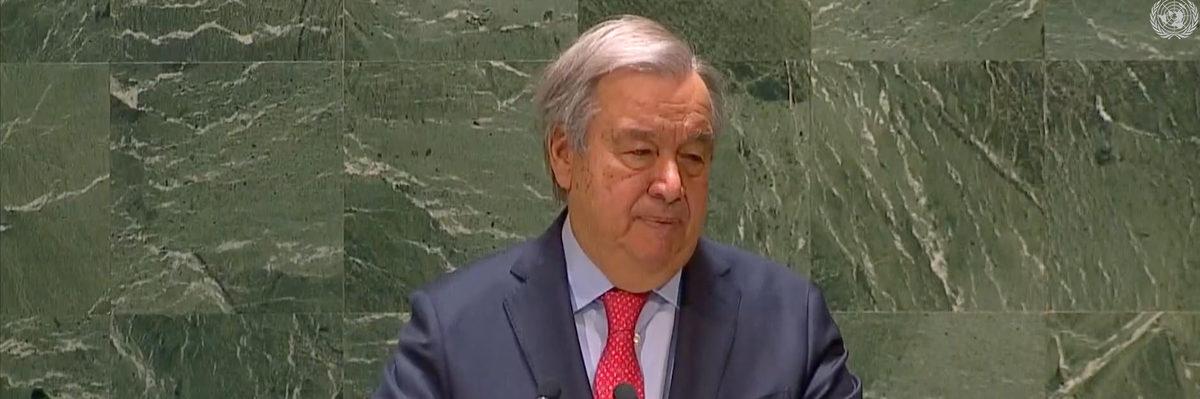
United Nations Secretary-General António Guterres speaks at a meeting of the United Nations General Assembly in New York City on February 6, 2023.
"No more baby steps. No more excuses. No more greenwashing," said U.N. Secretary-General António Guterres. "No more bottomless greed of the fossil fuel industry and its enablers."
United Nations Secretary-General António Guterres made clear Monday that securing a livable planet depends on stopping the "bottomless greed of the fossil fuel industry and its enablers."
In a speech to the General Assembly, Guterres called for an end to "the merciless, relentless, senseless war on nature" that "is putting our world at immediate risk of hurtling past the 1.5°C temperature increase limit and now still moving towards a deadly 2.8°C."
2023 must be "a year of reckoning," the U.N. chief said as he outlined his priorities for the months ahead. "It must be a year of game-changing climate action. We need disruption to end the destruction. No more baby steps. No more excuses. No more greenwashing."
Scientists have warned repeatedly that scaling up the extraction and burning of coal, oil, and gas is incompatible with averting the most catastrophic consequences of the climate emergency. Nevertheless, hundreds of corporations—bolstered by trillions of dollars in annual public subsidies—are still planning to ramp up planet-heating pollution in the years ahead, prioritizing profits over the lives of those who will be harmed by the ensuing chaos.
"I have a special message for fossil fuel producers and their enablers scrambling to expand production and raking in monster profits: If you cannot set a credible course for net-zero, with 2025 and 2030 targets covering all your operations, you should not be in business," said Guterres. "Your core product is our core problem."
"We need a renewables revolution, not a self-destructive fossil fuel resurgence," he added.
In order to halve global greenhouse gas emissions this decade, the U.N. chief said, the world needs "far more ambitious action to cut carbon pollution by speeding up the shift from fossil fuels to renewable energy—especially in G20 countries—and de-carbonizing highest emitting industrial sectors—steel, cement, shipping, and aviation."
In addition, he continued, the world needs "a Climate Solidarity Pact in which all big emitters make an extra effort to cut emissions, and wealthier countries mobilize financial and technical resources to support emerging economies in a common effort to keep 1.5°C alive."
"We need a renewables revolution, not a self-destructive fossil fuel resurgence."
"Climate action is impossible without adequate finance," Guterres noted. "Developed countries know what they must do: At minimum, deliver on commitments made at the latest COP. Make good on the $100 billion promise to developing countries. Finish the job and deliver on the Loss and Damage Fund agreed in Sharm El-Sheikh. Double adaptation funding. Replenish the Green Climate Fund by COP28. Advance plans for early warning systems to protect every person on earth within five years. And stop subsidizing fossil fuels and pivot investments to renewables."
Like the 26 annual U.N. climate meetings that preceded it, COP27 ended last November with no commitment to a swift and just global phase-out of coal, oil, and gas.
In an effort to avoid a repeat performance at COP28 in the United Arab Emirates this December, Guterres intends to convene a "Climate Ambition Summit" in September.
"The invitation is open to any leader—in government, business, or civil society," Guterres said Monday. "But it comes with a condition: Show us accelerated action in this decade and renewed ambitious net-zero plans—or please don't show up."
"COP28 in December will set the stage for the first-ever Global Stocktake—a collective moment of truth—to assess where we are, and where we need to go in the next five years to reach the Paris goals," he continued.
Guterres added that "humanity is taking a sledgehammer to our world's rich biodiversity—with brutal and even irreversible consequences for people and planet. Our ocean is choked by pollution, plastics, and chemicals. And vampiric overconsumption is draining the lifeblood of our planet—water."
In 2023, the world "must also bring the Global Biodiversity Framework to life and establish a clear pathway to mobilize sufficient resources," said the U.N. chief. "And governments must develop concrete plans to repurpose subsidies that are harming nature into incentives for conservation and sustainability."
"Climate action is the 21st century's greatest opportunity to drive forward all the Sustainable Development Goals," Guterres stressed. "A clean, healthy, and sustainable environment is a right we must make real for all."
Guterres' speech was not limited to the climate and biodiversity crises. He also emphasized the need for a "course correction" on devastating wars and raging inequality, calling for a new global economic architecture that foregrounds the needs of the poor instead of allowing the richest 1% to capture nearly half of all newly created wealth.
"This is not a time for tinkering," said the U.N. chief. "It is a time for transformation."
This country and this world are at a monumental crossroads. US voters have an opportunity to beat back the forces of fascism and confront the billionaires who are rigging the economy, our media system, and our democracy, making it increasingly impossible for ordinary people to get by. We’re not just talking about the election. We’re talking about what must be done once these fascist elements are vanquished from power. We need a bolder set of solutions than what either major party has so far been willing to offer and a working-class movement ready to fight like hell for it. Trump didn't emerge from nowhere. The conditions that fueled MAGA authoritarianism were created by decades of radical neoliberal economic policies and a corrupt political system dominated by corporate interests. They slashed taxes on the super-rich, promising that the benefits would trickle down. They said giveaways to the corporate titans would make life more affordable for the rest of us. It was all bullshit. And when a bitter, betrayed populace searches for someone to blame, right-wing demagogues have little trouble finding scapegoats. People know when they're being lied to, but you won't hear any of this from the corporate media. Only independent journalism—powered and funded by people who believe in building a better world—can deliver truly trustworthy daily news. If you share our vision, please contribute whatever you can to sustain our work. |
United Nations Secretary-General António Guterres made clear Monday that securing a livable planet depends on stopping the "bottomless greed of the fossil fuel industry and its enablers."
In a speech to the General Assembly, Guterres called for an end to "the merciless, relentless, senseless war on nature" that "is putting our world at immediate risk of hurtling past the 1.5°C temperature increase limit and now still moving towards a deadly 2.8°C."
2023 must be "a year of reckoning," the U.N. chief said as he outlined his priorities for the months ahead. "It must be a year of game-changing climate action. We need disruption to end the destruction. No more baby steps. No more excuses. No more greenwashing."
Scientists have warned repeatedly that scaling up the extraction and burning of coal, oil, and gas is incompatible with averting the most catastrophic consequences of the climate emergency. Nevertheless, hundreds of corporations—bolstered by trillions of dollars in annual public subsidies—are still planning to ramp up planet-heating pollution in the years ahead, prioritizing profits over the lives of those who will be harmed by the ensuing chaos.
"I have a special message for fossil fuel producers and their enablers scrambling to expand production and raking in monster profits: If you cannot set a credible course for net-zero, with 2025 and 2030 targets covering all your operations, you should not be in business," said Guterres. "Your core product is our core problem."
"We need a renewables revolution, not a self-destructive fossil fuel resurgence," he added.
In order to halve global greenhouse gas emissions this decade, the U.N. chief said, the world needs "far more ambitious action to cut carbon pollution by speeding up the shift from fossil fuels to renewable energy—especially in G20 countries—and de-carbonizing highest emitting industrial sectors—steel, cement, shipping, and aviation."
In addition, he continued, the world needs "a Climate Solidarity Pact in which all big emitters make an extra effort to cut emissions, and wealthier countries mobilize financial and technical resources to support emerging economies in a common effort to keep 1.5°C alive."
"We need a renewables revolution, not a self-destructive fossil fuel resurgence."
"Climate action is impossible without adequate finance," Guterres noted. "Developed countries know what they must do: At minimum, deliver on commitments made at the latest COP. Make good on the $100 billion promise to developing countries. Finish the job and deliver on the Loss and Damage Fund agreed in Sharm El-Sheikh. Double adaptation funding. Replenish the Green Climate Fund by COP28. Advance plans for early warning systems to protect every person on earth within five years. And stop subsidizing fossil fuels and pivot investments to renewables."
Like the 26 annual U.N. climate meetings that preceded it, COP27 ended last November with no commitment to a swift and just global phase-out of coal, oil, and gas.
In an effort to avoid a repeat performance at COP28 in the United Arab Emirates this December, Guterres intends to convene a "Climate Ambition Summit" in September.
"The invitation is open to any leader—in government, business, or civil society," Guterres said Monday. "But it comes with a condition: Show us accelerated action in this decade and renewed ambitious net-zero plans—or please don't show up."
"COP28 in December will set the stage for the first-ever Global Stocktake—a collective moment of truth—to assess where we are, and where we need to go in the next five years to reach the Paris goals," he continued.
Guterres added that "humanity is taking a sledgehammer to our world's rich biodiversity—with brutal and even irreversible consequences for people and planet. Our ocean is choked by pollution, plastics, and chemicals. And vampiric overconsumption is draining the lifeblood of our planet—water."
In 2023, the world "must also bring the Global Biodiversity Framework to life and establish a clear pathway to mobilize sufficient resources," said the U.N. chief. "And governments must develop concrete plans to repurpose subsidies that are harming nature into incentives for conservation and sustainability."
"Climate action is the 21st century's greatest opportunity to drive forward all the Sustainable Development Goals," Guterres stressed. "A clean, healthy, and sustainable environment is a right we must make real for all."
Guterres' speech was not limited to the climate and biodiversity crises. He also emphasized the need for a "course correction" on devastating wars and raging inequality, calling for a new global economic architecture that foregrounds the needs of the poor instead of allowing the richest 1% to capture nearly half of all newly created wealth.
"This is not a time for tinkering," said the U.N. chief. "It is a time for transformation."

