5
#000000
#FFFFFF
To donate by check, phone, or other method, see our More Ways to Give page.
Daily news & progressive opinion—funded by the people, not the corporations—delivered straight to your inbox.
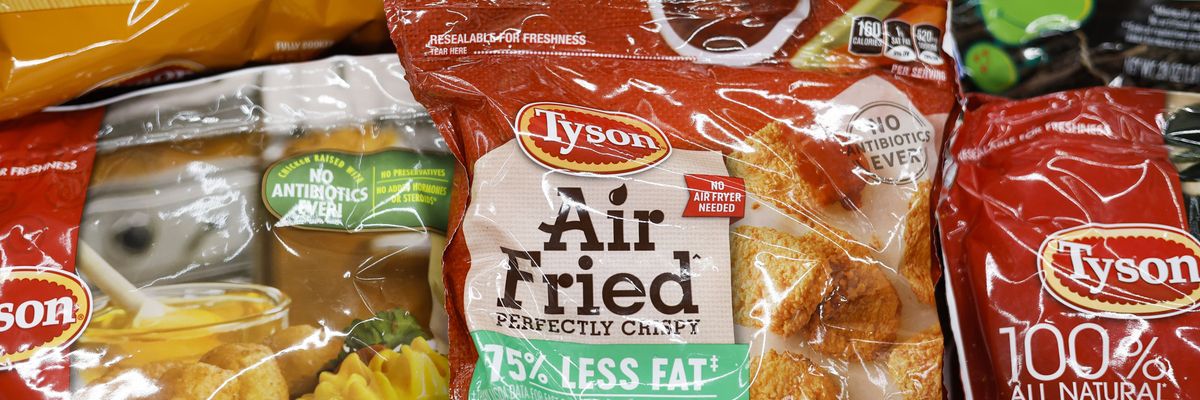
Tyson Foods frozen products are pictured in a Safeway store on August 8, 2023 in Washington, DC.
"It’s no secret that just a few years ago, packers like Tyson were making windfall profits while the rest of the industry was continuously in the red," said a Republican US senator from Nebraska.
Tyson Foods, the largest meat supplier in the United States, is shutting down a Nebraska beef-processing plant that employs more than 3,000 people just months after the company rewarded shareholders by boosting its dividend and ramping up stock buybacks.
The company said late last week that its decision to shutter the Lexington, Nebraska plant and scale back shifts at its Amarillo, Texas facility is "designed to right size its beef business and position it for long-term success" even as beef prices are close to record highs. The Wall Street Journal reported that Tyson and other meatpackers, which are facing federal scrutiny for allegedly colluding to drive up prices, "have been losing hundreds of millions of dollars processing beef because of the lowest amount of cattle on U.S. pastures since the 1950s."
Tyson, the latest company to cut thousands of jobs after prioritizing stock-boosting share buybacks, said it intends to provide "relocation benefits" to impacted workers, but provided no details.
"Tyson Foods recognizes the impact these decisions have on team members and the communities where we operate," the company said in a statement.
The plant in Lexington, which has a population of 11,000, is one of the largest beef-processing facilities in the United States. US Sen. Deb Fischer (R-Neb.), a member of the Senate Agriculture Committee, said in a statement that she was "extremely disappointed" by Tyson's decision to close the Lexington plant, warning it would "have a devastating impact on a truly wonderful community, the region, and our state."
"It’s no secret that just a few years ago, packers like Tyson were making windfall profits while the rest of the industry was continuously in the red," Fischer added. "As we head into the holiday season, I call on Tyson to do everything in its power to take care of the families affected by this short-sighted decision."
Tyson's announcement came days after the company said its adjusted operating income increased by 26% this fiscal year compared to 2024. The company also said it repurchased 3.5 million of its own shares for $196 million.
In early August, Tyson announced that its board "approved an increase of 43 million shares authorized for repurchase under the company’s share repurchase program."
Stock buybacks have long been associated with mass layoffs, wage stagnation, and other harms to workers.
"Tens of thousands of workers are losing their jobs in thousands of companies only because CEOs and their major stockholders want to make a quick killing by artificially jacking up the price of their stock," Les Leopold, executive director of the Labor Institute, told Common Dreams last year after mass layoffs at John Deere.
"We must always call stock buybacks for what they really are: blatant stock manipulation," he added.
Dear Common Dreams reader, It’s been nearly 30 years since I co-founded Common Dreams with my late wife, Lina Newhouser. We had the radical notion that journalism should serve the public good, not corporate profits. It was clear to us from the outset what it would take to build such a project. No paid advertisements. No corporate sponsors. No millionaire publisher telling us what to think or do. Many people said we wouldn't last a year, but we proved those doubters wrong. Together with a tremendous team of journalists and dedicated staff, we built an independent media outlet free from the constraints of profits and corporate control. Our mission has always been simple: To inform. To inspire. To ignite change for the common good. Building Common Dreams was not easy. Our survival was never guaranteed. When you take on the most powerful forces—Wall Street greed, fossil fuel industry destruction, Big Tech lobbyists, and uber-rich oligarchs who have spent billions upon billions rigging the economy and democracy in their favor—the only bulwark you have is supporters who believe in your work. But here’s the urgent message from me today. It's never been this bad out there. And it's never been this hard to keep us going. At the very moment Common Dreams is most needed, the threats we face are intensifying. We need your support now more than ever. We don't accept corporate advertising and never will. We don't have a paywall because we don't think people should be blocked from critical news based on their ability to pay. Everything we do is funded by the donations of readers like you. When everyone does the little they can afford, we are strong. But if that support retreats or dries up, so do we. Will you donate now to make sure Common Dreams not only survives but thrives? —Craig Brown, Co-founder |
Tyson Foods, the largest meat supplier in the United States, is shutting down a Nebraska beef-processing plant that employs more than 3,000 people just months after the company rewarded shareholders by boosting its dividend and ramping up stock buybacks.
The company said late last week that its decision to shutter the Lexington, Nebraska plant and scale back shifts at its Amarillo, Texas facility is "designed to right size its beef business and position it for long-term success" even as beef prices are close to record highs. The Wall Street Journal reported that Tyson and other meatpackers, which are facing federal scrutiny for allegedly colluding to drive up prices, "have been losing hundreds of millions of dollars processing beef because of the lowest amount of cattle on U.S. pastures since the 1950s."
Tyson, the latest company to cut thousands of jobs after prioritizing stock-boosting share buybacks, said it intends to provide "relocation benefits" to impacted workers, but provided no details.
"Tyson Foods recognizes the impact these decisions have on team members and the communities where we operate," the company said in a statement.
The plant in Lexington, which has a population of 11,000, is one of the largest beef-processing facilities in the United States. US Sen. Deb Fischer (R-Neb.), a member of the Senate Agriculture Committee, said in a statement that she was "extremely disappointed" by Tyson's decision to close the Lexington plant, warning it would "have a devastating impact on a truly wonderful community, the region, and our state."
"It’s no secret that just a few years ago, packers like Tyson were making windfall profits while the rest of the industry was continuously in the red," Fischer added. "As we head into the holiday season, I call on Tyson to do everything in its power to take care of the families affected by this short-sighted decision."
Tyson's announcement came days after the company said its adjusted operating income increased by 26% this fiscal year compared to 2024. The company also said it repurchased 3.5 million of its own shares for $196 million.
In early August, Tyson announced that its board "approved an increase of 43 million shares authorized for repurchase under the company’s share repurchase program."
Stock buybacks have long been associated with mass layoffs, wage stagnation, and other harms to workers.
"Tens of thousands of workers are losing their jobs in thousands of companies only because CEOs and their major stockholders want to make a quick killing by artificially jacking up the price of their stock," Les Leopold, executive director of the Labor Institute, told Common Dreams last year after mass layoffs at John Deere.
"We must always call stock buybacks for what they really are: blatant stock manipulation," he added.
Tyson Foods, the largest meat supplier in the United States, is shutting down a Nebraska beef-processing plant that employs more than 3,000 people just months after the company rewarded shareholders by boosting its dividend and ramping up stock buybacks.
The company said late last week that its decision to shutter the Lexington, Nebraska plant and scale back shifts at its Amarillo, Texas facility is "designed to right size its beef business and position it for long-term success" even as beef prices are close to record highs. The Wall Street Journal reported that Tyson and other meatpackers, which are facing federal scrutiny for allegedly colluding to drive up prices, "have been losing hundreds of millions of dollars processing beef because of the lowest amount of cattle on U.S. pastures since the 1950s."
Tyson, the latest company to cut thousands of jobs after prioritizing stock-boosting share buybacks, said it intends to provide "relocation benefits" to impacted workers, but provided no details.
"Tyson Foods recognizes the impact these decisions have on team members and the communities where we operate," the company said in a statement.
The plant in Lexington, which has a population of 11,000, is one of the largest beef-processing facilities in the United States. US Sen. Deb Fischer (R-Neb.), a member of the Senate Agriculture Committee, said in a statement that she was "extremely disappointed" by Tyson's decision to close the Lexington plant, warning it would "have a devastating impact on a truly wonderful community, the region, and our state."
"It’s no secret that just a few years ago, packers like Tyson were making windfall profits while the rest of the industry was continuously in the red," Fischer added. "As we head into the holiday season, I call on Tyson to do everything in its power to take care of the families affected by this short-sighted decision."
Tyson's announcement came days after the company said its adjusted operating income increased by 26% this fiscal year compared to 2024. The company also said it repurchased 3.5 million of its own shares for $196 million.
In early August, Tyson announced that its board "approved an increase of 43 million shares authorized for repurchase under the company’s share repurchase program."
Stock buybacks have long been associated with mass layoffs, wage stagnation, and other harms to workers.
"Tens of thousands of workers are losing their jobs in thousands of companies only because CEOs and their major stockholders want to make a quick killing by artificially jacking up the price of their stock," Les Leopold, executive director of the Labor Institute, told Common Dreams last year after mass layoffs at John Deere.
"We must always call stock buybacks for what they really are: blatant stock manipulation," he added.