SUBSCRIBE TO OUR FREE NEWSLETTER
Daily news & progressive opinion—funded by the people, not the corporations—delivered straight to your inbox.
5
#000000
#FFFFFF
To donate by check, phone, or other method, see our More Ways to Give page.
Daily news & progressive opinion—funded by the people, not the corporations—delivered straight to your inbox.
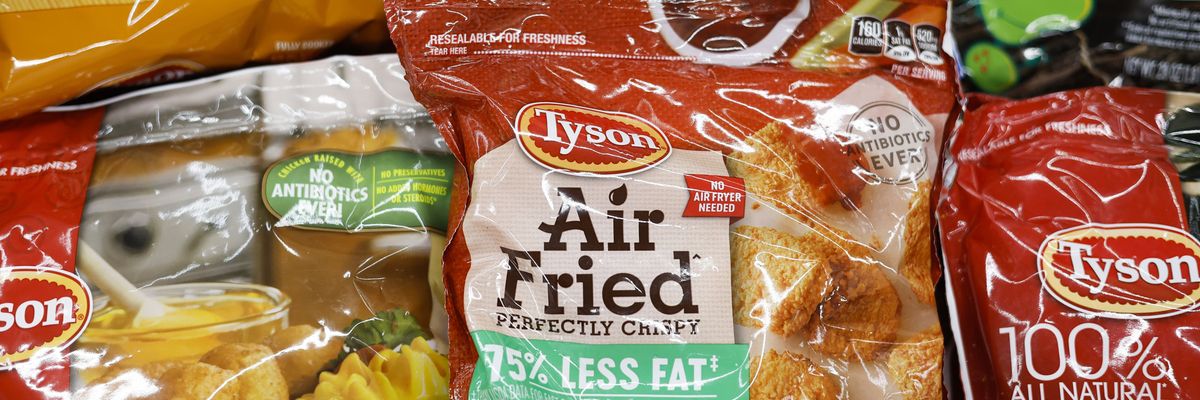
Tyson Foods frozen products are pictured in a Safeway store on August 8, 2023 in Washington, DC.
"It’s no secret that just a few years ago, packers like Tyson were making windfall profits while the rest of the industry was continuously in the red," said a Republican US senator from Nebraska.
Tyson Foods, the largest meat supplier in the United States, is shutting down a Nebraska beef-processing plant that employs more than 3,000 people just months after the company rewarded shareholders by boosting its dividend and ramping up stock buybacks.
The company said late last week that its decision to shutter the Lexington, Nebraska plant and scale back shifts at its Amarillo, Texas facility is "designed to right size its beef business and position it for long-term success" even as beef prices are close to record highs. The Wall Street Journal reported that Tyson and other meatpackers, which are facing federal scrutiny for allegedly colluding to drive up prices, "have been losing hundreds of millions of dollars processing beef because of the lowest amount of cattle on U.S. pastures since the 1950s."
Tyson, the latest company to cut thousands of jobs after prioritizing stock-boosting share buybacks, said it intends to provide "relocation benefits" to impacted workers, but provided no details.
"Tyson Foods recognizes the impact these decisions have on team members and the communities where we operate," the company said in a statement.
The plant in Lexington, which has a population of 11,000, is one of the largest beef-processing facilities in the United States. US Sen. Deb Fischer (R-Neb.), a member of the Senate Agriculture Committee, said in a statement that she was "extremely disappointed" by Tyson's decision to close the Lexington plant, warning it would "have a devastating impact on a truly wonderful community, the region, and our state."
"It’s no secret that just a few years ago, packers like Tyson were making windfall profits while the rest of the industry was continuously in the red," Fischer added. "As we head into the holiday season, I call on Tyson to do everything in its power to take care of the families affected by this short-sighted decision."
Tyson's announcement came days after the company said its adjusted operating income increased by 26% this fiscal year compared to 2024. The company also said it repurchased 3.5 million of its own shares for $196 million.
In early August, Tyson announced that its board "approved an increase of 43 million shares authorized for repurchase under the company’s share repurchase program."
Stock buybacks have long been associated with mass layoffs, wage stagnation, and other harms to workers.
"Tens of thousands of workers are losing their jobs in thousands of companies only because CEOs and their major stockholders want to make a quick killing by artificially jacking up the price of their stock," Les Leopold, executive director of the Labor Institute, told Common Dreams last year after mass layoffs at John Deere.
"We must always call stock buybacks for what they really are: blatant stock manipulation," he added.
This country and this world are at a monumental crossroads. US voters have an opportunity to beat back the forces of fascism and confront the billionaires who are rigging the economy, our media system, and our democracy, making it increasingly impossible for ordinary people to get by. We’re not just talking about the election. We’re talking about what must be done once these fascist elements are vanquished from power. We need a bolder set of solutions than what either major party has so far been willing to offer and a working-class movement ready to fight like hell for it. Trump didn't emerge from nowhere. The conditions that fueled MAGA authoritarianism were created by decades of radical neoliberal economic policies and a corrupt political system dominated by corporate interests. They slashed taxes on the super-rich, promising that the benefits would trickle down. They said giveaways to the corporate titans would make life more affordable for the rest of us. It was all bullshit. And when a bitter, betrayed populace searches for someone to blame, right-wing demagogues have little trouble finding scapegoats. People know when they're being lied to, but you won't hear any of this from the corporate media. Only independent journalism—powered and funded by people who believe in building a better world—can deliver truly trustworthy daily news. If you share our vision, please contribute whatever you can to sustain our work. |
Tyson Foods, the largest meat supplier in the United States, is shutting down a Nebraska beef-processing plant that employs more than 3,000 people just months after the company rewarded shareholders by boosting its dividend and ramping up stock buybacks.
The company said late last week that its decision to shutter the Lexington, Nebraska plant and scale back shifts at its Amarillo, Texas facility is "designed to right size its beef business and position it for long-term success" even as beef prices are close to record highs. The Wall Street Journal reported that Tyson and other meatpackers, which are facing federal scrutiny for allegedly colluding to drive up prices, "have been losing hundreds of millions of dollars processing beef because of the lowest amount of cattle on U.S. pastures since the 1950s."
Tyson, the latest company to cut thousands of jobs after prioritizing stock-boosting share buybacks, said it intends to provide "relocation benefits" to impacted workers, but provided no details.
"Tyson Foods recognizes the impact these decisions have on team members and the communities where we operate," the company said in a statement.
The plant in Lexington, which has a population of 11,000, is one of the largest beef-processing facilities in the United States. US Sen. Deb Fischer (R-Neb.), a member of the Senate Agriculture Committee, said in a statement that she was "extremely disappointed" by Tyson's decision to close the Lexington plant, warning it would "have a devastating impact on a truly wonderful community, the region, and our state."
"It’s no secret that just a few years ago, packers like Tyson were making windfall profits while the rest of the industry was continuously in the red," Fischer added. "As we head into the holiday season, I call on Tyson to do everything in its power to take care of the families affected by this short-sighted decision."
Tyson's announcement came days after the company said its adjusted operating income increased by 26% this fiscal year compared to 2024. The company also said it repurchased 3.5 million of its own shares for $196 million.
In early August, Tyson announced that its board "approved an increase of 43 million shares authorized for repurchase under the company’s share repurchase program."
Stock buybacks have long been associated with mass layoffs, wage stagnation, and other harms to workers.
"Tens of thousands of workers are losing their jobs in thousands of companies only because CEOs and their major stockholders want to make a quick killing by artificially jacking up the price of their stock," Les Leopold, executive director of the Labor Institute, told Common Dreams last year after mass layoffs at John Deere.
"We must always call stock buybacks for what they really are: blatant stock manipulation," he added.