SUBSCRIBE TO OUR FREE NEWSLETTER
Daily news & progressive opinion—funded by the people, not the corporations—delivered straight to your inbox.
5
#000000
#FFFFFF
To donate by check, phone, or other method, see our More Ways to Give page.
Daily news & progressive opinion—funded by the people, not the corporations—delivered straight to your inbox.
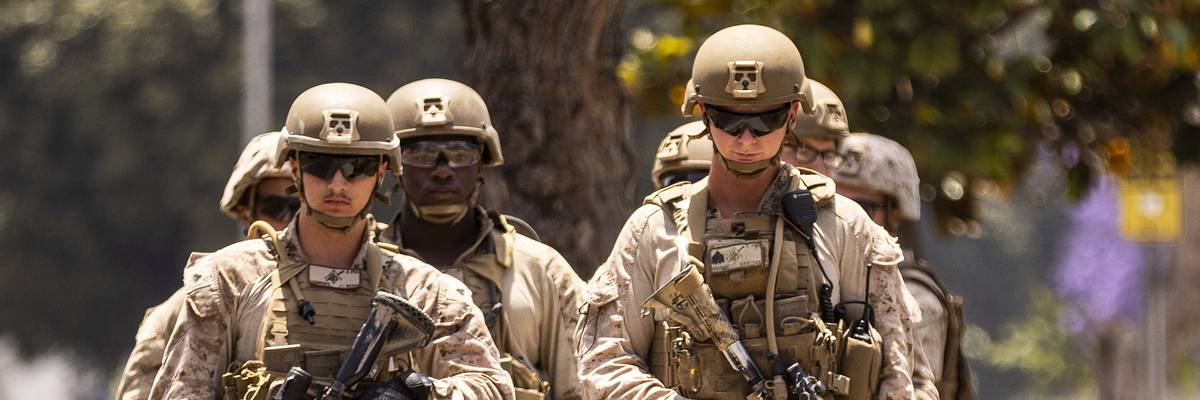
US Marines from 2nd Battalion, 7th Marines, 1st Marine Division walk to their assignment at the Wilshire Federal Building, ahead of nationwide "No Kings Day" protests, in Los Angeles, on June 13, 2025.
“Our military exists to defend the nation and protect our freedoms, not to be weaponized against American cities," said critics.
President Donald Trump alarmed many critics this week when he once again mused about deploying the military on the streets of US cities.
As reported by The New York Times, Trump told a group of American troops stationed in Japan on Tuesday that he could send the military into US cities under the pretense of fighting crime.
"We have cities that are troubled, we can’t have cities that are troubled," Trump said. "And we’re sending in our National Guard, and if we need more than the National Guard, we’ll send more than the National Guard, because we’re going to have safe cities."
Trump has deployed the National Guard to cities including Los Angeles, Chicago, Memphis, and Portland in recent months, but local and state officials have opposed the deployment in most cases and have filed legal challenges. Most recently, a federal appeals court voted on Tuesday to rehear the administration's case pushing to send the National Guard to Portland—vacating an earlier decision that allowed Trump to federalize Oregon's troops.
On Wednesday, Trump was asked by a New York Times reporter to specify what he meant when he said he could send "more than the National Guard" into American cities, and he replied that he could send any branch of the military he wanted without any oversight from courts or from Congress.
"If I want to enact a certain act, I'm allowed to do it," Trump said. "I'd be allowed to do whatever I want. The courts wouldn't get involved. Nobody would get involved. And I could send the Army, Navy, Air Force, Marines—I could send anybody I wanted."
Q: What did you mean last night when you said you were prepared to send 'more than the National Guard' into American cities?
TRUMP: Sure, I'd do that. As you know I'm allowed to do that
Q: Do you mean other branches of the military you'd send in?
TRUMP: If it were -- who are… pic.twitter.com/5O733Mas5V
— Aaron Rupar (@atrupar) October 29, 2025
The president threatened to invoke the Insurrection Act earlier this month, falsely claiming the law gives him "unquestioned power." The Insurrection Act allows presidents to deploy federal troops to enforce US laws in cases of extreme emergency, such as violent rebellions—but local officials in the cities Trump has targeted so far have categorically denied that anti-Trump protests there meet the high threshold for invoking the law.
The co-chairs of the Not Above the Law Coalition—Lisa Gilbert, co-president of Public Citizen; Praveen Fernandes, vice president of the Constitutional Accountability Center; Kelsey Herbert, campaign director at MoveOn; and Brett Edkins, managing director for policy and political affairs at Stand Up America—condemned Trump's threats on Tuesday as "unlawful and un-American."
"Our military exists to defend the nation and protect our freedoms, not to be weaponized against American cities," they said. "In his remarks today, Trump claimed that he and his administration cronies 'can do as we want to do.' That is as dangerous as it is unlawful and un-American."
Trump's use of the American military for domestic law enforcement purposes was also condemned by Ret. Maj. Gen. Randy Manner, a former top official at the National Guard.
Writing in the Home of the Brave newsletter, Manner condemned Trump's National Guard deployments to US cities as "un-American and wrong."
Manner noted that the National Guard has traditionally existed to augment US forces overseas during times of war, and also to serve at the request of state governors during times of emergencies. Using the National Guard to do standard police work, Manner added, is simply unprecedented.
"Our military is not trained in law enforcement," he argued. "There are absolutely zero situations where our National Guard should be on the streets of America as a status quo measure, absent some acute short-term crisis. We would never send our sheriff’s deputies to Afghanistan for a special operation; it’s just as illogical to send highly trained combat soldiers and put them into civilian law enforcement roles."
Trump first began musing about deploying the US military on American soil during the 2024 election campaign, when he said he could use it to take down a group of US citizens whom he described as "the enemy from within." Trump ratcheted up his threats last month when he told a group of assembled US generals that "we should use some of these dangerous cities as training grounds for our military."
Dear Common Dreams reader, It’s been nearly 30 years since I co-founded Common Dreams with my late wife, Lina Newhouser. We had the radical notion that journalism should serve the public good, not corporate profits. It was clear to us from the outset what it would take to build such a project. No paid advertisements. No corporate sponsors. No millionaire publisher telling us what to think or do. Many people said we wouldn't last a year, but we proved those doubters wrong. Together with a tremendous team of journalists and dedicated staff, we built an independent media outlet free from the constraints of profits and corporate control. Our mission has always been simple: To inform. To inspire. To ignite change for the common good. Building Common Dreams was not easy. Our survival was never guaranteed. When you take on the most powerful forces—Wall Street greed, fossil fuel industry destruction, Big Tech lobbyists, and uber-rich oligarchs who have spent billions upon billions rigging the economy and democracy in their favor—the only bulwark you have is supporters who believe in your work. But here’s the urgent message from me today. It's never been this bad out there. And it's never been this hard to keep us going. At the very moment Common Dreams is most needed, the threats we face are intensifying. We need your support now more than ever. We don't accept corporate advertising and never will. We don't have a paywall because we don't think people should be blocked from critical news based on their ability to pay. Everything we do is funded by the donations of readers like you. When everyone does the little they can afford, we are strong. But if that support retreats or dries up, so do we. Will you donate now to make sure Common Dreams not only survives but thrives? —Craig Brown, Co-founder |
President Donald Trump alarmed many critics this week when he once again mused about deploying the military on the streets of US cities.
As reported by The New York Times, Trump told a group of American troops stationed in Japan on Tuesday that he could send the military into US cities under the pretense of fighting crime.
"We have cities that are troubled, we can’t have cities that are troubled," Trump said. "And we’re sending in our National Guard, and if we need more than the National Guard, we’ll send more than the National Guard, because we’re going to have safe cities."
Trump has deployed the National Guard to cities including Los Angeles, Chicago, Memphis, and Portland in recent months, but local and state officials have opposed the deployment in most cases and have filed legal challenges. Most recently, a federal appeals court voted on Tuesday to rehear the administration's case pushing to send the National Guard to Portland—vacating an earlier decision that allowed Trump to federalize Oregon's troops.
On Wednesday, Trump was asked by a New York Times reporter to specify what he meant when he said he could send "more than the National Guard" into American cities, and he replied that he could send any branch of the military he wanted without any oversight from courts or from Congress.
"If I want to enact a certain act, I'm allowed to do it," Trump said. "I'd be allowed to do whatever I want. The courts wouldn't get involved. Nobody would get involved. And I could send the Army, Navy, Air Force, Marines—I could send anybody I wanted."
Q: What did you mean last night when you said you were prepared to send 'more than the National Guard' into American cities?
TRUMP: Sure, I'd do that. As you know I'm allowed to do that
Q: Do you mean other branches of the military you'd send in?
TRUMP: If it were -- who are… pic.twitter.com/5O733Mas5V
— Aaron Rupar (@atrupar) October 29, 2025
The president threatened to invoke the Insurrection Act earlier this month, falsely claiming the law gives him "unquestioned power." The Insurrection Act allows presidents to deploy federal troops to enforce US laws in cases of extreme emergency, such as violent rebellions—but local officials in the cities Trump has targeted so far have categorically denied that anti-Trump protests there meet the high threshold for invoking the law.
The co-chairs of the Not Above the Law Coalition—Lisa Gilbert, co-president of Public Citizen; Praveen Fernandes, vice president of the Constitutional Accountability Center; Kelsey Herbert, campaign director at MoveOn; and Brett Edkins, managing director for policy and political affairs at Stand Up America—condemned Trump's threats on Tuesday as "unlawful and un-American."
"Our military exists to defend the nation and protect our freedoms, not to be weaponized against American cities," they said. "In his remarks today, Trump claimed that he and his administration cronies 'can do as we want to do.' That is as dangerous as it is unlawful and un-American."
Trump's use of the American military for domestic law enforcement purposes was also condemned by Ret. Maj. Gen. Randy Manner, a former top official at the National Guard.
Writing in the Home of the Brave newsletter, Manner condemned Trump's National Guard deployments to US cities as "un-American and wrong."
Manner noted that the National Guard has traditionally existed to augment US forces overseas during times of war, and also to serve at the request of state governors during times of emergencies. Using the National Guard to do standard police work, Manner added, is simply unprecedented.
"Our military is not trained in law enforcement," he argued. "There are absolutely zero situations where our National Guard should be on the streets of America as a status quo measure, absent some acute short-term crisis. We would never send our sheriff’s deputies to Afghanistan for a special operation; it’s just as illogical to send highly trained combat soldiers and put them into civilian law enforcement roles."
Trump first began musing about deploying the US military on American soil during the 2024 election campaign, when he said he could use it to take down a group of US citizens whom he described as "the enemy from within." Trump ratcheted up his threats last month when he told a group of assembled US generals that "we should use some of these dangerous cities as training grounds for our military."
President Donald Trump alarmed many critics this week when he once again mused about deploying the military on the streets of US cities.
As reported by The New York Times, Trump told a group of American troops stationed in Japan on Tuesday that he could send the military into US cities under the pretense of fighting crime.
"We have cities that are troubled, we can’t have cities that are troubled," Trump said. "And we’re sending in our National Guard, and if we need more than the National Guard, we’ll send more than the National Guard, because we’re going to have safe cities."
Trump has deployed the National Guard to cities including Los Angeles, Chicago, Memphis, and Portland in recent months, but local and state officials have opposed the deployment in most cases and have filed legal challenges. Most recently, a federal appeals court voted on Tuesday to rehear the administration's case pushing to send the National Guard to Portland—vacating an earlier decision that allowed Trump to federalize Oregon's troops.
On Wednesday, Trump was asked by a New York Times reporter to specify what he meant when he said he could send "more than the National Guard" into American cities, and he replied that he could send any branch of the military he wanted without any oversight from courts or from Congress.
"If I want to enact a certain act, I'm allowed to do it," Trump said. "I'd be allowed to do whatever I want. The courts wouldn't get involved. Nobody would get involved. And I could send the Army, Navy, Air Force, Marines—I could send anybody I wanted."
Q: What did you mean last night when you said you were prepared to send 'more than the National Guard' into American cities?
TRUMP: Sure, I'd do that. As you know I'm allowed to do that
Q: Do you mean other branches of the military you'd send in?
TRUMP: If it were -- who are… pic.twitter.com/5O733Mas5V
— Aaron Rupar (@atrupar) October 29, 2025
The president threatened to invoke the Insurrection Act earlier this month, falsely claiming the law gives him "unquestioned power." The Insurrection Act allows presidents to deploy federal troops to enforce US laws in cases of extreme emergency, such as violent rebellions—but local officials in the cities Trump has targeted so far have categorically denied that anti-Trump protests there meet the high threshold for invoking the law.
The co-chairs of the Not Above the Law Coalition—Lisa Gilbert, co-president of Public Citizen; Praveen Fernandes, vice president of the Constitutional Accountability Center; Kelsey Herbert, campaign director at MoveOn; and Brett Edkins, managing director for policy and political affairs at Stand Up America—condemned Trump's threats on Tuesday as "unlawful and un-American."
"Our military exists to defend the nation and protect our freedoms, not to be weaponized against American cities," they said. "In his remarks today, Trump claimed that he and his administration cronies 'can do as we want to do.' That is as dangerous as it is unlawful and un-American."
Trump's use of the American military for domestic law enforcement purposes was also condemned by Ret. Maj. Gen. Randy Manner, a former top official at the National Guard.
Writing in the Home of the Brave newsletter, Manner condemned Trump's National Guard deployments to US cities as "un-American and wrong."
Manner noted that the National Guard has traditionally existed to augment US forces overseas during times of war, and also to serve at the request of state governors during times of emergencies. Using the National Guard to do standard police work, Manner added, is simply unprecedented.
"Our military is not trained in law enforcement," he argued. "There are absolutely zero situations where our National Guard should be on the streets of America as a status quo measure, absent some acute short-term crisis. We would never send our sheriff’s deputies to Afghanistan for a special operation; it’s just as illogical to send highly trained combat soldiers and put them into civilian law enforcement roles."
Trump first began musing about deploying the US military on American soil during the 2024 election campaign, when he said he could use it to take down a group of US citizens whom he described as "the enemy from within." Trump ratcheted up his threats last month when he told a group of assembled US generals that "we should use some of these dangerous cities as training grounds for our military."