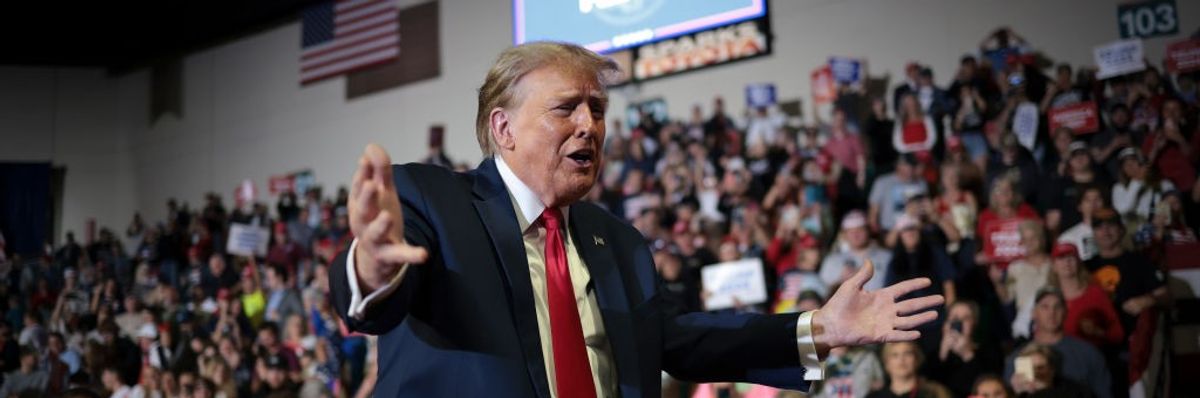
Former U.S. President Donald Trump, who is on track to win the Republican nomination, attends a rally at Carolina University on February 10, 2024 in Conway, South Carolina.
Trump Appeals Presidential Immunity Claim to US Supreme Court
One watchdog responded by stressing that "Trump is NOT above the law."
Former Republican President Donald Trump on Monday asked the right-wing U.S. Supreme Court to block a federal appellate court panel's ruling from last week that he cannot claim immunity in a criminal case related to his efforts to overturn the 2020 election results.
The three-member panel from the District of Columbia Circuit—featuring one judge appointed by former GOP President George H.W. Bush and two appointed by Democratic President Joe Biden, who is seeking reelection—unanimously ruled against Trump, the Republican presidential front-runner.
In response to the Monday filing, the government watchdog Citizens for Responsibility and Ethics in Washington reiterated that "Trump is NOT above the law."
Trump's new filing complies with the deadline set by the panel, which "temporarily paused the case from going back to the trial court, giving him through Monday to ask the justices to keep it paused while he appeals," explained MSNBC legal blogger Jordan Rubin, who called on the high court to "reject this and any other efforts to delay the trial further."
Rubin argued that the justices should also reject Trump's appeal on the merits, writing that "a court concerned with consequences should consider the effect of condoning broad presidential immunity."
"But even if the Supreme Court agrees with the D.C. Circuit's bottom line yet feels the need to add its own two cents or stamp on the historic matter, then taking the case up—as opposed to just rejecting it outright and sending it back for trial—could needlessly give Trump a win, effectively immunizing him in the process," he added.
While Trump was president, he appointed three justices to the nation's highest court, which previously punted on the case.
After Judge Tayna Chutkan of the U.S. District Court for the District of Columbia rejected Trump's immunity claim in December, Special Counsel Jack Smith—who is overseeing Trump's two federal cases because of the presidential contest—asked the Supreme Court to skip over the appeals level. However, the justices declined to do so.
Chutkan had initially scheduled the trial for March but recently postponed it while waiting for the appeals court's decision.
In addition to the two federal cases led by Smith, Trump has been indicted in two state-level criminal cases. He is also wrapped up in legal battles related to his eligibility to appear on the ballot or hold office after engaging in insurrection on January 6, 2021. The Supreme Court heard arguments for one of those disqualification cases last week.
We are at a crossroads
This country and this world are at a monumental crossroads. In a few short weeks, US voters will have an opportunity to beat back the forces of fascism and confront the billionaires who are rigging the economy, our media system, and our democracy, making it increasingly impossible for ordinary people to get by. We’re not just talking about the election. We’re talking about what must be done once these fascist elements are vanquished from power. We need a bolder set of solutions than what either major party has so far been willing to offer and a working-class movement ready to fight like hell for it. Trump didn't emerge from nowhere. The conditions that fueled MAGA authoritarianism were created by decades of radical neoliberal economic policies and a corrupt political system dominated by corporate interests. They slashed taxes on the super-rich, promising that the benefits would trickle down. They said giveaways to the corporate titans would make life more affordable for the rest of us. It was all bullshit. And when a bitter, betrayed populace searches for someone to blame, right-wing demagogues have little trouble finding scapegoats. People know when they're being lied to, but you won't hear any of this from the corporate media. Only independent journalism—powered and funded by people who believe in building a better world—can deliver truly trustworthy daily news. Our Fall Campaign is underway, and we need your help. To power our newsroom through the rest of the year, we need to raise $125,000 by midnight on October 31. So if you share our vision, please contribute whatever you can to sustain our work. |
Former Republican President Donald Trump on Monday asked the right-wing U.S. Supreme Court to block a federal appellate court panel's ruling from last week that he cannot claim immunity in a criminal case related to his efforts to overturn the 2020 election results.
The three-member panel from the District of Columbia Circuit—featuring one judge appointed by former GOP President George H.W. Bush and two appointed by Democratic President Joe Biden, who is seeking reelection—unanimously ruled against Trump, the Republican presidential front-runner.
In response to the Monday filing, the government watchdog Citizens for Responsibility and Ethics in Washington reiterated that "Trump is NOT above the law."
Trump's new filing complies with the deadline set by the panel, which "temporarily paused the case from going back to the trial court, giving him through Monday to ask the justices to keep it paused while he appeals," explained MSNBC legal blogger Jordan Rubin, who called on the high court to "reject this and any other efforts to delay the trial further."
Rubin argued that the justices should also reject Trump's appeal on the merits, writing that "a court concerned with consequences should consider the effect of condoning broad presidential immunity."
"But even if the Supreme Court agrees with the D.C. Circuit's bottom line yet feels the need to add its own two cents or stamp on the historic matter, then taking the case up—as opposed to just rejecting it outright and sending it back for trial—could needlessly give Trump a win, effectively immunizing him in the process," he added.
While Trump was president, he appointed three justices to the nation's highest court, which previously punted on the case.
After Judge Tayna Chutkan of the U.S. District Court for the District of Columbia rejected Trump's immunity claim in December, Special Counsel Jack Smith—who is overseeing Trump's two federal cases because of the presidential contest—asked the Supreme Court to skip over the appeals level. However, the justices declined to do so.
Chutkan had initially scheduled the trial for March but recently postponed it while waiting for the appeals court's decision.
In addition to the two federal cases led by Smith, Trump has been indicted in two state-level criminal cases. He is also wrapped up in legal battles related to his eligibility to appear on the ballot or hold office after engaging in insurrection on January 6, 2021. The Supreme Court heard arguments for one of those disqualification cases last week.
- 'Citizen Trump': Appeals Court Says No Immunity in Jan. 6 Case ›
- Trump Claims Presidents 'Have Absolute Immunity,' But Judges Seem Skeptical ›
- Win for Trump as US Supreme Court Punts on Immunity Question ›
- As Supreme Court Takes Trump Immunity Case, Clarence Thomas Urged to Recuse ›
- Opinion | The Supreme Court Is Doing Everything It Can to Get Trump Back in Office | Common Dreams ›
- Opinion | The Supreme Court Is Not Going to Save Us From Donald Trump | Common Dreams ›
- Major Asset Seizure Likely as Trump Can't Afford Bond for NY Fraud Case ›
- Opinion | The Supreme Court Has Already Helped Trump Win His Immunity Case | Common Dreams ›
Former Republican President Donald Trump on Monday asked the right-wing U.S. Supreme Court to block a federal appellate court panel's ruling from last week that he cannot claim immunity in a criminal case related to his efforts to overturn the 2020 election results.
The three-member panel from the District of Columbia Circuit—featuring one judge appointed by former GOP President George H.W. Bush and two appointed by Democratic President Joe Biden, who is seeking reelection—unanimously ruled against Trump, the Republican presidential front-runner.
In response to the Monday filing, the government watchdog Citizens for Responsibility and Ethics in Washington reiterated that "Trump is NOT above the law."
Trump's new filing complies with the deadline set by the panel, which "temporarily paused the case from going back to the trial court, giving him through Monday to ask the justices to keep it paused while he appeals," explained MSNBC legal blogger Jordan Rubin, who called on the high court to "reject this and any other efforts to delay the trial further."
Rubin argued that the justices should also reject Trump's appeal on the merits, writing that "a court concerned with consequences should consider the effect of condoning broad presidential immunity."
"But even if the Supreme Court agrees with the D.C. Circuit's bottom line yet feels the need to add its own two cents or stamp on the historic matter, then taking the case up—as opposed to just rejecting it outright and sending it back for trial—could needlessly give Trump a win, effectively immunizing him in the process," he added.
While Trump was president, he appointed three justices to the nation's highest court, which previously punted on the case.
After Judge Tayna Chutkan of the U.S. District Court for the District of Columbia rejected Trump's immunity claim in December, Special Counsel Jack Smith—who is overseeing Trump's two federal cases because of the presidential contest—asked the Supreme Court to skip over the appeals level. However, the justices declined to do so.
Chutkan had initially scheduled the trial for March but recently postponed it while waiting for the appeals court's decision.
In addition to the two federal cases led by Smith, Trump has been indicted in two state-level criminal cases. He is also wrapped up in legal battles related to his eligibility to appear on the ballot or hold office after engaging in insurrection on January 6, 2021. The Supreme Court heard arguments for one of those disqualification cases last week.
- 'Citizen Trump': Appeals Court Says No Immunity in Jan. 6 Case ›
- Trump Claims Presidents 'Have Absolute Immunity,' But Judges Seem Skeptical ›
- Win for Trump as US Supreme Court Punts on Immunity Question ›
- As Supreme Court Takes Trump Immunity Case, Clarence Thomas Urged to Recuse ›
- Opinion | The Supreme Court Is Doing Everything It Can to Get Trump Back in Office | Common Dreams ›
- Opinion | The Supreme Court Is Not Going to Save Us From Donald Trump | Common Dreams ›
- Major Asset Seizure Likely as Trump Can't Afford Bond for NY Fraud Case ›
- Opinion | The Supreme Court Has Already Helped Trump Win His Immunity Case | Common Dreams ›