SUBSCRIBE TO OUR FREE NEWSLETTER
Daily news & progressive opinion—funded by the people, not the corporations—delivered straight to your inbox.
5
#000000
#FFFFFF
To donate by check, phone, or other method, see our More Ways to Give page.
Daily news & progressive opinion—funded by the people, not the corporations—delivered straight to your inbox.
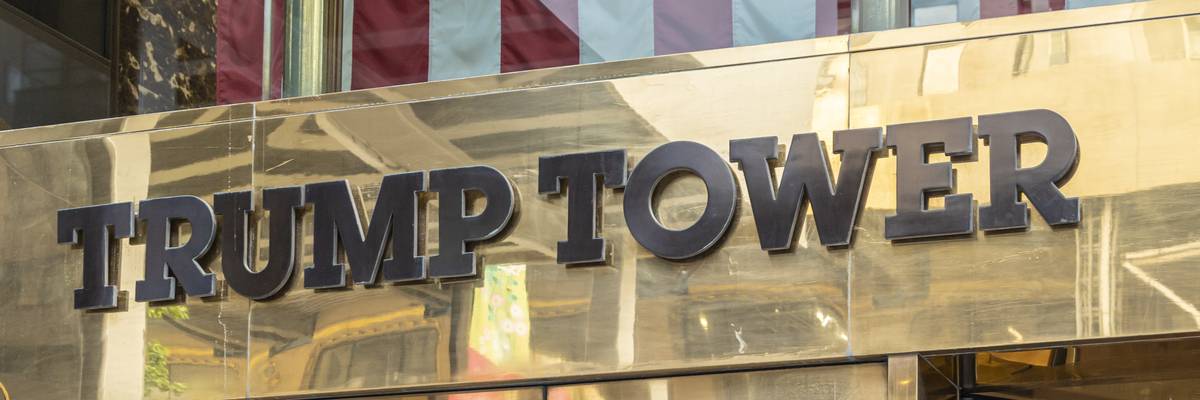
The main entrance of Trump Tower is seen in New York City in May 2023.
"Trump owes this money because he fraudulently misrepresented the value of his assets—and now (oops) apparently no one will accept those assets as collateral."
Less than a month after New York Attorney General Letitia James said she would be willing to seize former Republican President Donald Trump's assets if he is unable to pay the $464 million required by last month's judgment in his civil fraud case, Trump's lawyers disclosed in court filings Monday that he had failed to secure a bond for the amount.
In the nearly 5,000-page filing, lawyers for Trump said it has proven a "practical impossibility" for Trump to secure a bond from any financial institutions in the state, as "about 30 surety companies" have refused to accept assets including real estate as collateral and have demanded cash and other liquid assets instead.
To get the institutions to agree to cover that $464 million judgment if Trump loses his appeal and fails to pay the state, he would have to pledge more than $550 million as collateral—"a sum he simply does not have," reported The New York Times, despite his frequent boasting of his wealth and business prowess.
Trump himself was ordered to pay $454 million; the remainder was demanded from his sons, Donald Trump, Jr. and Eric Trump.
A Times analysis found earlier this month that Trump has only about $350 million in cash.
James has given Trump until March 25 to pay the judgment, which was announced last month as New York State Supreme Court Justice Arthur Engoron found the former president and his real estate empire, the Trump Organization, had committed "repeated and persistent fraud," including by falsifying financial statements by as much as $2.2 billion.
"It wouldn't surprise me if lenders are refusing real estate as collateral due to his lying about their value," said attorney Blake Allen.
The attorney general said last month that regardless of Trump's difficulty in securing the bond, her office is "prepared to make sure that the judgment is paid to New Yorkers" and suggested she would pursue asset seizure.
"I look at 40 Wall Street each and every day," James told ABC News, referring to one of Trump's buildings in New York's Financial District.
James hasn't publicly stated what other Trump assets she would potentially seize from the presumptive Republican presidential candidate.
On Monday, Trump asked an appeals court to issue a stay on the judgment, pausing enforcement while his appeal proceeds, or to accept just $100 million.
In addition to potentially levying and selling Trump's assets, Syracuse University law professor Gregory Germain told The Associated Press last month, James' office could "lien his real property, and garnish anyone who owes him money."
Dear Common Dreams reader, It’s been nearly 30 years since I co-founded Common Dreams with my late wife, Lina Newhouser. We had the radical notion that journalism should serve the public good, not corporate profits. It was clear to us from the outset what it would take to build such a project. No paid advertisements. No corporate sponsors. No millionaire publisher telling us what to think or do. Many people said we wouldn't last a year, but we proved those doubters wrong. Together with a tremendous team of journalists and dedicated staff, we built an independent media outlet free from the constraints of profits and corporate control. Our mission has always been simple: To inform. To inspire. To ignite change for the common good. Building Common Dreams was not easy. Our survival was never guaranteed. When you take on the most powerful forces—Wall Street greed, fossil fuel industry destruction, Big Tech lobbyists, and uber-rich oligarchs who have spent billions upon billions rigging the economy and democracy in their favor—the only bulwark you have is supporters who believe in your work. But here’s the urgent message from me today. It's never been this bad out there. And it's never been this hard to keep us going. At the very moment Common Dreams is most needed, the threats we face are intensifying. We need your support now more than ever. We don't accept corporate advertising and never will. We don't have a paywall because we don't think people should be blocked from critical news based on their ability to pay. Everything we do is funded by the donations of readers like you. When everyone does the little they can afford, we are strong. But if that support retreats or dries up, so do we. Will you donate now to make sure Common Dreams not only survives but thrives? —Craig Brown, Co-founder |
Less than a month after New York Attorney General Letitia James said she would be willing to seize former Republican President Donald Trump's assets if he is unable to pay the $464 million required by last month's judgment in his civil fraud case, Trump's lawyers disclosed in court filings Monday that he had failed to secure a bond for the amount.
In the nearly 5,000-page filing, lawyers for Trump said it has proven a "practical impossibility" for Trump to secure a bond from any financial institutions in the state, as "about 30 surety companies" have refused to accept assets including real estate as collateral and have demanded cash and other liquid assets instead.
To get the institutions to agree to cover that $464 million judgment if Trump loses his appeal and fails to pay the state, he would have to pledge more than $550 million as collateral—"a sum he simply does not have," reported The New York Times, despite his frequent boasting of his wealth and business prowess.
Trump himself was ordered to pay $454 million; the remainder was demanded from his sons, Donald Trump, Jr. and Eric Trump.
A Times analysis found earlier this month that Trump has only about $350 million in cash.
James has given Trump until March 25 to pay the judgment, which was announced last month as New York State Supreme Court Justice Arthur Engoron found the former president and his real estate empire, the Trump Organization, had committed "repeated and persistent fraud," including by falsifying financial statements by as much as $2.2 billion.
"It wouldn't surprise me if lenders are refusing real estate as collateral due to his lying about their value," said attorney Blake Allen.
The attorney general said last month that regardless of Trump's difficulty in securing the bond, her office is "prepared to make sure that the judgment is paid to New Yorkers" and suggested she would pursue asset seizure.
"I look at 40 Wall Street each and every day," James told ABC News, referring to one of Trump's buildings in New York's Financial District.
James hasn't publicly stated what other Trump assets she would potentially seize from the presumptive Republican presidential candidate.
On Monday, Trump asked an appeals court to issue a stay on the judgment, pausing enforcement while his appeal proceeds, or to accept just $100 million.
In addition to potentially levying and selling Trump's assets, Syracuse University law professor Gregory Germain told The Associated Press last month, James' office could "lien his real property, and garnish anyone who owes him money."
Less than a month after New York Attorney General Letitia James said she would be willing to seize former Republican President Donald Trump's assets if he is unable to pay the $464 million required by last month's judgment in his civil fraud case, Trump's lawyers disclosed in court filings Monday that he had failed to secure a bond for the amount.
In the nearly 5,000-page filing, lawyers for Trump said it has proven a "practical impossibility" for Trump to secure a bond from any financial institutions in the state, as "about 30 surety companies" have refused to accept assets including real estate as collateral and have demanded cash and other liquid assets instead.
To get the institutions to agree to cover that $464 million judgment if Trump loses his appeal and fails to pay the state, he would have to pledge more than $550 million as collateral—"a sum he simply does not have," reported The New York Times, despite his frequent boasting of his wealth and business prowess.
Trump himself was ordered to pay $454 million; the remainder was demanded from his sons, Donald Trump, Jr. and Eric Trump.
A Times analysis found earlier this month that Trump has only about $350 million in cash.
James has given Trump until March 25 to pay the judgment, which was announced last month as New York State Supreme Court Justice Arthur Engoron found the former president and his real estate empire, the Trump Organization, had committed "repeated and persistent fraud," including by falsifying financial statements by as much as $2.2 billion.
"It wouldn't surprise me if lenders are refusing real estate as collateral due to his lying about their value," said attorney Blake Allen.
The attorney general said last month that regardless of Trump's difficulty in securing the bond, her office is "prepared to make sure that the judgment is paid to New Yorkers" and suggested she would pursue asset seizure.
"I look at 40 Wall Street each and every day," James told ABC News, referring to one of Trump's buildings in New York's Financial District.
James hasn't publicly stated what other Trump assets she would potentially seize from the presumptive Republican presidential candidate.
On Monday, Trump asked an appeals court to issue a stay on the judgment, pausing enforcement while his appeal proceeds, or to accept just $100 million.
In addition to potentially levying and selling Trump's assets, Syracuse University law professor Gregory Germain told The Associated Press last month, James' office could "lien his real property, and garnish anyone who owes him money."