SUBSCRIBE TO OUR FREE NEWSLETTER
Daily news & progressive opinion—funded by the people, not the corporations—delivered straight to your inbox.
5
#000000
#FFFFFF
To donate by check, phone, or other method, see our More Ways to Give page.
Daily news & progressive opinion—funded by the people, not the corporations—delivered straight to your inbox.
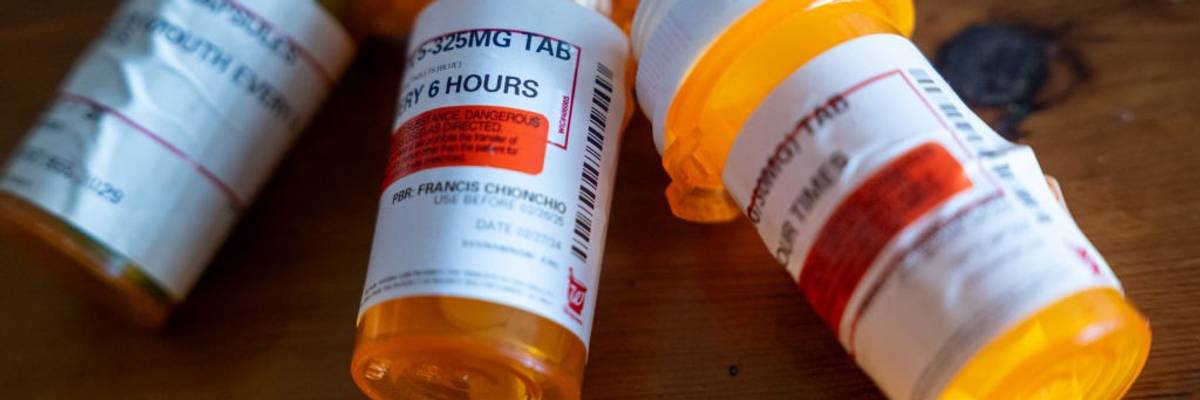
In a photo illustration, prescription drugs are seen in pill bottles on July 23, 2024 in New York City.
"Because of you and congressional Republicans, seniors will continue to face astronomical, unaffordable costs for lifesaving cancer treatments," said Sens. Ron Wyden and Catherine Cortez Masto.
Two Democratic senators on Monday tore into their Republican counterparts for "sneaking" a provision into their party's massive budget legislation that they said would provide a "multibillion dollar bailout" for the American pharmaceutical industry.
In a letter sent to U.S. President Donald Trump, Sens. Ron Wyden (D-Ore.) and Catherine Cortez Masto (D-Nev.) pointed out that the budget package "includes provisions that block or delay the Trump administration from using Medicare drug price negotiation to lower the price of certain blockbuster drugs" including "the top-selling cancer drugs in the world, such as Keytruda, Opdivo, Darzalex, and more."
The senators explained that Keytruda was originally due to become subject to Medicare price negotiations starting next year, but that has now been put on ice by the GOP's legislation.
"We see no policy rationale whatsoever for delaying the... ability to negotiate lower prices on these drugs other than handing money over to the industry," they charged. "Because of you and congressional Republicans, seniors will continue to face astronomical, unaffordable costs for lifesaving cancer treatments."
The senators noted the cruel irony of this gift to the pharmaceutical industry was that Republicans offset its cost by slashing roughly $1 trillion from Medicaid over the next decade, a move that's projected to strip health insurance from millions of Americans.
"Republicans were able to find billions of dollars to bailout the pharmaceutical industry in their multitrillion tax bill, but you claimed that fiscal austerity required you to enact the largest healthcare cuts in history, terminating coverage for more than 15 million Americans and hiking healthcare costs for everyone, even imposing a 'sick tax' on the lowest income Americans," the senators argued. "Republicans' budget bill benefited the ultrawealthy and big corporations, like Big Pharma, with tax cuts and bailouts at the expense of working and middle-class Americans' healthcare."
The senators also slammed Trump's decision to eschew Medicare price negotiations of the kind first employed by former U.S. President Joe Biden's administration after the passage of the 2022 Inflation Reduction Act that authorized such negotiations for a limited set of drugs for the first time. Instead, they pointed out that Trump has demanded pharmaceutical companies cut prices on Americans by raising them everywhere else in the world, which they described as a "flashy, empty announcement."
Steve Knievel, access to medicines advocate at Public Citizen, similarly dismissed Trump's recent letters to pharmaceutical companies last week as a completely ineffective approach to lowering prescription drug costs.
"If President Trump was serious about lowering drug prices for Americans, instead of promising to help drug corporations profiteer in other countries, he would work with Congress to pass legislation to lower prices here so Big Pharma can no longer charge U.S. patients and taxpayers the highest prices in the world," he said.
Trump in recent days has been making a number of mathematically impossible promises to lower the cost of drugs for Americans by as much as "1,200%," which would mean that pharmaceutical companies would be paying Americans substantial sums of money in exchange for taking their drugs.
Dear Common Dreams reader, It’s been nearly 30 years since I co-founded Common Dreams with my late wife, Lina Newhouser. We had the radical notion that journalism should serve the public good, not corporate profits. It was clear to us from the outset what it would take to build such a project. No paid advertisements. No corporate sponsors. No millionaire publisher telling us what to think or do. Many people said we wouldn't last a year, but we proved those doubters wrong. Together with a tremendous team of journalists and dedicated staff, we built an independent media outlet free from the constraints of profits and corporate control. Our mission has always been simple: To inform. To inspire. To ignite change for the common good. Building Common Dreams was not easy. Our survival was never guaranteed. When you take on the most powerful forces—Wall Street greed, fossil fuel industry destruction, Big Tech lobbyists, and uber-rich oligarchs who have spent billions upon billions rigging the economy and democracy in their favor—the only bulwark you have is supporters who believe in your work. But here’s the urgent message from me today. It's never been this bad out there. And it's never been this hard to keep us going. At the very moment Common Dreams is most needed, the threats we face are intensifying. We need your support now more than ever. We don't accept corporate advertising and never will. We don't have a paywall because we don't think people should be blocked from critical news based on their ability to pay. Everything we do is funded by the donations of readers like you. When everyone does the little they can afford, we are strong. But if that support retreats or dries up, so do we. Will you donate now to make sure Common Dreams not only survives but thrives? —Craig Brown, Co-founder |
Two Democratic senators on Monday tore into their Republican counterparts for "sneaking" a provision into their party's massive budget legislation that they said would provide a "multibillion dollar bailout" for the American pharmaceutical industry.
In a letter sent to U.S. President Donald Trump, Sens. Ron Wyden (D-Ore.) and Catherine Cortez Masto (D-Nev.) pointed out that the budget package "includes provisions that block or delay the Trump administration from using Medicare drug price negotiation to lower the price of certain blockbuster drugs" including "the top-selling cancer drugs in the world, such as Keytruda, Opdivo, Darzalex, and more."
The senators explained that Keytruda was originally due to become subject to Medicare price negotiations starting next year, but that has now been put on ice by the GOP's legislation.
"We see no policy rationale whatsoever for delaying the... ability to negotiate lower prices on these drugs other than handing money over to the industry," they charged. "Because of you and congressional Republicans, seniors will continue to face astronomical, unaffordable costs for lifesaving cancer treatments."
The senators noted the cruel irony of this gift to the pharmaceutical industry was that Republicans offset its cost by slashing roughly $1 trillion from Medicaid over the next decade, a move that's projected to strip health insurance from millions of Americans.
"Republicans were able to find billions of dollars to bailout the pharmaceutical industry in their multitrillion tax bill, but you claimed that fiscal austerity required you to enact the largest healthcare cuts in history, terminating coverage for more than 15 million Americans and hiking healthcare costs for everyone, even imposing a 'sick tax' on the lowest income Americans," the senators argued. "Republicans' budget bill benefited the ultrawealthy and big corporations, like Big Pharma, with tax cuts and bailouts at the expense of working and middle-class Americans' healthcare."
The senators also slammed Trump's decision to eschew Medicare price negotiations of the kind first employed by former U.S. President Joe Biden's administration after the passage of the 2022 Inflation Reduction Act that authorized such negotiations for a limited set of drugs for the first time. Instead, they pointed out that Trump has demanded pharmaceutical companies cut prices on Americans by raising them everywhere else in the world, which they described as a "flashy, empty announcement."
Steve Knievel, access to medicines advocate at Public Citizen, similarly dismissed Trump's recent letters to pharmaceutical companies last week as a completely ineffective approach to lowering prescription drug costs.
"If President Trump was serious about lowering drug prices for Americans, instead of promising to help drug corporations profiteer in other countries, he would work with Congress to pass legislation to lower prices here so Big Pharma can no longer charge U.S. patients and taxpayers the highest prices in the world," he said.
Trump in recent days has been making a number of mathematically impossible promises to lower the cost of drugs for Americans by as much as "1,200%," which would mean that pharmaceutical companies would be paying Americans substantial sums of money in exchange for taking their drugs.
Two Democratic senators on Monday tore into their Republican counterparts for "sneaking" a provision into their party's massive budget legislation that they said would provide a "multibillion dollar bailout" for the American pharmaceutical industry.
In a letter sent to U.S. President Donald Trump, Sens. Ron Wyden (D-Ore.) and Catherine Cortez Masto (D-Nev.) pointed out that the budget package "includes provisions that block or delay the Trump administration from using Medicare drug price negotiation to lower the price of certain blockbuster drugs" including "the top-selling cancer drugs in the world, such as Keytruda, Opdivo, Darzalex, and more."
The senators explained that Keytruda was originally due to become subject to Medicare price negotiations starting next year, but that has now been put on ice by the GOP's legislation.
"We see no policy rationale whatsoever for delaying the... ability to negotiate lower prices on these drugs other than handing money over to the industry," they charged. "Because of you and congressional Republicans, seniors will continue to face astronomical, unaffordable costs for lifesaving cancer treatments."
The senators noted the cruel irony of this gift to the pharmaceutical industry was that Republicans offset its cost by slashing roughly $1 trillion from Medicaid over the next decade, a move that's projected to strip health insurance from millions of Americans.
"Republicans were able to find billions of dollars to bailout the pharmaceutical industry in their multitrillion tax bill, but you claimed that fiscal austerity required you to enact the largest healthcare cuts in history, terminating coverage for more than 15 million Americans and hiking healthcare costs for everyone, even imposing a 'sick tax' on the lowest income Americans," the senators argued. "Republicans' budget bill benefited the ultrawealthy and big corporations, like Big Pharma, with tax cuts and bailouts at the expense of working and middle-class Americans' healthcare."
The senators also slammed Trump's decision to eschew Medicare price negotiations of the kind first employed by former U.S. President Joe Biden's administration after the passage of the 2022 Inflation Reduction Act that authorized such negotiations for a limited set of drugs for the first time. Instead, they pointed out that Trump has demanded pharmaceutical companies cut prices on Americans by raising them everywhere else in the world, which they described as a "flashy, empty announcement."
Steve Knievel, access to medicines advocate at Public Citizen, similarly dismissed Trump's recent letters to pharmaceutical companies last week as a completely ineffective approach to lowering prescription drug costs.
"If President Trump was serious about lowering drug prices for Americans, instead of promising to help drug corporations profiteer in other countries, he would work with Congress to pass legislation to lower prices here so Big Pharma can no longer charge U.S. patients and taxpayers the highest prices in the world," he said.
Trump in recent days has been making a number of mathematically impossible promises to lower the cost of drugs for Americans by as much as "1,200%," which would mean that pharmaceutical companies would be paying Americans substantial sums of money in exchange for taking their drugs.