

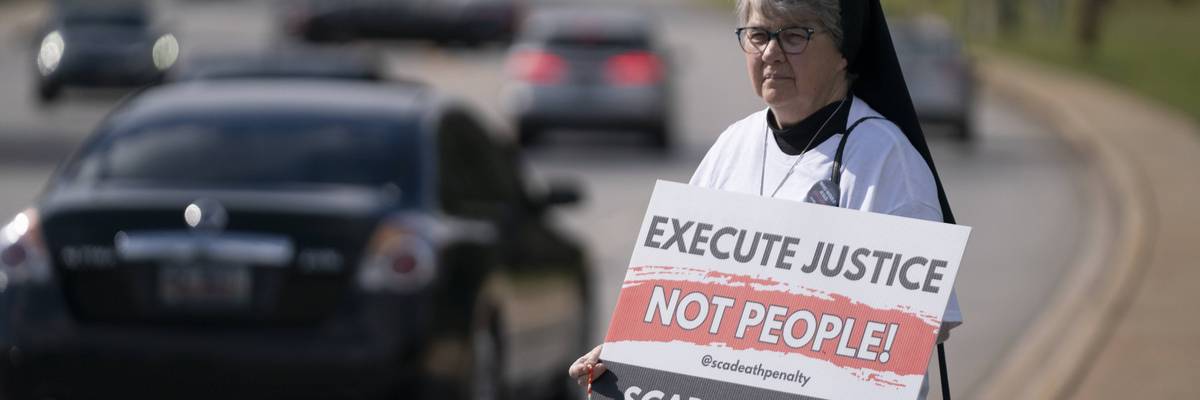
A woman holds a sign during a demonstration outside the department of corrections before the scheduled firing squad execution South Carolina inmate Mikal Mahdi on April 11, 2025 in Columbia, South Carolina.
(Photo by Sean Rayford/Getty Images)
'This Isn't Justice': Trump to Bring Back Firing Squad, Electric Chair, and Gas Executions
"Expanding the federal death penalty will be a stain on our history," said Sen. Dick Durbin.
Apr 24, 2026
The US Department of Justice said on Friday that it was planning to bring back several long-abandoned methods of execution—including firing squads, gas asphyxiation, and electrocution—as part of President Donald Trump's effort to expand the use of the federal death penalty.
Trump has vowed to restore the death penalty at the federal level, reversing the moratorium imposed by former President Joe Biden, who downgraded the sentences of nearly all 40 people on death row to life in prison without parole.
"The prior administration failed in its duty to protect the American people by refusing to pursue and carry out the ultimate punishment against the most dangerous criminals, including terrorists, child murderers, and cop killers," said acting Attorney General Todd Blanche on Friday. "Under President Trump's leadership, the Department of Justice is once again enforcing the law and standing with victims."
The federal government has never in modern history used the firing squad as a method of execution. And with the exception of Utah and South Carolina—the latter of which only revived the practice in 2025—it has not been used in state executions in the modern era.
The chair, which was the most common method of execution in the 20th century, was gradually phased out beginning in the 1980s because it came to be widely viewed as violent and cruel.
Meanwhile, execution by poison gas was carried on in the US for decades after the Nazis used it to murder millions of victims during the Holocaust, with states mostly abandoning it because it was viewed as expensive and impractical. However, Alabama and Louisiana have recently brought it back using nitrogen gas.
Nearly all executions at the state level are now carried out with lethal injections, which, despite being considered more "humane," are known to cause intense pain and suffocation and are frequently botched.
Blanche, who has authorized the government to seek the death penalty against nine people, said reviving old methods is necessary to ensure that the department "is prepared to carry out lawful executions even if a specific drug is unavailable."
According to data from the Death Penalty Information Center, nearly 1 in 8 people convicted and sentenced to death have later been exonerated. Meanwhile, more than 550 capital convictions, over 5% of them, have been overturned due to prosecutorial misconduct.
Efforts to revive antiquated methods are likely to draw challenges from civil rights groups like the American Civil Liberties Union, which have called the death penalty a form of "cruel and unusual punishment" forbidden by the US Constitution and one that disproportionately harms people of color.
"This isn’t justice. It’s cruel, immoral, and discriminatory," said Sen. Dick Durbin (D-Ill.). "Expanding the federal death penalty will be a stain on our history."
An Urgent Message From Our Co-Founder
Dear Common Dreams reader, The U.S. is on a fast track to authoritarianism like nothing I've ever seen. Meanwhile, corporate news outlets are utterly capitulating to Trump, twisting their coverage to avoid drawing his ire while lining up to stuff cash in his pockets. That's why I believe that Common Dreams is doing the best and most consequential reporting that we've ever done. Our small but mighty team is a progressive reporting powerhouse, covering the news every day that the corporate media never will. Our mission has always been simple: To inform. To inspire. And to ignite change for the common good. Now here's the key piece that I want all our readers to understand: None of this would be possible without your financial support. That's not just some fundraising cliche. It's the absolute and literal truth. We don't accept corporate advertising and never will. We don't have a paywall because we don't think people should be blocked from critical news based on their ability to pay. Everything we do is funded by the donations of readers like you. Will you donate now to help power the nonprofit, independent reporting of Common Dreams? Thank you for being a vital member of our community. Together, we can keep independent journalism alive when it’s needed most. - Craig Brown, Co-founder |
Our work is licensed under Creative Commons (CC BY-NC-ND 3.0). Feel free to republish and share widely.
firing squad
lethal injection
electric chair
trump administration
us department of justice
prisons
death penalty
The US Department of Justice said on Friday that it was planning to bring back several long-abandoned methods of execution—including firing squads, gas asphyxiation, and electrocution—as part of President Donald Trump's effort to expand the use of the federal death penalty.
Trump has vowed to restore the death penalty at the federal level, reversing the moratorium imposed by former President Joe Biden, who downgraded the sentences of nearly all 40 people on death row to life in prison without parole.
"The prior administration failed in its duty to protect the American people by refusing to pursue and carry out the ultimate punishment against the most dangerous criminals, including terrorists, child murderers, and cop killers," said acting Attorney General Todd Blanche on Friday. "Under President Trump's leadership, the Department of Justice is once again enforcing the law and standing with victims."
The federal government has never in modern history used the firing squad as a method of execution. And with the exception of Utah and South Carolina—the latter of which only revived the practice in 2025—it has not been used in state executions in the modern era.
The chair, which was the most common method of execution in the 20th century, was gradually phased out beginning in the 1980s because it came to be widely viewed as violent and cruel.
Meanwhile, execution by poison gas was carried on in the US for decades after the Nazis used it to murder millions of victims during the Holocaust, with states mostly abandoning it because it was viewed as expensive and impractical. However, Alabama and Louisiana have recently brought it back using nitrogen gas.
Nearly all executions at the state level are now carried out with lethal injections, which, despite being considered more "humane," are known to cause intense pain and suffocation and are frequently botched.
Blanche, who has authorized the government to seek the death penalty against nine people, said reviving old methods is necessary to ensure that the department "is prepared to carry out lawful executions even if a specific drug is unavailable."
According to data from the Death Penalty Information Center, nearly 1 in 8 people convicted and sentenced to death have later been exonerated. Meanwhile, more than 550 capital convictions, over 5% of them, have been overturned due to prosecutorial misconduct.
Efforts to revive antiquated methods are likely to draw challenges from civil rights groups like the American Civil Liberties Union, which have called the death penalty a form of "cruel and unusual punishment" forbidden by the US Constitution and one that disproportionately harms people of color.
"This isn’t justice. It’s cruel, immoral, and discriminatory," said Sen. Dick Durbin (D-Ill.). "Expanding the federal death penalty will be a stain on our history."
The US Department of Justice said on Friday that it was planning to bring back several long-abandoned methods of execution—including firing squads, gas asphyxiation, and electrocution—as part of President Donald Trump's effort to expand the use of the federal death penalty.
Trump has vowed to restore the death penalty at the federal level, reversing the moratorium imposed by former President Joe Biden, who downgraded the sentences of nearly all 40 people on death row to life in prison without parole.
"The prior administration failed in its duty to protect the American people by refusing to pursue and carry out the ultimate punishment against the most dangerous criminals, including terrorists, child murderers, and cop killers," said acting Attorney General Todd Blanche on Friday. "Under President Trump's leadership, the Department of Justice is once again enforcing the law and standing with victims."
The federal government has never in modern history used the firing squad as a method of execution. And with the exception of Utah and South Carolina—the latter of which only revived the practice in 2025—it has not been used in state executions in the modern era.
The chair, which was the most common method of execution in the 20th century, was gradually phased out beginning in the 1980s because it came to be widely viewed as violent and cruel.
Meanwhile, execution by poison gas was carried on in the US for decades after the Nazis used it to murder millions of victims during the Holocaust, with states mostly abandoning it because it was viewed as expensive and impractical. However, Alabama and Louisiana have recently brought it back using nitrogen gas.
Nearly all executions at the state level are now carried out with lethal injections, which, despite being considered more "humane," are known to cause intense pain and suffocation and are frequently botched.
Blanche, who has authorized the government to seek the death penalty against nine people, said reviving old methods is necessary to ensure that the department "is prepared to carry out lawful executions even if a specific drug is unavailable."
According to data from the Death Penalty Information Center, nearly 1 in 8 people convicted and sentenced to death have later been exonerated. Meanwhile, more than 550 capital convictions, over 5% of them, have been overturned due to prosecutorial misconduct.
Efforts to revive antiquated methods are likely to draw challenges from civil rights groups like the American Civil Liberties Union, which have called the death penalty a form of "cruel and unusual punishment" forbidden by the US Constitution and one that disproportionately harms people of color.
"This isn’t justice. It’s cruel, immoral, and discriminatory," said Sen. Dick Durbin (D-Ill.). "Expanding the federal death penalty will be a stain on our history."
firing squad
lethal injection
electric chair
trump administration
us department of justice
prisons
death penalty
We've had enough. The 1% own and operate the corporate media. They are doing everything they can to defend the status quo, squash dissent and protect the wealthy and the powerful. The Common Dreams media model is different. We cover the news that matters to the 99%. Our mission? To inform. To inspire. To ignite change for the common good. How? Nonprofit. Independent. Reader-supported. Free to read. Free to republish. Free to share. With no advertising. No paywalls. No selling of your data. Thousands of small donations fund our newsroom and allow us to continue publishing. Can you chip in? We can't do it without you. Thank you.