SUBSCRIBE TO OUR FREE NEWSLETTER
Daily news & progressive opinion—funded by the people, not the corporations—delivered straight to your inbox.
5
#000000
#FFFFFF
To donate by check, phone, or other method, see our More Ways to Give page.
Daily news & progressive opinion—funded by the people, not the corporations—delivered straight to your inbox.
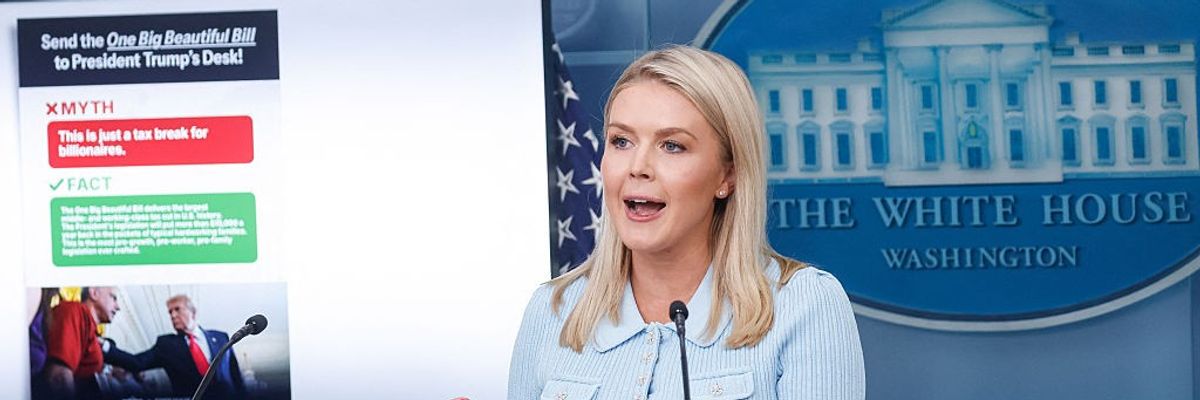
White House Press Secretary Karoline Leavitt speaks during a daily press briefing on June 26, 2025.
White House Press Secretary Karoline Leavitt misleadingly touted tax deductions for overtime and tips—while neglecting to mention the bill's much larger tax breaks for the wealthiest Americans and large corporations.
As the Republican reconciliation bill barrels toward final passage in Congress, the Trump White House is misrepresenting the measure's tax provisions in an attempt to paint the unpopular legislation as a boon for workers and ordinary seniors rather than a massive handout to the wealthiest Americans.
In an X post late Wednesday, White House Press Secretary Karoline Leavitt declared that any lawmaker who opposes the 887-page bill is voting against "no tax on tips," "no tax on overtime," and "no tax on Social Security" benefits.
Leavitt's post was sufficiently misleading as to draw a "community note" on the Elon Musk-owned platform, which clarified that the Republican bill "does not fully eliminate taxes on tips, overtime, or Social Security as claimed; it offers limited deductions with caps (e.g., $25,000 for tips, $12,500 for overtime) and excludes high earners, with no provision to remove taxes on Social Security."
As Axios reported Thursday, the Republican legislation does include "an increased tax deduction for tax filers age 64 and older," but the benefit "leaves out the poorest seniors" and expires in 2028, when President Donald Trump is set to leave office.
The tax deductions for overtime and tips also expire in 2028.
That's unlike the major tax breaks for the wealthy that are included in the legislation, which extends soon-to-expire provisions of the 2017 Trump-GOP tax law. For example, the new Republican bill would permanently raise the estate tax exemption, allowing ultrawealthy individuals and married couples to give their heirs up to $15 million or $30 million without paying any federal taxes.
"A married couple worth $30 million where both spouses die in 2026 would pay some $6 million less under the bill compared with current law," The Wall Street Journal observed.
Brendan Duke, senior director for federal budget policy at the Center on Budget and Policy Priorities, estimates that the GOP reconciliation bill's tax breaks for the richest 1% are roughly 10 times larger than the tax deductions for tips and overtime combined.
You left something out. https://t.co/LwMFX2nbyM pic.twitter.com/9Dn2FoBZNH
— Brendan Duke (@Brendan_Duke) July 3, 2025
The Institute on Taxation and Economic Policy (ITEP) noted in a recent analysis that the Senate-passed legislation also "includes permanent corporate tax breaks (involving more generous versions of tax rules for bonus depreciation, research, and limits on interest deductions) that lawmakers have attempted to enact in recent years."
Contrary to the Trump White House's characterization of the reconciliation bill as a historic "middle- and working-class tax cut," ITEP found that "the richest 1% of Americans would receive a total of $117 billion in net tax cuts in 2026."
By contrast, according to ITEP, "the middle 20% of taxpayers on the income scale, a group that has 20 times the number of taxpayers as the richest 1%, would receive less than half that much, $53 billion in net tax cuts that year."
"The effects of President Trump's tariff policies alone offset most of the tax cuts for the bottom 80% of Americans," the group added. "For the bottom 40% of Americans, the tariffs impose a cost that is greater than the tax cuts they would receive under this legislation."
Survey data released Wednesday by Data for Progress shows that the Republican legislation is unpopular with a majority of likely U.S. voters. The new poll, conducted between June 27 and July 1, found that 62% of Americans are either somewhat or very concerned about the bill's "cuts to income taxes on wealthy Americans."
Dear Common Dreams reader, It’s been nearly 30 years since I co-founded Common Dreams with my late wife, Lina Newhouser. We had the radical notion that journalism should serve the public good, not corporate profits. It was clear to us from the outset what it would take to build such a project. No paid advertisements. No corporate sponsors. No millionaire publisher telling us what to think or do. Many people said we wouldn't last a year, but we proved those doubters wrong. Together with a tremendous team of journalists and dedicated staff, we built an independent media outlet free from the constraints of profits and corporate control. Our mission has always been simple: To inform. To inspire. To ignite change for the common good. Building Common Dreams was not easy. Our survival was never guaranteed. When you take on the most powerful forces—Wall Street greed, fossil fuel industry destruction, Big Tech lobbyists, and uber-rich oligarchs who have spent billions upon billions rigging the economy and democracy in their favor—the only bulwark you have is supporters who believe in your work. But here’s the urgent message from me today. It's never been this bad out there. And it's never been this hard to keep us going. At the very moment Common Dreams is most needed, the threats we face are intensifying. We need your support now more than ever. We don't accept corporate advertising and never will. We don't have a paywall because we don't think people should be blocked from critical news based on their ability to pay. Everything we do is funded by the donations of readers like you. When everyone does the little they can afford, we are strong. But if that support retreats or dries up, so do we. Will you donate now to make sure Common Dreams not only survives but thrives? —Craig Brown, Co-founder |
As the Republican reconciliation bill barrels toward final passage in Congress, the Trump White House is misrepresenting the measure's tax provisions in an attempt to paint the unpopular legislation as a boon for workers and ordinary seniors rather than a massive handout to the wealthiest Americans.
In an X post late Wednesday, White House Press Secretary Karoline Leavitt declared that any lawmaker who opposes the 887-page bill is voting against "no tax on tips," "no tax on overtime," and "no tax on Social Security" benefits.
Leavitt's post was sufficiently misleading as to draw a "community note" on the Elon Musk-owned platform, which clarified that the Republican bill "does not fully eliminate taxes on tips, overtime, or Social Security as claimed; it offers limited deductions with caps (e.g., $25,000 for tips, $12,500 for overtime) and excludes high earners, with no provision to remove taxes on Social Security."
As Axios reported Thursday, the Republican legislation does include "an increased tax deduction for tax filers age 64 and older," but the benefit "leaves out the poorest seniors" and expires in 2028, when President Donald Trump is set to leave office.
The tax deductions for overtime and tips also expire in 2028.
That's unlike the major tax breaks for the wealthy that are included in the legislation, which extends soon-to-expire provisions of the 2017 Trump-GOP tax law. For example, the new Republican bill would permanently raise the estate tax exemption, allowing ultrawealthy individuals and married couples to give their heirs up to $15 million or $30 million without paying any federal taxes.
"A married couple worth $30 million where both spouses die in 2026 would pay some $6 million less under the bill compared with current law," The Wall Street Journal observed.
Brendan Duke, senior director for federal budget policy at the Center on Budget and Policy Priorities, estimates that the GOP reconciliation bill's tax breaks for the richest 1% are roughly 10 times larger than the tax deductions for tips and overtime combined.
You left something out. https://t.co/LwMFX2nbyM pic.twitter.com/9Dn2FoBZNH
— Brendan Duke (@Brendan_Duke) July 3, 2025
The Institute on Taxation and Economic Policy (ITEP) noted in a recent analysis that the Senate-passed legislation also "includes permanent corporate tax breaks (involving more generous versions of tax rules for bonus depreciation, research, and limits on interest deductions) that lawmakers have attempted to enact in recent years."
Contrary to the Trump White House's characterization of the reconciliation bill as a historic "middle- and working-class tax cut," ITEP found that "the richest 1% of Americans would receive a total of $117 billion in net tax cuts in 2026."
By contrast, according to ITEP, "the middle 20% of taxpayers on the income scale, a group that has 20 times the number of taxpayers as the richest 1%, would receive less than half that much, $53 billion in net tax cuts that year."
"The effects of President Trump's tariff policies alone offset most of the tax cuts for the bottom 80% of Americans," the group added. "For the bottom 40% of Americans, the tariffs impose a cost that is greater than the tax cuts they would receive under this legislation."
Survey data released Wednesday by Data for Progress shows that the Republican legislation is unpopular with a majority of likely U.S. voters. The new poll, conducted between June 27 and July 1, found that 62% of Americans are either somewhat or very concerned about the bill's "cuts to income taxes on wealthy Americans."
As the Republican reconciliation bill barrels toward final passage in Congress, the Trump White House is misrepresenting the measure's tax provisions in an attempt to paint the unpopular legislation as a boon for workers and ordinary seniors rather than a massive handout to the wealthiest Americans.
In an X post late Wednesday, White House Press Secretary Karoline Leavitt declared that any lawmaker who opposes the 887-page bill is voting against "no tax on tips," "no tax on overtime," and "no tax on Social Security" benefits.
Leavitt's post was sufficiently misleading as to draw a "community note" on the Elon Musk-owned platform, which clarified that the Republican bill "does not fully eliminate taxes on tips, overtime, or Social Security as claimed; it offers limited deductions with caps (e.g., $25,000 for tips, $12,500 for overtime) and excludes high earners, with no provision to remove taxes on Social Security."
As Axios reported Thursday, the Republican legislation does include "an increased tax deduction for tax filers age 64 and older," but the benefit "leaves out the poorest seniors" and expires in 2028, when President Donald Trump is set to leave office.
The tax deductions for overtime and tips also expire in 2028.
That's unlike the major tax breaks for the wealthy that are included in the legislation, which extends soon-to-expire provisions of the 2017 Trump-GOP tax law. For example, the new Republican bill would permanently raise the estate tax exemption, allowing ultrawealthy individuals and married couples to give their heirs up to $15 million or $30 million without paying any federal taxes.
"A married couple worth $30 million where both spouses die in 2026 would pay some $6 million less under the bill compared with current law," The Wall Street Journal observed.
Brendan Duke, senior director for federal budget policy at the Center on Budget and Policy Priorities, estimates that the GOP reconciliation bill's tax breaks for the richest 1% are roughly 10 times larger than the tax deductions for tips and overtime combined.
You left something out. https://t.co/LwMFX2nbyM pic.twitter.com/9Dn2FoBZNH
— Brendan Duke (@Brendan_Duke) July 3, 2025
The Institute on Taxation and Economic Policy (ITEP) noted in a recent analysis that the Senate-passed legislation also "includes permanent corporate tax breaks (involving more generous versions of tax rules for bonus depreciation, research, and limits on interest deductions) that lawmakers have attempted to enact in recent years."
Contrary to the Trump White House's characterization of the reconciliation bill as a historic "middle- and working-class tax cut," ITEP found that "the richest 1% of Americans would receive a total of $117 billion in net tax cuts in 2026."
By contrast, according to ITEP, "the middle 20% of taxpayers on the income scale, a group that has 20 times the number of taxpayers as the richest 1%, would receive less than half that much, $53 billion in net tax cuts that year."
"The effects of President Trump's tariff policies alone offset most of the tax cuts for the bottom 80% of Americans," the group added. "For the bottom 40% of Americans, the tariffs impose a cost that is greater than the tax cuts they would receive under this legislation."
Survey data released Wednesday by Data for Progress shows that the Republican legislation is unpopular with a majority of likely U.S. voters. The new poll, conducted between June 27 and July 1, found that 62% of Americans are either somewhat or very concerned about the bill's "cuts to income taxes on wealthy Americans."