SUBSCRIBE TO OUR FREE NEWSLETTER
Daily news & progressive opinion—funded by the people, not the corporations—delivered straight to your inbox.
5
#000000
#FFFFFF
To donate by check, phone, or other method, see our More Ways to Give page.
Daily news & progressive opinion—funded by the people, not the corporations—delivered straight to your inbox.
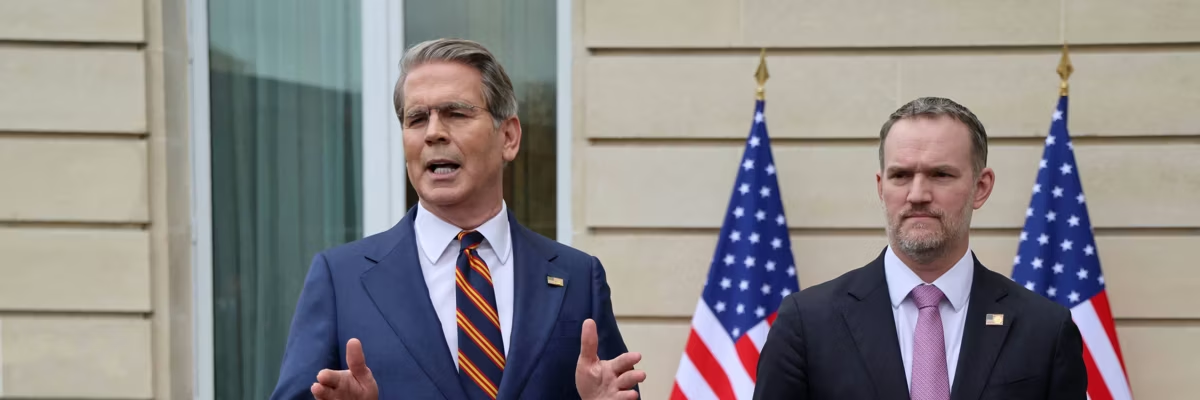
US Treasury Secretary Scott Bessent addresses journalists next to US Trade Representative Jamieson Greer in Paris on March 16, 2026.
"It is unacceptable that Treasury may not have performed the most basic planning before it was launched," said US Sen. Ron Wyden.
The top Democrat on the Senate Finance Committee revealed Thursday that an adviser to the US Treasury Department admitted he was unaware of the agency doing any work to prepare for the economic fallout of President Donald Trump's war on Iran, which has plunged the global economy into chaos and cost American drivers billions at the pump.
Sriprakash Kothari, a top adviser to Treasury Secretary Scott Bessent and Trump's nominee to serve as Assistant Secretary of the Treasury for Economic Policy, told US Sen. Ron Wyden's (D-Ore.) staff behind closed doors that "not only did he not perform any work related to energy markets leading up to the war, but that he wasn’t aware of anyone at Treasury who did," Wyden wrote in a letter to Bessent.
Wyden quotes Kothari as saying he did no work to prepare for economic impacts of the war "leading up to the conflict," just "subsequent" to its start on February 28.
"When later asked to clarify this response, he reiterated that he had not performed any analysis or work related to energy markets, or any other economic facet, in the lead-up to military action in Iran," Wyden added. "He further told staff that the work he performed subsequently occurred after learning about the February 2026 strikes in the news. Mr. Kothari was then asked whether he was aware of anyone at Treasury performing analysis or work related to energy markets in the lead-up to potential military action in Iran, he responded that he was not aware of anyone performing any such work."
Wyden wrote that given the "rapidly growing affordability crisis" in the US—a crisis intensified by Trump's war on Iran—"it is unacceptable that Treasury may not have performed the most basic planning before it was launched."
"Every problem resulting from the conflict which we are seeing now," wrote Wyden, "was not only foreseeable but was predicted by the intelligence agencies, which reported as recently as last March that Iran was 'capable of inflicting severe damage to an attacker' and of 'disrupting shipping, particularly energy supplies, through the Strait of Hormuz.'"
In just six weeks, Trump's Iran war has cost American taxpayers over $30 billion and counting, and US drivers collectively spent over $8 billion more on gas during the first month of the illegal assault, which sent oil prices surging.
CNN reported last month that the Trump administration "significantly underestimated Iran’s willingness to close the Strait of Hormuz in response to US military strikes while planning the ongoing operation."
"While key officials from the Departments of Energy and Treasury were present for some of the official planning meetings about the operation before it started," CNN reported, citing unnamed sources familiar with the discussions, "the agency analysis and forecasts that would be integral elements of the decision-making process in past administrations were secondary considerations."
Dear Common Dreams reader, It’s been nearly 30 years since I co-founded Common Dreams with my late wife, Lina Newhouser. We had the radical notion that journalism should serve the public good, not corporate profits. It was clear to us from the outset what it would take to build such a project. No paid advertisements. No corporate sponsors. No millionaire publisher telling us what to think or do. Many people said we wouldn't last a year, but we proved those doubters wrong. Together with a tremendous team of journalists and dedicated staff, we built an independent media outlet free from the constraints of profits and corporate control. Our mission has always been simple: To inform. To inspire. To ignite change for the common good. Building Common Dreams was not easy. Our survival was never guaranteed. When you take on the most powerful forces—Wall Street greed, fossil fuel industry destruction, Big Tech lobbyists, and uber-rich oligarchs who have spent billions upon billions rigging the economy and democracy in their favor—the only bulwark you have is supporters who believe in your work. But here’s the urgent message from me today. It's never been this bad out there. And it's never been this hard to keep us going. At the very moment Common Dreams is most needed, the threats we face are intensifying. We need your support now more than ever. We don't accept corporate advertising and never will. We don't have a paywall because we don't think people should be blocked from critical news based on their ability to pay. Everything we do is funded by the donations of readers like you. When everyone does the little they can afford, we are strong. But if that support retreats or dries up, so do we. Will you donate now to make sure Common Dreams not only survives but thrives? —Craig Brown, Co-founder |
The top Democrat on the Senate Finance Committee revealed Thursday that an adviser to the US Treasury Department admitted he was unaware of the agency doing any work to prepare for the economic fallout of President Donald Trump's war on Iran, which has plunged the global economy into chaos and cost American drivers billions at the pump.
Sriprakash Kothari, a top adviser to Treasury Secretary Scott Bessent and Trump's nominee to serve as Assistant Secretary of the Treasury for Economic Policy, told US Sen. Ron Wyden's (D-Ore.) staff behind closed doors that "not only did he not perform any work related to energy markets leading up to the war, but that he wasn’t aware of anyone at Treasury who did," Wyden wrote in a letter to Bessent.
Wyden quotes Kothari as saying he did no work to prepare for economic impacts of the war "leading up to the conflict," just "subsequent" to its start on February 28.
"When later asked to clarify this response, he reiterated that he had not performed any analysis or work related to energy markets, or any other economic facet, in the lead-up to military action in Iran," Wyden added. "He further told staff that the work he performed subsequently occurred after learning about the February 2026 strikes in the news. Mr. Kothari was then asked whether he was aware of anyone at Treasury performing analysis or work related to energy markets in the lead-up to potential military action in Iran, he responded that he was not aware of anyone performing any such work."
Wyden wrote that given the "rapidly growing affordability crisis" in the US—a crisis intensified by Trump's war on Iran—"it is unacceptable that Treasury may not have performed the most basic planning before it was launched."
"Every problem resulting from the conflict which we are seeing now," wrote Wyden, "was not only foreseeable but was predicted by the intelligence agencies, which reported as recently as last March that Iran was 'capable of inflicting severe damage to an attacker' and of 'disrupting shipping, particularly energy supplies, through the Strait of Hormuz.'"
In just six weeks, Trump's Iran war has cost American taxpayers over $30 billion and counting, and US drivers collectively spent over $8 billion more on gas during the first month of the illegal assault, which sent oil prices surging.
CNN reported last month that the Trump administration "significantly underestimated Iran’s willingness to close the Strait of Hormuz in response to US military strikes while planning the ongoing operation."
"While key officials from the Departments of Energy and Treasury were present for some of the official planning meetings about the operation before it started," CNN reported, citing unnamed sources familiar with the discussions, "the agency analysis and forecasts that would be integral elements of the decision-making process in past administrations were secondary considerations."
The top Democrat on the Senate Finance Committee revealed Thursday that an adviser to the US Treasury Department admitted he was unaware of the agency doing any work to prepare for the economic fallout of President Donald Trump's war on Iran, which has plunged the global economy into chaos and cost American drivers billions at the pump.
Sriprakash Kothari, a top adviser to Treasury Secretary Scott Bessent and Trump's nominee to serve as Assistant Secretary of the Treasury for Economic Policy, told US Sen. Ron Wyden's (D-Ore.) staff behind closed doors that "not only did he not perform any work related to energy markets leading up to the war, but that he wasn’t aware of anyone at Treasury who did," Wyden wrote in a letter to Bessent.
Wyden quotes Kothari as saying he did no work to prepare for economic impacts of the war "leading up to the conflict," just "subsequent" to its start on February 28.
"When later asked to clarify this response, he reiterated that he had not performed any analysis or work related to energy markets, or any other economic facet, in the lead-up to military action in Iran," Wyden added. "He further told staff that the work he performed subsequently occurred after learning about the February 2026 strikes in the news. Mr. Kothari was then asked whether he was aware of anyone at Treasury performing analysis or work related to energy markets in the lead-up to potential military action in Iran, he responded that he was not aware of anyone performing any such work."
Wyden wrote that given the "rapidly growing affordability crisis" in the US—a crisis intensified by Trump's war on Iran—"it is unacceptable that Treasury may not have performed the most basic planning before it was launched."
"Every problem resulting from the conflict which we are seeing now," wrote Wyden, "was not only foreseeable but was predicted by the intelligence agencies, which reported as recently as last March that Iran was 'capable of inflicting severe damage to an attacker' and of 'disrupting shipping, particularly energy supplies, through the Strait of Hormuz.'"
In just six weeks, Trump's Iran war has cost American taxpayers over $30 billion and counting, and US drivers collectively spent over $8 billion more on gas during the first month of the illegal assault, which sent oil prices surging.
CNN reported last month that the Trump administration "significantly underestimated Iran’s willingness to close the Strait of Hormuz in response to US military strikes while planning the ongoing operation."
"While key officials from the Departments of Energy and Treasury were present for some of the official planning meetings about the operation before it started," CNN reported, citing unnamed sources familiar with the discussions, "the agency analysis and forecasts that would be integral elements of the decision-making process in past administrations were secondary considerations."