SUBSCRIBE TO OUR FREE NEWSLETTER
Daily news & progressive opinion—funded by the people, not the corporations—delivered straight to your inbox.
5
#000000
#FFFFFF
To donate by check, phone, or other method, see our More Ways to Give page.
Daily news & progressive opinion—funded by the people, not the corporations—delivered straight to your inbox.
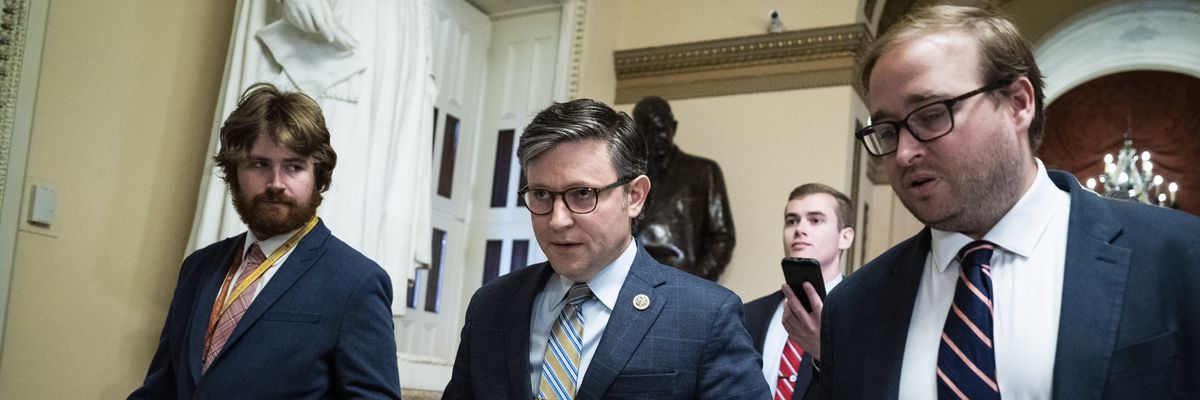
House Speaker Mike Johnson (R-La.) walks to the floor for a vote on Capitol Hill on October 26, 2023 in Washington, D.C.
"The only reason to create a fast-track, closed-door commission is to overthrow the will of the American people by cutting their hard-earned benefits," said Social Security Works president Nancy Altman.
More than 100 organizations, including the largest federation of labor unions in the United States, released a joint letter to members of Congress on Wednesday opposing Republican House Speaker Mike Johnson's push for a "fiscal commission" that opponents warn would fast-track cuts to Social Security.
"The White House has accurately described such a commission as a 'death panel' for Social Security," reads the new letter, which was signed by Social Security Works, the AFL-CIO, the Alliance for Retired Americans, the American Federation of Teachers, and dozens of other groups.
"It is imperative to understand that Social Security does not add a penny to the federal debt," the letter continues. "It has its own dedicated revenue, cannot spend a penny unless it has sufficient dedicated revenue to cover the cost of all benefits and associated administrative costs, and has no borrowing authority."
"Congress should not abdicate its responsibility to make hard choices through regular order by hiding behind a fiscal commission," the letter adds. "Congress already has a process to confront the federal debt. That process is known as reconciliation. Revealingly, Social Security cuts are excluded from the reconciliation procedure, because, as previously stated, the program is totally self-funded, cannot pay benefits or associated costs without the revenue to cover the costs, has no borrowing authority, and, therefore, does not add a penny to the deficit."
The letter was released days after Johnson (La.)—who previously helped craft budget proposals calling for trillions of dollars in cuts to Social Security, Medicare, and Medicaid—pitched the idea of a bipartisan, bicameral fiscal commission to Senate Republicans. According to Johnson, his proposal "was met with great enthusiasm."
Rank-and-file House Republicans have also shown an interest in establishing a commission to propose changes to mandatory spending programs such as Social Security. Last month, the GOP-controlled House Budget Committee held a hearing titled, "Sounding the Alarm: Examining the Need for a Fiscal Commission." In late September, House Republicans approved a continuing resolution that proposed forming such a commission.
The
Koch-tied group FreedomWorks and other right-wing organizations have joined the call for a bipartisan fiscal commission, which is far from an original idea.
In 2021, Sen. Mitt Romney (R-Utah) led a bipartisan group of lawmakers in introducing the TRUST Act, a bill that would establish bipartisan panels with mandates to produce legislation that "improves" the finances of Social Security and other trust fund programs. The legislation would then receive expedited consideration in both chambers of Congress, with no amendments allowed.
Romney's TRUST Act, which resembles more recent fiscal commission proposals, was endorsed by former Sen. Alan Simpson (R-Wyo.) and former White House Chief of Staff Erskine Bowles, who co-chaired the National Commission on Fiscal Responsibility and Reform—commonly known as the Bowles-Simpson Commission.
Formed during the Obama presidency, the panel recommended steep cuts to Social Security benefits that Congress ultimately rejected.
"Congress should address Social Security in the sunlight, through regular order, as it always has."
In their letter on Wednesday, the progressive advocacy coalition noted that some have compared Johnson's proposed fiscal panel to the Greenspan Commission, a body formed in the early 1980s ahead of the 1983 Social Security amendments that raised the retirement age, among other changes.
"However, they are nothing alike," the letter argues. "The Greenspan Commission recommendations were nothing more than recommendations. What was ultimately proposed and considered by Congress went through regular order, with committee hearings and the ability to amend and debate, both in committee and on the floor of both the House and Senate."
A group of individuals who worked as staffers on the Greenspan panel or for its members released a statement Wednesday affirming that point and voicing opposition to the renewed push for a fiscal commission.
"Today's policymakers should not use the Greenspan Commission as the rationale for using a fast-tracked commission to push through highly unpopular and unwise benefit cuts," the statement reads. "With the disappearance of traditional pensions, Social Security is more important than ever."
Nancy Altman, president of Social Security Works and a former top staffer on the Greenspan Commission, said Wednesday that "Congress should address Social Security in the sunlight, through regular order, as it always has."
"The only reason to create a fast-track, closed-door commission is to overthrow the will of the American people by cutting their hard-earned benefits," said Altman. "Anyone who supports this commission is supporting benefit cuts."
Dear Common Dreams reader, It’s been nearly 30 years since I co-founded Common Dreams with my late wife, Lina Newhouser. We had the radical notion that journalism should serve the public good, not corporate profits. It was clear to us from the outset what it would take to build such a project. No paid advertisements. No corporate sponsors. No millionaire publisher telling us what to think or do. Many people said we wouldn't last a year, but we proved those doubters wrong. Together with a tremendous team of journalists and dedicated staff, we built an independent media outlet free from the constraints of profits and corporate control. Our mission has always been simple: To inform. To inspire. To ignite change for the common good. Building Common Dreams was not easy. Our survival was never guaranteed. When you take on the most powerful forces—Wall Street greed, fossil fuel industry destruction, Big Tech lobbyists, and uber-rich oligarchs who have spent billions upon billions rigging the economy and democracy in their favor—the only bulwark you have is supporters who believe in your work. But here’s the urgent message from me today. It's never been this bad out there. And it's never been this hard to keep us going. At the very moment Common Dreams is most needed, the threats we face are intensifying. We need your support now more than ever. We don't accept corporate advertising and never will. We don't have a paywall because we don't think people should be blocked from critical news based on their ability to pay. Everything we do is funded by the donations of readers like you. When everyone does the little they can afford, we are strong. But if that support retreats or dries up, so do we. Will you donate now to make sure Common Dreams not only survives but thrives? —Craig Brown, Co-founder |
More than 100 organizations, including the largest federation of labor unions in the United States, released a joint letter to members of Congress on Wednesday opposing Republican House Speaker Mike Johnson's push for a "fiscal commission" that opponents warn would fast-track cuts to Social Security.
"The White House has accurately described such a commission as a 'death panel' for Social Security," reads the new letter, which was signed by Social Security Works, the AFL-CIO, the Alliance for Retired Americans, the American Federation of Teachers, and dozens of other groups.
"It is imperative to understand that Social Security does not add a penny to the federal debt," the letter continues. "It has its own dedicated revenue, cannot spend a penny unless it has sufficient dedicated revenue to cover the cost of all benefits and associated administrative costs, and has no borrowing authority."
"Congress should not abdicate its responsibility to make hard choices through regular order by hiding behind a fiscal commission," the letter adds. "Congress already has a process to confront the federal debt. That process is known as reconciliation. Revealingly, Social Security cuts are excluded from the reconciliation procedure, because, as previously stated, the program is totally self-funded, cannot pay benefits or associated costs without the revenue to cover the costs, has no borrowing authority, and, therefore, does not add a penny to the deficit."
The letter was released days after Johnson (La.)—who previously helped craft budget proposals calling for trillions of dollars in cuts to Social Security, Medicare, and Medicaid—pitched the idea of a bipartisan, bicameral fiscal commission to Senate Republicans. According to Johnson, his proposal "was met with great enthusiasm."
Rank-and-file House Republicans have also shown an interest in establishing a commission to propose changes to mandatory spending programs such as Social Security. Last month, the GOP-controlled House Budget Committee held a hearing titled, "Sounding the Alarm: Examining the Need for a Fiscal Commission." In late September, House Republicans approved a continuing resolution that proposed forming such a commission.
The
Koch-tied group FreedomWorks and other right-wing organizations have joined the call for a bipartisan fiscal commission, which is far from an original idea.
In 2021, Sen. Mitt Romney (R-Utah) led a bipartisan group of lawmakers in introducing the TRUST Act, a bill that would establish bipartisan panels with mandates to produce legislation that "improves" the finances of Social Security and other trust fund programs. The legislation would then receive expedited consideration in both chambers of Congress, with no amendments allowed.
Romney's TRUST Act, which resembles more recent fiscal commission proposals, was endorsed by former Sen. Alan Simpson (R-Wyo.) and former White House Chief of Staff Erskine Bowles, who co-chaired the National Commission on Fiscal Responsibility and Reform—commonly known as the Bowles-Simpson Commission.
Formed during the Obama presidency, the panel recommended steep cuts to Social Security benefits that Congress ultimately rejected.
"Congress should address Social Security in the sunlight, through regular order, as it always has."
In their letter on Wednesday, the progressive advocacy coalition noted that some have compared Johnson's proposed fiscal panel to the Greenspan Commission, a body formed in the early 1980s ahead of the 1983 Social Security amendments that raised the retirement age, among other changes.
"However, they are nothing alike," the letter argues. "The Greenspan Commission recommendations were nothing more than recommendations. What was ultimately proposed and considered by Congress went through regular order, with committee hearings and the ability to amend and debate, both in committee and on the floor of both the House and Senate."
A group of individuals who worked as staffers on the Greenspan panel or for its members released a statement Wednesday affirming that point and voicing opposition to the renewed push for a fiscal commission.
"Today's policymakers should not use the Greenspan Commission as the rationale for using a fast-tracked commission to push through highly unpopular and unwise benefit cuts," the statement reads. "With the disappearance of traditional pensions, Social Security is more important than ever."
Nancy Altman, president of Social Security Works and a former top staffer on the Greenspan Commission, said Wednesday that "Congress should address Social Security in the sunlight, through regular order, as it always has."
"The only reason to create a fast-track, closed-door commission is to overthrow the will of the American people by cutting their hard-earned benefits," said Altman. "Anyone who supports this commission is supporting benefit cuts."
More than 100 organizations, including the largest federation of labor unions in the United States, released a joint letter to members of Congress on Wednesday opposing Republican House Speaker Mike Johnson's push for a "fiscal commission" that opponents warn would fast-track cuts to Social Security.
"The White House has accurately described such a commission as a 'death panel' for Social Security," reads the new letter, which was signed by Social Security Works, the AFL-CIO, the Alliance for Retired Americans, the American Federation of Teachers, and dozens of other groups.
"It is imperative to understand that Social Security does not add a penny to the federal debt," the letter continues. "It has its own dedicated revenue, cannot spend a penny unless it has sufficient dedicated revenue to cover the cost of all benefits and associated administrative costs, and has no borrowing authority."
"Congress should not abdicate its responsibility to make hard choices through regular order by hiding behind a fiscal commission," the letter adds. "Congress already has a process to confront the federal debt. That process is known as reconciliation. Revealingly, Social Security cuts are excluded from the reconciliation procedure, because, as previously stated, the program is totally self-funded, cannot pay benefits or associated costs without the revenue to cover the costs, has no borrowing authority, and, therefore, does not add a penny to the deficit."
The letter was released days after Johnson (La.)—who previously helped craft budget proposals calling for trillions of dollars in cuts to Social Security, Medicare, and Medicaid—pitched the idea of a bipartisan, bicameral fiscal commission to Senate Republicans. According to Johnson, his proposal "was met with great enthusiasm."
Rank-and-file House Republicans have also shown an interest in establishing a commission to propose changes to mandatory spending programs such as Social Security. Last month, the GOP-controlled House Budget Committee held a hearing titled, "Sounding the Alarm: Examining the Need for a Fiscal Commission." In late September, House Republicans approved a continuing resolution that proposed forming such a commission.
The
Koch-tied group FreedomWorks and other right-wing organizations have joined the call for a bipartisan fiscal commission, which is far from an original idea.
In 2021, Sen. Mitt Romney (R-Utah) led a bipartisan group of lawmakers in introducing the TRUST Act, a bill that would establish bipartisan panels with mandates to produce legislation that "improves" the finances of Social Security and other trust fund programs. The legislation would then receive expedited consideration in both chambers of Congress, with no amendments allowed.
Romney's TRUST Act, which resembles more recent fiscal commission proposals, was endorsed by former Sen. Alan Simpson (R-Wyo.) and former White House Chief of Staff Erskine Bowles, who co-chaired the National Commission on Fiscal Responsibility and Reform—commonly known as the Bowles-Simpson Commission.
Formed during the Obama presidency, the panel recommended steep cuts to Social Security benefits that Congress ultimately rejected.
"Congress should address Social Security in the sunlight, through regular order, as it always has."
In their letter on Wednesday, the progressive advocacy coalition noted that some have compared Johnson's proposed fiscal panel to the Greenspan Commission, a body formed in the early 1980s ahead of the 1983 Social Security amendments that raised the retirement age, among other changes.
"However, they are nothing alike," the letter argues. "The Greenspan Commission recommendations were nothing more than recommendations. What was ultimately proposed and considered by Congress went through regular order, with committee hearings and the ability to amend and debate, both in committee and on the floor of both the House and Senate."
A group of individuals who worked as staffers on the Greenspan panel or for its members released a statement Wednesday affirming that point and voicing opposition to the renewed push for a fiscal commission.
"Today's policymakers should not use the Greenspan Commission as the rationale for using a fast-tracked commission to push through highly unpopular and unwise benefit cuts," the statement reads. "With the disappearance of traditional pensions, Social Security is more important than ever."
Nancy Altman, president of Social Security Works and a former top staffer on the Greenspan Commission, said Wednesday that "Congress should address Social Security in the sunlight, through regular order, as it always has."
"The only reason to create a fast-track, closed-door commission is to overthrow the will of the American people by cutting their hard-earned benefits," said Altman. "Anyone who supports this commission is supporting benefit cuts."