SUBSCRIBE TO OUR FREE NEWSLETTER
Daily news & progressive opinion—funded by the people, not the corporations—delivered straight to your inbox.
5
#000000
#FFFFFF
To donate by check, phone, or other method, see our More Ways to Give page.
Daily news & progressive opinion—funded by the people, not the corporations—delivered straight to your inbox.
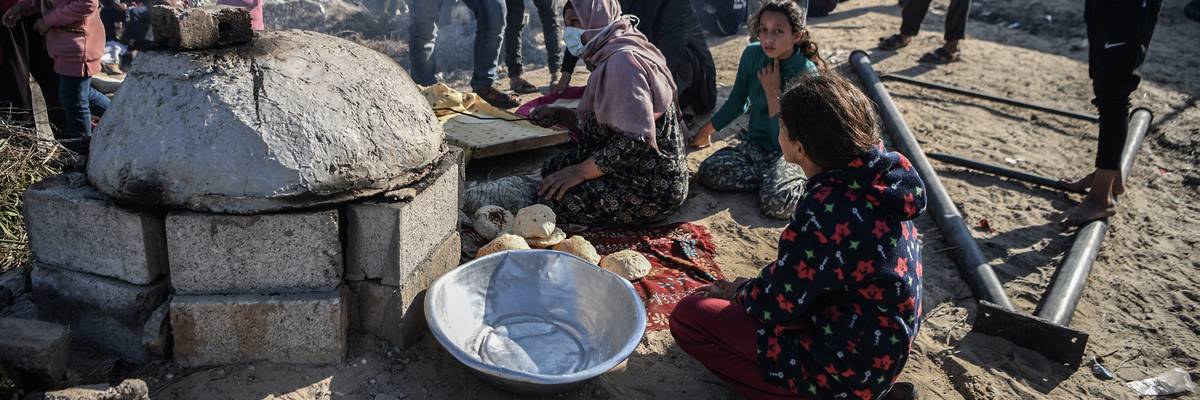
Displaced people prepare food in a clay oven in Rafah, Gaza on December 18, 2023.
"It bars all funding in the pipeline," said one policy expert. "I don't see any other way to read it."
As the United Nations warned Monday that at least a quarter of civilians in Gaza are suffering from "catastrophic" food insecurity and the collapse of the healthcare system is causing disease to spread, the U.S. Senate doubled down on cutting funding for the U.N.'s top humanitarian agency serving Palestinians by including in a bipartisan package a provision that would block aid for the body.
The proposed $118 billion Emergency National Security Supplemental Appropriations Act, chiefly negotiated by Sens. Chris Murphy (D-Conn.), Kyrsten Sinema (I-Ariz.), and James Lankford (R-Okla.) includes $14.1 billion for Israel, which has killed at least 27,468 Palestinians in Gaza and at least 360 in the West Bank since beginning its assault on the occupied territories in October.
But a provision notes that none of the $10 billion in humanitarian assistance for Palestinians and Ukrainians "may be made available for a contribution, grant, or other payment" to the United Nations Relief and Works Agency for Palestine Refugees in the Near East (UNRWA).
Just after the International Court of Justice (ICJ) said in an interim ruling late last month that South Africa's claim that Israel is committing a genocide in Gaza is "plausible," Israel announced it had discovered that 12 of the agency's 13,000 employees in Palestine had been involved in the Hamas-led attack on southern Israel on October 7.
Israeli officials did not provide evidence confirming their allegations, but the announcement was followed by a swift suspension of UNRWA funding by countries including the United States, Canada, Finland, and the United Kingdom—imperiling the donor-supported agency's ability to continue providing shelter, food, sanitation, and other basic services to more than 1 million Palestinians who are sheltering in its facilities in Gaza.
Now, said Lara Friedman, president of the Foundation for Middle East Peace, the proposed package "bars all funding in the pipeline" to UNRWA. "I don't see any other way to read it."
HuffPost reporter Akbar Shahid Ahmed noted that the provision's inclusion in the bill is a "huge concession from Democrats," several of whom proposed amendments to reaffirm the United States' commitment to a two-state solution; to demand that any countries receiving aid through the supplemental package follow "U.S. law, international humanitarian law, and the law of armed conflict"; and to maintain congressional oversight of military aid. None of the amendments were included in the final text.
"Hard-right UNRWA critics are already celebrating this as a big win," said Ahmed.
U.S. State Department spokesperson Vedant Patel confirmed in a briefing that the package in its current form would eliminate U.S. aid to UNRWA and said the government would redirect the agency's aid to other humanitarian bodies including the United Nations Children's Fund and the World Food Program—both of which have condemned Israel's U.S.-backed assault, demanded a cease-fire, and warned that ending funding for UNRWA will "have catastrophic consequences for the people of Gaza" and leave a gap that "no other entity has the capacity" to fill.
Patel told reporters that because the Biden White House is "an administration that follows the law," it would abide by the legislation's ban on UNRWA funding if passed, but sidestepped a question about evidence of Israel's human rights violations—and whether they may ever push the U.S. to stop funding the Israeli military.
Despite the ICJ's finding last month, the U.S. has continued to say it will not change its policies related to Israel.
House Republicans on Monday indicated that they would not pass the Senate's current version of the package, objecting to U.S.-Mexico border funding provisions in the text.
Dear Common Dreams reader, It’s been nearly 30 years since I co-founded Common Dreams with my late wife, Lina Newhouser. We had the radical notion that journalism should serve the public good, not corporate profits. It was clear to us from the outset what it would take to build such a project. No paid advertisements. No corporate sponsors. No millionaire publisher telling us what to think or do. Many people said we wouldn't last a year, but we proved those doubters wrong. Together with a tremendous team of journalists and dedicated staff, we built an independent media outlet free from the constraints of profits and corporate control. Our mission has always been simple: To inform. To inspire. To ignite change for the common good. Building Common Dreams was not easy. Our survival was never guaranteed. When you take on the most powerful forces—Wall Street greed, fossil fuel industry destruction, Big Tech lobbyists, and uber-rich oligarchs who have spent billions upon billions rigging the economy and democracy in their favor—the only bulwark you have is supporters who believe in your work. But here’s the urgent message from me today. It's never been this bad out there. And it's never been this hard to keep us going. At the very moment Common Dreams is most needed, the threats we face are intensifying. We need your support now more than ever. We don't accept corporate advertising and never will. We don't have a paywall because we don't think people should be blocked from critical news based on their ability to pay. Everything we do is funded by the donations of readers like you. When everyone does the little they can afford, we are strong. But if that support retreats or dries up, so do we. Will you donate now to make sure Common Dreams not only survives but thrives? —Craig Brown, Co-founder |
As the United Nations warned Monday that at least a quarter of civilians in Gaza are suffering from "catastrophic" food insecurity and the collapse of the healthcare system is causing disease to spread, the U.S. Senate doubled down on cutting funding for the U.N.'s top humanitarian agency serving Palestinians by including in a bipartisan package a provision that would block aid for the body.
The proposed $118 billion Emergency National Security Supplemental Appropriations Act, chiefly negotiated by Sens. Chris Murphy (D-Conn.), Kyrsten Sinema (I-Ariz.), and James Lankford (R-Okla.) includes $14.1 billion for Israel, which has killed at least 27,468 Palestinians in Gaza and at least 360 in the West Bank since beginning its assault on the occupied territories in October.
But a provision notes that none of the $10 billion in humanitarian assistance for Palestinians and Ukrainians "may be made available for a contribution, grant, or other payment" to the United Nations Relief and Works Agency for Palestine Refugees in the Near East (UNRWA).
Just after the International Court of Justice (ICJ) said in an interim ruling late last month that South Africa's claim that Israel is committing a genocide in Gaza is "plausible," Israel announced it had discovered that 12 of the agency's 13,000 employees in Palestine had been involved in the Hamas-led attack on southern Israel on October 7.
Israeli officials did not provide evidence confirming their allegations, but the announcement was followed by a swift suspension of UNRWA funding by countries including the United States, Canada, Finland, and the United Kingdom—imperiling the donor-supported agency's ability to continue providing shelter, food, sanitation, and other basic services to more than 1 million Palestinians who are sheltering in its facilities in Gaza.
Now, said Lara Friedman, president of the Foundation for Middle East Peace, the proposed package "bars all funding in the pipeline" to UNRWA. "I don't see any other way to read it."
HuffPost reporter Akbar Shahid Ahmed noted that the provision's inclusion in the bill is a "huge concession from Democrats," several of whom proposed amendments to reaffirm the United States' commitment to a two-state solution; to demand that any countries receiving aid through the supplemental package follow "U.S. law, international humanitarian law, and the law of armed conflict"; and to maintain congressional oversight of military aid. None of the amendments were included in the final text.
"Hard-right UNRWA critics are already celebrating this as a big win," said Ahmed.
U.S. State Department spokesperson Vedant Patel confirmed in a briefing that the package in its current form would eliminate U.S. aid to UNRWA and said the government would redirect the agency's aid to other humanitarian bodies including the United Nations Children's Fund and the World Food Program—both of which have condemned Israel's U.S.-backed assault, demanded a cease-fire, and warned that ending funding for UNRWA will "have catastrophic consequences for the people of Gaza" and leave a gap that "no other entity has the capacity" to fill.
Patel told reporters that because the Biden White House is "an administration that follows the law," it would abide by the legislation's ban on UNRWA funding if passed, but sidestepped a question about evidence of Israel's human rights violations—and whether they may ever push the U.S. to stop funding the Israeli military.
Despite the ICJ's finding last month, the U.S. has continued to say it will not change its policies related to Israel.
House Republicans on Monday indicated that they would not pass the Senate's current version of the package, objecting to U.S.-Mexico border funding provisions in the text.
As the United Nations warned Monday that at least a quarter of civilians in Gaza are suffering from "catastrophic" food insecurity and the collapse of the healthcare system is causing disease to spread, the U.S. Senate doubled down on cutting funding for the U.N.'s top humanitarian agency serving Palestinians by including in a bipartisan package a provision that would block aid for the body.
The proposed $118 billion Emergency National Security Supplemental Appropriations Act, chiefly negotiated by Sens. Chris Murphy (D-Conn.), Kyrsten Sinema (I-Ariz.), and James Lankford (R-Okla.) includes $14.1 billion for Israel, which has killed at least 27,468 Palestinians in Gaza and at least 360 in the West Bank since beginning its assault on the occupied territories in October.
But a provision notes that none of the $10 billion in humanitarian assistance for Palestinians and Ukrainians "may be made available for a contribution, grant, or other payment" to the United Nations Relief and Works Agency for Palestine Refugees in the Near East (UNRWA).
Just after the International Court of Justice (ICJ) said in an interim ruling late last month that South Africa's claim that Israel is committing a genocide in Gaza is "plausible," Israel announced it had discovered that 12 of the agency's 13,000 employees in Palestine had been involved in the Hamas-led attack on southern Israel on October 7.
Israeli officials did not provide evidence confirming their allegations, but the announcement was followed by a swift suspension of UNRWA funding by countries including the United States, Canada, Finland, and the United Kingdom—imperiling the donor-supported agency's ability to continue providing shelter, food, sanitation, and other basic services to more than 1 million Palestinians who are sheltering in its facilities in Gaza.
Now, said Lara Friedman, president of the Foundation for Middle East Peace, the proposed package "bars all funding in the pipeline" to UNRWA. "I don't see any other way to read it."
HuffPost reporter Akbar Shahid Ahmed noted that the provision's inclusion in the bill is a "huge concession from Democrats," several of whom proposed amendments to reaffirm the United States' commitment to a two-state solution; to demand that any countries receiving aid through the supplemental package follow "U.S. law, international humanitarian law, and the law of armed conflict"; and to maintain congressional oversight of military aid. None of the amendments were included in the final text.
"Hard-right UNRWA critics are already celebrating this as a big win," said Ahmed.
U.S. State Department spokesperson Vedant Patel confirmed in a briefing that the package in its current form would eliminate U.S. aid to UNRWA and said the government would redirect the agency's aid to other humanitarian bodies including the United Nations Children's Fund and the World Food Program—both of which have condemned Israel's U.S.-backed assault, demanded a cease-fire, and warned that ending funding for UNRWA will "have catastrophic consequences for the people of Gaza" and leave a gap that "no other entity has the capacity" to fill.
Patel told reporters that because the Biden White House is "an administration that follows the law," it would abide by the legislation's ban on UNRWA funding if passed, but sidestepped a question about evidence of Israel's human rights violations—and whether they may ever push the U.S. to stop funding the Israeli military.
Despite the ICJ's finding last month, the U.S. has continued to say it will not change its policies related to Israel.
House Republicans on Monday indicated that they would not pass the Senate's current version of the package, objecting to U.S.-Mexico border funding provisions in the text.