

SUBSCRIBE TO OUR FREE NEWSLETTER
Daily news & progressive opinion—funded by the people, not the corporations—delivered straight to your inbox.
5
#000000
#FFFFFF
To donate by check, phone, or other method, see our More Ways to Give page.
Daily news & progressive opinion—funded by the people, not the corporations—delivered straight to your inbox.
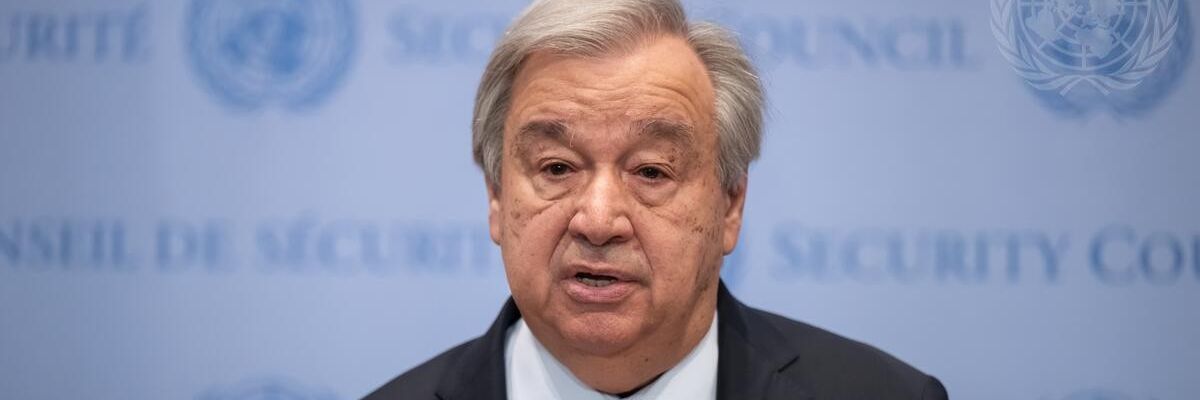
U.N. Secretary-General António Guterres speaks to the press about Russia's termination of the Black Sea Grain Initiative.
"Today's decision by the Russian Federation will strike a blow to people in need everywhere," said U.N. Secretary-General António Guterres.
United Nations Secretary-General António Guterres on Monday condemned Russia's decision to withdraw from a deal enabling Ukraine to export grain from Black Sea ports—an effort that has significantly lowered global food prices and whose termination is expected to compound a worsening hunger crisis.
The so-called Black Sea Grain Initiative was brokered by the U.N. and Turkey and agreed to by Moscow and Kyiv last July. Since then, it has facilitated the shipment of more than 32 million metric tons of food from Ukrainian ports, Guterres said. He noted that at least 725,000 tons have been used by the World Food Program to support humanitarian operations—alleviating hunger in some of the most poverty-stricken and war-torn parts of the world, including Afghanistan, the Horn of Africa, and Yemen.
That accord was finalized alongside a parallel memorandum of understanding between the U.N. and Moscow on easing exports of Russian grain and fertilizer.
Both pacts "have been a lifeline for global food security and a beacon of hope in a troubled world," said Guterres. "At a time when the production and availability of food is being disrupted by conflict, climate change, energy prices, and more, these agreements have helped to reduce food prices by over 23% since March last year."
"Ultimately, participation in these agreements is a choice. But struggling people everywhere and developing countries don't have a choice," the U.N. chief continued. "Hundreds of millions of people face hunger and consumers are confronting a global cost-of-living crisis. They will pay the price."
As Guterres pointed out, the price of wheat jumped in response to Monday's news. Meanwhile, a U.N. report published last week showed that Russia's invasion of Ukraine, other wars, the Covid-19 pandemic, and the fossil fuel-driven climate crisis have pushed an additional 122 million people into hunger worldwide since 2019, with an estimated 735 million people suffering from a lack of food as of last year.
"Today's decision by the Russian Federation will strike a blow to people in need everywhere," Guterres lamented. "But it will not stop our efforts to facilitate the unimpeded access to global markets for food products and fertilizers from both Ukraine and the Russian Federation."
"Looking ahead, our goal must continue to be advancing global food security and global food price stability," said the U.N. chief. "This will remain the focus of my efforts, taking into account the rise in human suffering that will inevitably result from today's decision."
The Black Sea Grain Initiative is set to end on Tuesday despite weeks of negotiations aimed at prolonging it.
Moscow's suspension of the accord came just hours after Ukraine attacked a key bridge that Russia uses to supply its troops in Crimea, killing two civilians and injuring their 14-year-old daughter.
But Russia said its decision to resume its military blockade on Ukrainian grain exports had nothing to do with the attack.
"Unfortunately, the part of these Black Sea agreements concerning Russia has not been implemented so far, so its effect is terminated," Kremlin spokesman Dmitry Peskov told reporters, referring to the memorandum of understanding between Moscow and the U.N.
As U.N. News reported:
Mr. Guterres said he was aware of obstacles that remained in the foreign trade of Russian food and fertilizer products and that he had written to President Vladimir Putin with a new proposal to keep the Black Sea Initiative alive.
Quoting extensively from the letter, he noted that since the signing of the memorandum of understanding, and measures adopted by the government, Russia's grain trade had achieved high export volumes and fertilizer markets were stabilizing, with Russian exports nearing full recovery.
The letter also outlined U.N. action to facilitate trade amid sanctions against Russia, such as securing licenses from the United States, the United Kingdom, and the European Union, and providing clarifications and guidance to the private sector.
The secretary-general's letter also explained how the U.N. has worked to find "dedicated solutions" across the banking and private sectors, which included building a "bespoke payments mechanism" for the Russian Agricultural Bank outside the SWIFT international banking network.
The continued disconnection of Russia's agricultural bank from the SWIFT international payments system remains a key sticking point.
"As soon as the Russian part of the agreements is fulfilled, the Russian side will return to the implementation of this deal immediately," said Peskov.
Dear Common Dreams reader, It’s been nearly 30 years since I co-founded Common Dreams with my late wife, Lina Newhouser. We had the radical notion that journalism should serve the public good, not corporate profits. It was clear to us from the outset what it would take to build such a project. No paid advertisements. No corporate sponsors. No millionaire publisher telling us what to think or do. Many people said we wouldn't last a year, but we proved those doubters wrong. Together with a tremendous team of journalists and dedicated staff, we built an independent media outlet free from the constraints of profits and corporate control. Our mission has always been simple: To inform. To inspire. To ignite change for the common good. Building Common Dreams was not easy. Our survival was never guaranteed. When you take on the most powerful forces—Wall Street greed, fossil fuel industry destruction, Big Tech lobbyists, and uber-rich oligarchs who have spent billions upon billions rigging the economy and democracy in their favor—the only bulwark you have is supporters who believe in your work. But here’s the urgent message from me today. It's never been this bad out there. And it's never been this hard to keep us going. At the very moment Common Dreams is most needed, the threats we face are intensifying. We need your support now more than ever. We don't accept corporate advertising and never will. We don't have a paywall because we don't think people should be blocked from critical news based on their ability to pay. Everything we do is funded by the donations of readers like you. When everyone does the little they can afford, we are strong. But if that support retreats or dries up, so do we. Will you donate now to make sure Common Dreams not only survives but thrives? —Craig Brown, Co-founder |
United Nations Secretary-General António Guterres on Monday condemned Russia's decision to withdraw from a deal enabling Ukraine to export grain from Black Sea ports—an effort that has significantly lowered global food prices and whose termination is expected to compound a worsening hunger crisis.
The so-called Black Sea Grain Initiative was brokered by the U.N. and Turkey and agreed to by Moscow and Kyiv last July. Since then, it has facilitated the shipment of more than 32 million metric tons of food from Ukrainian ports, Guterres said. He noted that at least 725,000 tons have been used by the World Food Program to support humanitarian operations—alleviating hunger in some of the most poverty-stricken and war-torn parts of the world, including Afghanistan, the Horn of Africa, and Yemen.
That accord was finalized alongside a parallel memorandum of understanding between the U.N. and Moscow on easing exports of Russian grain and fertilizer.
Both pacts "have been a lifeline for global food security and a beacon of hope in a troubled world," said Guterres. "At a time when the production and availability of food is being disrupted by conflict, climate change, energy prices, and more, these agreements have helped to reduce food prices by over 23% since March last year."
"Ultimately, participation in these agreements is a choice. But struggling people everywhere and developing countries don't have a choice," the U.N. chief continued. "Hundreds of millions of people face hunger and consumers are confronting a global cost-of-living crisis. They will pay the price."
As Guterres pointed out, the price of wheat jumped in response to Monday's news. Meanwhile, a U.N. report published last week showed that Russia's invasion of Ukraine, other wars, the Covid-19 pandemic, and the fossil fuel-driven climate crisis have pushed an additional 122 million people into hunger worldwide since 2019, with an estimated 735 million people suffering from a lack of food as of last year.
"Today's decision by the Russian Federation will strike a blow to people in need everywhere," Guterres lamented. "But it will not stop our efforts to facilitate the unimpeded access to global markets for food products and fertilizers from both Ukraine and the Russian Federation."
"Looking ahead, our goal must continue to be advancing global food security and global food price stability," said the U.N. chief. "This will remain the focus of my efforts, taking into account the rise in human suffering that will inevitably result from today's decision."
The Black Sea Grain Initiative is set to end on Tuesday despite weeks of negotiations aimed at prolonging it.
Moscow's suspension of the accord came just hours after Ukraine attacked a key bridge that Russia uses to supply its troops in Crimea, killing two civilians and injuring their 14-year-old daughter.
But Russia said its decision to resume its military blockade on Ukrainian grain exports had nothing to do with the attack.
"Unfortunately, the part of these Black Sea agreements concerning Russia has not been implemented so far, so its effect is terminated," Kremlin spokesman Dmitry Peskov told reporters, referring to the memorandum of understanding between Moscow and the U.N.
As U.N. News reported:
Mr. Guterres said he was aware of obstacles that remained in the foreign trade of Russian food and fertilizer products and that he had written to President Vladimir Putin with a new proposal to keep the Black Sea Initiative alive.
Quoting extensively from the letter, he noted that since the signing of the memorandum of understanding, and measures adopted by the government, Russia's grain trade had achieved high export volumes and fertilizer markets were stabilizing, with Russian exports nearing full recovery.
The letter also outlined U.N. action to facilitate trade amid sanctions against Russia, such as securing licenses from the United States, the United Kingdom, and the European Union, and providing clarifications and guidance to the private sector.
The secretary-general's letter also explained how the U.N. has worked to find "dedicated solutions" across the banking and private sectors, which included building a "bespoke payments mechanism" for the Russian Agricultural Bank outside the SWIFT international banking network.
The continued disconnection of Russia's agricultural bank from the SWIFT international payments system remains a key sticking point.
"As soon as the Russian part of the agreements is fulfilled, the Russian side will return to the implementation of this deal immediately," said Peskov.
United Nations Secretary-General António Guterres on Monday condemned Russia's decision to withdraw from a deal enabling Ukraine to export grain from Black Sea ports—an effort that has significantly lowered global food prices and whose termination is expected to compound a worsening hunger crisis.
The so-called Black Sea Grain Initiative was brokered by the U.N. and Turkey and agreed to by Moscow and Kyiv last July. Since then, it has facilitated the shipment of more than 32 million metric tons of food from Ukrainian ports, Guterres said. He noted that at least 725,000 tons have been used by the World Food Program to support humanitarian operations—alleviating hunger in some of the most poverty-stricken and war-torn parts of the world, including Afghanistan, the Horn of Africa, and Yemen.
That accord was finalized alongside a parallel memorandum of understanding between the U.N. and Moscow on easing exports of Russian grain and fertilizer.
Both pacts "have been a lifeline for global food security and a beacon of hope in a troubled world," said Guterres. "At a time when the production and availability of food is being disrupted by conflict, climate change, energy prices, and more, these agreements have helped to reduce food prices by over 23% since March last year."
"Ultimately, participation in these agreements is a choice. But struggling people everywhere and developing countries don't have a choice," the U.N. chief continued. "Hundreds of millions of people face hunger and consumers are confronting a global cost-of-living crisis. They will pay the price."
As Guterres pointed out, the price of wheat jumped in response to Monday's news. Meanwhile, a U.N. report published last week showed that Russia's invasion of Ukraine, other wars, the Covid-19 pandemic, and the fossil fuel-driven climate crisis have pushed an additional 122 million people into hunger worldwide since 2019, with an estimated 735 million people suffering from a lack of food as of last year.
"Today's decision by the Russian Federation will strike a blow to people in need everywhere," Guterres lamented. "But it will not stop our efforts to facilitate the unimpeded access to global markets for food products and fertilizers from both Ukraine and the Russian Federation."
"Looking ahead, our goal must continue to be advancing global food security and global food price stability," said the U.N. chief. "This will remain the focus of my efforts, taking into account the rise in human suffering that will inevitably result from today's decision."
The Black Sea Grain Initiative is set to end on Tuesday despite weeks of negotiations aimed at prolonging it.
Moscow's suspension of the accord came just hours after Ukraine attacked a key bridge that Russia uses to supply its troops in Crimea, killing two civilians and injuring their 14-year-old daughter.
But Russia said its decision to resume its military blockade on Ukrainian grain exports had nothing to do with the attack.
"Unfortunately, the part of these Black Sea agreements concerning Russia has not been implemented so far, so its effect is terminated," Kremlin spokesman Dmitry Peskov told reporters, referring to the memorandum of understanding between Moscow and the U.N.
As U.N. News reported:
Mr. Guterres said he was aware of obstacles that remained in the foreign trade of Russian food and fertilizer products and that he had written to President Vladimir Putin with a new proposal to keep the Black Sea Initiative alive.
Quoting extensively from the letter, he noted that since the signing of the memorandum of understanding, and measures adopted by the government, Russia's grain trade had achieved high export volumes and fertilizer markets were stabilizing, with Russian exports nearing full recovery.
The letter also outlined U.N. action to facilitate trade amid sanctions against Russia, such as securing licenses from the United States, the United Kingdom, and the European Union, and providing clarifications and guidance to the private sector.
The secretary-general's letter also explained how the U.N. has worked to find "dedicated solutions" across the banking and private sectors, which included building a "bespoke payments mechanism" for the Russian Agricultural Bank outside the SWIFT international banking network.
The continued disconnection of Russia's agricultural bank from the SWIFT international payments system remains a key sticking point.
"As soon as the Russian part of the agreements is fulfilled, the Russian side will return to the implementation of this deal immediately," said Peskov.

