SUBSCRIBE TO OUR FREE NEWSLETTER
Daily news & progressive opinion—funded by the people, not the corporations—delivered straight to your inbox.
5
#000000
#FFFFFF
To donate by check, phone, or other method, see our More Ways to Give page.
Daily news & progressive opinion—funded by the people, not the corporations—delivered straight to your inbox.
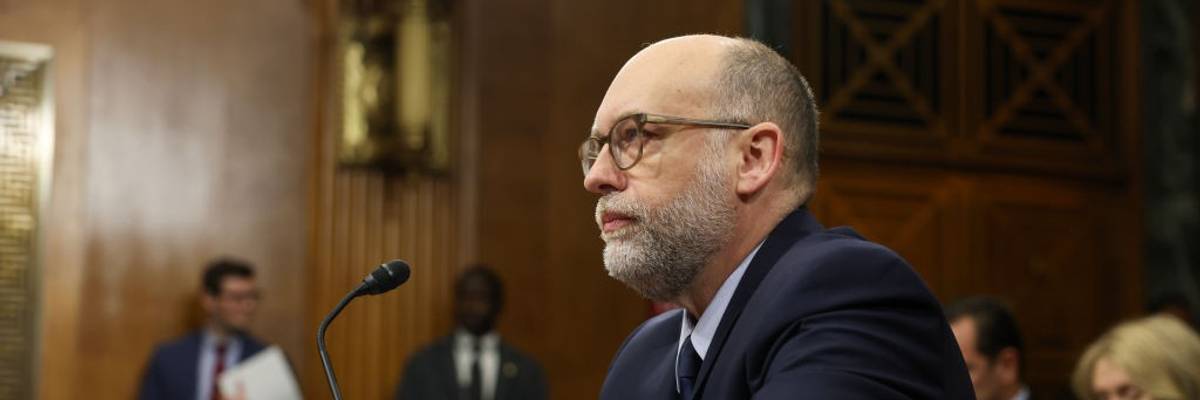
Russ Vought, U.S. President Donald Trump's nominee to lead the Office of Management and Budget, testifies before the Senate Budget Committee on January 22, 2025.
Russ Vought, an architect of Project 2025, said he's "very proud" of Clinton-era welfare reform that devastated some of the nation's most vulnerable people.
U.S. President Donald Trump's pick to lead the Office of Management and Budget told lawmakers Wednesday that he's "proud" of the impacts of Clinton-era welfare reform, a Republican-backed legislative change that doubled extreme poverty by stripping government support from some of the nation's most vulnerable people—including children with disabilities.
Pressed on his record of advocating work requirements for Medicaid recipients, Project 2025 architect Russ Vought told members of the Senate Budget Committee that "one of the major legislations that our side has been very proud of since the 1990s was the impact of welfare reform" and suggested it should be a model for the Trump administration to apply to other federal programs going forward.
"It led to caseload reductions, people getting off of welfare, going back into the workforce," Vought said of the 1996 reform, neglecting to mention research showing that the law resulted in an explosion of extreme poverty as people were often unable to find jobs after losing benefits.
In response to Vought's remarks, Sen. Jeff Merkley (D-Ore.) noted that Arkansas' temporary imposition of work requirements on Medicaid recipients—with a green light from the first Trump administration—was a "failed experiment," with thousands losing health coverage without any significant increase in employment.
Watch the exchange:
At @SenateBudget confirmation hearing, Russell Vought says he's "very proud" of his plans to take Medicaid away from people who can't work.@SenJeffMerkley tells Vought this would trap Americans in poverty: "The way that people are able to work is when they're healthy". pic.twitter.com/3GmaVwmnVo
— Social Security Works (@SSWorks) January 22, 2025
Later in Wednesday's hearing, Vought—a longtime supporter of Medicaid cuts—said that "we need to go after the mandatory programs," a category that includes Social Security, Medicare, Medicaid, and the Supplemental Nutrition Assistance Program.
Republicans in Congress have reportedly discussed cutting trillions of dollars from Medicaid to help pay for another round of tax cuts that would disproportionately benefit the wealthiest Americans.
During his time questioning Vought on Wednesday, Sen. Ron Wyden (D-Ore.) said that "the distillation of the Trump economic program is to give tax breaks to all the people at the top, and it's gonna be paid for by" cuts to Medicaid and federal nutrition assistance.
"We would not characterize our economic program that way," Vought replied.
Dear Common Dreams reader, It’s been nearly 30 years since I co-founded Common Dreams with my late wife, Lina Newhouser. We had the radical notion that journalism should serve the public good, not corporate profits. It was clear to us from the outset what it would take to build such a project. No paid advertisements. No corporate sponsors. No millionaire publisher telling us what to think or do. Many people said we wouldn't last a year, but we proved those doubters wrong. Together with a tremendous team of journalists and dedicated staff, we built an independent media outlet free from the constraints of profits and corporate control. Our mission has always been simple: To inform. To inspire. To ignite change for the common good. Building Common Dreams was not easy. Our survival was never guaranteed. When you take on the most powerful forces—Wall Street greed, fossil fuel industry destruction, Big Tech lobbyists, and uber-rich oligarchs who have spent billions upon billions rigging the economy and democracy in their favor—the only bulwark you have is supporters who believe in your work. But here’s the urgent message from me today. It's never been this bad out there. And it's never been this hard to keep us going. At the very moment Common Dreams is most needed, the threats we face are intensifying. We need your support now more than ever. We don't accept corporate advertising and never will. We don't have a paywall because we don't think people should be blocked from critical news based on their ability to pay. Everything we do is funded by the donations of readers like you. When everyone does the little they can afford, we are strong. But if that support retreats or dries up, so do we. Will you donate now to make sure Common Dreams not only survives but thrives? —Craig Brown, Co-founder |
U.S. President Donald Trump's pick to lead the Office of Management and Budget told lawmakers Wednesday that he's "proud" of the impacts of Clinton-era welfare reform, a Republican-backed legislative change that doubled extreme poverty by stripping government support from some of the nation's most vulnerable people—including children with disabilities.
Pressed on his record of advocating work requirements for Medicaid recipients, Project 2025 architect Russ Vought told members of the Senate Budget Committee that "one of the major legislations that our side has been very proud of since the 1990s was the impact of welfare reform" and suggested it should be a model for the Trump administration to apply to other federal programs going forward.
"It led to caseload reductions, people getting off of welfare, going back into the workforce," Vought said of the 1996 reform, neglecting to mention research showing that the law resulted in an explosion of extreme poverty as people were often unable to find jobs after losing benefits.
In response to Vought's remarks, Sen. Jeff Merkley (D-Ore.) noted that Arkansas' temporary imposition of work requirements on Medicaid recipients—with a green light from the first Trump administration—was a "failed experiment," with thousands losing health coverage without any significant increase in employment.
Watch the exchange:
At @SenateBudget confirmation hearing, Russell Vought says he's "very proud" of his plans to take Medicaid away from people who can't work.@SenJeffMerkley tells Vought this would trap Americans in poverty: "The way that people are able to work is when they're healthy". pic.twitter.com/3GmaVwmnVo
— Social Security Works (@SSWorks) January 22, 2025
Later in Wednesday's hearing, Vought—a longtime supporter of Medicaid cuts—said that "we need to go after the mandatory programs," a category that includes Social Security, Medicare, Medicaid, and the Supplemental Nutrition Assistance Program.
Republicans in Congress have reportedly discussed cutting trillions of dollars from Medicaid to help pay for another round of tax cuts that would disproportionately benefit the wealthiest Americans.
During his time questioning Vought on Wednesday, Sen. Ron Wyden (D-Ore.) said that "the distillation of the Trump economic program is to give tax breaks to all the people at the top, and it's gonna be paid for by" cuts to Medicaid and federal nutrition assistance.
"We would not characterize our economic program that way," Vought replied.
U.S. President Donald Trump's pick to lead the Office of Management and Budget told lawmakers Wednesday that he's "proud" of the impacts of Clinton-era welfare reform, a Republican-backed legislative change that doubled extreme poverty by stripping government support from some of the nation's most vulnerable people—including children with disabilities.
Pressed on his record of advocating work requirements for Medicaid recipients, Project 2025 architect Russ Vought told members of the Senate Budget Committee that "one of the major legislations that our side has been very proud of since the 1990s was the impact of welfare reform" and suggested it should be a model for the Trump administration to apply to other federal programs going forward.
"It led to caseload reductions, people getting off of welfare, going back into the workforce," Vought said of the 1996 reform, neglecting to mention research showing that the law resulted in an explosion of extreme poverty as people were often unable to find jobs after losing benefits.
In response to Vought's remarks, Sen. Jeff Merkley (D-Ore.) noted that Arkansas' temporary imposition of work requirements on Medicaid recipients—with a green light from the first Trump administration—was a "failed experiment," with thousands losing health coverage without any significant increase in employment.
Watch the exchange:
At @SenateBudget confirmation hearing, Russell Vought says he's "very proud" of his plans to take Medicaid away from people who can't work.@SenJeffMerkley tells Vought this would trap Americans in poverty: "The way that people are able to work is when they're healthy". pic.twitter.com/3GmaVwmnVo
— Social Security Works (@SSWorks) January 22, 2025
Later in Wednesday's hearing, Vought—a longtime supporter of Medicaid cuts—said that "we need to go after the mandatory programs," a category that includes Social Security, Medicare, Medicaid, and the Supplemental Nutrition Assistance Program.
Republicans in Congress have reportedly discussed cutting trillions of dollars from Medicaid to help pay for another round of tax cuts that would disproportionately benefit the wealthiest Americans.
During his time questioning Vought on Wednesday, Sen. Ron Wyden (D-Ore.) said that "the distillation of the Trump economic program is to give tax breaks to all the people at the top, and it's gonna be paid for by" cuts to Medicaid and federal nutrition assistance.
"We would not characterize our economic program that way," Vought replied.