SUBSCRIBE TO OUR FREE NEWSLETTER
Daily news & progressive opinion—funded by the people, not the corporations—delivered straight to your inbox.
5
#000000
#FFFFFF
To donate by check, phone, or other method, see our More Ways to Give page.
Daily news & progressive opinion—funded by the people, not the corporations—delivered straight to your inbox.
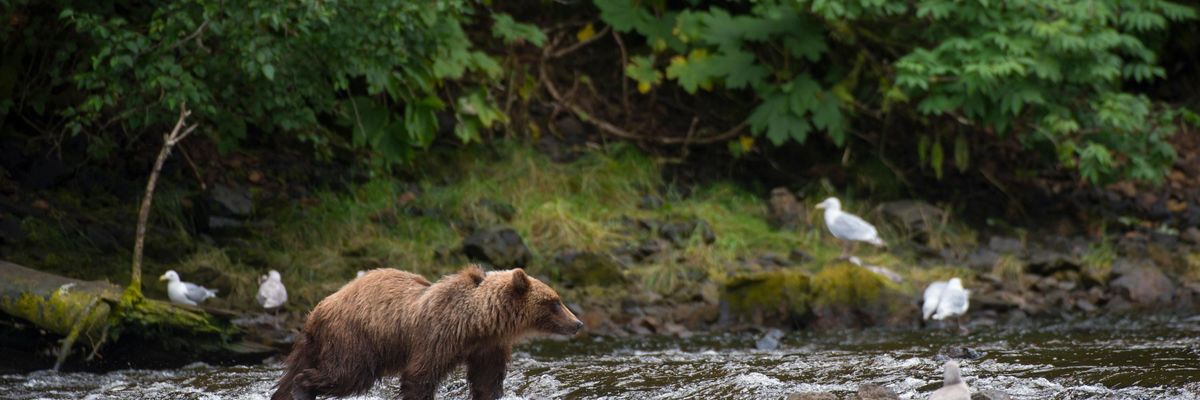
A brown bear fishes for salmon in a creek at Pavlof Harbor in Chatham Strait, Tongass National Forest in Alaska.
"This is great news for the forest, the salmon, the wildlife, and the people who depend on intact ecosystems to support their ways of life and livelihoods," said one advocate.
Indigenous and green groups on Wednesday applauded the Biden administration for reinstating protections for millions of acres of wilderness in Alaska's Tongass National Forest that were lifted during a Trump-era regulatory rollback spree.
The United States Department of Agriculture (USDA) announced Wednesday that it has finalized protections for the Tongass National Forest by restoring "longstanding roadless protections to 9.37 million acres of roadless areas that support the ecological, economic, and cultural values of Southeastern Alaska."
The Roadless Rule was established in 2001 to protect wilderness areas in U.S. national forests from roads and logging. The administration of former President Donald Trump rescinded the rule in 2020 amid a flurry of regulatory rollbacks, prompting a lawsuit from a coalition of Indigenous, conservation, and business organizations. The Biden administration subsequently committed to reviving the Roadless Rule in 2021.
"As our nation's largest national forest and the largest intact temperate rainforest in the world, the Tongass National Forest is key to conserving biodiversity and addressing the climate crisis," U.S. Agriculture Secretary Tom Vilsack said in a statement Wednesday. "Restoring roadless protections listens to the voices of tribal nations and the people of Southeast Alaska while recognizing the importance of fishing and tourism to the region's economy."
According to the advocacy group Defenders of Wildlife:
The Tongass contains rare expanses of pristine old-growth forest and as many as 17,000 miles of creeks, rivers, and lakes. These waters abound with all five species of Pacific salmon, which anchor the economy of Southeast Alaska. Approximately 1 million visitors come from all over the U.S. and internationally each year to see its glaciers, old-growth forests, and abundant wildlife.
The Tongass supports an incredible array of biodiversity and is home to the Alexander Archipelago wolf, brown bears, bald eagles, northern goshawks, and Pacific marten, among others. The Tongass is also one of the world's largest carbon reservoirs, storing the equivalent of about 8% of the carbon stored in all the U.S. forests combined. In addition, a broad coalition of tribal leaders, outdoor recreation businesses, and conservationists in Southeast Alaska have fought to preserve the region's remaining cedar, hemlock, and Sitka spruce trees.
"The restoration of National Roadless Rule protections for the Tongass National Forest is a great first step in honoring the voices of the many tribal governments and tribal citizens who spoke out in favor of Roadless Rule protections for the Tongass," said Naawéiyaa Tagaban, the environmental justice strategy lead at Native Movement. "We are grateful to the Biden administration for taking this first step toward long-term protections for the Tongass. We hope that going forward true long-term protections will be established that do not rely on a rule which can be changed at the whim of a presidential administration."
"The administration must look to tribal sovereignty and Indigenous stewardship as the true long-term solution for protections in the Tongass," Tagaban added. "Tlingit, Haida, and Tsimshian people have lived in and managed the Tongass national forest for generations; true protections will look like the restoration of lands into Indigenous ownership."
Kate Glover, senior attorney at EarthJustice, said her group applauds the Forest Service "for making good on its commitment to tribes and to the climate by restoring the Roadless Rule across the Tongass. This is great news for the forest, the salmon, the wildlife, and the people who depend on intact ecosystems to support their ways of life and livelihoods."
Teague Whalen, who owns Tongass Teague, asserted that "there are two uncompromising realities for the survival of life on this planet: clean air and clean water."
"My hiking tours into the Tongass begin at the literal end of our road, where the Roadless Rule reinstatement will ensure that the Tongass can continue to be a lasting carbon sink," Whalen added.
Dear Common Dreams reader, It’s been nearly 30 years since I co-founded Common Dreams with my late wife, Lina Newhouser. We had the radical notion that journalism should serve the public good, not corporate profits. It was clear to us from the outset what it would take to build such a project. No paid advertisements. No corporate sponsors. No millionaire publisher telling us what to think or do. Many people said we wouldn't last a year, but we proved those doubters wrong. Together with a tremendous team of journalists and dedicated staff, we built an independent media outlet free from the constraints of profits and corporate control. Our mission has always been simple: To inform. To inspire. To ignite change for the common good. Building Common Dreams was not easy. Our survival was never guaranteed. When you take on the most powerful forces—Wall Street greed, fossil fuel industry destruction, Big Tech lobbyists, and uber-rich oligarchs who have spent billions upon billions rigging the economy and democracy in their favor—the only bulwark you have is supporters who believe in your work. But here’s the urgent message from me today. It's never been this bad out there. And it's never been this hard to keep us going. At the very moment Common Dreams is most needed, the threats we face are intensifying. We need your support now more than ever. We don't accept corporate advertising and never will. We don't have a paywall because we don't think people should be blocked from critical news based on their ability to pay. Everything we do is funded by the donations of readers like you. When everyone does the little they can afford, we are strong. But if that support retreats or dries up, so do we. Will you donate now to make sure Common Dreams not only survives but thrives? —Craig Brown, Co-founder |
Indigenous and green groups on Wednesday applauded the Biden administration for reinstating protections for millions of acres of wilderness in Alaska's Tongass National Forest that were lifted during a Trump-era regulatory rollback spree.
The United States Department of Agriculture (USDA) announced Wednesday that it has finalized protections for the Tongass National Forest by restoring "longstanding roadless protections to 9.37 million acres of roadless areas that support the ecological, economic, and cultural values of Southeastern Alaska."
The Roadless Rule was established in 2001 to protect wilderness areas in U.S. national forests from roads and logging. The administration of former President Donald Trump rescinded the rule in 2020 amid a flurry of regulatory rollbacks, prompting a lawsuit from a coalition of Indigenous, conservation, and business organizations. The Biden administration subsequently committed to reviving the Roadless Rule in 2021.
"As our nation's largest national forest and the largest intact temperate rainforest in the world, the Tongass National Forest is key to conserving biodiversity and addressing the climate crisis," U.S. Agriculture Secretary Tom Vilsack said in a statement Wednesday. "Restoring roadless protections listens to the voices of tribal nations and the people of Southeast Alaska while recognizing the importance of fishing and tourism to the region's economy."
According to the advocacy group Defenders of Wildlife:
The Tongass contains rare expanses of pristine old-growth forest and as many as 17,000 miles of creeks, rivers, and lakes. These waters abound with all five species of Pacific salmon, which anchor the economy of Southeast Alaska. Approximately 1 million visitors come from all over the U.S. and internationally each year to see its glaciers, old-growth forests, and abundant wildlife.
The Tongass supports an incredible array of biodiversity and is home to the Alexander Archipelago wolf, brown bears, bald eagles, northern goshawks, and Pacific marten, among others. The Tongass is also one of the world's largest carbon reservoirs, storing the equivalent of about 8% of the carbon stored in all the U.S. forests combined. In addition, a broad coalition of tribal leaders, outdoor recreation businesses, and conservationists in Southeast Alaska have fought to preserve the region's remaining cedar, hemlock, and Sitka spruce trees.
"The restoration of National Roadless Rule protections for the Tongass National Forest is a great first step in honoring the voices of the many tribal governments and tribal citizens who spoke out in favor of Roadless Rule protections for the Tongass," said Naawéiyaa Tagaban, the environmental justice strategy lead at Native Movement. "We are grateful to the Biden administration for taking this first step toward long-term protections for the Tongass. We hope that going forward true long-term protections will be established that do not rely on a rule which can be changed at the whim of a presidential administration."
"The administration must look to tribal sovereignty and Indigenous stewardship as the true long-term solution for protections in the Tongass," Tagaban added. "Tlingit, Haida, and Tsimshian people have lived in and managed the Tongass national forest for generations; true protections will look like the restoration of lands into Indigenous ownership."
Kate Glover, senior attorney at EarthJustice, said her group applauds the Forest Service "for making good on its commitment to tribes and to the climate by restoring the Roadless Rule across the Tongass. This is great news for the forest, the salmon, the wildlife, and the people who depend on intact ecosystems to support their ways of life and livelihoods."
Teague Whalen, who owns Tongass Teague, asserted that "there are two uncompromising realities for the survival of life on this planet: clean air and clean water."
"My hiking tours into the Tongass begin at the literal end of our road, where the Roadless Rule reinstatement will ensure that the Tongass can continue to be a lasting carbon sink," Whalen added.
Indigenous and green groups on Wednesday applauded the Biden administration for reinstating protections for millions of acres of wilderness in Alaska's Tongass National Forest that were lifted during a Trump-era regulatory rollback spree.
The United States Department of Agriculture (USDA) announced Wednesday that it has finalized protections for the Tongass National Forest by restoring "longstanding roadless protections to 9.37 million acres of roadless areas that support the ecological, economic, and cultural values of Southeastern Alaska."
The Roadless Rule was established in 2001 to protect wilderness areas in U.S. national forests from roads and logging. The administration of former President Donald Trump rescinded the rule in 2020 amid a flurry of regulatory rollbacks, prompting a lawsuit from a coalition of Indigenous, conservation, and business organizations. The Biden administration subsequently committed to reviving the Roadless Rule in 2021.
"As our nation's largest national forest and the largest intact temperate rainforest in the world, the Tongass National Forest is key to conserving biodiversity and addressing the climate crisis," U.S. Agriculture Secretary Tom Vilsack said in a statement Wednesday. "Restoring roadless protections listens to the voices of tribal nations and the people of Southeast Alaska while recognizing the importance of fishing and tourism to the region's economy."
According to the advocacy group Defenders of Wildlife:
The Tongass contains rare expanses of pristine old-growth forest and as many as 17,000 miles of creeks, rivers, and lakes. These waters abound with all five species of Pacific salmon, which anchor the economy of Southeast Alaska. Approximately 1 million visitors come from all over the U.S. and internationally each year to see its glaciers, old-growth forests, and abundant wildlife.
The Tongass supports an incredible array of biodiversity and is home to the Alexander Archipelago wolf, brown bears, bald eagles, northern goshawks, and Pacific marten, among others. The Tongass is also one of the world's largest carbon reservoirs, storing the equivalent of about 8% of the carbon stored in all the U.S. forests combined. In addition, a broad coalition of tribal leaders, outdoor recreation businesses, and conservationists in Southeast Alaska have fought to preserve the region's remaining cedar, hemlock, and Sitka spruce trees.
"The restoration of National Roadless Rule protections for the Tongass National Forest is a great first step in honoring the voices of the many tribal governments and tribal citizens who spoke out in favor of Roadless Rule protections for the Tongass," said Naawéiyaa Tagaban, the environmental justice strategy lead at Native Movement. "We are grateful to the Biden administration for taking this first step toward long-term protections for the Tongass. We hope that going forward true long-term protections will be established that do not rely on a rule which can be changed at the whim of a presidential administration."
"The administration must look to tribal sovereignty and Indigenous stewardship as the true long-term solution for protections in the Tongass," Tagaban added. "Tlingit, Haida, and Tsimshian people have lived in and managed the Tongass national forest for generations; true protections will look like the restoration of lands into Indigenous ownership."
Kate Glover, senior attorney at EarthJustice, said her group applauds the Forest Service "for making good on its commitment to tribes and to the climate by restoring the Roadless Rule across the Tongass. This is great news for the forest, the salmon, the wildlife, and the people who depend on intact ecosystems to support their ways of life and livelihoods."
Teague Whalen, who owns Tongass Teague, asserted that "there are two uncompromising realities for the survival of life on this planet: clean air and clean water."
"My hiking tours into the Tongass begin at the literal end of our road, where the Roadless Rule reinstatement will ensure that the Tongass can continue to be a lasting carbon sink," Whalen added.