

SUBSCRIBE TO OUR FREE NEWSLETTER
Daily news & progressive opinion—funded by the people, not the corporations—delivered straight to your inbox.
5
#000000
#FFFFFF
To donate by check, phone, or other method, see our More Ways to Give page.
Daily news & progressive opinion—funded by the people, not the corporations—delivered straight to your inbox.
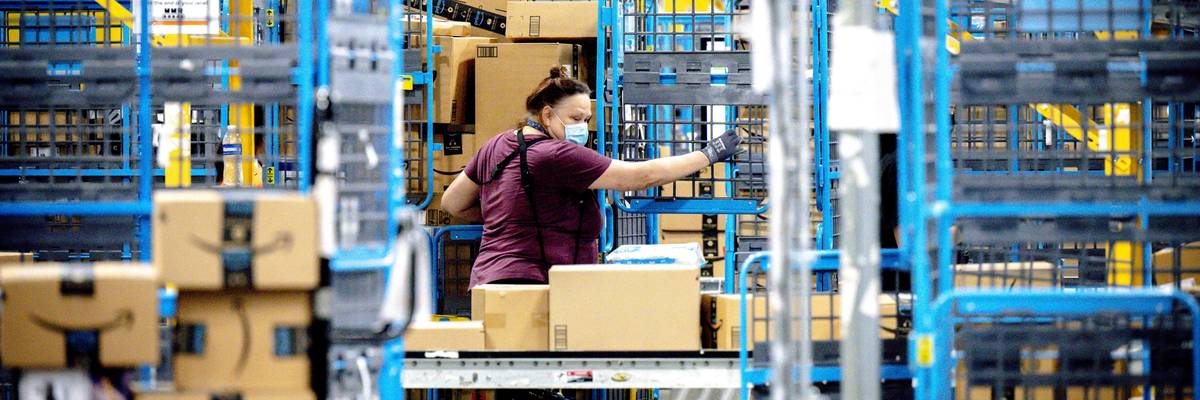
A worker sorts out parcels in the outbound dock at an Amazon warehouse in Eastvale, California in 2021.
"Amazon continues to treat its workers as disposable and with complete contempt for their safety and wellbeing," Sen. Bernie Sanders said.
U.S. Sen. Bernie Sanders on Tuesday released a report on the high levels of injuries at Amazon warehouses, especially during sales periods, as the tech giant launched its annual Prime Day discount event.
The report shows that during Prime Day in 2019, one of the last years for which data was available, more than 10% of Amazon's U.S. warehouse workers suffered injuries that required federal disclosure, and more than 45% endured injuries recorded internally by the company.
The company takes in billions of dollars in revenues during its two-day Prime Day sale every year.
"The incredibly dangerous working conditions at Amazon revealed in this investigation are a perfect example of the type of corporate greed that the American people are sick and tired of," Sanders (I-Vt.), chair of the Senate Committee on Health, Education, Labor, and Pensions (HELP), said in a statement.
"Amazon continues to treat its workers as disposable and with complete contempt for their safety and wellbeing," he added. "That is unacceptable and that has got to change. Amazon must be held accountable for the horrendous working conditions at its warehouses and substantially reduce its injury rates."
Incredibly, during Prime Day week in 2019, nearly 45% of Amazon's warehouse workers were injured. Amazon is a $2 trillion corporation owned by Jeff Bezos worth $215 billion. Corporate greed at Amazon is off the charts. It must be held accountable. pic.twitter.com/tP1zVKtaDY
— Bernie Sanders (@SenSanders) July 16, 2024
As HELP chair, Sanders launched an investigation into Amazon warehouse safety issues in June 2023, and the new report marks its interim findings, based on internal records that the company shared with the committee and interviews with over 100 workers.
Amazon's recordable injury rate, which it reports to the Occupational Safety and Health Administration (OSHA), has gone down in the last few years, but the report's authors question the reliability of that data. They point to a "documented history" of "failing to record injuries and illnesses" and "misclassifying injuries and illnesses," as per federal and state citations that the company has received.
Amazon made $12.7 billion in sales on 375 million products on Prime Day in 2023. The crush of orders during such discount periods, combined with what the report calls "regularly understaffed" warehouses, places huge burdens on employees, one of whom reported working back-to-back 12 hour shifts with only a seven hour break in between.
Another Amazon worker reported having to process twice as many packages as normal at their stations. A third employee said that the Prime Day rush caused management, in its focus on maximizing sales, to install a conveyor belt that didn't automatically stop when there was a jam, which led packages to overload and fall off when jams inevitably occurred. Workers were instructed to keep piling more packages on the belt even as jammed packages, some weighing as much as 50 pounds, piled up around other workers.
A 2021 investigation by The Washington Post found that injury rates at Amazon warehouses were significantly higher than those at other companies and peaked on Prime Day and holidays. Muscle sprains, rotator cuff injuries, and herniated disks are among the types of workplace injuries that warehouse workers face.
Amazon's critics argue that the workplace surveillance measures, which allow the company to control workers' physical movements and limit any "time off task," also contribute to increased injuries.
Sanders is not the only government official looking into Amazon's workplace safety record. OSHA, part of the Labor Department, has repeatedly cited Amazon for putting workers at risk of injuries such as sprains, strains, and carpal tunnel syndrome. In 2022, Washington state fined the company for the rushed pace of work, which it said put employees at risk. Last month, California fined the company $5.9 million for illegal use of productivity quotas in its warehouses.
The fines themselves are inconsequential for Amazon, which made $36 billion in profits last year and is valued at over $2 trillion, but workplace safety advocates hope the attention will lead to meaningful government action.
Several states have regulated the use of productivity quotas in recent years and Sen. Ed Markey (D-Mass.) in May introduced legislation to do so at the federal level. The Biden administration is also taking on Amazon's monopoly power, with the Federal Trade Commission filing suit against the company last year.
In a statement to The Washington Post, an Amazon spokesperson dismissed the new report, arguing that "it draws sweeping and inaccurate conclusions based on unverified anecdotes, and it misrepresents documents that are several years old and contained factual errors and faulty analysis." The spokesperson also said that the report authors' suggestion that Amazon underreports injury levels was "false."
Dear Common Dreams reader, It’s been nearly 30 years since I co-founded Common Dreams with my late wife, Lina Newhouser. We had the radical notion that journalism should serve the public good, not corporate profits. It was clear to us from the outset what it would take to build such a project. No paid advertisements. No corporate sponsors. No millionaire publisher telling us what to think or do. Many people said we wouldn't last a year, but we proved those doubters wrong. Together with a tremendous team of journalists and dedicated staff, we built an independent media outlet free from the constraints of profits and corporate control. Our mission has always been simple: To inform. To inspire. To ignite change for the common good. Building Common Dreams was not easy. Our survival was never guaranteed. When you take on the most powerful forces—Wall Street greed, fossil fuel industry destruction, Big Tech lobbyists, and uber-rich oligarchs who have spent billions upon billions rigging the economy and democracy in their favor—the only bulwark you have is supporters who believe in your work. But here’s the urgent message from me today. It's never been this bad out there. And it's never been this hard to keep us going. At the very moment Common Dreams is most needed, the threats we face are intensifying. We need your support now more than ever. We don't accept corporate advertising and never will. We don't have a paywall because we don't think people should be blocked from critical news based on their ability to pay. Everything we do is funded by the donations of readers like you. When everyone does the little they can afford, we are strong. But if that support retreats or dries up, so do we. Will you donate now to make sure Common Dreams not only survives but thrives? —Craig Brown, Co-founder |
U.S. Sen. Bernie Sanders on Tuesday released a report on the high levels of injuries at Amazon warehouses, especially during sales periods, as the tech giant launched its annual Prime Day discount event.
The report shows that during Prime Day in 2019, one of the last years for which data was available, more than 10% of Amazon's U.S. warehouse workers suffered injuries that required federal disclosure, and more than 45% endured injuries recorded internally by the company.
The company takes in billions of dollars in revenues during its two-day Prime Day sale every year.
"The incredibly dangerous working conditions at Amazon revealed in this investigation are a perfect example of the type of corporate greed that the American people are sick and tired of," Sanders (I-Vt.), chair of the Senate Committee on Health, Education, Labor, and Pensions (HELP), said in a statement.
"Amazon continues to treat its workers as disposable and with complete contempt for their safety and wellbeing," he added. "That is unacceptable and that has got to change. Amazon must be held accountable for the horrendous working conditions at its warehouses and substantially reduce its injury rates."
Incredibly, during Prime Day week in 2019, nearly 45% of Amazon's warehouse workers were injured. Amazon is a $2 trillion corporation owned by Jeff Bezos worth $215 billion. Corporate greed at Amazon is off the charts. It must be held accountable. pic.twitter.com/tP1zVKtaDY
— Bernie Sanders (@SenSanders) July 16, 2024
As HELP chair, Sanders launched an investigation into Amazon warehouse safety issues in June 2023, and the new report marks its interim findings, based on internal records that the company shared with the committee and interviews with over 100 workers.
Amazon's recordable injury rate, which it reports to the Occupational Safety and Health Administration (OSHA), has gone down in the last few years, but the report's authors question the reliability of that data. They point to a "documented history" of "failing to record injuries and illnesses" and "misclassifying injuries and illnesses," as per federal and state citations that the company has received.
Amazon made $12.7 billion in sales on 375 million products on Prime Day in 2023. The crush of orders during such discount periods, combined with what the report calls "regularly understaffed" warehouses, places huge burdens on employees, one of whom reported working back-to-back 12 hour shifts with only a seven hour break in between.
Another Amazon worker reported having to process twice as many packages as normal at their stations. A third employee said that the Prime Day rush caused management, in its focus on maximizing sales, to install a conveyor belt that didn't automatically stop when there was a jam, which led packages to overload and fall off when jams inevitably occurred. Workers were instructed to keep piling more packages on the belt even as jammed packages, some weighing as much as 50 pounds, piled up around other workers.
A 2021 investigation by The Washington Post found that injury rates at Amazon warehouses were significantly higher than those at other companies and peaked on Prime Day and holidays. Muscle sprains, rotator cuff injuries, and herniated disks are among the types of workplace injuries that warehouse workers face.
Amazon's critics argue that the workplace surveillance measures, which allow the company to control workers' physical movements and limit any "time off task," also contribute to increased injuries.
Sanders is not the only government official looking into Amazon's workplace safety record. OSHA, part of the Labor Department, has repeatedly cited Amazon for putting workers at risk of injuries such as sprains, strains, and carpal tunnel syndrome. In 2022, Washington state fined the company for the rushed pace of work, which it said put employees at risk. Last month, California fined the company $5.9 million for illegal use of productivity quotas in its warehouses.
The fines themselves are inconsequential for Amazon, which made $36 billion in profits last year and is valued at over $2 trillion, but workplace safety advocates hope the attention will lead to meaningful government action.
Several states have regulated the use of productivity quotas in recent years and Sen. Ed Markey (D-Mass.) in May introduced legislation to do so at the federal level. The Biden administration is also taking on Amazon's monopoly power, with the Federal Trade Commission filing suit against the company last year.
In a statement to The Washington Post, an Amazon spokesperson dismissed the new report, arguing that "it draws sweeping and inaccurate conclusions based on unverified anecdotes, and it misrepresents documents that are several years old and contained factual errors and faulty analysis." The spokesperson also said that the report authors' suggestion that Amazon underreports injury levels was "false."
U.S. Sen. Bernie Sanders on Tuesday released a report on the high levels of injuries at Amazon warehouses, especially during sales periods, as the tech giant launched its annual Prime Day discount event.
The report shows that during Prime Day in 2019, one of the last years for which data was available, more than 10% of Amazon's U.S. warehouse workers suffered injuries that required federal disclosure, and more than 45% endured injuries recorded internally by the company.
The company takes in billions of dollars in revenues during its two-day Prime Day sale every year.
"The incredibly dangerous working conditions at Amazon revealed in this investigation are a perfect example of the type of corporate greed that the American people are sick and tired of," Sanders (I-Vt.), chair of the Senate Committee on Health, Education, Labor, and Pensions (HELP), said in a statement.
"Amazon continues to treat its workers as disposable and with complete contempt for their safety and wellbeing," he added. "That is unacceptable and that has got to change. Amazon must be held accountable for the horrendous working conditions at its warehouses and substantially reduce its injury rates."
Incredibly, during Prime Day week in 2019, nearly 45% of Amazon's warehouse workers were injured. Amazon is a $2 trillion corporation owned by Jeff Bezos worth $215 billion. Corporate greed at Amazon is off the charts. It must be held accountable. pic.twitter.com/tP1zVKtaDY
— Bernie Sanders (@SenSanders) July 16, 2024
As HELP chair, Sanders launched an investigation into Amazon warehouse safety issues in June 2023, and the new report marks its interim findings, based on internal records that the company shared with the committee and interviews with over 100 workers.
Amazon's recordable injury rate, which it reports to the Occupational Safety and Health Administration (OSHA), has gone down in the last few years, but the report's authors question the reliability of that data. They point to a "documented history" of "failing to record injuries and illnesses" and "misclassifying injuries and illnesses," as per federal and state citations that the company has received.
Amazon made $12.7 billion in sales on 375 million products on Prime Day in 2023. The crush of orders during such discount periods, combined with what the report calls "regularly understaffed" warehouses, places huge burdens on employees, one of whom reported working back-to-back 12 hour shifts with only a seven hour break in between.
Another Amazon worker reported having to process twice as many packages as normal at their stations. A third employee said that the Prime Day rush caused management, in its focus on maximizing sales, to install a conveyor belt that didn't automatically stop when there was a jam, which led packages to overload and fall off when jams inevitably occurred. Workers were instructed to keep piling more packages on the belt even as jammed packages, some weighing as much as 50 pounds, piled up around other workers.
A 2021 investigation by The Washington Post found that injury rates at Amazon warehouses were significantly higher than those at other companies and peaked on Prime Day and holidays. Muscle sprains, rotator cuff injuries, and herniated disks are among the types of workplace injuries that warehouse workers face.
Amazon's critics argue that the workplace surveillance measures, which allow the company to control workers' physical movements and limit any "time off task," also contribute to increased injuries.
Sanders is not the only government official looking into Amazon's workplace safety record. OSHA, part of the Labor Department, has repeatedly cited Amazon for putting workers at risk of injuries such as sprains, strains, and carpal tunnel syndrome. In 2022, Washington state fined the company for the rushed pace of work, which it said put employees at risk. Last month, California fined the company $5.9 million for illegal use of productivity quotas in its warehouses.
The fines themselves are inconsequential for Amazon, which made $36 billion in profits last year and is valued at over $2 trillion, but workplace safety advocates hope the attention will lead to meaningful government action.
Several states have regulated the use of productivity quotas in recent years and Sen. Ed Markey (D-Mass.) in May introduced legislation to do so at the federal level. The Biden administration is also taking on Amazon's monopoly power, with the Federal Trade Commission filing suit against the company last year.
In a statement to The Washington Post, an Amazon spokesperson dismissed the new report, arguing that "it draws sweeping and inaccurate conclusions based on unverified anecdotes, and it misrepresents documents that are several years old and contained factual errors and faulty analysis." The spokesperson also said that the report authors' suggestion that Amazon underreports injury levels was "false."

