SUBSCRIBE TO OUR FREE NEWSLETTER
Daily news & progressive opinion—funded by the people, not the corporations—delivered straight to your inbox.
5
#000000
#FFFFFF
To donate by check, phone, or other method, see our More Ways to Give page.
Daily news & progressive opinion—funded by the people, not the corporations—delivered straight to your inbox.
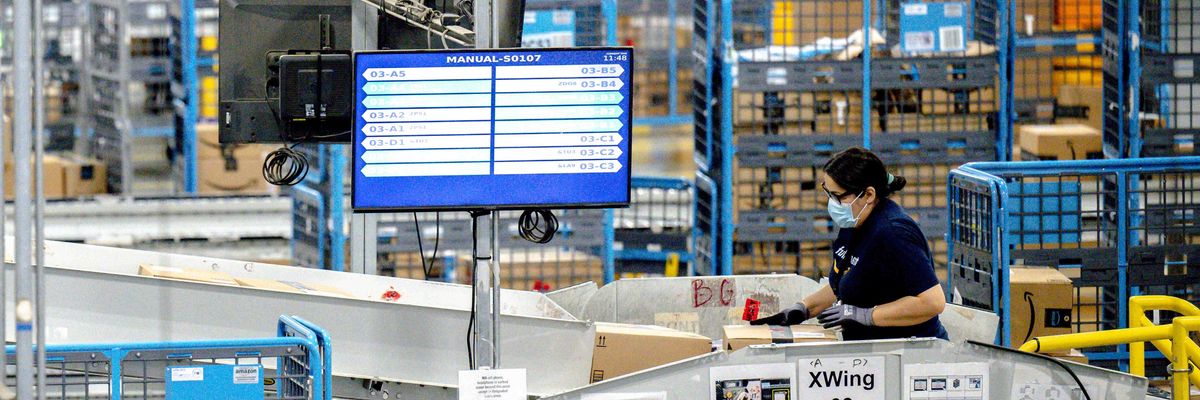
A worker sorts parcels in the outbound dock at Amazon fulfillment center in Eastvale, California on August 31, 2021.
For serious injuries linked to the company's insistence that employees maintain a relentless pace of work, Amazon was fined $60,000—the amount it made "every four seconds in 2022."
A paltry $60,000 fine for failing to keep employees safe at one of the world's richest companies offered the latest evidence, according to one critic, that the system ostensibly meant to protect workers "is so broken."
That was the assessment of Paris Marx, host of the podcast "Tech Won't Save Us," after the Occupational Safety and Health Administration (OSHA) announced Wednesday it had issued a citation to Amazon for worker safety violations at three of its warehouses in Deltona, Florida; Waukegan, Illinois; and New Windsor, New York.
As part of an investigation that is still ongoing, OSHA found that Amazon warehouse employees experience "high rates of musculoskeletal disorders" and are at high risk for lower back injuries due to frequently being required to lift heavy packages for long hours.
A log of injuries sustained by workers at the warehouse in Waukegan showed one employee suffered a foot fracture while handling a 55-pound package, another person's face was "crushed/smashed" by a 61-pound piece of furniture, and another worker sprained their lower leg while handling a 148-pound item.
While many warehouse workers at a variety of companies lift heavy objects during their workdays, Amazon has been denounced by workers and labor rights groups for requiring employees to maintain a grueling pace in order to meet quotas and ensure deliveries are made rapidly.
As the Strategic Organizing Center (SOC) said in its report Primed for Pain: Amazon's Epidemic of Workplace Injuries in 2021, "the company's obsession with speed has come at a huge cost for Amazon's workforce," with workers suffering serious injuries at a rate 80% higher than warehouse employees at other companies.
"Each of these inspections found work processes that were designed for speed but not safety, and they resulted in serious worker injuries," said Doug Parker, assistant secretary for occupational safety and health at the U.S. Department of Labor.
Despite OSHA's findings, noted Mother Jones, the agency fined the e-commerce giant "roughly 0.000013% of its reported $469,822,000,000 2021 revenue," or as progressive journalist Timothy Burke put it, the amount the company made every four seconds last year.
Amazon said Wednesday it plans to appeal OSHA's citation and appeared to reject the agency's findings, which represent the first time the Labor Department has accused a employer of maintaining an excessive work pace.
"The government's allegations don't reflect the reality of safety at our sites," Kelly Nantel, a spokesperson for Amazon, told Wired. "The vast majority of our employees tell us they feel our workplace is safe."
Eric Frumin, health and safety director at SOC, called on Amazon "to drop its relentless resistance to OSHA's orders to fix these hazards."
"Today's OSHA citations are the latest evidence that Amazon has company-wide, corporate-level policies and practices that create hazardous workplaces, and may result in medical mistreatment or denial of treatment for seriously injured workers," said Frumin. "Amazon treats its workers from the warehouse to the delivery route as disposable in its relentless drive for profit."
OSHA's investigation into the company is continuing at warehouses in Aurora, Colorado; Nampa, Idaho; and Castleton, New York.
Dear Common Dreams reader, It’s been nearly 30 years since I co-founded Common Dreams with my late wife, Lina Newhouser. We had the radical notion that journalism should serve the public good, not corporate profits. It was clear to us from the outset what it would take to build such a project. No paid advertisements. No corporate sponsors. No millionaire publisher telling us what to think or do. Many people said we wouldn't last a year, but we proved those doubters wrong. Together with a tremendous team of journalists and dedicated staff, we built an independent media outlet free from the constraints of profits and corporate control. Our mission has always been simple: To inform. To inspire. To ignite change for the common good. Building Common Dreams was not easy. Our survival was never guaranteed. When you take on the most powerful forces—Wall Street greed, fossil fuel industry destruction, Big Tech lobbyists, and uber-rich oligarchs who have spent billions upon billions rigging the economy and democracy in their favor—the only bulwark you have is supporters who believe in your work. But here’s the urgent message from me today. It's never been this bad out there. And it's never been this hard to keep us going. At the very moment Common Dreams is most needed, the threats we face are intensifying. We need your support now more than ever. We don't accept corporate advertising and never will. We don't have a paywall because we don't think people should be blocked from critical news based on their ability to pay. Everything we do is funded by the donations of readers like you. When everyone does the little they can afford, we are strong. But if that support retreats or dries up, so do we. Will you donate now to make sure Common Dreams not only survives but thrives? —Craig Brown, Co-founder |
A paltry $60,000 fine for failing to keep employees safe at one of the world's richest companies offered the latest evidence, according to one critic, that the system ostensibly meant to protect workers "is so broken."
That was the assessment of Paris Marx, host of the podcast "Tech Won't Save Us," after the Occupational Safety and Health Administration (OSHA) announced Wednesday it had issued a citation to Amazon for worker safety violations at three of its warehouses in Deltona, Florida; Waukegan, Illinois; and New Windsor, New York.
As part of an investigation that is still ongoing, OSHA found that Amazon warehouse employees experience "high rates of musculoskeletal disorders" and are at high risk for lower back injuries due to frequently being required to lift heavy packages for long hours.
A log of injuries sustained by workers at the warehouse in Waukegan showed one employee suffered a foot fracture while handling a 55-pound package, another person's face was "crushed/smashed" by a 61-pound piece of furniture, and another worker sprained their lower leg while handling a 148-pound item.
While many warehouse workers at a variety of companies lift heavy objects during their workdays, Amazon has been denounced by workers and labor rights groups for requiring employees to maintain a grueling pace in order to meet quotas and ensure deliveries are made rapidly.
As the Strategic Organizing Center (SOC) said in its report Primed for Pain: Amazon's Epidemic of Workplace Injuries in 2021, "the company's obsession with speed has come at a huge cost for Amazon's workforce," with workers suffering serious injuries at a rate 80% higher than warehouse employees at other companies.
"Each of these inspections found work processes that were designed for speed but not safety, and they resulted in serious worker injuries," said Doug Parker, assistant secretary for occupational safety and health at the U.S. Department of Labor.
Despite OSHA's findings, noted Mother Jones, the agency fined the e-commerce giant "roughly 0.000013% of its reported $469,822,000,000 2021 revenue," or as progressive journalist Timothy Burke put it, the amount the company made every four seconds last year.
Amazon said Wednesday it plans to appeal OSHA's citation and appeared to reject the agency's findings, which represent the first time the Labor Department has accused a employer of maintaining an excessive work pace.
"The government's allegations don't reflect the reality of safety at our sites," Kelly Nantel, a spokesperson for Amazon, told Wired. "The vast majority of our employees tell us they feel our workplace is safe."
Eric Frumin, health and safety director at SOC, called on Amazon "to drop its relentless resistance to OSHA's orders to fix these hazards."
"Today's OSHA citations are the latest evidence that Amazon has company-wide, corporate-level policies and practices that create hazardous workplaces, and may result in medical mistreatment or denial of treatment for seriously injured workers," said Frumin. "Amazon treats its workers from the warehouse to the delivery route as disposable in its relentless drive for profit."
OSHA's investigation into the company is continuing at warehouses in Aurora, Colorado; Nampa, Idaho; and Castleton, New York.
A paltry $60,000 fine for failing to keep employees safe at one of the world's richest companies offered the latest evidence, according to one critic, that the system ostensibly meant to protect workers "is so broken."
That was the assessment of Paris Marx, host of the podcast "Tech Won't Save Us," after the Occupational Safety and Health Administration (OSHA) announced Wednesday it had issued a citation to Amazon for worker safety violations at three of its warehouses in Deltona, Florida; Waukegan, Illinois; and New Windsor, New York.
As part of an investigation that is still ongoing, OSHA found that Amazon warehouse employees experience "high rates of musculoskeletal disorders" and are at high risk for lower back injuries due to frequently being required to lift heavy packages for long hours.
A log of injuries sustained by workers at the warehouse in Waukegan showed one employee suffered a foot fracture while handling a 55-pound package, another person's face was "crushed/smashed" by a 61-pound piece of furniture, and another worker sprained their lower leg while handling a 148-pound item.
While many warehouse workers at a variety of companies lift heavy objects during their workdays, Amazon has been denounced by workers and labor rights groups for requiring employees to maintain a grueling pace in order to meet quotas and ensure deliveries are made rapidly.
As the Strategic Organizing Center (SOC) said in its report Primed for Pain: Amazon's Epidemic of Workplace Injuries in 2021, "the company's obsession with speed has come at a huge cost for Amazon's workforce," with workers suffering serious injuries at a rate 80% higher than warehouse employees at other companies.
"Each of these inspections found work processes that were designed for speed but not safety, and they resulted in serious worker injuries," said Doug Parker, assistant secretary for occupational safety and health at the U.S. Department of Labor.
Despite OSHA's findings, noted Mother Jones, the agency fined the e-commerce giant "roughly 0.000013% of its reported $469,822,000,000 2021 revenue," or as progressive journalist Timothy Burke put it, the amount the company made every four seconds last year.
Amazon said Wednesday it plans to appeal OSHA's citation and appeared to reject the agency's findings, which represent the first time the Labor Department has accused a employer of maintaining an excessive work pace.
"The government's allegations don't reflect the reality of safety at our sites," Kelly Nantel, a spokesperson for Amazon, told Wired. "The vast majority of our employees tell us they feel our workplace is safe."
Eric Frumin, health and safety director at SOC, called on Amazon "to drop its relentless resistance to OSHA's orders to fix these hazards."
"Today's OSHA citations are the latest evidence that Amazon has company-wide, corporate-level policies and practices that create hazardous workplaces, and may result in medical mistreatment or denial of treatment for seriously injured workers," said Frumin. "Amazon treats its workers from the warehouse to the delivery route as disposable in its relentless drive for profit."
OSHA's investigation into the company is continuing at warehouses in Aurora, Colorado; Nampa, Idaho; and Castleton, New York.