

SUBSCRIBE TO OUR FREE NEWSLETTER
Daily news & progressive opinion—funded by the people, not the corporations—delivered straight to your inbox.
5
#000000
#FFFFFF
To donate by check, phone, or other method, see our More Ways to Give page.
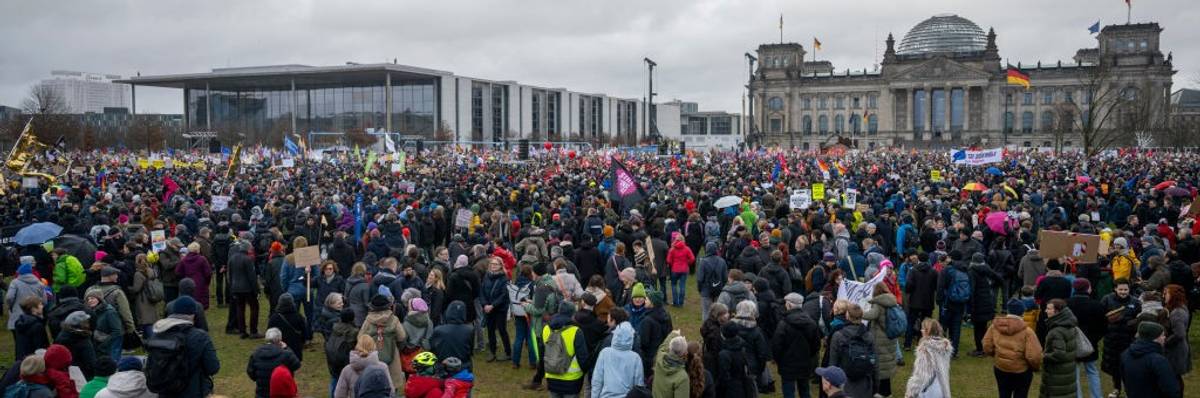
Up to 300,000 people took to the rainy streets of Berlin, Germany on Saturday as nationwide protests against the far-right Alternative for Germany (AfD) party. Protests were also taking place in dozens of other cities such as Freiburg, Dresden, Hannover, and Mainz, a sign of growing alarm at growing support for the AfD.
Under the slogan “We are the Firewall” — a reference to the longstanding taboo against collaborating with the far right in German politics — protesters turned the space next to the Bundestag, or national parliament, into a sea of signs, flags, and umbrellas.
“All together against racism,” the crowd in Berlin shouted. Some held posters that said “Heart instead of hate” or “Racism is not an alternative.”
The new wave of mobilization against Alternative for Germany (AfD) was ignited by a January report by investigative outlet Correctiv. It revealed that AfD members had discussed the expulsion of immigrants and “non-assimilated citizens” at a meeting with extremists.
The report sent shockwaves across Germany at a time when the AfD was soaring in opinion polls, months ahead of three major regional elections in eastern Germany where their support was strongest.
“We absolutely must not allow the stories that we experienced in 1930 or even back in the 1920s to happen again ... We must do everything we can to prevent that,” said Jonas Schmidt, who came from the western port city of Bremen told the Associated Press. “That’s why I’m here.”
Kathrin Zauter, another protester, called the strong attendance “really encouraging.”
“This encourages everyone and shows that we are more — we are many,” she said.
Jakob Springfeld, the spokesman for the NGO Solidarity Network Saxony, said he was shocked that it had taken such a long time for mass demonstrations against the far-right, given the AfD had been successful in many smaller communities already. "But there's a jolt now. And the fact that the jolt is coming provides hope, I believe."
German Chancellor Olaf Scholz praised the protests, writing in a Saturday post on the social media platform X that citizens’ presence at the gatherings is “a strong sign for democracy and our constitution.”
“In small and big cities across the country, citizens are coming together to demonstrate against forgetting, against hate and incitement,” he added.
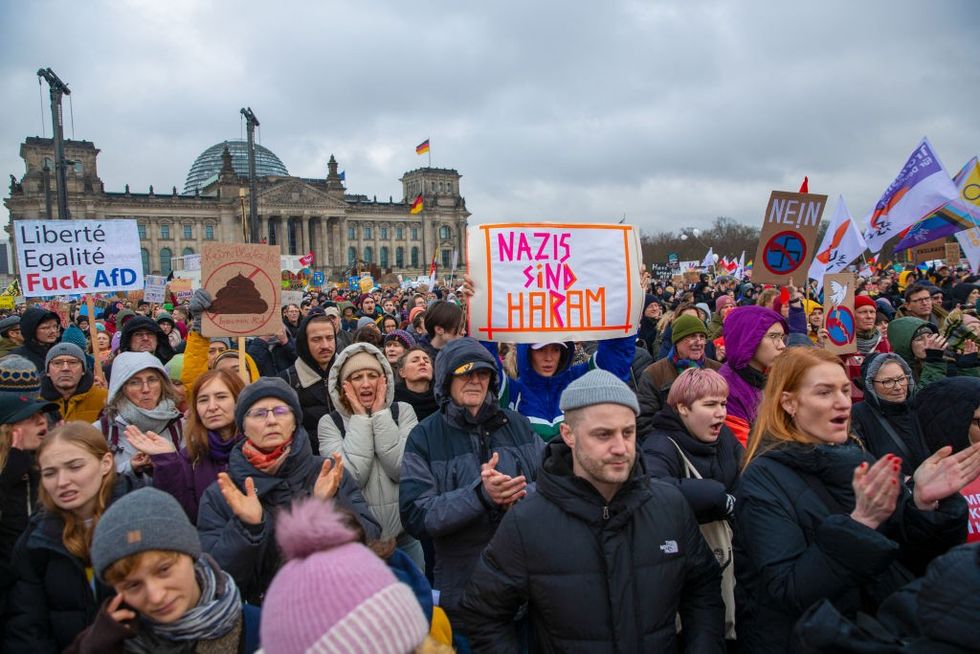 Saturday's protest was a collaboration involving more than one thousand entities, including leave none behind, Amnesty International, Echo Iran, and FridaysForFuture, initiated the call for action against right-wing extremism at the Reichstag building. (Photo by HAMI ROSHAN/Middle East Images/AFP via Getty Images)
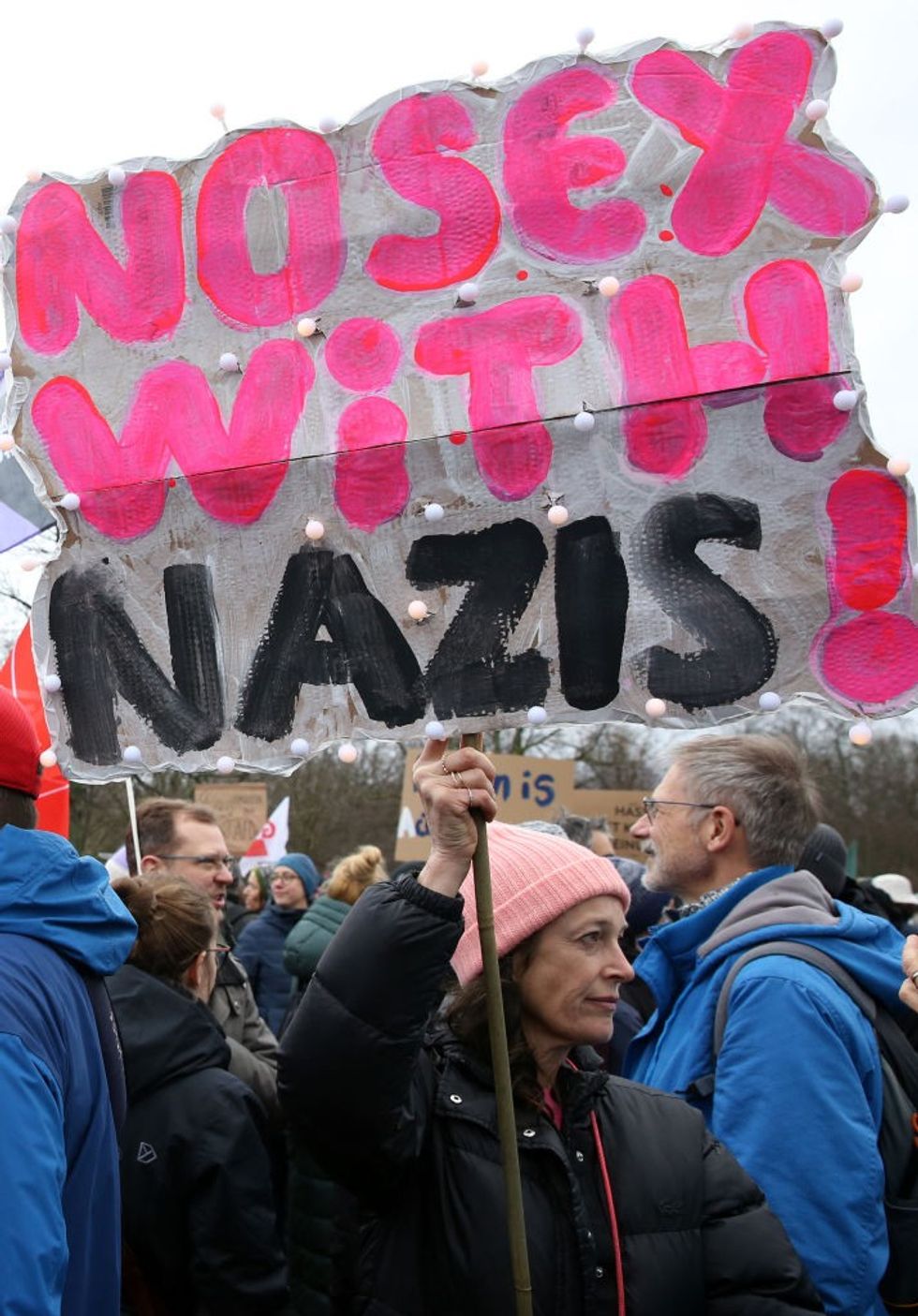 A participant holds up a placard reading 'No sex with Nazis' during a rally under the motto 'We are the firewall' called for by international non-profit organisation 'Hand in Hand' against right-wing politics in front of the Reichstag building in Berlin, Germany on February 3, 2024. (Photo by ADAM BERRY/AFP via Getty Images)
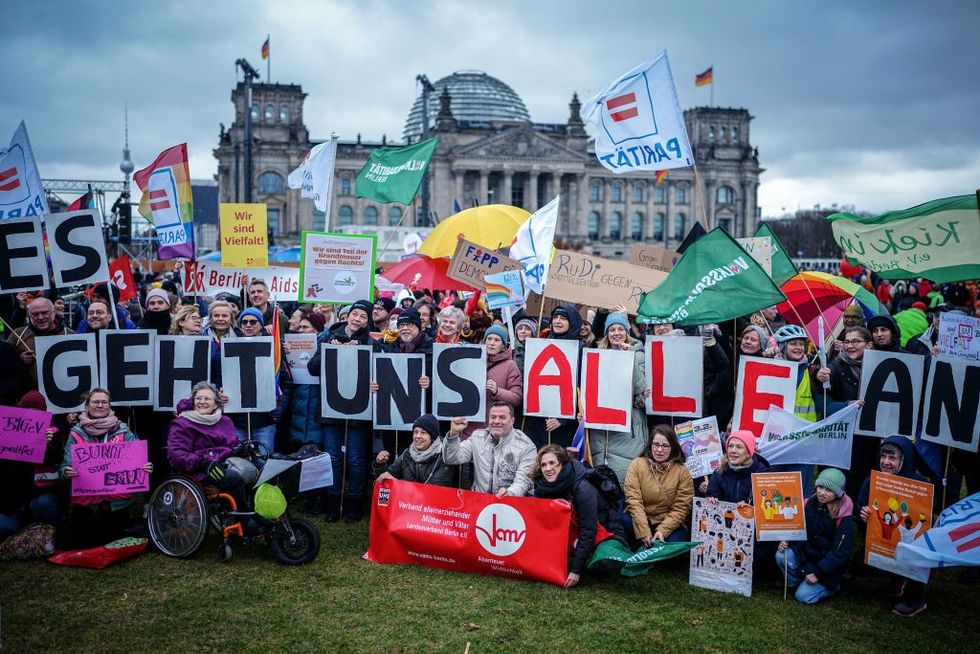 "We are the firewall" for democracy and against right-wing extremism. With the demonstration, the participants want to set an example of resistance against right-wing extremist activities. (Photo by Kay Nietfeld/picture alliance via Getty Images)
Up to 300,000 people took to the rainy streets of Berlin, Germany on Saturday as nationwide protests against the far-right Alternative for Germany (AfD) party. Protests were also taking place in dozens of other cities such as Freiburg, Dresden, Hannover, and Mainz, a sign of growing alarm at growing support for the AfD.
Under the slogan “We are the Firewall” — a reference to the longstanding taboo against collaborating with the far right in German politics — protesters turned the space next to the Bundestag, or national parliament, into a sea of signs, flags, and umbrellas.
“All together against racism,” the crowd in Berlin shouted. Some held posters that said “Heart instead of hate” or “Racism is not an alternative.”
The new wave of mobilization against Alternative for Germany (AfD) was ignited by a January report by investigative outlet Correctiv. It revealed that AfD members had discussed the expulsion of immigrants and “non-assimilated citizens” at a meeting with extremists.
The report sent shockwaves across Germany at a time when the AfD was soaring in opinion polls, months ahead of three major regional elections in eastern Germany where their support was strongest.
“We absolutely must not allow the stories that we experienced in 1930 or even back in the 1920s to happen again ... We must do everything we can to prevent that,” said Jonas Schmidt, who came from the western port city of Bremen told the Associated Press. “That’s why I’m here.”
Kathrin Zauter, another protester, called the strong attendance “really encouraging.”
“This encourages everyone and shows that we are more — we are many,” she said.
Jakob Springfeld, the spokesman for the NGO Solidarity Network Saxony, said he was shocked that it had taken such a long time for mass demonstrations against the far-right, given the AfD had been successful in many smaller communities already. "But there's a jolt now. And the fact that the jolt is coming provides hope, I believe."
German Chancellor Olaf Scholz praised the protests, writing in a Saturday post on the social media platform X that citizens’ presence at the gatherings is “a strong sign for democracy and our constitution.”
“In small and big cities across the country, citizens are coming together to demonstrate against forgetting, against hate and incitement,” he added.
Saturday's protest was a collaboration involving more than one thousand entities, including leave none behind, Amnesty International, Echo Iran, and FridaysForFuture, initiated the call for action against right-wing extremism at the Reichstag building. (Photo by HAMI ROSHAN/Middle East Images/AFP via Getty Images)
A participant holds up a placard reading 'No sex with Nazis' during a rally under the motto 'We are the firewall' called for by international non-profit organisation 'Hand in Hand' against right-wing politics in front of the Reichstag building in Berlin, Germany on February 3, 2024. (Photo by ADAM BERRY/AFP via Getty Images)
"We are the firewall" for democracy and against right-wing extremism. With the demonstration, the participants want to set an example of resistance against right-wing extremist activities. (Photo by Kay Nietfeld/picture alliance via Getty Images)
Up to 300,000 people took to the rainy streets of Berlin, Germany on Saturday as nationwide protests against the far-right Alternative for Germany (AfD) party. Protests were also taking place in dozens of other cities such as Freiburg, Dresden, Hannover, and Mainz, a sign of growing alarm at growing support for the AfD.
Under the slogan “We are the Firewall” — a reference to the longstanding taboo against collaborating with the far right in German politics — protesters turned the space next to the Bundestag, or national parliament, into a sea of signs, flags, and umbrellas.
“All together against racism,” the crowd in Berlin shouted. Some held posters that said “Heart instead of hate” or “Racism is not an alternative.”
The new wave of mobilization against Alternative for Germany (AfD) was ignited by a January report by investigative outlet Correctiv. It revealed that AfD members had discussed the expulsion of immigrants and “non-assimilated citizens” at a meeting with extremists.
The report sent shockwaves across Germany at a time when the AfD was soaring in opinion polls, months ahead of three major regional elections in eastern Germany where their support was strongest.
“We absolutely must not allow the stories that we experienced in 1930 or even back in the 1920s to happen again ... We must do everything we can to prevent that,” said Jonas Schmidt, who came from the western port city of Bremen told the Associated Press. “That’s why I’m here.”
Kathrin Zauter, another protester, called the strong attendance “really encouraging.”
“This encourages everyone and shows that we are more — we are many,” she said.
Jakob Springfeld, the spokesman for the NGO Solidarity Network Saxony, said he was shocked that it had taken such a long time for mass demonstrations against the far-right, given the AfD had been successful in many smaller communities already. "But there's a jolt now. And the fact that the jolt is coming provides hope, I believe."
German Chancellor Olaf Scholz praised the protests, writing in a Saturday post on the social media platform X that citizens’ presence at the gatherings is “a strong sign for democracy and our constitution.”
“In small and big cities across the country, citizens are coming together to demonstrate against forgetting, against hate and incitement,” he added.
Saturday's protest was a collaboration involving more than one thousand entities, including leave none behind, Amnesty International, Echo Iran, and FridaysForFuture, initiated the call for action against right-wing extremism at the Reichstag building. (Photo by HAMI ROSHAN/Middle East Images/AFP via Getty Images)
A participant holds up a placard reading 'No sex with Nazis' during a rally under the motto 'We are the firewall' called for by international non-profit organisation 'Hand in Hand' against right-wing politics in front of the Reichstag building in Berlin, Germany on February 3, 2024. (Photo by ADAM BERRY/AFP via Getty Images)
"We are the firewall" for democracy and against right-wing extremism. With the demonstration, the participants want to set an example of resistance against right-wing extremist activities. (Photo by Kay Nietfeld/picture alliance via Getty Images)

