SUBSCRIBE TO OUR FREE NEWSLETTER
Daily news & progressive opinion—funded by the people, not the corporations—delivered straight to your inbox.
5
#000000
#FFFFFF
To donate by check, phone, or other method, see our More Ways to Give page.
Daily news & progressive opinion—funded by the people, not the corporations—delivered straight to your inbox.
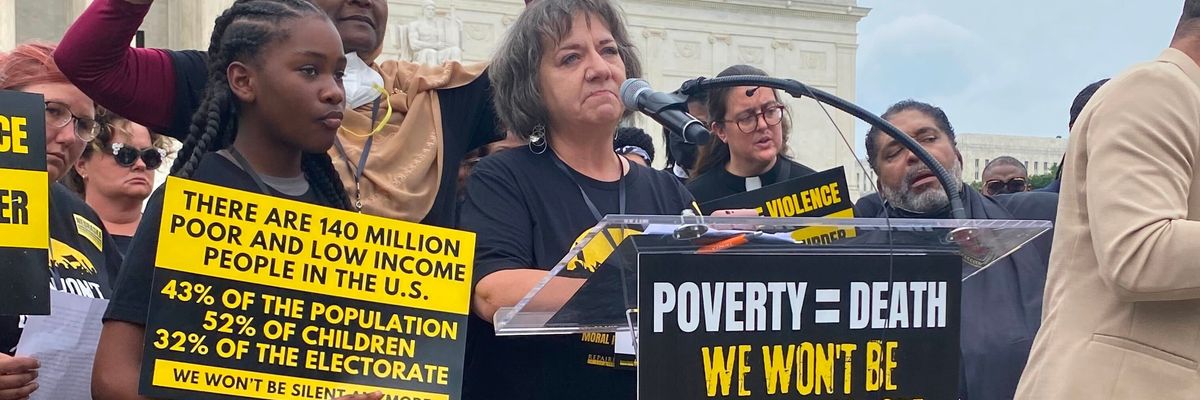
Members of the Poor People's Campaign rally on Capitol Hill on June 21, 2023.
"I need stronger safety net protections that won't be torn away by lawmakers or by complicated eligibility requirements for these benefits," said one Poor People's Campaign member from Ohio.
A multiracial, multigenerational coalition consisting of hundreds of poor people, faith leaders, organizers, and allies rallied on Capitol Hill Tuesday to demand that Congress deliver ambitious, universal solutions to the interconnected crises afflicting millions of people across the U.S., from starvation wages to lack of healthcare.
"If you've been wondering when poor folk and Black folk and brown folk and all different races of folk, and folk from Appalachia to Alabama, from Carolina to California, from Kansas to Kentucky, from farmers to fast food workers—if you've been wondering when they're going to get together, we are that movement," Rev. Dr. William J. Barber, co-chair of the national Poor People's Campaign, said during Tuesday's rally in Washington, D.C., part of a three-day mobilization dubbed the Moral Poverty Action Congress.
"We are together," Barber continued. "We are Black, we are white, we are brown, we are Asian, we are Indigenous, we are young, we are old, we are of every party, we are gay, we are straight, we are Jewish, we are Muslim, we are Christian, we are Unitarian, we are people of faith, we are people not of faith. And not only aren't we going anywhere, we're going to get louder and louder and louder."
"It's a moral disgrace that in the wealthiest, most powerful country in the world, we have more than 140 million people living below the poverty line."
Tuesday's demonstration featured speeches from low-wealth people from across the U.S. who have experienced directly the dire consequences of poverty, the fourth leading cause of death in the U.S. behind heart disease, cancer, and smoking.
Joyce Kendrick of Middletown, Ohio detailed how she has struggled to afford food and lost most of her teeth due to Medicare's lack of dental coverage. Emergency measures during the coronavirus pandemic provided some relief, Kendrick said, but lawmakers have allowed the nutrition aid expansion and other policy interventions to expire.
"I'm back in survival mode," Kendrick said. "I'm back to choosing between proper medical care and a proper meal. I need stronger safety net protections that won't be torn away by lawmakers or by complicated eligibility requirements for these benefits."
Kimberly Burks of West Virginia followed with impassioned remarks demanding long-overdue justice for her son, who was killed in a county jail last year. An independent autopsy found that Quantez Burks suffered a heart attack caused by stress from blunt force trauma, contradicting West Virginia authorities' claim that he died of natural causes.
Burks said Tuesday that she's sick of poor people being "swept under the rug" as they face police brutality and other appalling injustices.
"I will not remain quiet any more," she added.
Following the testimony from Poor People's Campaign members, Reps. Barbara Lee (D-Calif.) and Pramila Jayapal (D-Wash.) announced plans to reintroduce a resolution calling for a " Third Reconstruction" to end poverty and provide healthcare, quality education, affordable housing, and other public goods to all who need them.
"It's a moral disgrace that in the wealthiest, most powerful country in the world, we have more than 140 million people living below the poverty line," said Lee, who credited the Poor People's Campaign with helping to revive discussions of poverty and potential policy solutions in Congress.
On Wednesday, ahead of a planned White House meeting, the Poor People's Campaign and the Institute for Policy Studies (IPS) released fact sheets noting that "poor and low-income people make up more than 40% of the population in 13 states: California, Mississippi, New Mexico, Florida, Hawaii, New York, Georgia, Alaska, Louisiana, Texas, Nevada, Arkansas, and North Carolina."
"Pandemic relief policies temporarily lifted the load of poverty, proving that poverty in the richest country in the world is a policy choice," the documents note. "But these initiatives ended too soon, resulting in higher rates of economic, food, and housing insecurity."
Sarah Anderson, director of the Global Economy Project at IPS, wrote Wednesday that the temporary pandemic measures further demonstrated that "poverty in the richest country in the world is a policy choice."
"In the wealthiest country on the planet, there's no excuse for failing to meet basic needs and ensuring we can all survive and thrive," Anderson continued. "The fact sheets reveal the number of each state’s resident billionaires, a class of Americans extremely adept at avoiding their fair share of taxes. Georgia, for example, has 88 billionaires while 42.5% of the state's population is poor or low-income."
"At their Moral Poverty Action Congress, the Poor People's Campaign is developing strategies to continue to build a moral force that can revive the heart and soul of this democracy and ensure dignity and justice for all," she added. "There is clearly much work to be done."
Dear Common Dreams reader, It’s been nearly 30 years since I co-founded Common Dreams with my late wife, Lina Newhouser. We had the radical notion that journalism should serve the public good, not corporate profits. It was clear to us from the outset what it would take to build such a project. No paid advertisements. No corporate sponsors. No millionaire publisher telling us what to think or do. Many people said we wouldn't last a year, but we proved those doubters wrong. Together with a tremendous team of journalists and dedicated staff, we built an independent media outlet free from the constraints of profits and corporate control. Our mission has always been simple: To inform. To inspire. To ignite change for the common good. Building Common Dreams was not easy. Our survival was never guaranteed. When you take on the most powerful forces—Wall Street greed, fossil fuel industry destruction, Big Tech lobbyists, and uber-rich oligarchs who have spent billions upon billions rigging the economy and democracy in their favor—the only bulwark you have is supporters who believe in your work. But here’s the urgent message from me today. It's never been this bad out there. And it's never been this hard to keep us going. At the very moment Common Dreams is most needed, the threats we face are intensifying. We need your support now more than ever. We don't accept corporate advertising and never will. We don't have a paywall because we don't think people should be blocked from critical news based on their ability to pay. Everything we do is funded by the donations of readers like you. When everyone does the little they can afford, we are strong. But if that support retreats or dries up, so do we. Will you donate now to make sure Common Dreams not only survives but thrives? —Craig Brown, Co-founder |
A multiracial, multigenerational coalition consisting of hundreds of poor people, faith leaders, organizers, and allies rallied on Capitol Hill Tuesday to demand that Congress deliver ambitious, universal solutions to the interconnected crises afflicting millions of people across the U.S., from starvation wages to lack of healthcare.
"If you've been wondering when poor folk and Black folk and brown folk and all different races of folk, and folk from Appalachia to Alabama, from Carolina to California, from Kansas to Kentucky, from farmers to fast food workers—if you've been wondering when they're going to get together, we are that movement," Rev. Dr. William J. Barber, co-chair of the national Poor People's Campaign, said during Tuesday's rally in Washington, D.C., part of a three-day mobilization dubbed the Moral Poverty Action Congress.
"We are together," Barber continued. "We are Black, we are white, we are brown, we are Asian, we are Indigenous, we are young, we are old, we are of every party, we are gay, we are straight, we are Jewish, we are Muslim, we are Christian, we are Unitarian, we are people of faith, we are people not of faith. And not only aren't we going anywhere, we're going to get louder and louder and louder."
"It's a moral disgrace that in the wealthiest, most powerful country in the world, we have more than 140 million people living below the poverty line."
Tuesday's demonstration featured speeches from low-wealth people from across the U.S. who have experienced directly the dire consequences of poverty, the fourth leading cause of death in the U.S. behind heart disease, cancer, and smoking.
Joyce Kendrick of Middletown, Ohio detailed how she has struggled to afford food and lost most of her teeth due to Medicare's lack of dental coverage. Emergency measures during the coronavirus pandemic provided some relief, Kendrick said, but lawmakers have allowed the nutrition aid expansion and other policy interventions to expire.
"I'm back in survival mode," Kendrick said. "I'm back to choosing between proper medical care and a proper meal. I need stronger safety net protections that won't be torn away by lawmakers or by complicated eligibility requirements for these benefits."
Kimberly Burks of West Virginia followed with impassioned remarks demanding long-overdue justice for her son, who was killed in a county jail last year. An independent autopsy found that Quantez Burks suffered a heart attack caused by stress from blunt force trauma, contradicting West Virginia authorities' claim that he died of natural causes.
Burks said Tuesday that she's sick of poor people being "swept under the rug" as they face police brutality and other appalling injustices.
"I will not remain quiet any more," she added.
Following the testimony from Poor People's Campaign members, Reps. Barbara Lee (D-Calif.) and Pramila Jayapal (D-Wash.) announced plans to reintroduce a resolution calling for a " Third Reconstruction" to end poverty and provide healthcare, quality education, affordable housing, and other public goods to all who need them.
"It's a moral disgrace that in the wealthiest, most powerful country in the world, we have more than 140 million people living below the poverty line," said Lee, who credited the Poor People's Campaign with helping to revive discussions of poverty and potential policy solutions in Congress.
On Wednesday, ahead of a planned White House meeting, the Poor People's Campaign and the Institute for Policy Studies (IPS) released fact sheets noting that "poor and low-income people make up more than 40% of the population in 13 states: California, Mississippi, New Mexico, Florida, Hawaii, New York, Georgia, Alaska, Louisiana, Texas, Nevada, Arkansas, and North Carolina."
"Pandemic relief policies temporarily lifted the load of poverty, proving that poverty in the richest country in the world is a policy choice," the documents note. "But these initiatives ended too soon, resulting in higher rates of economic, food, and housing insecurity."
Sarah Anderson, director of the Global Economy Project at IPS, wrote Wednesday that the temporary pandemic measures further demonstrated that "poverty in the richest country in the world is a policy choice."
"In the wealthiest country on the planet, there's no excuse for failing to meet basic needs and ensuring we can all survive and thrive," Anderson continued. "The fact sheets reveal the number of each state’s resident billionaires, a class of Americans extremely adept at avoiding their fair share of taxes. Georgia, for example, has 88 billionaires while 42.5% of the state's population is poor or low-income."
"At their Moral Poverty Action Congress, the Poor People's Campaign is developing strategies to continue to build a moral force that can revive the heart and soul of this democracy and ensure dignity and justice for all," she added. "There is clearly much work to be done."
A multiracial, multigenerational coalition consisting of hundreds of poor people, faith leaders, organizers, and allies rallied on Capitol Hill Tuesday to demand that Congress deliver ambitious, universal solutions to the interconnected crises afflicting millions of people across the U.S., from starvation wages to lack of healthcare.
"If you've been wondering when poor folk and Black folk and brown folk and all different races of folk, and folk from Appalachia to Alabama, from Carolina to California, from Kansas to Kentucky, from farmers to fast food workers—if you've been wondering when they're going to get together, we are that movement," Rev. Dr. William J. Barber, co-chair of the national Poor People's Campaign, said during Tuesday's rally in Washington, D.C., part of a three-day mobilization dubbed the Moral Poverty Action Congress.
"We are together," Barber continued. "We are Black, we are white, we are brown, we are Asian, we are Indigenous, we are young, we are old, we are of every party, we are gay, we are straight, we are Jewish, we are Muslim, we are Christian, we are Unitarian, we are people of faith, we are people not of faith. And not only aren't we going anywhere, we're going to get louder and louder and louder."
"It's a moral disgrace that in the wealthiest, most powerful country in the world, we have more than 140 million people living below the poverty line."
Tuesday's demonstration featured speeches from low-wealth people from across the U.S. who have experienced directly the dire consequences of poverty, the fourth leading cause of death in the U.S. behind heart disease, cancer, and smoking.
Joyce Kendrick of Middletown, Ohio detailed how she has struggled to afford food and lost most of her teeth due to Medicare's lack of dental coverage. Emergency measures during the coronavirus pandemic provided some relief, Kendrick said, but lawmakers have allowed the nutrition aid expansion and other policy interventions to expire.
"I'm back in survival mode," Kendrick said. "I'm back to choosing between proper medical care and a proper meal. I need stronger safety net protections that won't be torn away by lawmakers or by complicated eligibility requirements for these benefits."
Kimberly Burks of West Virginia followed with impassioned remarks demanding long-overdue justice for her son, who was killed in a county jail last year. An independent autopsy found that Quantez Burks suffered a heart attack caused by stress from blunt force trauma, contradicting West Virginia authorities' claim that he died of natural causes.
Burks said Tuesday that she's sick of poor people being "swept under the rug" as they face police brutality and other appalling injustices.
"I will not remain quiet any more," she added.
Following the testimony from Poor People's Campaign members, Reps. Barbara Lee (D-Calif.) and Pramila Jayapal (D-Wash.) announced plans to reintroduce a resolution calling for a " Third Reconstruction" to end poverty and provide healthcare, quality education, affordable housing, and other public goods to all who need them.
"It's a moral disgrace that in the wealthiest, most powerful country in the world, we have more than 140 million people living below the poverty line," said Lee, who credited the Poor People's Campaign with helping to revive discussions of poverty and potential policy solutions in Congress.
On Wednesday, ahead of a planned White House meeting, the Poor People's Campaign and the Institute for Policy Studies (IPS) released fact sheets noting that "poor and low-income people make up more than 40% of the population in 13 states: California, Mississippi, New Mexico, Florida, Hawaii, New York, Georgia, Alaska, Louisiana, Texas, Nevada, Arkansas, and North Carolina."
"Pandemic relief policies temporarily lifted the load of poverty, proving that poverty in the richest country in the world is a policy choice," the documents note. "But these initiatives ended too soon, resulting in higher rates of economic, food, and housing insecurity."
Sarah Anderson, director of the Global Economy Project at IPS, wrote Wednesday that the temporary pandemic measures further demonstrated that "poverty in the richest country in the world is a policy choice."
"In the wealthiest country on the planet, there's no excuse for failing to meet basic needs and ensuring we can all survive and thrive," Anderson continued. "The fact sheets reveal the number of each state’s resident billionaires, a class of Americans extremely adept at avoiding their fair share of taxes. Georgia, for example, has 88 billionaires while 42.5% of the state's population is poor or low-income."
"At their Moral Poverty Action Congress, the Poor People's Campaign is developing strategies to continue to build a moral force that can revive the heart and soul of this democracy and ensure dignity and justice for all," she added. "There is clearly much work to be done."