SUBSCRIBE TO OUR FREE NEWSLETTER
Daily news & progressive opinion—funded by the people, not the corporations—delivered straight to your inbox.
5
#000000
#FFFFFF
To donate by check, phone, or other method, see our More Ways to Give page.
Daily news & progressive opinion—funded by the people, not the corporations—delivered straight to your inbox.
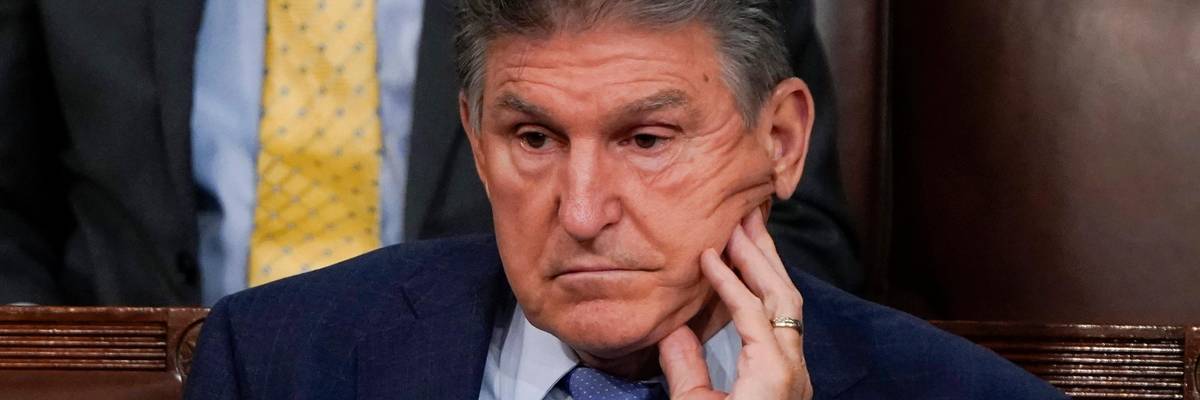
U.S. Sen. Joe Manchin (D-W.Va.) listens as President Joe Biden delivers his first State of the Union address to a joint session of Congress at the Capitol on March 1, 2022 in Washington, D.C
Poverty is solvable. We know what works. All we have to do is act.
After hitting a record low of 7.8 percent in 2021, new data shows the government’s Supplemental Poverty Measure jumped to 12.4 percent last year. That’s a nearly 60 percent increase. And it’s all because politicians allowed proven income support programs to expire.
I’m an expert on poverty. I’ve lived it most of my life in Iowa. I studied it as a Bill Emerson National Hunger Fellow in rural West Virginia and in Washington, D.C.. And now I help people experiencing poverty across the country tell their own stories to change policy.
People can pull themselves up by their bootstraps, get an education, and work multiple jobs. But in the face of rising prices, low wages, high rents, and a broken healthcare system, it’s often not enough. Without a safety net and a level playing field for families, financial security is often out of reach.
When I was growing up in Des Moines, my mom had a stable job with the state, but her pay wasn’t enough for a real home for my two siblings and me. Iowa, like every state, has a low-income housing crisis. And families of color like mine experience greater challenges obtaining affordable housing. We bounced around shelters, churches, and motel rooms.
Despite a stigma about accepting public assistance, we benefited from SNAP (aka “food stamps”) and the Women, Infants and Children (WIC) program. But like other low-income families, we had to navigate the “benefits cliff.” When my mother made just $10 more, we’d lose the benefits we needed for sufficient, regular meals.
My father suffered from opioid addiction. When he was eventually able to get stable employment and rejoin our family, we finally got an apartment where the schools were decent. But a brain aneurysm suddenly took his life and we ended up back on the opposite side of the city where the underfunded schools offered less opportunity.
I wanted to stay in my school, so I spent four hours a day commuting on public buses and on foot. I knew I needed to get into college to be able to help my family financially. Now I have a steady job, and so does my husband.
But everyday struggles don’t end. The brokenness of our healthcare system burst into my life again when our baby was born with a fatal condition. The medical costs ran nearly $1 million in just the first few months of his tragically short life.
What could prepare someone for that?
Thankfully, my employer pays 100 percent of my health insurance. That’s a rarity. If I’d been out of work or worked elsewhere, we would’ve gone bankrupt as we suffered the most tragic thing that could ever happen to us as parents.
These are just a few of the structural obstacles low-income people face every day. But there are solutions. The advocates I work with reported enormous relief after politicians finally agreed to invest in helping children and families during the COVID-19 crisis.
The expanded Child Tax Credit cut child poverty nearly in half. Expanded food programs through SNAP lifted more than 3 million people out of poverty and staved off an expected spike in hunger. Housing subsidies kept nearly 2.5 million people out of poverty and in their homes. And Medicaid enrollment protections reduced the number of uninsured people by 1.5 million.
The year those programs were implemented, the Supplemental Poverty Measure fell to 7.8 percent — its lowest ever level. But when politicians rejected continuing this vital help for families, it increased by a record amount.
This is a failure for families across the country. We need to renew and expand those programs as soon as possible.
Poverty is solvable. We know what works. Why don’t we do it?
Dear Common Dreams reader, It’s been nearly 30 years since I co-founded Common Dreams with my late wife, Lina Newhouser. We had the radical notion that journalism should serve the public good, not corporate profits. It was clear to us from the outset what it would take to build such a project. No paid advertisements. No corporate sponsors. No millionaire publisher telling us what to think or do. Many people said we wouldn't last a year, but we proved those doubters wrong. Together with a tremendous team of journalists and dedicated staff, we built an independent media outlet free from the constraints of profits and corporate control. Our mission has always been simple: To inform. To inspire. To ignite change for the common good. Building Common Dreams was not easy. Our survival was never guaranteed. When you take on the most powerful forces—Wall Street greed, fossil fuel industry destruction, Big Tech lobbyists, and uber-rich oligarchs who have spent billions upon billions rigging the economy and democracy in their favor—the only bulwark you have is supporters who believe in your work. But here’s the urgent message from me today. It's never been this bad out there. And it's never been this hard to keep us going. At the very moment Common Dreams is most needed, the threats we face are intensifying. We need your support now more than ever. We don't accept corporate advertising and never will. We don't have a paywall because we don't think people should be blocked from critical news based on their ability to pay. Everything we do is funded by the donations of readers like you. When everyone does the little they can afford, we are strong. But if that support retreats or dries up, so do we. Will you donate now to make sure Common Dreams not only survives but thrives? —Craig Brown, Co-founder |
After hitting a record low of 7.8 percent in 2021, new data shows the government’s Supplemental Poverty Measure jumped to 12.4 percent last year. That’s a nearly 60 percent increase. And it’s all because politicians allowed proven income support programs to expire.
I’m an expert on poverty. I’ve lived it most of my life in Iowa. I studied it as a Bill Emerson National Hunger Fellow in rural West Virginia and in Washington, D.C.. And now I help people experiencing poverty across the country tell their own stories to change policy.
People can pull themselves up by their bootstraps, get an education, and work multiple jobs. But in the face of rising prices, low wages, high rents, and a broken healthcare system, it’s often not enough. Without a safety net and a level playing field for families, financial security is often out of reach.
When I was growing up in Des Moines, my mom had a stable job with the state, but her pay wasn’t enough for a real home for my two siblings and me. Iowa, like every state, has a low-income housing crisis. And families of color like mine experience greater challenges obtaining affordable housing. We bounced around shelters, churches, and motel rooms.
Despite a stigma about accepting public assistance, we benefited from SNAP (aka “food stamps”) and the Women, Infants and Children (WIC) program. But like other low-income families, we had to navigate the “benefits cliff.” When my mother made just $10 more, we’d lose the benefits we needed for sufficient, regular meals.
My father suffered from opioid addiction. When he was eventually able to get stable employment and rejoin our family, we finally got an apartment where the schools were decent. But a brain aneurysm suddenly took his life and we ended up back on the opposite side of the city where the underfunded schools offered less opportunity.
I wanted to stay in my school, so I spent four hours a day commuting on public buses and on foot. I knew I needed to get into college to be able to help my family financially. Now I have a steady job, and so does my husband.
But everyday struggles don’t end. The brokenness of our healthcare system burst into my life again when our baby was born with a fatal condition. The medical costs ran nearly $1 million in just the first few months of his tragically short life.
What could prepare someone for that?
Thankfully, my employer pays 100 percent of my health insurance. That’s a rarity. If I’d been out of work or worked elsewhere, we would’ve gone bankrupt as we suffered the most tragic thing that could ever happen to us as parents.
These are just a few of the structural obstacles low-income people face every day. But there are solutions. The advocates I work with reported enormous relief after politicians finally agreed to invest in helping children and families during the COVID-19 crisis.
The expanded Child Tax Credit cut child poverty nearly in half. Expanded food programs through SNAP lifted more than 3 million people out of poverty and staved off an expected spike in hunger. Housing subsidies kept nearly 2.5 million people out of poverty and in their homes. And Medicaid enrollment protections reduced the number of uninsured people by 1.5 million.
The year those programs were implemented, the Supplemental Poverty Measure fell to 7.8 percent — its lowest ever level. But when politicians rejected continuing this vital help for families, it increased by a record amount.
This is a failure for families across the country. We need to renew and expand those programs as soon as possible.
Poverty is solvable. We know what works. Why don’t we do it?
After hitting a record low of 7.8 percent in 2021, new data shows the government’s Supplemental Poverty Measure jumped to 12.4 percent last year. That’s a nearly 60 percent increase. And it’s all because politicians allowed proven income support programs to expire.
I’m an expert on poverty. I’ve lived it most of my life in Iowa. I studied it as a Bill Emerson National Hunger Fellow in rural West Virginia and in Washington, D.C.. And now I help people experiencing poverty across the country tell their own stories to change policy.
People can pull themselves up by their bootstraps, get an education, and work multiple jobs. But in the face of rising prices, low wages, high rents, and a broken healthcare system, it’s often not enough. Without a safety net and a level playing field for families, financial security is often out of reach.
When I was growing up in Des Moines, my mom had a stable job with the state, but her pay wasn’t enough for a real home for my two siblings and me. Iowa, like every state, has a low-income housing crisis. And families of color like mine experience greater challenges obtaining affordable housing. We bounced around shelters, churches, and motel rooms.
Despite a stigma about accepting public assistance, we benefited from SNAP (aka “food stamps”) and the Women, Infants and Children (WIC) program. But like other low-income families, we had to navigate the “benefits cliff.” When my mother made just $10 more, we’d lose the benefits we needed for sufficient, regular meals.
My father suffered from opioid addiction. When he was eventually able to get stable employment and rejoin our family, we finally got an apartment where the schools were decent. But a brain aneurysm suddenly took his life and we ended up back on the opposite side of the city where the underfunded schools offered less opportunity.
I wanted to stay in my school, so I spent four hours a day commuting on public buses and on foot. I knew I needed to get into college to be able to help my family financially. Now I have a steady job, and so does my husband.
But everyday struggles don’t end. The brokenness of our healthcare system burst into my life again when our baby was born with a fatal condition. The medical costs ran nearly $1 million in just the first few months of his tragically short life.
What could prepare someone for that?
Thankfully, my employer pays 100 percent of my health insurance. That’s a rarity. If I’d been out of work or worked elsewhere, we would’ve gone bankrupt as we suffered the most tragic thing that could ever happen to us as parents.
These are just a few of the structural obstacles low-income people face every day. But there are solutions. The advocates I work with reported enormous relief after politicians finally agreed to invest in helping children and families during the COVID-19 crisis.
The expanded Child Tax Credit cut child poverty nearly in half. Expanded food programs through SNAP lifted more than 3 million people out of poverty and staved off an expected spike in hunger. Housing subsidies kept nearly 2.5 million people out of poverty and in their homes. And Medicaid enrollment protections reduced the number of uninsured people by 1.5 million.
The year those programs were implemented, the Supplemental Poverty Measure fell to 7.8 percent — its lowest ever level. But when politicians rejected continuing this vital help for families, it increased by a record amount.
This is a failure for families across the country. We need to renew and expand those programs as soon as possible.
Poverty is solvable. We know what works. Why don’t we do it?